


Chennai Tour
Chennai is the gateway to South India and is a cultural melting pot. Join us for an immersive experience.
Two Pallava temples, a silk dyeing unit and a weaving family at home.
This is not a temple run that ends in a silk showroom. It is a day that begins in stone and ends at a loom, with the families who make Kanchipuram silk paid directly for the time they give you.
Tour: Kanchipuram Tour from Chennai, a private 8 to 9 hour responsible tourism day tour
Route: Chennai, Kanchipuram, Chennai, about 75 kilometres each way
Stops: Ekambareswarar Temple, Kailasanathar Temple, a silk dyeing unit and a handloom weaving family’s home
Group size: always private, maximum 8 guests
Community hosts: the dyeing unit and the weaving family, each paid directly by 5 Senses Tours
Heritage: Kancheepuram silk has been a Geographical Indication product since 2005
Operator: 5 Senses Tours, Ministry of Tourism approved, running private tours across India since 2015
Kanchipuram holds two kinds of masterpiece within a few kilometres of each other, and almost every visitor sees only one. In the morning you will stand in front of a temple carved in the early eighth century, built in sandstone by a Pallava king whose dynasty pioneered the structural stone temple in South India. By midday you will be in a weaver’s home, where a single saree takes about ten days of eight hour work and the loom fills most of the main room.
Between the two, you will see where the silk takes its colour, in a dyeing unit that is not open to the public. Both hosts, the dyers and the weaving family, are paid directly by 5 Senses Tours for their time, built into the cost of your tour and never left to tips. What you carry home is not a souvenir saree. It is the understanding of what it costs, in time and in hands, to make one.
The Kanchipuram Tour from Chennai is a private day tour that visits Ekambareswarar and Kailasanathar temples, a silk dyeing unit and a handloom weaving family’s home in Kanchipuram, with a traditional South Indian vegetarian lunch, and returns to Chennai the same afternoon. The dyeing unit and the weaving family are paid directly by 5 Senses Tours, a Ministry of Tourism approved operator and winner of the Outlook Responsible Tourism Award, for a maximum group of 8 guests.
Kanchipuram Tour from Chennai is a private day trip of about nine hours that leaves your hotel in the morning, takes you through two of the town’s great temples, and then moves from stone to silk. You will visit Ekambareswarar Temple, Kailasanathar Temple, a silk dyeing unit, and the home of a handloom weaving family, with a traditional South Indian vegetarian lunch in between.
The second half of the day is built as responsible tourism. The dyeing unit and the weaving family are each paid directly by 5 Senses Tours, built into the cost of the tour and never left to tips. Visits happen during real working hours, nothing is staged for you, and each host decides what to open to you.
Named bodies stand behind this model. 5 Senses Tours has won the Outlook Responsible Tourism Award, is approved by the Ministry of Tourism, is a member of the Indian Association of Tour Operators, and was a Tripadvisor Travellers Choice 2025 winner. The company is ranked number one of 226 tours and activities in Chennai on Tripadvisor, with a 4.9 rating, and has run private tours across more than fifteen Indian cities since 2015.
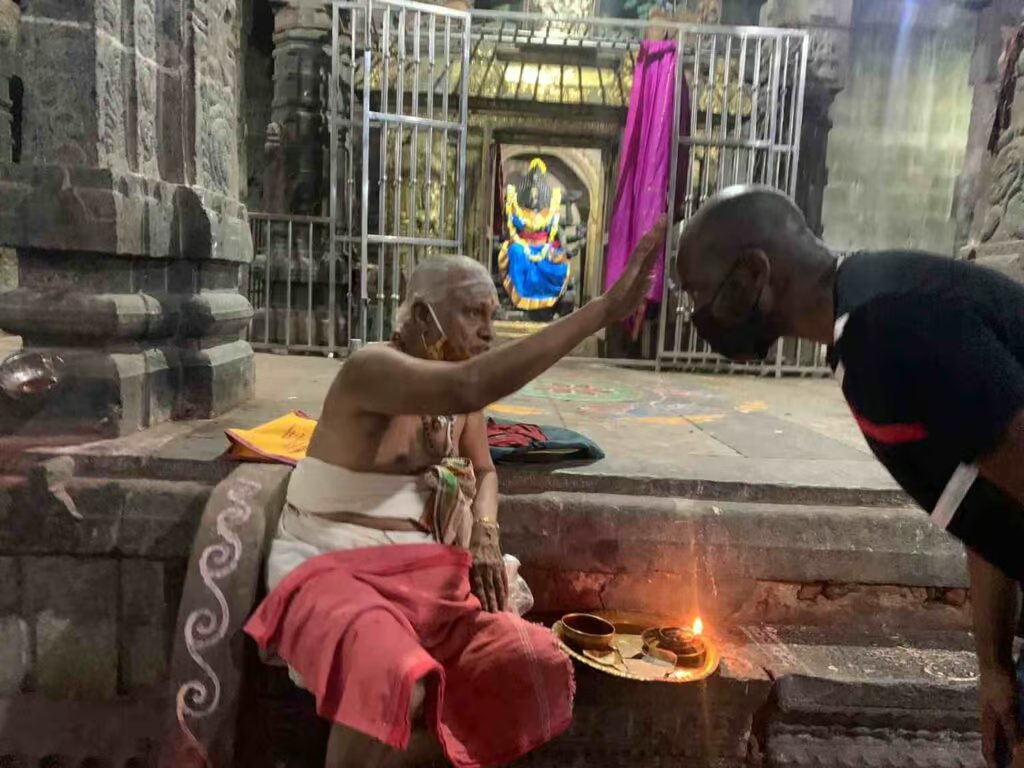
Ekambareswarar is one of the five Pancha Bhuta Sthalas, the Shiva temples that Hindu tradition associates with the five elements, and it holds the element of earth. You will arrive early, while the temple is calm and the light is soft on a gateway tower that ranks among the tallest in South India.
Your guide will take you through the story of the sacred mango tree in the courtyard, the Shiva lingam that tradition says was shaped from sand by the goddess Parvati, and the layered history of Pallava, Chola and Vijayanagara builders who each added to the complex. Footwear comes off at the entrance, and shoulders and knees should be covered.
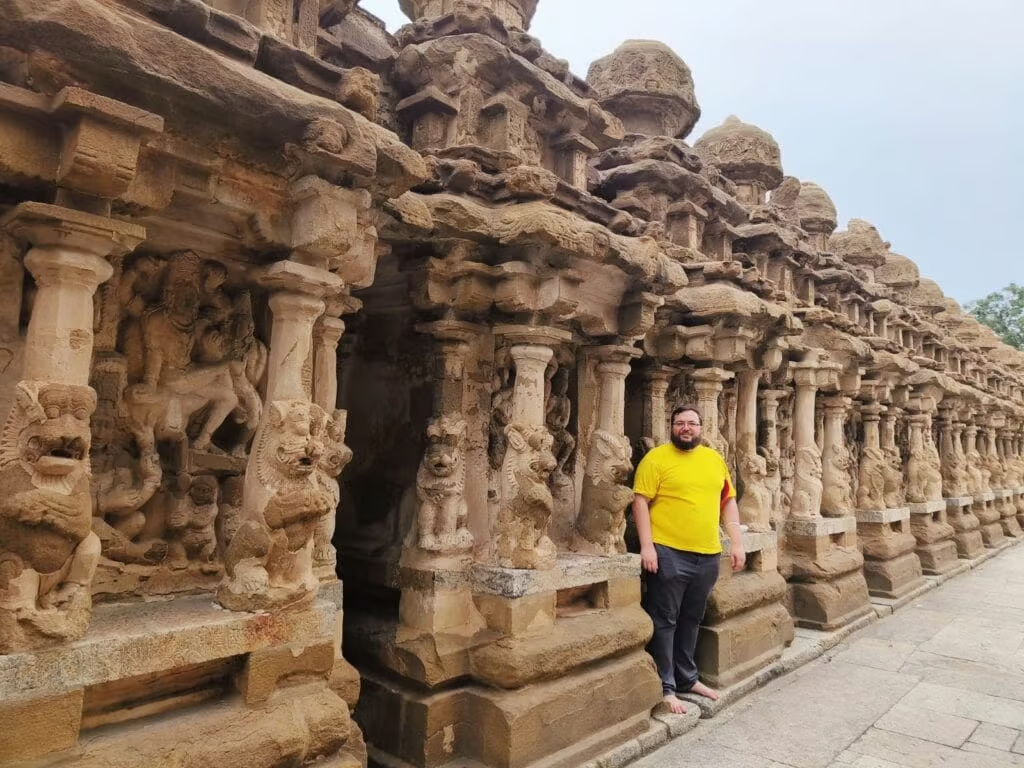
Kailasanathar is the oldest structural temple in Kanchipuram, built in the early eighth century by the Pallava king Narasimhavarman II, who is also known as Rajasimha. It is made of sandstone, set in a quiet walled courtyard, and surrounded by a ring of small shrines carved with Shiva in many forms.
Where Ekambareswarar is grand and busy, Kailasanathar is intimate and nearly silent. It is the place where Pallava stone carving can be seen at close range, and where you will have time to look slowly before the day turns to silk.
Kanchipuram silk is dyed in specialist units before it reaches the weaver, and most visitors never see inside one. Raw mulberry silk, which travels here from Karnataka, is dyed here before it passes to the loom. You will watch the process from a respectful distance, in a working unit where the people you see are at work and not performing.
Access is by agreement, and two rules apply. Please do not film, and please do not photograph the faces of the workers. Your guide will also speak plainly about what dyeing costs the area, including the water it uses. It is an honest part of the story, and around seven and a half thousand weaving families depend on this trade
A traditional Kanchipuram saree takes about ten days to weave at eight hours a day, and a weaver is typically paid around ₹5,000 for it, against a retail price that starts at ₹15,000 for an original silk saree. You will hear that number from the weaver, in the weaver’s own home.
The house is a simple village home, not a luxury stay. The loom takes up most of the main hall and the family lives around it. The saree is woven in pure mulberry silk with zari, silver thread plated in gold, using the korvai technique in which the border and the body are woven separately and joined by hand. Kancheepuram silk has held a Geographical Indication registration since 2005, which requires pure mulberry silk and zari made of silver thread plated with gold. The Silk Mark Organisation of India certifies pure silk, and a zari testing unit in Kanchipuram checks the gold and silver content of the thread. The saree is traditionally woven by families of the Saligar and Devanga weaving communities.
Ask about the weeks of heavy rain that cost a weaving family its working time, and ask about the next generation. These are not complaints. They are the reason your visit matters.
Papier mâché dolls in Kanchipuram are made from recycled waste paper. After lunch you spend about thirty minutes in a doll maker’s workshop and learn the traditional process, from paper to finished figure. It is a lighter, more colourful stop that follows the quieter weight of the weaving home.
Watch how paper that would otherwise be thrown away becomes something painted and handmade. Ask the makers how long a figure takes and who it is made for. Like the silk, it is a small handmade craft, and your visit is paid for directly, so the time you spend here supports the workshop itself.
This day belongs to you or your group alone. The itinerary can be shaped around your interests, from more time at the temples to longer at the loom.
Your English speaking cultural evangelist explains the temples as living places of worship, then the silk trade as a living economy, and moves the group at the pace each stop deserves.
✅ Hotel pickup and drop in a private air conditioned vehicle ✅ English speaking cultural guide ✅ Visit to a silk dyeing unit ✅ Visit to a handloom weaving family at home ✅ Visit to a papier-mâché doll workshop ✅ Direct payment to the dyeing unit, the weaving family and the doll makers ✅ Traditional South Indian vegetarian lunch ✅ All taxes
The dyeing unit, the weaving family and the doll makers you visit are each paid directly by 5 Senses Tours at the time of your visit. The payment is built into the tour cost and never left to tips, so no host depends on a guest’s generosity on the day. Hosts decide what to open to you, and every visit takes place while the work is under way.
Kanchipuram silk is a craft with real pressures: water used in dyeing, weeks lost to heavy rain, and a younger generation looking elsewhere for work. We tell you plainly, because a guest who understands those pressures supports the craft better than one who has only seen a finished saree.
5 Senses Tours is a member of the Indian Association of Tour Operators, and its founder holds the Incredible India Tourism Facilitator certification.
🏆 Outlook Responsible Tourism Award
🏛️ Ministry of Tourism Recognised
⭐ Ranked #1 on Tripadvisor
🤝 IATO Member




Visit 2 remarkable Temples built by Pallavas and a Silk weaver in the Kanchipuram tour
Choose from our comprehensive list of guided tour from Chennai.
Join our immersive culture walks to discover authentic India. Led by a guide, experience culture, heritage & food across India.
Listen to Incredible India Travel, a podcast about the best places to visit and experiences in India.
Join our ride on Royal Enfield Motorcycles s we experience authentic India, led by an escort rider.

