Historic Fort
Chitradurga Fort
Join our private tour to this Impregnable fort with 7 concentric walls & 2000 watch towers!
The greatest arc of Karnataka's ancient history in four extraordinary days
Three dynasties, four UNESCO-level heritage sites and four thousand years of architectural history — the Hampi Badami tour from Bangalore is the most comprehensive ancient heritage circuit available anywhere in South India. Hampi was the capital of the Vijayanagara Empire, which at its peak in the early 16th century was one of the wealthiest and most powerful cities in the world — larger than Rome, its bazaars described by Portuguese traders as the most magnificent they had ever seen. Badami, Aihole and Pattadakal were the successive capitals of the Chalukya dynasty, which ruled between the 6th and 8th centuries and gave the world some of the earliest experiments in Hindu and Jain temple architecture — Aihole is where the craftsmen of the Chalukya court effectively invented the grammar of the stone temple, and Pattadakal is where the greatest expression of their achievement was built by a queen to celebrate her husband's military victory. Riding a coracle on the Tungabhadra, walking through the village of Anegundi where the epic Ramayana has its roots, and sleeping inside the landscape of these extraordinary civilisations across three nights makes this one of the most complete heritage experiences in Asia. Our private Hampi Badami tour from Bangalore covers every extraordinary site with expert cultural guides who bring each dynasty and each stone to life. 5 Senses Tours is recognised by the Department of Tourism, a winner of the Outlook Responsible Tourism Award and the Tripadvisor Travellers Choice Award.
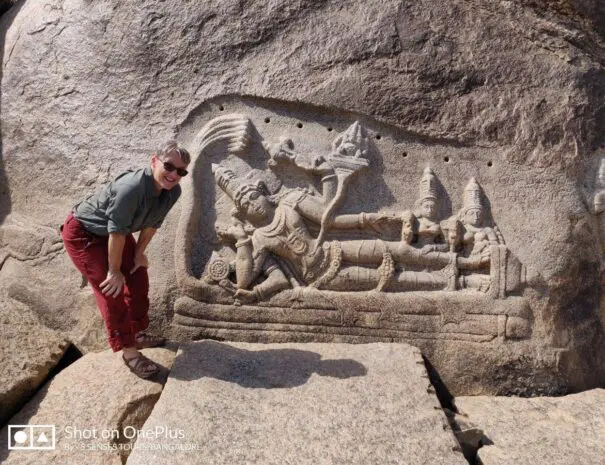
The Hampi Badami tour from Bangalore begins with hotel pickup at 7 am in a private air conditioned vehicle. The drive to Hampi takes approximately six hours through Karnataka.
Day 1 — The Royal City of Hampi
The afternoon at Hampi begins with Malyavantha Hill, from whose summit the full scale of the Vijayanagara ruins becomes visible — 26 square kilometres of temples, palaces, market streets and hydraulic systems spread across a landscape of extraordinary boulders that gives Hampi its unique and otherworldly character. The Royal Enclosure is the seat of power of the Vijayanagara kingdom, its durbar halls, ceremonial platforms, underground chambers, tanks and temples speaking directly to the administrative and ceremonial life of one of the greatest empires in Indian history. The Mahanavami Dibba, the ceremonial platform used for the great Dussehra festival, is covered in carvings of royal processions, soldiers, horses, elephants and foreign visitors that provide the most vivid picture of Vijayanagara court life. The Hazara Rama Temple, the private royal chapel, has wall carvings that tell the entire story of the Ramayana in sequential narrative panels running around the exterior.
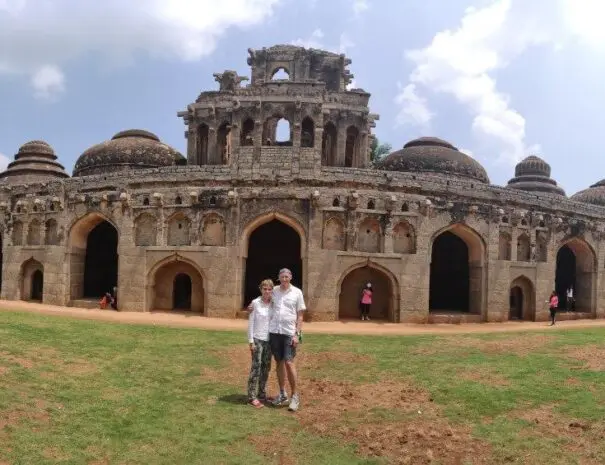
The Ugra Narasimha, a 22-foot monolithic image of Vishnu in his man-lion avatar carved during the reign of Krishnadevaraya, and the Badavi Linga, a 12-foot Shiva linga carved from black stone through which a canal passes continuously keeping it in water, are the two most powerful individual images in Hampi. The Elephant Stables, eleven domed chambers built to house the royal war elephants, give an immediate visceral sense of the wealth and military power of the empire.
Day 2 — The Temples and the River
The morning begins at Hemakuta Hill, whose cluster of early Vijayanagara temples offers the finest views over the town and the Virupaksha Temple below. The Virupaksha Temple is the oldest at Hampi, predating the Vijayanagara Empire itself, its eleven-storey tower rising 165 feet above the town in a building that is still in active daily worship. The Tungabhadra river flows along its boundary.
The Vittala Temple complex is the architectural masterpiece of the Hampi Badami tour from Bangalore. The stone chariot in the courtyard — built of rough quartz with figures of soldiers, hunters and even Portuguese and Arab visitors carved on its surface — is the most photographed image of Hampi. The musical pillars of the main hall, each one producing a different note when tapped, represent one of the most extraordinary feats of acoustic engineering in ancient Indian architecture.
The afternoon crosses the river to Anegundi, the village on the northern bank that is older than the Vijayanagara Empire itself and is associated in Hindu tradition with the Kishkindha of the Ramayana — the kingdom of the monkey king Sugriva where Rama met Hanuman and prepared his campaign to rescue Sita. A coracle ride on the Tungabhadra and a walk through the village and its banana plantations complete the second day.
Day 3 — The Chalukya Circuit
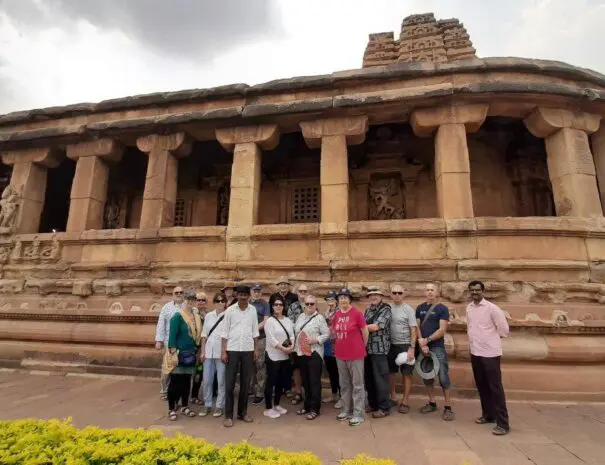
Aihole is the starting point of day three — a village of over 125 temples from the 5th century onwards that served as the open-air laboratory where Chalukya craftsmen invented and refined the grammar of the Indian stone temple. The Durga Temple, the Lad Khan Temple and the Huchimalli Temple each represent a different stage in the evolution of this tradition, and your guide explains what the craftsmen were solving architecturally at each step. Legend holds that it was at Aihole that Lord Parashurama washed his axe after his legendary campaign against the Kshatriyas — a mythological memory of the site’s sacred antiquity that predates the Chalukyas by centuries.
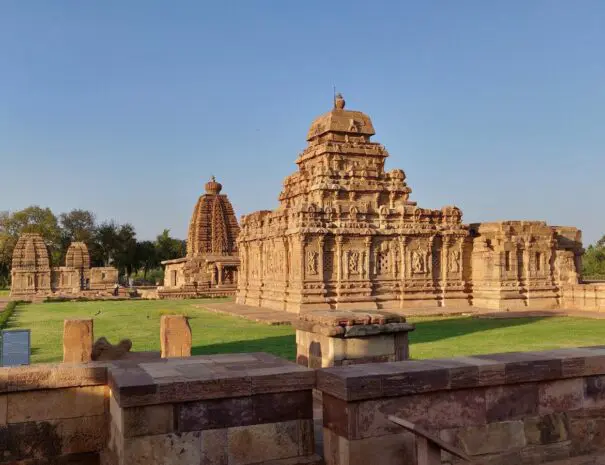
Pattadakal, the UNESCO World Heritage Site, is where the Chalukya achievement reached its peak. The Virupaksha Temple, built in 745 AD by Queen Lokamahadevi to commemorate her husband’s victory over the Pallava kings of Kanchipuram, is the grandest building in the complex, its sculptural programme drawing directly on the Pallava tradition of Mahabalipuram in a way that shows how closely the two royal courts watched each other’s architectural innovations. The Sangameshvara Temple and the Papanatha Temple complete the picture of a coronation site that was deliberately chosen to display the full range of Chalukya royal ambition.
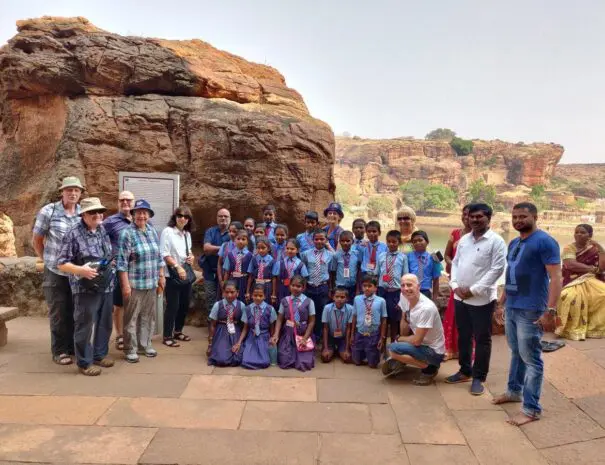
Badami, located in a ravine at the foot of red sandstone hills above the Agastya lake, is the final destination. The four cave temples carved from the red sandstone cliffs between the 6th and 7th centuries each represent a different theological tradition — Hindu Vaishnava, Hindu Shaiva and Jain — with painted ceilings, columned halls and sanctums of extraordinary refinement. The 18-armed Nataraja depicted in 81 different dance poses in Cave 1 is one of the most celebrated images in Chalukya art.
Day 4 — Drive back to Bangalore
The drive from Badami to Bangalore takes approximately five hours, arriving in Bangalore by 8 pm.
This private Hampi Badami tour from Bangalore is fully inclusive. We take care of hotel pickup and drop in Bangalore in a private air conditioned vehicle, your expert cultural guide throughout all four days, all entry fees, two nights stay in Hampi or Hospet on double occupancy with breakfast and one night stay in Badami on double occupancy with breakfast.
Hotel pickup and drop Bangalore in a private air-conditioned vehicle Expert cultural guide throughout all 4 days Entry fees to all sites 2 nights in Hampi or Hospet, double occupancy with breakfast 1 night Badami double occupancy with breakfast All taxes Duration: 4 days 3 nights
Hampi & Badami is a guided tour to unpack authentic India for better comprehension and appreciation of the cultural and heritage of the ancient Indian civilization.
A private Hampi Badami tour ensures that we are able to focus all our attention on you and adjust the pace of the Hampi & Badami tour according to your interests. Pick and drop from your hotel in an airconditioned vehicle is included .
Our company is helping the local community by training & employing local guides. There is a community of small businesses who are part of the Hampi eco system. We help this community by procuring their wares, This initiative is to ensure travel dollars stay where they are spent.




Hampi Badami Tour includes Aihole & Pattadakal
Choose from our comprehensive list of private guided tours that are immersive cultural experiences.
Join our immersive culture walks to discover authentic India. Led by a guide, experience culture, heritage & food across India.
Listen to Incredible India Travel, a podcast about the best places to visit and experiences in India.
Join our ride on Royal Enfield Motorcycles s we experience authentic India, led by an escort rider.