culture
Varanasi Experience
Full day tour of the world's oldest continuously inhabited city.
Four days through the greatest concentration of World Heritage monuments in Asia
The Golden Triangle tour of Delhi, Agra and Jaipur is the most famous heritage circuit in India and for entirely good reason — no other four-day journey anywhere in the world concentrates as many extraordinary monuments in as small an area. Delhi has five UNESCO World Heritage Sites within its boundaries. Agra has three. Jaipur has one — and the Taj Mahal alone justifies the journey from anywhere on Earth. Shah Jahan spent 22 years and resources drawn from across Asia building it for Mumtaz Mahal — red sandstone from Fatehpur Sikri, jasper from Punjab, jade and crystal from China, turquoise from Tibet, lapis lazuli from Afghanistan, sapphire from Sri Lanka — assembling the most beautiful building in the world from a supply chain that stretched from the Mediterranean to the South China Sea. In Delhi the Qutub Minar, built to celebrate a military victory that became the founding moment of the Delhi Sultanate, stands next to an iron pillar forged 1,600 years ago that has not rusted in all that time and that no metallurgist has fully explained. In Jaipur the Jantar Mantar astronomical observatory built in 1730 still accurately tells the time. Our private Golden Triangle tour takes you through all of this across four days with expert cultural guides in each city who bring the full story of Mughal, Rajput and Sultanate India to life. 5 Senses Tours is recognised by the Department of Tourism, a winner of the Outlook Responsible Tourism Award and the Tripadvisor Travellers Choice Award.
The Golden Triangle tour begins with hotel pickup at 8 am in Delhi in a private air conditioned vehicle.
Day 1 — Delhi
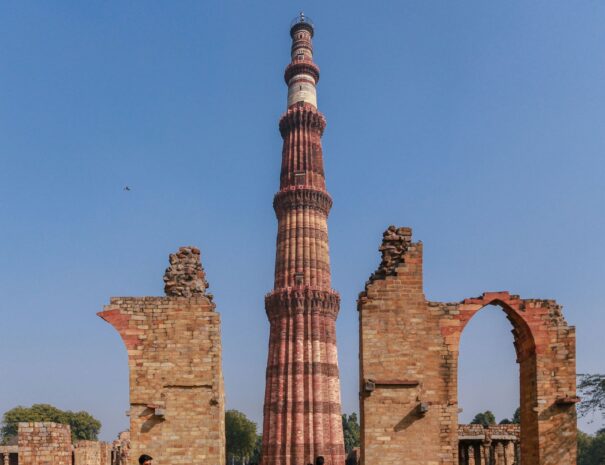
The Qutub Minar complex is the first stop — a 73-metre minaret built by Qutub-ud-din Aibak in the late 12th century to celebrate his sovereign Mohammad Ghori’s victory over Prithviraj Chauhan. During its construction Aibak himself became the first sultan of the Slave dynasty, making the Qutub Minar simultaneously a monument to a victory and the founding pillar of a new empire. The complex contains the remains of the Quwwat-ul-Islam mosque, the first mosque built in India after the Islamic conquest, and the extraordinary Iron Pillar — a 24-foot, six-tonne column of 98% wrought iron forged 1,600 years ago through a technique that has left it virtually rust-free. Your guide explains both the metallurgical mystery of the pillar and the complex history of the site around it.
Humayun’s Tomb is the second stop — the mausoleum of the second Mughal emperor, built by his widow Haji Begum in 1572 and the first mature example of Mughal garden tomb architecture in India. Its double dome, arched alcoves and char bagh garden directly inspired the Taj Mahal a century later, and standing before it you can see exactly what Shah Jahan was building on and building beyond.
India Gate and the ceremonial axis of Rajpath close the Delhi day — the war memorial commemorating 70,000 Indian soldiers who died fighting for the British in World War I, its eternal flame burning below the canopy that once held a statue of King George V, with the Rashtrapati Bhavan at the far end of the boulevard.
Day 2 — Jaipur
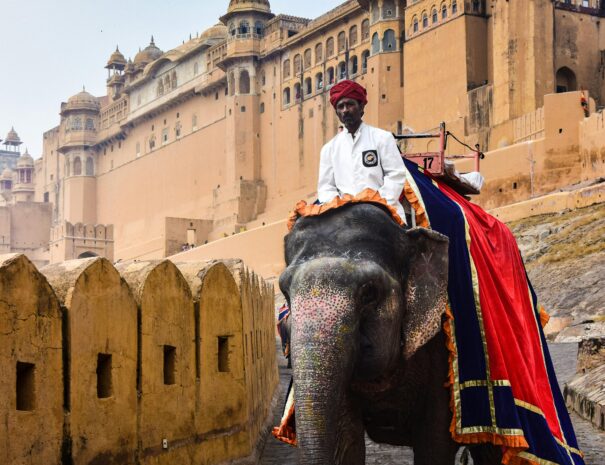
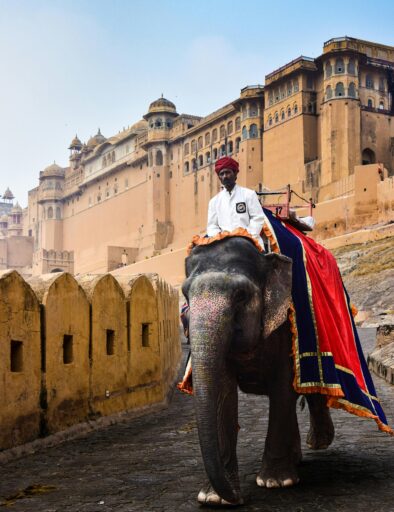
The drive from Delhi to Jaipur takes approximately five hours. Amber Fort is the first destination — the 16th century palace fortress of the Kachhwaha Rajput dynasty, its red sandstone and white marble walls rising above Maota Lake in one of the most dramatic settings of any fort in Rajasthan. The Sheesh Mahal, the Hall of Mirrors, with its intricate mirror mosaic ceiling that reflects a single candle flame into a thousand points of light, is the interior highlight. The Diwan-i-Aam and the Ganesh Pol gateway with its elaborate painted facade show the full artistic ambition of the Rajput court at its height.
Jal Mahal, the Water Palace, appears to float at the centre of Man Sagar Lake — a five-storey structure of which only the top storey is visible above the water, its reflection in the still lake one of the most photographed images in Jaipur.
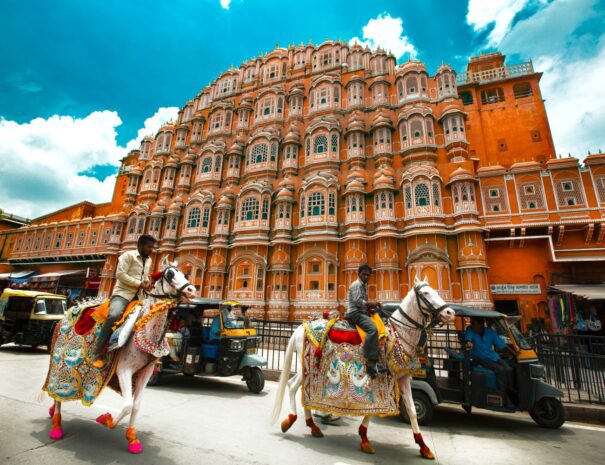
Hawa Mahal, the Palace of Winds, is the most iconic image of Jaipur — a five-storey honeycomb facade of 953 latticed windows built in 1798 by Maharaja Sawai Pratap Singh so that the women of the royal household could observe the street processions below without being seen. The facade was designed to represent the crown of Lord Krishna and its lattice work creates a natural ventilation system that keeps the interior cool regardless of the season.
The Jaipur City Palace, the seat of the Kachhwaha Maharajas, houses an extraordinary museum of royal artefacts, textiles and weapons within its courtyards and galleries — including two silver vessels that hold the Guinness World Record for the largest silver objects ever made, filled with Ganga water by Maharaja Sawai Madho Singh II when he travelled to London for the coronation of King Edward VII.
Day 3 — Fatehpur Sikri and Agra
The drive from Jaipur to Agra takes approximately four hours. Jantar Mantar Jaipur, the 1730 astronomical observatory of Maharaja Sawai Jai Singh II, is visited on the way — its 19 giant stone instruments including the Samrat Yantra, the world’s largest stone sundial, still accurate to within two seconds of the correct time.
Fatehpur Sikri, the abandoned Mughal capital built by Emperor Akbar in 1571, is an extraordinary ghost city in red sandstone — complete palaces, courtyards, mosques and audience halls built in a fusion of Persian, Hindu and Jain architectural styles, occupied for only 14 years before being abandoned when the local water supply ran dry. The Buland Darwaza, the Gate of Magnificence, is the tallest gateway in the world. The tomb of Salim Chishti inside the Jama Masjid is one of the most revered Sufi shrines in India.
Overnight in Agra.
Day 4 — The Taj Mahal
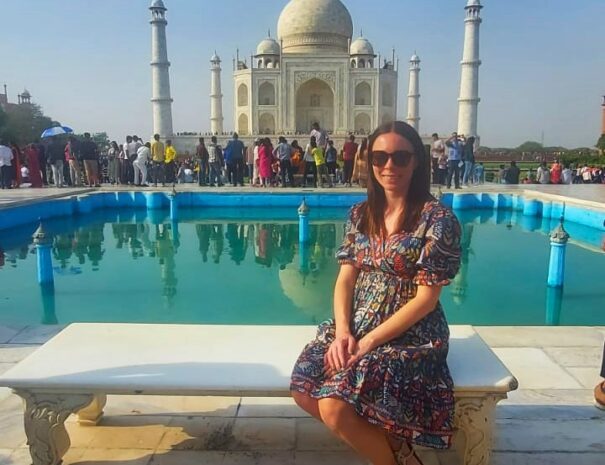
The Taj Mahal is best experienced at sunrise when the light on the white marble changes from grey to pink to brilliant white over the course of an hour and the reflecting pool in the char bagh garden catches every shift. The building took 22 years to complete, employed 20,000 workers and drew materials from across Asia. Your guide explains the architectural perfection of the building — the optical corrections that make the minarets appear perfectly vertical when they are actually inclined outward by a fraction to prevent them falling onto the main tomb in an earthquake, the inscriptions from the Quran on the entrance arch that appear the same size from top to bottom because the upper letters are proportionally larger to compensate for the viewing angle, and the pietra dura inlay work of semi-precious stones that covers the interior walls with patterns of extraordinary delicacy.
Drive back to Delhi, arriving by 3 pm.
Hotel pickup and drop Delhi Private air-conditioned vehicle throughout Expert cultural guide in Delhi, Jaipur and Agra Entry fees to all monuments Three nights' accommodation double occupancy, with breakfast All taxes Duration: 4 days, 3 nights
Our company is helping the local community by training & employing local guides. There is a community of small businesses who are part of the eco system. We help this community by procuring their wares to ensure travel dollars stay where they are spent.
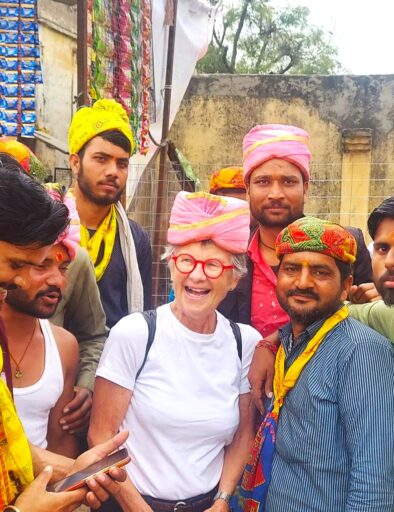



Golden triangle tour of Delhi, Agra & Jaipur
Choose from our comprehensive list of private guided tours that are immersive cultural experiences.
Join our immersive culture walks to discover authentic India. Led by a guide, experience culture, heritage & food across India.
Listen to Incredible India Travel, a podcast about the best places to visit and experiences in India.
Join our ride on Royal Enfield Motorcycles s we experience authentic India, led by an escort rider.