world heritage site
Ajanta Caves
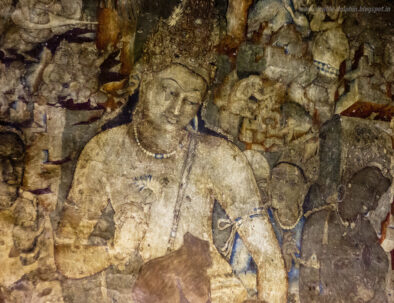
Ajanta Caves are a magnificent set of 30 rock cut Buddhist caves. Famous for Buddhist Paintings and Sculpture, Ajanta Caves are a UNESCO world heritage site
34 caves carved by three faiths over six centuries from a single basalt hill
In the 8th century, the builders of the Kailasa Temple at Ellora began not from the ground up but from the top down, carving into the basalt hillside of the Charanandri hills and removing over 200,000 tonnes of rock to reveal a freestanding temple complex twice the size of the Parthenon in Athens. Seven thousand labourers worked for 150 years to complete it. The result is the largest single monolithic excavation in the world and the centrepiece of a UNESCO World Heritage Site containing 34 caves representing three faiths, Buddhist, Hindu and Jain, carved between the 5th and 10th centuries by craftsmen who left one of the most extraordinary concentrations of rock cut art anywhere on Earth. Our private Ellora Caves tour takes you through this extraordinary site with an expert art historian guide who brings the iconography, the history and the engineering genius behind every cave to life. 5 Senses Tours is recognised by the Department of Tourism, a winner of the Outlook Responsible Tourism Award and the Tripadvisor Travellers Choice Award.
The Ellora Caves tour begins with hotel pickup at 9 am in a private air conditioned vehicle from Aurangabad. The drive to the caves takes approximately 30 minutes.
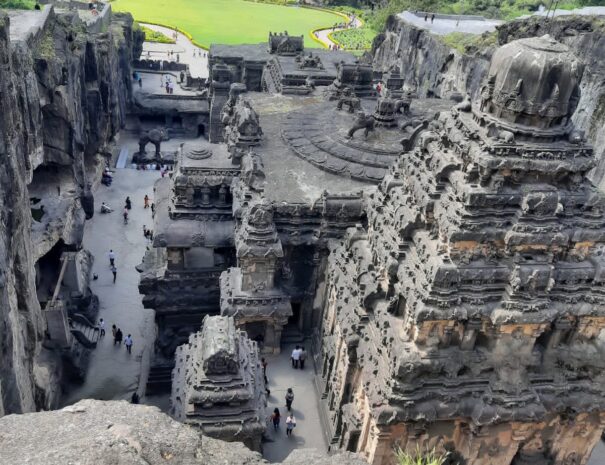
The Kailasa Temple, Cave 16, is the first and most overwhelming stop. Built by Krishna I of the Rashtrakuta dynasty between 757 and 773 AD, this is not a cave but a freestanding temple complex carved entirely from the living rock of the hillside. The builders began at the top of the hill and worked downwards, cutting away the surrounding rock to reveal the gateway, the antechamber, the assembly hall, the sanctuary and the tower as they descended. The surfaces of every structure are covered in carvings from the Puranas, the ancient Sanskrit texts, with scenes of extraordinary narrative complexity and technical refinement. The most famous is the panel showing Ravana attempting to lift Mount Kailash with the figures of Shiva and Parvati above him, a carving that is widely considered one of the greatest works of relief sculpture in the history of Indian art. Your guide explains the full theological and artistic programme of the temple and why the choice to carve it top-down rather than build it bottom-up was one of the most ambitious decisions in the history of world architecture.
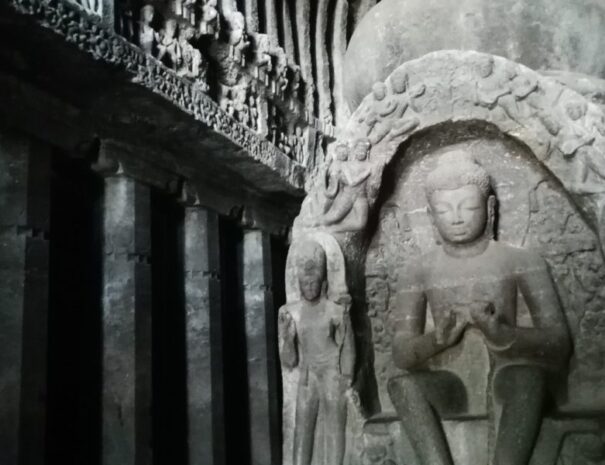
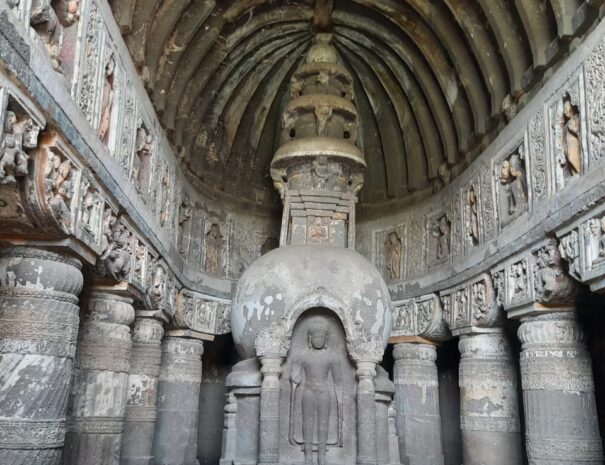
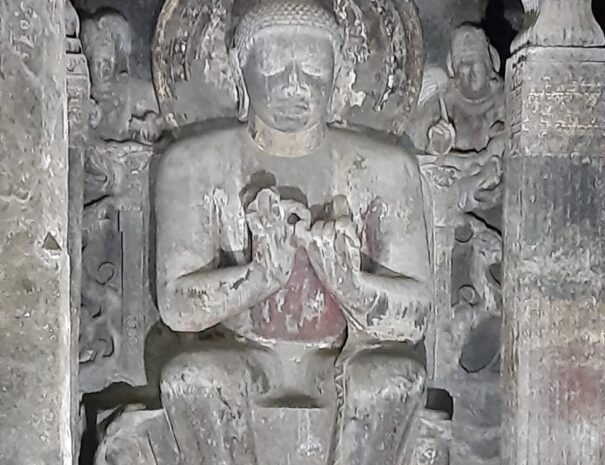
The Buddhist caves, numbered 1 through 12, come next. These are the oldest at Ellora, dating from the 5th to the 8th century, and they represent the full range of Mahayana Buddhist monastery architecture from simple residential cells to the extraordinary Vishvakarma Cave, Cave 10, also known as the Carpenter’s Cave, whose vaulted ceiling was carved to imitate the wooden beams of a timber-roofed prayer hall. The central stupa inside is flanked by a colossal standing Buddha, and the ribbed vault above creates an acoustic effect that was almost certainly intentional.
The Dashavatara Cave, Cave 15, is one of the most important Hindu caves outside Kailasa. Its two storey structure contains some of the finest Vaishnava sculpture at Ellora, including the celebrated relief of Lord Narasimha, the man-lion avatar of Vishnu, tearing open the chest of the demon king Hiranyakashipu at the precise moment that fulfils the conditions of Brahma’s protective boon. Your guide explains the theological significance of this scene and what it reveals about the relationship between Vaishnavism and the Rashtrakuta royal court.
The Jain caves, numbered 30 through 34, are the last in the sequence and the most delicate in their carving. Built between the 9th and 12th centuries, they display a refinement of surface treatment that reflects the Jain emphasis on purity and non-violence in every aspect of artistic expression.
Hotel drop in Aurangabad by 3 pm.
This private Ellora Caves tour is fully inclusive. We take care of hotel pickup and drop in a private air conditioned vehicle, your expert guide throughout the tour, all entry fees and a vegetarian lunch.
Verul Leni, better known as Ellora Caves are one of the finest specimens of rock cut architecture in India. Located near the Indian City of Aurangabad, Ellora Caves are a set of 34 caves excavated out of the Charanandri hills. This UNESCO world heritage site has a mix of Hindu, Buddhist and Jain caves. Built between 5th and 10th century, Ellora caves are located on an ancient trade route and hence unlike the Ajanta Caves were never lost and have always been frequented over the years.
The most impressive cave at Ellora is # 16 called the Kailasa Cave. Built to resemble Mount Kailash, the heavenly abode of Lord Shiva, Cave 16 is a free standing Temple complex and the largest single monolithic excavation in the world. Kailasa was built by Krishna I (757–773) of the Rashtrakuta dynasty. Kaliasa is twice the size of Parthenon in Athens and was built by 7,000 laborers over 150 years.
The temple complex which was built on the lines of the Virupaksha Temple in Pattadakal, comprises a gateway, antechamber, assembly hall, sanctuary and tower. Surfaces of the structure are all embellished by verses from the Puranas, ancient Sanskrit Poems.
Cave 10 also called Dashavatara is another splendid specimen of rock cut sculpture. It has an open court with a free-standing monolithic “mandapa” at the middle and a two-storeyed excavated temple at the rear. A must see relief in Dashavatara is the one depicting the death of Hiranyakashipu, by Lord Narasimha the Man-Lion avatar of Vishnu.
Ellora Caves were located on an ancient trade route connecting the western ports on the Arabian sea like Sopara, , Kalyan, and the inland cities like Paithan, Ter and Bhokardan.Over the years, many famous travellers have visited Ellora caves. Arab geographer Al-Mas‘udi came here in the 10th century A.D. In 1352 A.D Sultan Hasan Gangu Bahmani had visited the Caves. Some of the other famous traveler who wrote about Ellora caves after visiting are Firishta, Thevenot (1633-67), Niccolao Manucci (1653-1708), Charles Warre Malet (1794) and Seely (1824).
Ellora Caves tour is a guided tour where an expert guide will provide the cultural context during our visit to the caves. Our cultural evangelists unpack authentic India for better comprehension and appreciation of the cultural and heritage of the ancient Indian civilization.
A private tour ensures that we are able to focus all our attention on you and adjust the pace of the tour according to your interests. Pick and drop from your hotel in an airconditioned vehicle is included in the Ajanta Caves tour.
Our company is helping the local community by training & employing local guides. This initiative is to ensure travel dollars stay where they are spent.


Experience cultural immersion in the Ajanta Caves tour.
Choose from our comprehensive list of private guided tours that are immersive cultural experiences.
Join our immersive culture walks to discover authentic India. Led by a guide, experience culture, heritage & food across India.
Listen to Incredible India Travel, a podcast about the best places to visit and experiences in India.
Join our ride on Royal Enfield Motorcycles s we experience authentic India, led by an escort rider.