Pink city of Jaipur
Experience magnificent palaces, impregnable forts and Rajasthani cuisine.
The Kamasutra carved in stone by a dynasty that survived a Mughal invasion and built 22 temples
Most visitors to Khajuraho come expecting erotic sculptures and leave having encountered something far more profound. The Chandela kings who built these 22 temples between the 9th and 11th centuries were not simply carving titillation in stone. They were expressing a complete cosmological philosophy — the idea that kama, desire and sensory experience, is not the opposite of spiritual liberation but one of the four legitimate goals of human existence, as valid and as sacred as dharma, artha and moksha. The erotic panels occupy only a fraction of the total carved surface at Khajuraho. The rest is filled with gods, goddesses, celestial musicians, mythical creatures, scenes of royal court life and images of devotion of extraordinary beauty and refinement. Without a guide who understands the theological programme behind the carvings, Khajuraho is a spectacle. With one, it becomes one of the most intellectually extraordinary places in India. Our private Khajuraho tour takes you through the full UNESCO World Heritage complex across two days — the western group of Hindu temples, the Chausath Yogini, the Jain temples of the eastern group — with an expert cultural guide who brings the complete Chandela vision to life. 5 Senses Tours is recognised by the Department of Tourism, a winner of the Outlook Responsible Tourism Award and the Tripadvisor Travellers Choice Award.
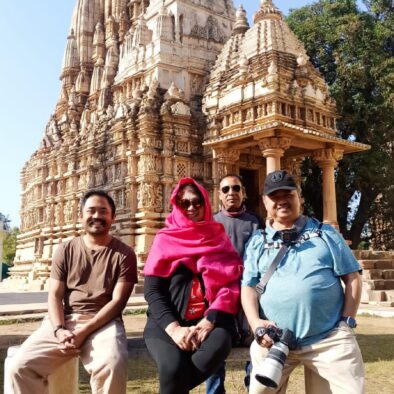
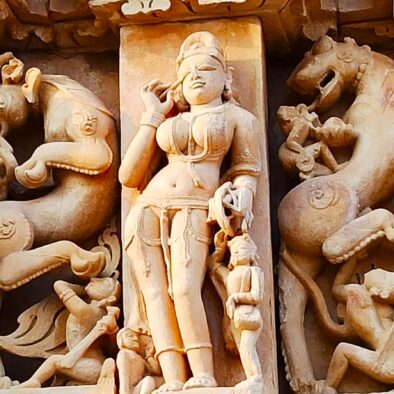
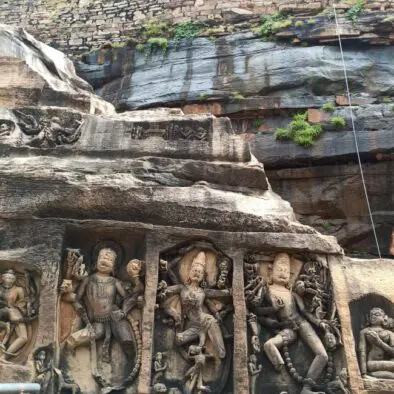
The Khajuraho tour begins with hotel pickup at 8:30 am on day one in a private air conditioned vehicle.
Day 1 — The Western Group
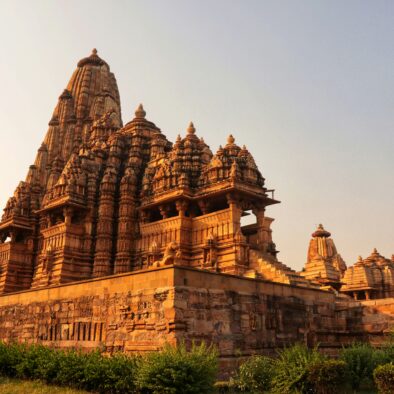
The Kandariya Mahadeva Temple is the architectural and artistic masterpiece of Khajuraho and the natural starting point of the Khajuraho tour. Built by Chandela King Vidyadhara in the early 11th century in the aftermath of Mahmud of Ghazni’s devastating raids on the region, it represents an extraordinary act of cultural defiance — a temple of such ambition and beauty that it declares the Chandela dynasty’s absolute refusal to be diminished. Rising to 31 metres, its tower clusters are the finest expression of the Nagara style of North Indian temple architecture, and its sculptural programme is the most complete and the most theologically sophisticated at the entire site. The Makara Torana at the entrance, the intricately carved hallways and the main sanctum with its Shiva linga are surrounded on every exterior surface by figures of extraordinary technical refinement — apsaras, divine couples, celestial musicians and the celebrated erotic panels that your guide explains in their full theological context.
The Lakshmana Temple, built by King Yashovarman in the 10th century, is among the earliest and most complete of the Khajuraho temples. The main idol of Lord Vaikuntha with its three heads and four arms — the central human face flanked by the lion of Narasimha and the boar of Varaha — is one of the most unusual and powerful Vaishnava images in North India. The subsidiary shrines at the four corners of the platform each contain their own sculptural programmes, and the friezes running around the base of the temple include scenes of processional elephants, celestial beings and the famous groups of figures in various states of intimacy and devotion.
The Chausath Yogini Temple is the oldest structure at Khajuraho, built mostly in granite in the 9th century before the sandstone temples that followed. Its 64 shrines — each housing a different yogini, a female spiritual master or manifestation of divine energy — form an open courtyard of extraordinary power. The central shrine houses a large idol of Shiva with Parvati on Nandi. Each of the 64 yogini statues is different from every other in posture, expression and attribute, and the collective effect of moving through the courtyard is one of the most unusual religious experiences at the entire site.
The Javari Temple, smaller than Kandariya but exquisitely refined in its sculptural detail, stands on a high platform and demonstrates the Chandela tradition at its most intimate and precise.
Day 2 — The Eastern Group
The Varaha Temple is the starting point of day two, housing one of the most remarkable single sculptures at Khajuraho — a massive polished sandstone image of Lord Vishnu in his boar avatar, every inch of its surface covered in miniature carvings of gods and goddesses from the Hindu pantheon. The image of Goddess Saraswati playing her veena, carved on the body of the Varaha, is considered one of the finest individual figures at the entire site.
The Jagadamba Temple houses a striking image of Goddess Parvati in its main shrine, but it is the exterior that demands the most attention — mythical hybrid creatures called Shardulas, with the body of a lion and the head of a parrot, boar or elephant, move through the carved bands of the exterior with a fantastic energy that is unlike the iconography of any other tradition in Indian art.
The Dulhadeo Temple is the last major Hindu temple built at Khajuraho before the Chandela dynasty went into decline, its style slightly more restrained than the earlier temples but still of extraordinary quality.
The Parshvanath Jain Temple is the largest and finest of the Jain temples in the eastern group, built by the Chandela ruler Dhanga in the early 10th century. Its walls carry carvings of female goddesses playing musical instruments — the gandarva, manjira, shankha, mridanga and vadya — in panels of exceptional delicacy. The Jain temples demonstrate that the extraordinary sculptural tradition of Khajuraho was not the exclusive possession of the Hindu patrons but was shared across faith traditions in a way that speaks to the remarkable cultural openness of the Chandela court.
The Khajuraho tour ends at 4:30 pm on day two.
This private Khajuraho tour is fully inclusive. We take care of hotel pickup each day in a private air conditioned vehicle, your expert cultural guide across both days and all entry fees.
Hotel pickup each day in a private air-conditioned vehicle Expert cultural guide across both days Entry fees to all temples All taxes Duration: 2 days, 8:30 am to 4:30 pm each day
Khajuraho tour is a fully guided tour led by a guide who will help you appreciate Kamasutra on stone.
A private Khajuraho tour ensures that we are able to focus all our attention on you and adjust the pace of the tour according to your interests. Pick and drop from your hotel in an air-conditioned vehicle is included in the Khajuraho tour.
Our company is helping the local communities by training & employing local guides and by procuring their wares to strengthen their livelihood.



Khajuraho tour to world heritage site over 2 days
Choose from our comprehensive list of private guided tours that bring alive the rich culture of North India.
Join our immersive culture walks to discover authentic India. Led by a guide, experience culture, heritage & food across India.
Listen to Incredible India Travel, a podcast about the best places to visit and experiences in India.
Join our ride on Royal Enfield Motorcycles s we experience authentic India, led by an escort rider.