
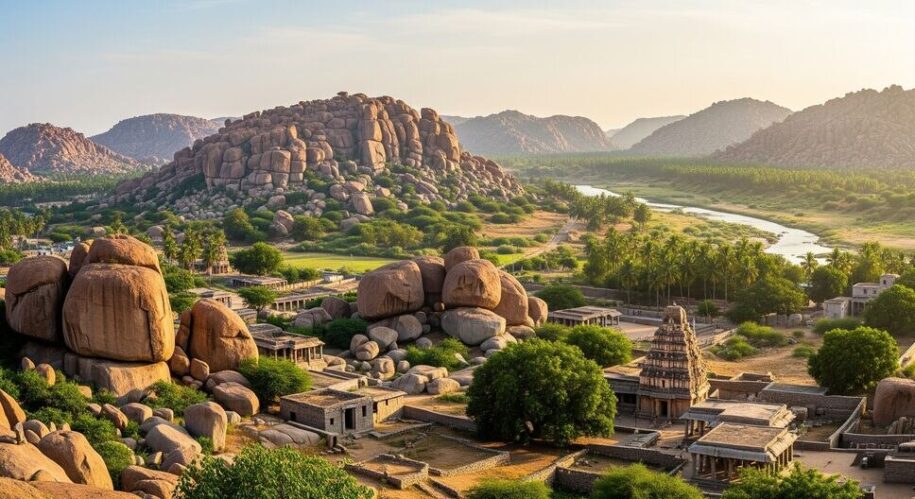
Hampi’s Boulders: How do they stand?
Imagine stepping into a world where colossal rocks are playfully stacked, defying gravity as if giants once roamed and played a cosmic game of pebbles. This is the immediate, breathtaking impression Hampi leaves on every visitor, evoking imagery of “a long-dead giant’s bones strewn across the earth”. Nestled in the heart of Karnataka, Hampi is far more than just a collection of ancient stones; it is a proud UNESCO World Heritage Site, once the magnificent capital of the mighty Vijayanagara Empire. Its ruins, spread across approximately 41 square kilometers, whisper tales of unparalleled prosperity, culture, and architectural brilliance.
But as one gazes upon these monumental formations, an inevitable question arises: How do they stand? Why don’t they simply slide down?. This profound enigma, with some boulders forming “precarious, gravity-defying piles”, is at the very heart of Hampi’s allure, inviting all who visit to unravel its secrets. As your trusted tour operator, we invite you to discover Hampi with us and uncover the fascinating truths behind its impossible landscape!
Hampi’s Boulders: A Geological Marvel Billions of Years in the Making
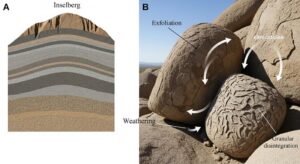
For the scientifically curious, the mystery of Hampi’s boulders has a fascinating geological explanation, rooted in ancient processes. This ancient landscape sits atop the “Dharwar craton,” one of Earth’s oldest and most stable crustal chunks, formed an astonishing “3.6-2.5 billion years ago”. The rock formations in Hampi represent “one of the oldest surfaces one can see on earth”. Unlike most mountain ranges, these boulder heaps were not created by volcanic activity or crustal uplift.
Instead, these formations are known as ‘inselbergs,’ or “island mountains,” which are residual features that persist long after surrounding landscapes have eroded. The process began with gigantic granite monoliths developing cracks and joints. Rainwater then percolated through these fissures, slowly breaking down the rock into “grus” (weathered material) and leaving behind “corestones”—the unweathered, rounded boulders seen today. This slow, gradual weathering process smoothed and rounded the angular sides of these corestones. It is as if “Nature played the role of a sculpturer,” meticulously scooping out the ‘unwanted’ portions to create this bizarre, yet beautiful, arrangement over immense periods, estimated between “10,000 – 1,00,000 years”. The strong, sandy wind also contributed to polishing these cyclopean boulders into their strange shapes.
Remarkably, despite the inherent hardness of this granite, the ingenuity of the Vijayanagara Empire allowed ancient artisans to “slice the boulders” for construction. They achieved this by using rudimentary metal tools to make holes, then pegging dry wood into these holes and pouring water to expand the wood, perfectly cracking the rock along desired lines. This allowed them to construct their imperial capital literally “out of boulders,” using them as foundational building material and for massive in-situ religious carvings like the Sasivekalu and Kadalekalu Ganesha idols, or the giant monolithic Nandi at the end of the Hampi Bazaar. The technique of stone splitting by Vijayanagara masons involved rectangular or square wedge holes, leaving angular wedge marks on the split stone surfaces. This is distinctly different from the lenticular wedge holes and U-shaped marks of earlier artisans like the Early Chalukyas.
Echoes of Epics: Where Mythology Shaped Hampi’s Boulders
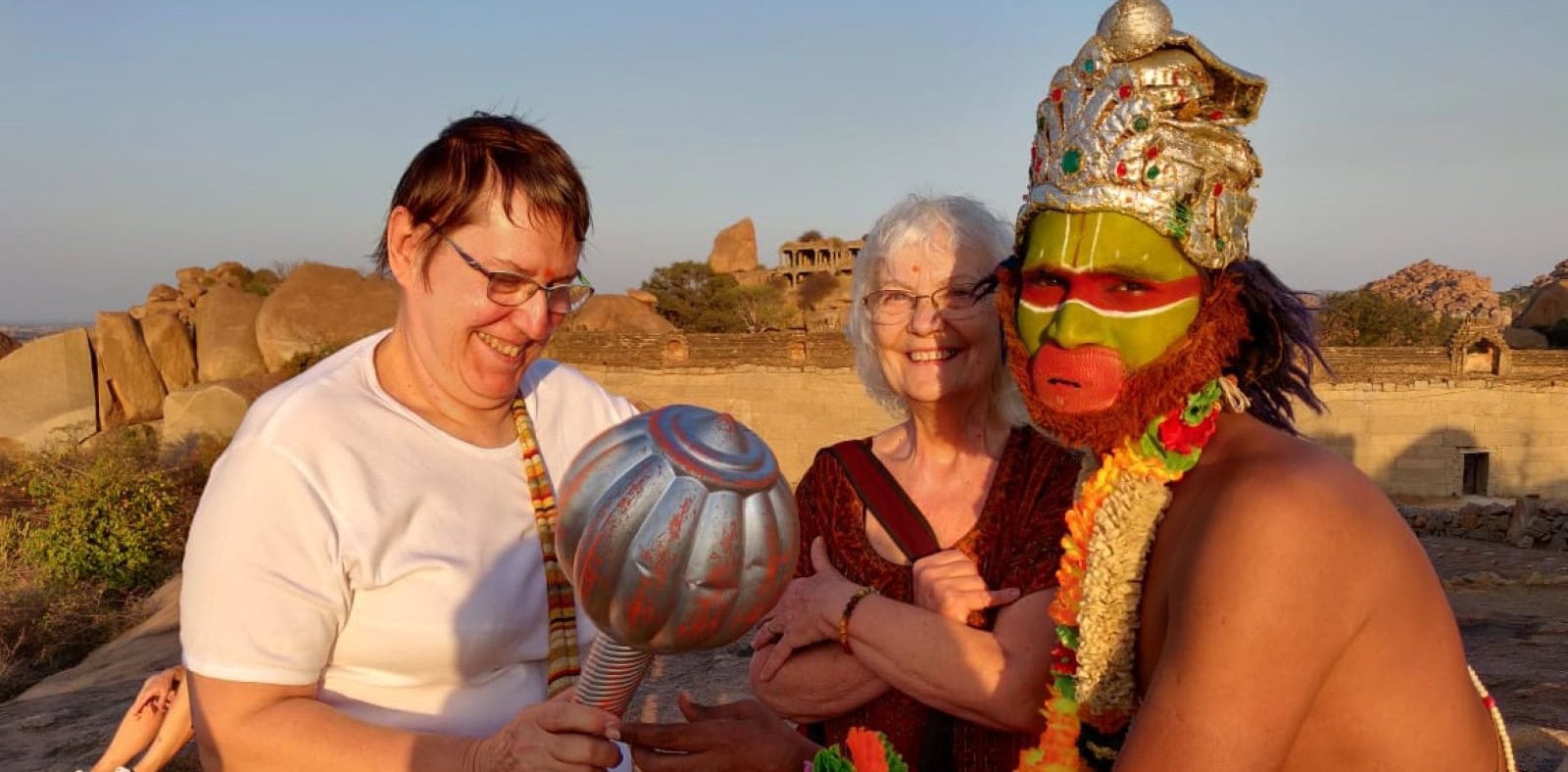
While geology offers a scientific explanation, Hampi’s landscape is equally, if not more, vibrant with the echoes of ancient Hindu mythology. Hampi is widely believed to be Kishkindha, the fabled monkey kingdom from the epic Ramayana. This was the home of King Sugreeva, his powerful “vanar sena” (monkey army), and the revered birthplace of Lord Hanuman.
According to local folklore, the very boulders that define Hampi’s terrain are remnants of epic battles. The most dramatic tale recounts the fierce power struggle between the princely brothers, Sugreeva and Vali, who “threw boulders at each other” in a “pitched battle,” leading to the piles of rocks scattered across the landscape. Another popular version suggests that Hanuman’s monkey army piled these boulders to “build a bridge to Lanka” to rescue Sita.
Every step in Hampi can evoke these myths. Matanga Hill, the tallest peak in Hampi’s citadel, is where the frightened Sugreeva took refuge from Vali. Anjaneya Hill, across the Tungabhadra River, is believed to be Hanuman’s birthplace, and Rishimukh Hill is where Lord Rama first met Hanuman and Lakshmana. Even specific boulder formations have their own legends, such as the “Akka Tangi Gudda” or ‘Sister Boulders,’ said to be two sisters cursed and turned to stone. The “balancing boulder atop Malayavanta Hill” is another iconic example, often associated with these ancient tales. To the ancient civilizations, these rocks weren’t just geological formations; they were sacred, symbolic, and alive.
Adding another layer to Hampi’s rich tapestry of mysteries are the enigmatic eclipse sculptures found in temples like the Krishna Temple, the Virupaksha Temple, and the Varaha Temple. These celestial narratives embedded in stone feature depictions such as a fearful rabbit in the moon disc leaping away from a snake on the roof of the Virupaksha Temple’s pavilion. In the Varaha Temple, two serpents are seen approaching lotus medallions and discs on the gopuram threshold ceiling, symbolizing the moon. Such eclipse motifs only appeared in Karnataka during the Vijayanagara rule. These carvings suggest a sophisticated understanding of ancient cosmologies and the artistic representation of celestial events within the Vijayanagara worldview.
Whether seen through the lens of geological time or mythological grandeur, Hampi’s boulder-strewn landscape is undeniably awe-inspiring, creating a backdrop that is both “grand, majestic and extraordinary” and profoundly mysterious. The boulders, appearing “as if someone had stacked the boulders with precision” or “float on each other,” continuously puzzle and delight visitors, making Hampi an inexplicable and unforgettable destination.
Beyond the Boulders: Your Hampi Adventure Awaits!
Hampi truly is a destination that promises an unforgettable journey, where the stories of the past meld into your personal experience, fostering awe amidst ageless beauty and tranquility. Its strategic location, with natural boulder hills forming a “natural fortress” and the Tungabhadra River acting as a moat, played a crucial role in the Vijayanagara Empire’s prosperity. This vast city, once “one of the richest cities in the world,” was a hub of unparalleled prosperity, culture, and spirituality.
Beyond the geological and mythological wonders, Hampi is a sprawling open-air museum, a testament to the grandeur of the Vijayanagara Empire, which flourished from the 14th to the 16th century. Here’s a glimpse of the timeless tapestry you’ll explore:
-
- Virupaksha Temple: Still a “living, oldest functioning temple in India” and a major pilgrimage site dedicated to Lord Shiva. Its towering gopuram welcomes you to a place of profound religious significance.
-
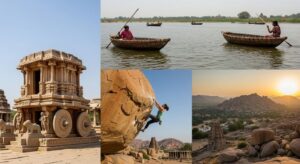
- Vittala Temple Complex: The crown jewel of Hampi, featuring the iconic Stone Chariot (now on the INR 50 note!) and the astonishing Musical Pillars that produce the harmonies of “81 different musical instruments” when tapped—a true testament to ancient acoustic mastery.
-
- Lotus Mahal: A beautiful blend of Indo-Muslim architectural styles.
-
- Elephant Stables: A grand structure with unique acoustic domes.
-
- Royal Enclosure & Dasara Dibba: Explore the remnants of royal palaces and public buildings, where kings once presided over grand celebrations.
-
- Monolithic Idols: Marvel at the Sasivekalu and Kadalekalu Ganesha, and the colossal 22-foot Ugra Narasimha statue, all carved from single granite boulders.
-
- Queen’s Bath: A lavish bathing complex showcasing advanced hydraulic engineering.
-
- Hampi Bazaar: Once a bustling marketplace where diamonds and jewels were traded, its ruins still hint at a vibrant commercial past.
The serene Tungabhadra River, Hampi’s “lifeline,” gracefully meanders through the landscape, its banks adorned with ancient ghats. Here, you can experience the magic of gliding in a traditional coracle (a round, basket-like boat), offering “unique perspective of the scenic Tungabhadra River”. For an added thrill, some boat riders even perform “tricks… makes the coracle go round and round”!
For the adventurous soul, Hampi is a “paradise for rock climbers” with a “thriving climbing scene”. While climbing is restricted in the UNESCO core zone, the “precariously balancing boulders” in the buffer zones, like Hanumanahalli and Anegundi, offer a “thrilling sport” for enthusiasts. There are around “1,500 documented problems in Hampi and just as many undocumented ones”. As one climber noted, “What Hampi may currently lack in quantity, it makes up for in variety,” offering razor-sharp aretes, impossibly thin slabs, and very high boulders. Even beginners can enjoy Hampi’s bouldering scene, with local guides available to lead sessions.
Trekkers can embark on climbs to iconic viewpoints like Matanga Hill, the “highest point in Hampi,” for “spectacular sunrise views” over the entire city, or Hemakuta Hill for “panoramic views of the ruins” and a “great sunset point”. Hampi is also a photographer’s paradise, offering “enchanting sunrise and sunset views” that paint the sky in “hues of deep orange-pink”.
Guided tour of Hampi

5 Senses tours organises immersive culture tours of Hampi and nearby heritage wonders like Badami, Aihole and Pattadakal. These tours connect you with history, myth, and nature in a truly unique way. For more details visit Hampi Experience and Badami, Aihole & Pattadakal tour.
Leave a Reply