

Introduction – The Riddle of Nothing
In the world of numbers, there is a single symbol that changed the course of human history: zero. Today we take it for granted, written as a simple hollow circle on a page or screen. Yet centuries ago, zero was not just a number—it was a mystery, a philosophical puzzle, even a source of wonder.
To uncover the story of how zero traveled from India to the courts of Baghdad, we must turn not to a dry history book, but to the enchanted tales of the Arabian Nights. Here we meet Jafar ibn Yahya, vizier to Caliph Harun al-Rashid, a man remembered both in history and legend. And it is through his world—the libraries of Baghdad, the caravans from India, the golden age of Islamic scholarship—that the “nothing” of mathematics became “everything” to civilization.

The Baghdad of Jafar – A City of Light and Knowledge
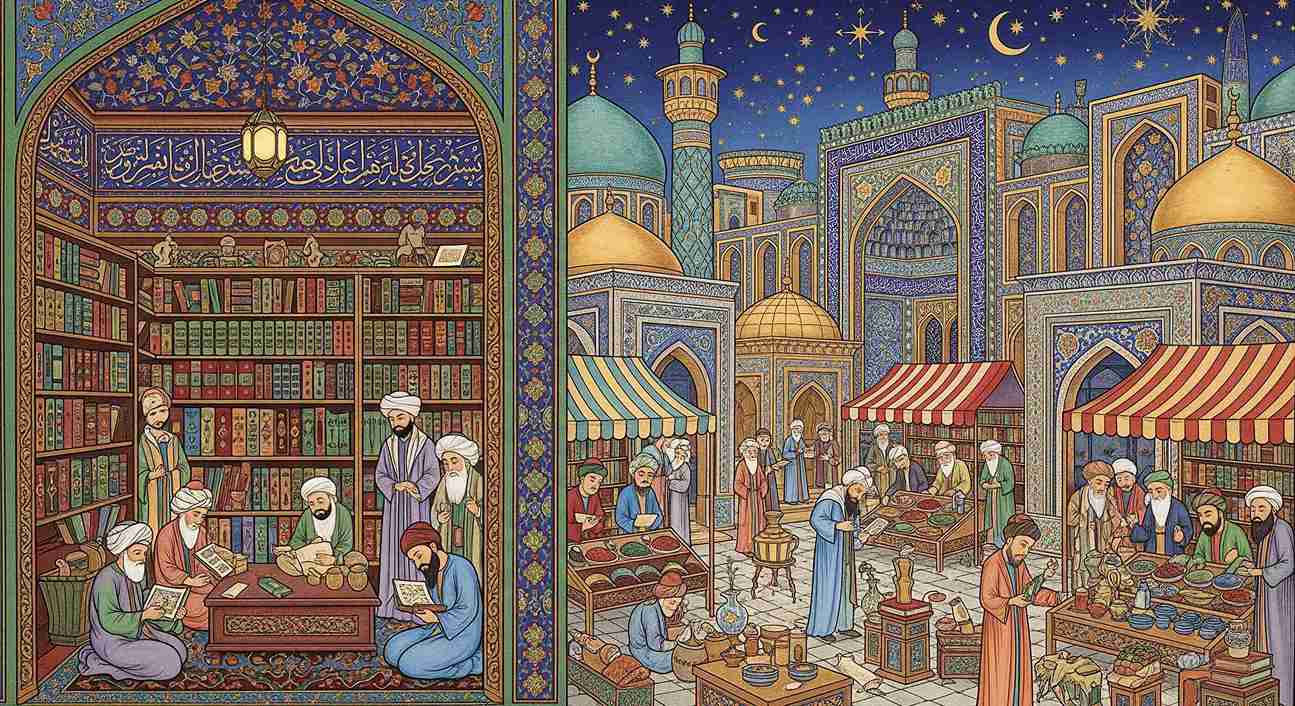
Imagine Baghdad in the 9th century CE: not the troubled city of modern times, but the shining jewel of the Islamic world. Its streets bustled with merchants from China, India, Africa, and Byzantium. Scholars debated in gardens, astronomers measured the heavens from observatories, and musicians filled the palaces with melodies.
At the heart of this world stood Harun al-Rashid, the Abbasid caliph whose name still echoes in One Thousand and One Nights. His faithful vizier, Jafar ibn Yahya al-Barmaki, was no ordinary courtier. A man of letters, science, and statecraft, Jafar and his family, the Barmakids, were patrons of scholars, poets, and travelers.
It was under their watch that Baghdad became the center of the world’s learning. The House of Wisdom (Bayt al-Hikma) gathered manuscripts from Greece, Persia, and India, translating them into Arabic. This was the crossroads where civilizations exchanged not just goods, but ideas.
And one of the most powerful ideas to cross those deserts was a circle for nothing.
India’s Gift: The Invention of Zero
Centuries before Baghdad’s glory, mathematicians in India were exploring the mysteries of numbers. The Indian word śūnya meant “void” or “emptiness.” But in the hands of scholars like Brahmagupta (7th century CE), śūnya was more than philosophy—it became a tool of mathematics.
Brahmagupta’s work, the Brahmasphutasiddhanta, laid out rules for zero: how to add it, subtract it, and use it in calculations. He treated zero as a number in its own right, not just a placeholder. With this, India created the foundation of the decimal place-value system—the very way we write numbers today.
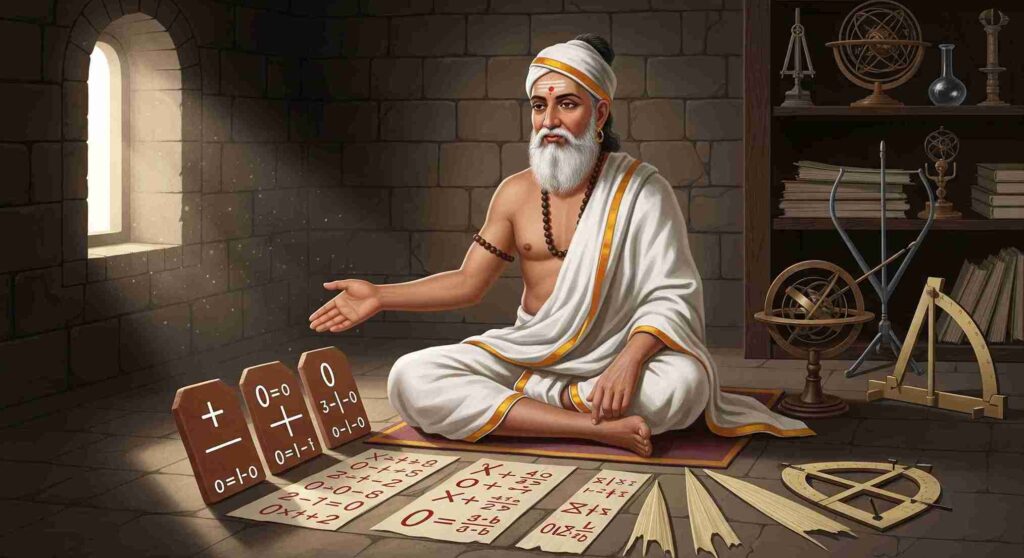
From India, this system traveled west. Caravans carried not only silk and spices but also palm-leaf manuscripts filled with strange symbols: 1, 2, 3, 4, and the mysterious circle.
The Encounter: When Jafar Met the Sage
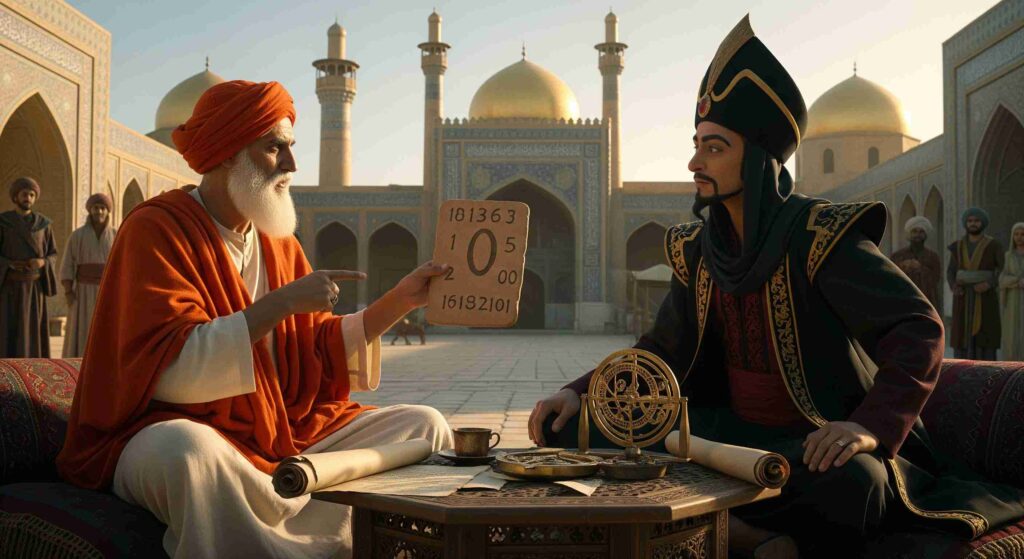
The story goes that one evening, as Harun al-Rashid held court beneath the golden lamps of Baghdad, a caravan arrived from Hind (India). Its camels bore scrolls, not jewels. With the caravan came an Indian sage.
The Caliph welcomed him with pomp, but it was Jafar who leaned forward, eyes sharp, heart hungry for wisdom.
“Tell me, O sage,” the Caliph asked, “what treasure do you bring us?”
The sage unfurled a manuscript. Upon it danced strange marks—1, 2, 3… and a hollow circle.
“This is śūnya,” the sage said. “The nothing that makes everything possible. With it, you may count stars in the heavens and coins in the marketplace alike. Without it, your numbers will falter.”
Jafar frowned. “But how can nothing have value?”
The sage smiled. “Without nothing, there can be no ten, no hundred, no thousand. Nothing gives place to something. In this emptiness lies infinity.”
The Caliph, delighted, ordered the manuscripts to be translated into Arabic. Jafar supervised the task himself, ensuring that the wisdom of India would take root in Baghdad’s gardens of knowledge.
Note that this particular incident with Jafar and the Sage may or may not have happened. But there is sufficient evidence about the movement of knowledge of Zero from India to Arabia and finally to Europe.
From Baghdad to the World
The adoption of Indian numerals and zero in Baghdad was revolutionary. Scholars used them in astronomy, merchants in accounting, engineers in architecture. The “Hindu-Arabic numeral system,” as it came to be known, replaced clumsy Roman numerals in Europe centuries later.
Through translations into Latin in Spain and Italy, zero reached Europe. There, thinkers like Fibonacci embraced it, spreading it further. Without zero, modern science, banking, and technology would be impossible.
Thus, the silent circle that began in India, nurtured in Baghdad under men like Jafar, and carried across continents, became the very foundation of the modern world.
The Legend Behind the History
In Arabian Nights, Jafar appears in many guises—sometimes wise, sometimes tragic. In the Disney retelling of Aladdin, he became a sorcerer hungry for power. Yet in history, Jafar was not merely a character of fantasy but a real man who helped shape one of the greatest cultural exchanges in human history.
Perhaps that is why the tale of zero fits so well in his story. For what is zero if not a kind of magic—turning nothing into something, absence into power?
Why This Story Matters Today
For travelers and dreamers, the story of Jafar and zero is more than history—it is a reminder of how civilizations are connected. India, Baghdad, and the Arab world are not separate chapters but linked pages in a single book of human knowledge.
When you stand in the ruins of Nalanda in India, where Brahmagupta’s ideas took root, or when you imagine Baghdad’s lost House of Wisdom, you are standing in the birthplace of the modern mind.
The tale of Jafar and zero shows us that knowledge knows no borders. It moves like a caravan across deserts, like a whisper across centuries, until it shapes the very world we live in.
Leave a Reply