
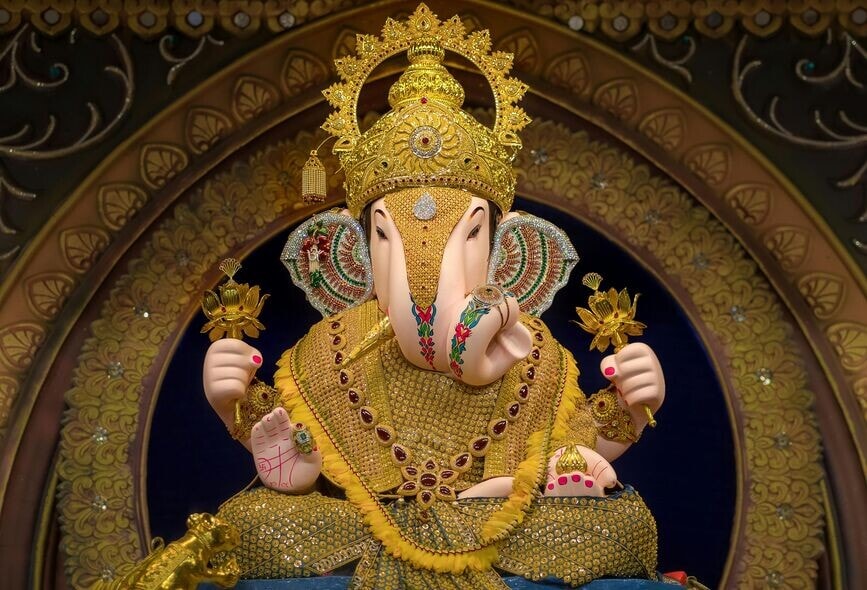
Ganesh Chaturthi, also known as Vinayaka Chaturthi, is one of the most vibrant and widely celebrated festivals in India. A 10-day long celebration, it marks the birth of Lord Ganesha, the elephant-headed deity revered as the “Remover of Obstacles” and the “Lord of Wisdom and Prosperity.” This festival is a spectacular display of devotion, art, and community spirit, bringing people together from all walks of life.
A Look Back at History
While the origins of Ganesh Chaturthi as a private festival are ancient, its transformation into a grand public event is a more recent development with a powerful patriotic backstory.
In the late 1800s, India was a land bubbling with suppressed emotions. The British Raj was at its peak, and freedom felt like a distant dream. Public gatherings were closely watched, political speeches were restricted, and Indians were discouraged from assembling in large numbers.
But then came Lokmanya Bal Gangadhar Tilak—fiery, brilliant, and always thinking a step ahead of the rulers. He realized something profound: the strength of a nation lies in unity. And unity needed a common platform, a reason for people to gather without inviting the wrath of the British.
Tilak’s eyes fell on Lord Ganesha, the beloved remover of obstacles. Until then, Ganesh Chaturthi was largely a quiet, household affair—families worshipped in their homes, immersed the idol, and life went on. Tilak, with his keen mind, saw in this festival a hidden weapon.
Imagine the scene: Pune, 1893. Instead of small idols tucked away in homes, suddenly giant clay Ganeshas appeared in neighborhoods, placed on decorated platforms, surrounded by flowers, music, and lamps. Crowds gathered, not just for worship, but for songs, dramas, discourses, and debates. The atmosphere turned electric.
And behind it all was Tilak’s masterstroke—he had transformed the private worship of Ganesha into a public celebration.
Under the protective shadow of the festival, people did much more than sing hymns. They discussed their motherland, their identity, and their rights. Nationalistic plays were staged, patriotic songs were sung, speeches disguised as religious discourses stirred the crowd. It was a gathering the British couldn’t ban—after all, who could stop Indians from celebrating their god?
For the first time, rich and poor, Brahmin and non-Brahmin, Hindu and non-Hindu stood shoulder to shoulder before Ganesha, united as children of one land. The streets of Maharashtra came alive not just with devotion, but with the heartbeat of nationalism.
The British had feared rifles and swords. They had not expected the revolution to rise with the beat of the dhol-tasha, the chants of “Ganpati Bappa Morya!”, and the unity of millions under the banner of faith.
Tilak’s vision had worked. Ganesha had become more than a deity—He had become a symbol of resistance, of unity, of freedom. Year after year, the festival grew stronger, spreading from Pune to Bombay and beyond, sowing the seeds of a movement that no empire could stop.
And so, through the wisdom of Tilak and the spirit of Ganesha, the festival became not just a religious celebration, but a rehearsal for freedom—a reminder that the obstacles before India could be removed, just as Ganesha always promised.
The Significance: Why We Celebrate Ganesh Chaturthi
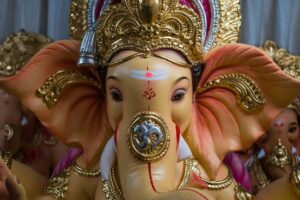
The festival is a tribute to Lord Ganesha, who is worshipped before the beginning of any new venture, be it a business, an intellectual journey, or a new phase of life. He is the Vighnaharta (remover of obstacles) and Sukhkarta (giver of happiness), and his blessings are sought for success and good fortune.
The festival also holds a deeper, symbolic meaning. The immersion of the idol at the end of the festival, known as Ganesh Visarjan, symbolizes the cycle of creation and dissolution. It represents the belief that Lord Ganesha returns to his heavenly abode on Mount Kailash, taking with him the obstacles and sorrows of his devotees. The chant “Ganpati Bappa Morya, Pudhchya Varshi Lavkar Ya!” (O Lord Ganesha, come again soon next year!) perfectly encapsulates this hopeful farewell.
The Craftsmanship: Bringing the Deity to Life
The creation of the Ganesha idols is a major part of the festival’s charm. In the weeks leading up to Ganesh Chaturthi, skilled artisans, particularly in places like Pen in Maharashtra, work tirelessly to sculpt millions of idols. The process is a blend of traditional techniques and modern innovations.
- Traditional Process: The traditional and most eco-friendly method involves using natural clay, often called shadu mati. The clay is kneaded to the right consistency and then shaped by hand or with simple tools. Artisans create the various parts of the idol—the base, body, head, limbs, and intricate features like the trunk and ears—and then join them together. The idols are then left to air-dry naturally before being painted with natural dyes derived from plants, flowers, and even vegetable colors like turmeric and beetroot.
- The Rise of Plaster of Paris (PoP): With the growing demand for large, ornate, and lightweight idols, many artisans shifted to using Plaster of Paris (PoP). PoP is a durable and lighter material that allows for greater detail and is easier to transport. However, these idols contain harmful chemicals and do not dissolve in water, causing significant environmental pollution during the immersion process.
- The Modern Twist: Eco-Friendly Celebrations: In recent years, there has been a significant push towards celebrating Ganesh Chaturthi in an environmentally conscious manner. Communities and individual devotees are actively choosing eco-friendly alternatives. This has led to a revival of traditional clay idols and the innovation of new, sustainable options. Some popular eco-friendly idols are:
- Seed Ganeshas: These are made of clay infused with seeds of various plants and trees. After the puja, the idol can be immersed in a pot, and the seeds will sprout, literally turning the deity into a source of life.
- Paper Mache and Natural Materials: Artisans are also experimenting with materials like paper mache, coconut husks, and organic dyes to create beautiful idols that are both sustainable and biodegradable.
The Festivities: A Riot of Color and Devotion
The 10-day festival is a spectacle of rituals, traditions, and community events.
- Idol Installation (Ganesh Sthapana): The festival begins with the ceremonial installation of a Ganesha idol in homes or public pandals (decorated marquees). The idols are adorned with flowers, garlands, and lights.
- Daily Rituals and Offerings: Devotees perform daily pujas (worship), chant mantras, and sing devotional songs known as aartis. The most beloved offering to Lord Ganesha is the Modak, a sweet dumpling filled with coconut and jaggery, which is considered his favorite. Other sweets and fruits are also offered as prasad.
- Community Celebrations: Public pandals are a major highlight, especially in states like Maharashtra, where communities come together to celebrate. These pandals often host cultural events, music and dance performances, and social welfare activities like blood donation camps and charity drives.
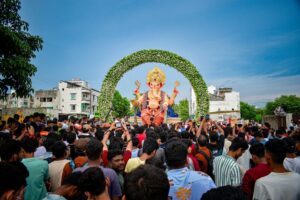
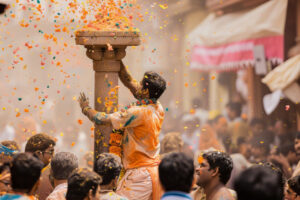
- The Grand Farewell (Ganesh Visarjan): On the final day, Anant Chaturdashi, the Ganesha idols are taken in a grand procession with music, dance, and a wave of joyous chants. The idols are then immersed in a water body—a river, a sea, or a designated tank—symbolizing the god’s return to his celestial home.
Ganesh Chaturthi is more than just a religious festival; it’s a cultural phenomenon that reinforces values of unity, devotion, and new beginnings. It’s a time when cities come alive with faith, music, and the shared joy of welcoming the beloved elephant-headed god.
For a guided tour of Ganesh festival, please visit Pune Ganpatis.
Leave a Reply