

Where Myth, Science, and the Universe Converge
India is often called the land of stories, but some stories are not merely legends — they are maps to understanding existence itself. One of the most fascinating among them is the story of the five elements — earth, water, fire, air, and space — and their embodiment in five grand temples of Lord Shiva in South India, known as the Pancha Bhoota Sthalas.
For a traveler, these temples are not only destinations of devotion but also living laboratories where philosophy, cosmology, and ecological wisdom meet. They are experiences that reveal how ancient Indians looked at the universe, the body, and the environment as deeply interconnected.
Let’s journey through this story — part legend, part science — and discover why the Pancha Bhoota temples remain one of the most intriguing pilgrimages for explorers of culture, history, and the cosmos.
For a private guided tour please visit cosmic temples of India.
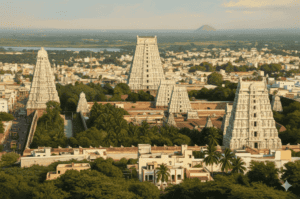
The Story of the Elements
According to the Vedic worldview, all that exists — from stars to stones, from forests to humans — is woven out of five basic elements, called the Pancha Bhootas. The Taittiriya Upanishad poetically explains:
“From space came air,
from air came fire,
from fire came water,
from water came earth.
From earth, all beings arose.”
Shiva, as the eternal yogi, is said to embody these forces of creation. To make this cosmic truth tangible, legend says Shiva manifested himself in five sacred places across South India, each aligned with one element. Together they form the Pancha Bhoota Sthalas:
- Earth (Prithvi) – Ekambareswarar Temple, Kanchipuram (Tamil Nadu)
- Water (Appu) – Jambukeswarar Temple, Thiruvanaikaval (Tamil Nadu)
- Fire (Agni) – Arunachaleswarar Temple, Tiruvannamalai (Tamil Nadu)
- Air (Vayu) – Srikalahasti Temple, Andhra Pradesh
- Space (Akasha) – Nataraja Temple, Chidambaram (Tamil Nadu)
Each temple is a microcosm, designed not only for worship but to immerse the visitor in an elemental experience.
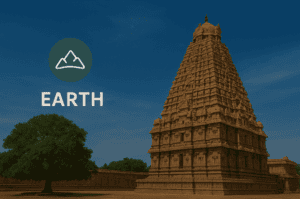
Earth – Stability and the Root of Life (Kanchipuram)
At the Ekambareswarar Temple in Kanchipuram, Shiva is worshipped as Prithvi Lingam, the embodiment of earth. The temple is vast, but its heart is a 3,500-year-old mango tree, believed to represent the fertility of the soil.
Scientific Resonance:
Earth is not just the ground we stand upon — it is the planet itself, carrying minerals, nutrients, and metals that sustain life. The symbolism of the tree connects to ecological science: trees anchor soil, generate oxygen, and stabilize climate.
In yogic thought, earth corresponds to the Muladhara chakra — the root, representing grounding and security. Modern psychology too, affirms that a sense of stability and connection to nature reduces anxiety and fosters resilience.
Water – Flow and Adaptability (Thiruvanaikaval)
At Jambukeswarar Temple near Trichy, the sanctum of Shiva literally has water flowing around it. A natural spring keeps the linga constantly moist, a reminder of water’s centrality to life.
Scientific Resonance:
Water covers 71% of Earth and forms 60% of the human body. Modern hydrology shows how aquifers and underground springs, like the one beneath this temple, are vital reservoirs that sustain civilizations. Ancient builders located this temple deliberately over such a spring — a lesson in hydro-engineering and sustainable water management.
In yogic philosophy, water is linked to the Swadhisthana chakra, the seat of emotions, creativity, and adaptability. Neuroscience today recognizes water’s importance for brain health, circulation, and emotional regulation.
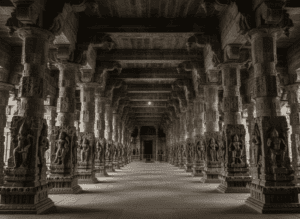
Fire – Energy and Transformation (Tiruvannamalai)
The Arunachaleswarar Temple at Tiruvannamalai is associated with fire. Legends say Shiva appeared here as an endless column of flame, symbolizing energy without beginning or end. To this day, the annual Karthigai Deepam festival lights a massive beacon flame atop the sacred hill, visible for miles.
Scientific Resonance:
Fire is transformation: the sun’s nuclear fusion, the cooking of food, the electricity that powers modern life. Fire is the engine of civilization. At a cellular level, fire equates to metabolism — the burning of nutrients to release energy.
In yogic terms, fire corresponds to the Manipura chakra, the solar plexus, seat of willpower and vitality. Psychology too notes that motivation and drive are the fire that propels human achievement.
Air – Breath and Life Force (Srikalahasti)
In the temple of Srikalahasti, oil lamps near the linga flicker mysteriously even when no air movement is visible. Devotees say this is Shiva manifesting as Vayu, the life-giving air.
Scientific Resonance:
Air is prana, oxygen — the very breath of life. Without air, neither fire burns nor life survives. Atmospheric science explains how winds shape weather, spread seeds, and regulate climate. The temple’s geography, near the river Swarnamukhi, reinforces the role of wind in shaping ecosystems.
In yoga, air relates to the Anahata chakra — the heart center, governing breath and love. Interestingly, modern science shows that controlled breathing (pranayama) lowers stress, balances the nervous system, and improves longevity.
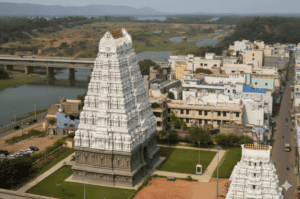
Space – The Infinite Canvas (Chidambaram)
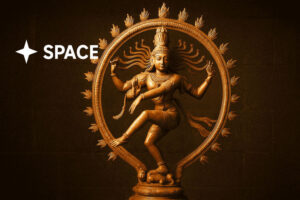
The Nataraja Temple at Chidambaram is the most enigmatic of all. Its sanctum does not hold a visible linga but instead an empty space, symbolizing Akasha, the ether. Here, Shiva is worshipped as Nataraja, the cosmic dancer whose movements represent the rhythm of creation and dissolution.
Scientific Resonance:
Space is paradoxical — seemingly empty, yet it contains galaxies, stars, and dark matter. Modern physics views space as the very fabric of the cosmos, woven with quantum fields.
In yogic philosophy, space corresponds to the Vishuddha chakra (throat, sound) and the Ajna chakra (awareness). Space is not absence, but potentiality. In the human mind, it represents silence and consciousness — the backdrop for all thought.
The Chidambaram temple also encodes astronomical knowledge: its roof is gilded with 21,600 tiles representing the number of breaths in a day, and 72,000 nails representing the nadis (energy channels) in the human body, echoing both physiology and cosmic cycles.
The Cosmology of the Five Temples
When seen together, the five temples map out a profound cosmology:
- Earth – the foundation, the body
- Water – the flow of life, the blood
- Fire – energy, metabolism
- Air – breath, circulation
- Space – consciousness, awareness
In effect, the Pancha Bhoota Sthalas represent a human being as a miniature universe. This mirrors the modern scientific idea of microcosm and macrocosm — the same elements and forces governing both galaxies and DNA.
Ancient Indian cosmology anticipated ecological science too: imbalance in any element leads to disharmony in nature and the self. Today, climate change, deforestation, and pollution can be seen as disruptions in these very elements. Visiting these temples is like stepping into an ancient ecological manifesto.
Why Travelers Should Visit
For the modern traveler, these temples are not merely religious shrines — they are experiential spaces of culture, architecture, and science:
- Architecture as Cosmic Symbolism: The gopurams (towers), sanctums, and layouts are aligned with cardinal directions, planetary positions, and geometry — echoes of sacred mathematics.
- Ecology in Stone: Each temple emphasizes one element, teaching sustainability and balance in ways that modern science now validates.
- Living Rituals: Festivals like Karthigai Deepam (fire) or daily abhishekams (water) are theatrical expressions of natural forces, like ancient documentaries enacted live.
- Philosophy for the Mind: These temples invite not only faith but also contemplation — on the universe, the body, and the balance of life.
A visit to the Pancha Bhoota Sthalas is like walking through a living textbook of cosmology, a reminder that long before telescopes and particle accelerators, humans sought to understand the universe by turning inward — through myth, meditation, and architecture.
The Larger Lesson
In the dance of Shiva, in the five temples, lies a profound message: we are not separate from nature, but made of it. The earth is our body, water our blood, fire our energy, air our breath, and space our consciousness. To disturb them outside is to disturb them within.
This marriage of myth and science is what makes India’s heritage unique. As the Chandogya Upanishad declares:
“Tat Tvam Asi — Thou art that.”
The Pancha Bhoota Sthalas invite the traveler not only to see India but to see themselves reflected in the elements of the cosmos.
For a private guided tour please visit cosmic temples of India.
Leave a Reply