
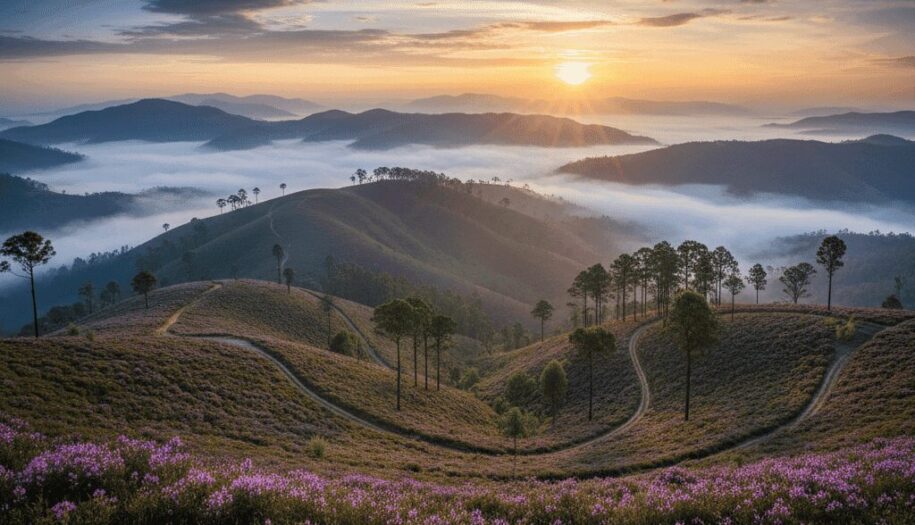
From the aroma of freshly rolled tea leaves to the distant echo of a century-old mountain train and the ancient chants of the Toda people, the Nilgiris — South India’s Blue Mountains — invite you into a world where nature and culture breathe in the same rhythm.
The Blue Mountains Awaken
When dawn rises over the Nilgiris, mist drifts like silk across slopes of emerald green. The first light touches the tea leaves, and the mountains take on their signature hue — a bluish shimmer born from the Neelakurinji, the wild flower that blooms once every twelve years.
This is a land where nature hums softly, where every breeze carries the scent of eucalyptus, and where time itself seems to move at the pace of a mountain train.
The Nilgiris — straddling Tamil Nadu, Kerala, and Karnataka — are not merely hills. They are an ecosystem, a culture, and a living museum of stories.
A Sip of the Sky – Tea Tasting in the Clouds

To understand the Nilgiris, one must start with a cup of tea.
Here, plantations sprawl across undulating hills, tended by generations of workers who know that altitude is the secret ingredient.
The region’s high elevation — above 6,000 feet — and cool climate infuse Nilgiri tea with distinctive floral and fruity notes. Chemically, this comes from the concentration of natural compounds like linalool and geraniol, which flourish in misty, oxygen-rich air.
Visitors walking through the plantations near Coonoor or Kotagiri can watch leaves being plucked, withered, and rolled before sitting down for a tasting session. As the golden liquor swirls in the cup, one realizes that this tea carries the taste of clouds and monsoon rains — a sensory bridge between land and sky.
For a 4 day 3 night tour of the Nilgiris from Bangalore, please visit The Blue Mountain Trail.
The Heritage Rails – Nilgiri Mountain Railway
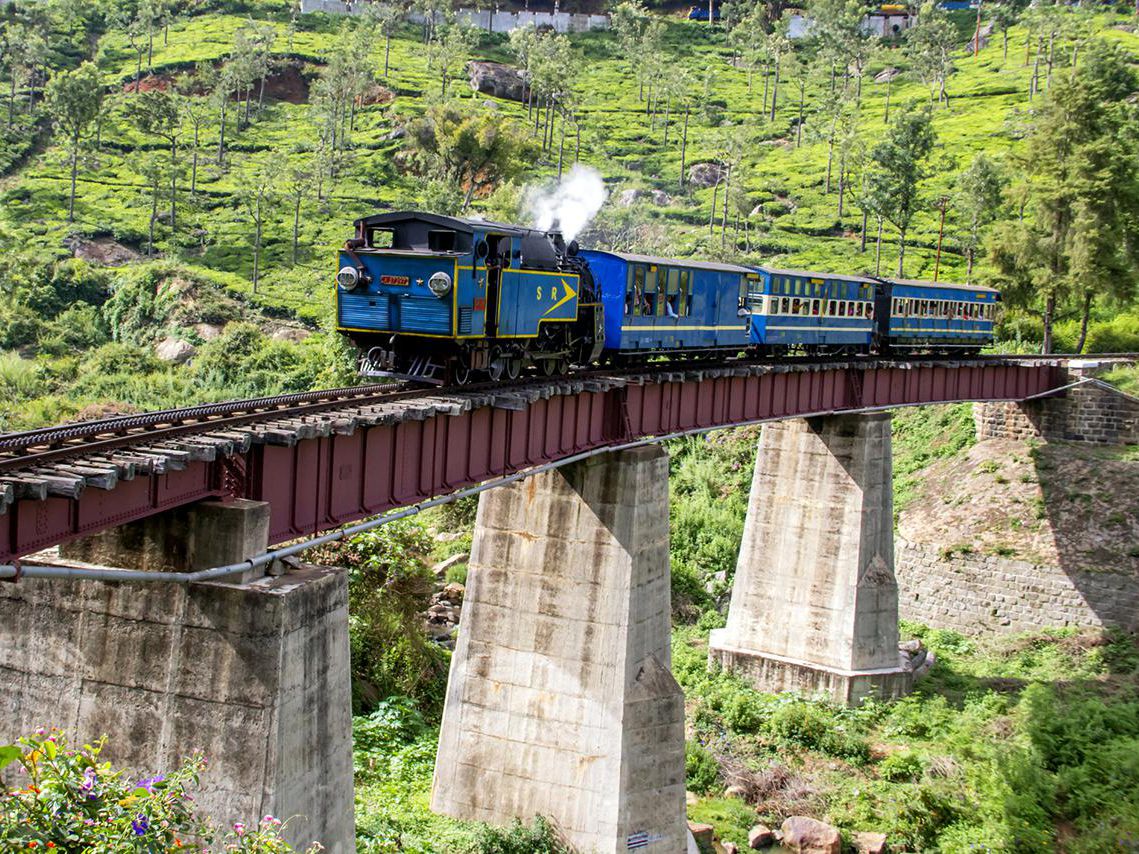
Follow the scent of tea and you’ll hear a distant whistle. The Nilgiri Mountain Railway — built in 1908 — still puffs along its 46-kilometre climb from Mettupalayam to Ooty, groaning through tunnels and forests.
This UNESCO World Heritage marvel is powered by an ingenious rack-and-pinion system that allows it to conquer gradients of up to 1:12 — an engineering wonder of its time.
Passengers lean out of the blue carriages to feel the mist on their faces as the train climbs past waterfalls, pine groves, and valleys where villages appear and vanish like dreams.
Every turn reveals a new vista — a living diorama of colonial history and natural splendor. The rhythmic chug of the train is the heartbeat of the Nilgiris, steady and timeless.
The First People of the Hills – The Toda Tribes
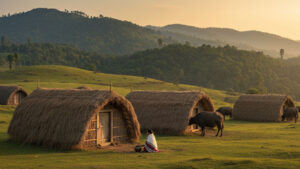
Long before the British laid rail tracks or the first tea bush was planted, the Nilgiris belonged to the Toda people — pastoralists who have lived here for centuries.
Their homes, called munds, are barrel-shaped huts made from bamboo and grass that blend into the rolling grasslands. The Todas worship buffaloes, which play a sacred role in their mythology and rituals.
Their embroidery — intricate red, black, and white geometric patterns — is recognized by UNESCO for its cultural heritage value. To the Todas, these patterns are not just decoration but spiritual maps, symbolizing harmony between earth, water, and sky.
Visitors who meet Toda elders often leave with a sense of awe. Their traditions remind us that the hills are not something to be conquered, but cherished. Their way of life — simple, cyclical, and respectful — is a quiet philosophy etched into the mountain wind.
The Wild Heart – Nilgiri Biosphere Reserve
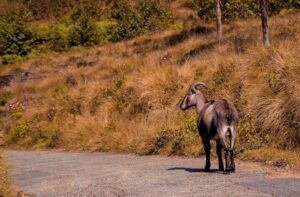
Beyond tea estates and tribal hamlets stretches one of India’s greatest ecological treasures — the Nilgiri Biosphere Reserve. Spanning over 5,500 square kilometers across Tamil Nadu, Kerala, and Karnataka, it was the first biosphere reserve declared in India in 1986.
This sanctuary of life shelters over 3,000 plant species and 600 animal species, including some of the most elusive creatures on the planet.
In Mudumalai and Mukurthi National Parks, you might spot herds of Asian elephants trudging silently through bamboo groves, or — if fortune smiles — a tiger blending into the forest’s shadowed gold. The reserve also protects endemic species like the lion-tailed macaque, Nilgiri tahr, and the Nilgiri langur — each a living emblem of evolution’s artistry.
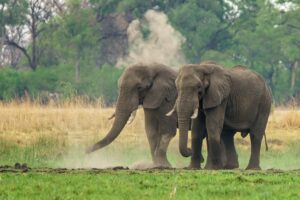
Scientifically, the region’s Shola-grassland ecosystem performs a vital service: its sponge-like soils absorb monsoon water and slowly release it through the year, feeding rivers such as the Kabini and Moyar. Without these forests, southern India’s water cycle would falter.
For the traveler, exploring this wilderness is to step into the oldest story of all — the conversation between life and landscape.
The Symphony of the Nilgiris
As dusk falls, the train whistles again — a single note echoing across valleys heavy with the scent of rain. The hills are bathed in the soft glow of twilight. Somewhere, a Toda flute plays, a leopard prowls the ridgeline, and the wind carries the earthy fragrance of wet tea leaves.
The Nilgiris are not simply a destination; they are a living symphony.
Every sound — the hiss of the locomotive, the hum of insects, the chant of tribes, the rush of waterfalls — forms part of an ancient harmony.
Here, travelers do not just see the landscape; they become part of its rhythm. And when they leave, the mountains linger in memory — blue, fragrant, and timeless.
Practical Essence for Travelers
- Best Time to Visit: October to May for clear skies and cool weather.
- Highlights: Tea tasting in Coonoor, Nilgiri Mountain Railway from Mettupalayam to Ooty, Toda village experience near Avalanche, wildlife safari in Mudumalai or Mukurthi.
- Responsible Travel Tip: Respect local communities, avoid plastic, and choose eco-friendly lodges — the Nilgiris thrive only when its delicate balance is preserved.
For a 4 day 3 night tour of the Nilgiris from Bangalore, please visit The Blue Mountain Trail.
For travellers seeking immersive cultural experiences in near by regions, please check our Mysore Silk Tour from Bangalore combines the Mysore Palace with Asia’s largest silk cocoon auction and the royal silk weaving factory for a deeper exploration of the Mysore royal heritage.
Our Hampi tour from Bangalore covers the UNESCO World Heritage ruins of the Vijayanagara Empire, the second largest city in the world in 1500 AD.
Our Belur and Halebid day trip from Bangalore covers the UNESCO-nominated Hoysala temples whose soapstone carvings represent the Karnataka artistic tradition at its extraordinary peak.
Explore our complete Bangalore tours portfolio for the full range of experiences available from the city.
Leave a Reply