
Most visitors meet Goa at the shoreline. But Goa’s oldest conversations are happening far from the sea—inside forests, beside rivers, and within temple courtyards where time moves at a very different speed. To understand Goa beyond its colonial chapter, you need to begin where stone, belief, and landscape first aligned. That journey starts at Tambdi Surla and unfolds through Mangeshi and Saptakoteshwar, three temples that quietly map Goa’s sacred evolution over nearly a thousand years.
Tambdi Surla: A Temple That Refused to Disappear
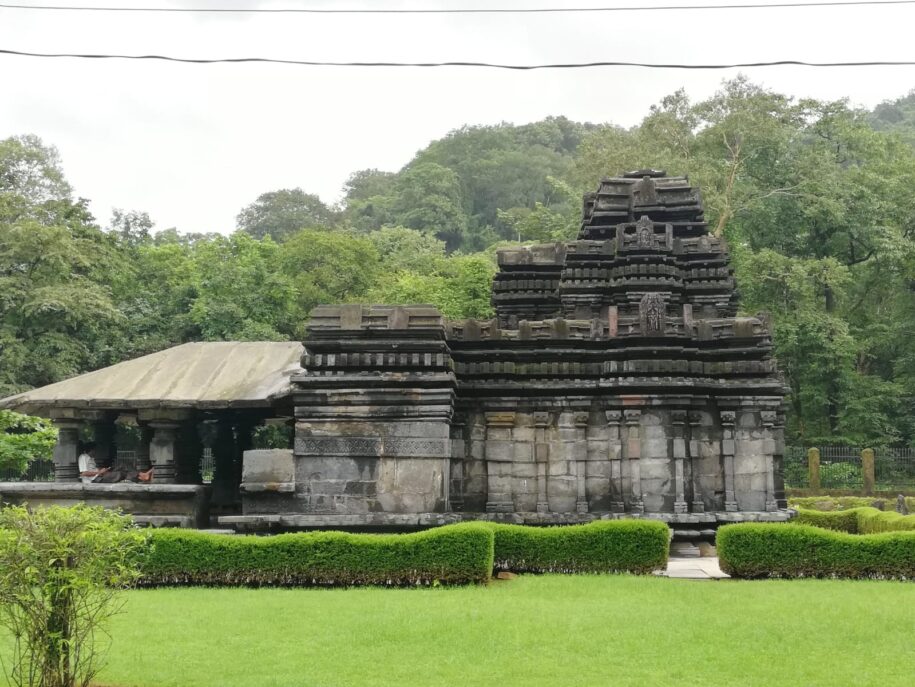
Hidden deep within the Bhagwan Mahavir Wildlife Sanctuary, Tambdi Surla does not announce itself. There is no grand approach road, no marketplace, no dramatic reveal. Instead, the forest thins, light shifts, and a dark basalt temple appears—small, precise, and astonishingly intact.
Built in the 12th century under the Kadamba dynasty, Tambdi Surla is the oldest surviving temple in Goa. Archaeological studies show that its survival is no accident. The temple is constructed from locally sourced basalt, a volcanic stone with high density and low porosity. In humid environments, basalt resists erosion far better than laterite or softer stone, which explains why this temple endured floods, forest growth, and political upheaval while many others vanished.
Its placement is equally deliberate. Sacred architecture studies across India show a strong correlation between temples and water systems. Tambdi Surla sits near a perennial stream feeding the Surla River, aligning ritual life with ecological cycles. The sound of flowing water, the cooler forest microclimate, and the filtered light create an environment that naturally slows perception. Environment psychology research suggests that such settings heighten focus and memory, which may explain why Tambdi Surla feels deeply immersive despite its modest size.
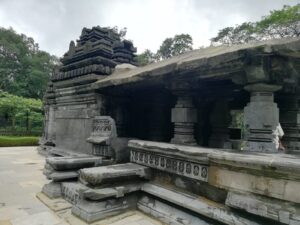
The carvings—lotus motifs, Shaiva iconography, celestial figures—are intricate but restrained. This is devotion expressed through proportion rather than scale. A private guided visit here matters because the details are subtle, and the story lives in what most people walk past without noticing.
Mangeshi: Faith That Learned to Move
If Tambdi Surla represents endurance through isolation, Mangeshi Temple represents survival through adaptation.
Originally located near the coast, the deity of Mangeshi was relocated inland during periods of Portuguese religious persecution in the 16th century. Historical records and temple chronicles document how entire communities migrated with their gods, preserving ritual continuity even as architecture and geography changed. This phenomenon—mobile sacred identity—is well documented in South Asian religious history.
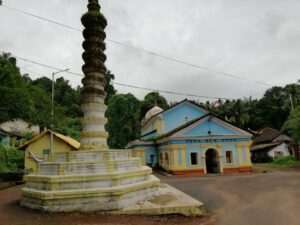
Today’s Mangeshi Temple, with its white façade, deepstambha (lamp tower), and expansive courtyard, reflects a later architectural vocabulary shaped by both Hindu tradition and colonial-era influences. The temple complex is open, luminous, and communal, designed to accommodate festivals, gatherings, and daily worship.
From a sociological perspective, Mangeshi demonstrates how religion functions as a stabilizing system during periods of displacement. The rituals remained constant even as the setting evolved. Visiting Mangeshi after Tambdi Surla reveals a striking contrast: one temple inward and elemental, the other expansive and social. Together, they show how belief adjusts without breaking.
A knowledgeable guide plays a critical role here—connecting political history, ritual practice, and architectural change into a single narrative rather than isolated facts.
Saptakoteshwar: Power, Kingship, and the Sacred
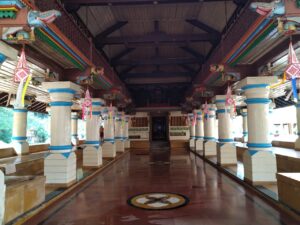
The journey completes at Saptakoteshwar, once the most powerful Shaiva shrine in Goa and closely associated with Kadamba royal authority. Unlike Tambdi Surla’s forest seclusion or Mangeshi’s community-centered openness, Saptakoteshwar speaks of state power.
Historical and inscriptional evidence suggests that Saptakoteshwar was not merely a religious site but a political one, where divine legitimacy reinforced royal rule. Across early Indian kingdoms, this relationship between temple and throne was common; rulers patronized shrines to assert cosmic order alongside political control.
The temple suffered destruction during Portuguese rule and was later rebuilt inland, much like Mangeshi. What survives today is not just architecture but memory—of a time when Goa’s identity was shaped as much by inland capitals and river valleys as by maritime trade.
Standing here after visiting the other two temples, a pattern becomes visible. Goa’s sacred geography did not disappear under colonialism; it fragmented, relocated, and adapted.
Why This Journey Needs to Be Guided
Seen separately, these temples are impressive. Seen together, they form a coherent timeline—ecological, political, and spiritual.
Cognitive research into heritage interpretation shows that visitors retain significantly more information and emotional connection when sites are presented as narratives rather than isolated stops. This is where a private guided experience transforms the journey. Instead of rushing, guests are encouraged to notice materials, orientation, silence, and transition.
With 5 Senses Tours, this experience is curated as a private journey—paced to allow reflection, questions, and quiet observation. The guide acts not as a lecturer, but as a translator between stone, history, and landscape. Travel between sites becomes part of the story, tracing how Goa’s sacred heart moved inland and survived.
These temples are explored as part of a thoughtfully designed private tour, details of which can be found at Forest Shrine and 2 magnificent temples.
A Different Way to Meet Goa
This is not the Goa of postcards. It is older, quieter, and more revealing.
Tambdi Surla shows how architecture listens to nature. Mangeshi shows how faith adapts under pressure. Saptakoteshwar shows how power once flowed through ritual and stone. Together, they form a sacred timeline that still shapes Goan identity today.
For travelers willing to step away from the coast and slow down, this journey offers something rare: not just sights, but understanding. And in a land layered as deeply as Goa, understanding is the most rewarding experience of all.
Leave a Reply