
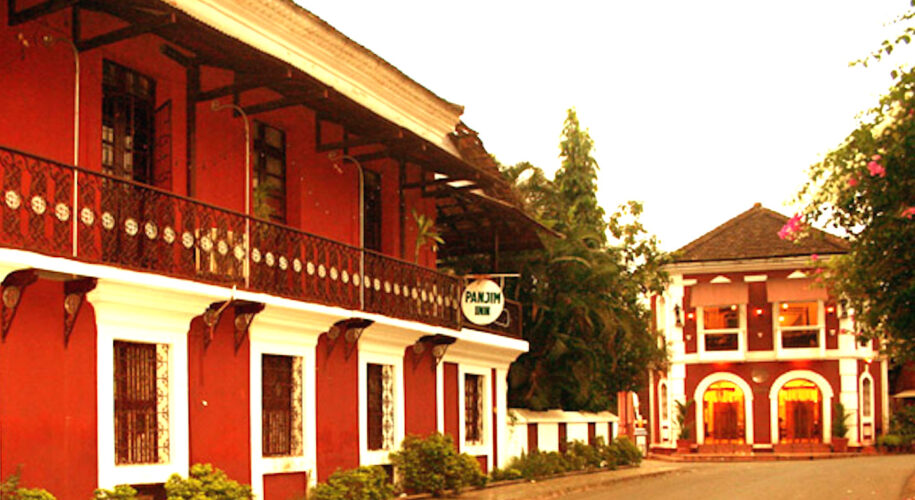
Panjim is often treated as a place to pass through—on the way to Old Goa, the casinos, or the beaches beyond. But Panjim rewards those who walk it slowly. This is a city designed on paper and softened by life, where colonial planning met local habits, and where history still unfolds every morning in bakeries, balconies, and shaded streets.
A heritage walk through Panjim is not about grand monuments alone. It is about scale, rhythm, and continuity. It is about understanding how a colonial capital learned to breathe like a Goan town.
A Capital by Design, a City by Habit

Panjim became the capital of Portuguese India in 1843, replacing Old Goa, which had declined due to disease and sanitation issues—well documented in historical epidemiology studies of tropical colonial cities. Unlike older Indian settlements that evolved organically, Panjim was planned: wide streets, administrative zones, residential quarters, and waterfront promenades.
Urban planning research shows that such grid-based colonial cities often struggled initially because they ignored local climate and social patterns. Panjim survived because it adapted. Buildings acquired verandas, balconies, internal courtyards, and shaded walkways. Streets became social spaces rather than mere transit routes.
Walking through Panjim today, this adaptation is visible everywhere. The city is structured, but never rigid.
Fontainhas: Where Colour Became Identity
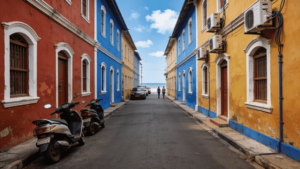
The heritage walk naturally begins in Fontainhas, Panjim’s Latin Quarter. Narrow lanes, overhanging balconies, and brightly painted houses define this neighbourhood. While the colours appear decorative, cultural historians note that they also served practical and symbolic purposes—lime-based paints reflected heat and marked annual maintenance rituals tied to the monsoon.
Fontainhas follows an organic layout shaped by a natural spring, from which it takes its name. Environmental geography explains why early settlements clustered around such water sources. The result is a neighbourhood that feels intimate and human-scaled, encouraging walking rather than rushing.
Here, doors open directly onto the street. Homes and public life blur together. This spatial closeness fosters social cohesion, a concept well studied in urban sociology. A guided walk helps visitors notice these subtleties—why windows are shaped a certain way, why streets narrow unexpectedly, why silence here feels different from silence elsewhere.
Churches, Chapels, and Everyday Faith
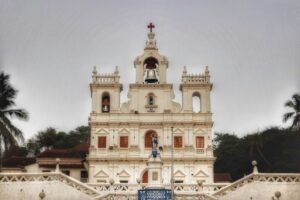
Panjim’s churches, such as the Church of Our Lady of the Immaculate Conception, dominate the skyline, but their real significance lies in daily use rather than grandeur. The church’s hilltop placement follows European visual symbolism—elevation as spiritual authority—yet its wide steps function as a social space, especially in the evenings.
Religious studies show that urban churches often double as civic anchors, marking time through bells and festivals. In Panjim, faith remains woven into routine life, not separated from it. A heritage walk places these churches within the city’s living fabric, rather than treating them as isolated monuments.
Bakeries, Cafés, and the Colonial Morning

No walk through Panjim is complete without noticing its bakeries. The early-morning delivery of pão (bread) is not nostalgia; it is continuity. Food anthropology research highlights how culinary habits are among the most persistent cultural practices, surviving political and social change more reliably than architecture.
Cafés and bakeries in Panjim act as informal social institutions. Conversations begin here, newspapers are shared, and the city wakes up collectively. A guided walk that pauses at these spaces reveals how colonial influences were absorbed into local routines, rather than replacing them.
Administrative Panjim and the Waterfront
Moving beyond Fontainhas, the walk opens into wider streets and administrative buildings—remnants of Panjim’s role as a colonial capital. These structures are functional, restrained, and deliberately non-monumental, reflecting bureaucratic priorities rather than religious or royal authority.
The Mandovi riverfront introduces another dimension. Waterfronts in colonial cities were often designed for trade and control, but in Panjim, the river has become a place of leisure and observation. Environmental psychology studies show that proximity to water lowers stress and enhances reflective thinking, which may explain why Panjim’s promenade feels contemplative rather than hurried.
Why Panjim Is Best Explored on Foot
Heritage research consistently demonstrates that walking is the most effective way to experience layered urban history. Movement at human speed allows for micro-observations—shifts in architecture, sound, smell, and social interaction.
Panjim reveals itself gradually. A corner shrine here, a faded signboard there, a balcony still used as it was a century ago. These details rarely appear in guidebooks, but they define the city’s character.
This is why a private guided heritage walk makes a profound difference. The guide does not simply point out landmarks; they help visitors read the city as a living system.
Experiencing Panjim with 5 Senses Tours
With 5 Senses Tours, the Panjim heritage walk is curated as a private experience, allowing guests to move at a thoughtful pace. The journey balances architecture, urban history, food culture, and daily life, without overwhelming the senses.
Being private, the walk adapts to curiosity—pausing where interest lingers, allowing conversations to unfold, and creating space for quiet observation. Please visit Panjim Heritage Walk.
Leave a Reply