

Al Biruni’s India account is very different from any other.
Most foreign travellers who came to India tried to explain it.
Al-Biruni tried to understand it.
Writing in the early 11th century, Abu Rayhan al-Biruni arrived in the Indian subcontinent not as a merchant chasing profit or a diplomat serving power, but as a scholar driven by methodical curiosity. Born in Central Asia and trained in mathematics, astronomy, geography, and languages, Al-Biruni represents a rare historical figure: a foreign observer who refused to judge before learning the rules of the world he had entered.
His great work, Kitab fi Tahqiq ma li’l-Hind—often shortened to Al-Biruni’s India—is unlike any other medieval account of the subcontinent. It is not a travelogue. It is not a collection of marvels. It is an attempt to document how Indians thought about time, space, number, faith, society, and knowledge itself.

Al Biruni’s India begins with a radical premise for his time: that no civilization can be understood through translation alone. To study India, he learned Sanskrit. He read Indian texts directly. He debated scholars, astronomers, and priests. He compared Indian ideas with Greek and Islamic ones—not to rank them, but to see where they converged and diverged.
This approach matters.
Where earlier foreign accounts often exoticized India, Al-Biruni’s India normalized it. He wrote that Indian ideas only seemed strange because outsiders refused to learn their internal logic. When Indians spoke of vast cosmic cycles, for example, he did not dismiss them as fantasy. He compared them to Greek and Islamic cosmologies and noted that all civilizations grappled with infinity in different ways.

Modern historians regard Al-Biruni as one of the earliest practitioners of comparative anthropology. His work is cited in studies of history of science, religion, linguistics, and cultural studies. What makes his writing enduring is not that he was always correct—he occasionally misunderstood social practices—but that he documented his process, admitted uncertainty, and distinguished observation from opinion.
One of his sharpest insights concerns knowledge systems. Al-Biruni observed that Indian civilization invested deeply in astronomy, mathematics, grammar, and metaphysics, but transmitted knowledge differently—often orally, through teacher–student lineages rather than centralized institutions. This, he argued, led outsiders to underestimate Indian science, even when its results were sophisticated.
His respect for Indian astronomy is particularly striking. Al-Biruni carefully studied Indian calculations of planetary motion, eclipses, and timekeeping, comparing them with Greek and Islamic models. In some cases, he found Indian methods more intuitive or better adapted to local geography. This was not flattery; it was empirical comparison.

Religion, too, is treated with unusual restraint. Al Biruni’s India describes Hindu beliefs, rituals, caste structures, and philosophical schools without mockery or moral panic. He explains why certain practices appear rigid, and how they functioned socially. He also criticizes his fellow Muslims for refusing to understand India on its own terms, arguing that ignorance breeds distortion.
What emerges from Al-Biruni’s India is not a static portrait, but a living intellectual landscape. India appears as a civilization comfortable with plurality—multiple philosophies, multiple paths, multiple truths operating side by side. For Al-Biruni, this was not chaos; it was coherence of a different kind.
Importantly, Al-Biruni was honest about distance. He acknowledged that as a foreigner, he could not fully access all layers of Indian society. Rather than filling gaps with speculation, he left them open. That restraint—rare in any era—is what gives his work credibility a thousand years later.
Experiencing Al-Biruni’s India Today
While the exact institutions Al-Biruni studied no longer exist in their original form, the intellectual and cultural landscapes he encountered remain remarkably accessible.

In Varanasi, India’s oldest continuous center of learning, debates on philosophy, ritual, astronomy, and metaphysics still unfold daily along the ghats and within traditional schools. Here, Al-Biruni’s descriptions of scholars and knowledge transmission feel alive rather than archival.
In Ujjain, once one of India’s major astronomical centers, the relationship between time, cosmos, and calculation—so central to Al-Biruni’s curiosity—can be explored through the city’s scientific and cosmological heritage. It is a place where Indian and Islamic astronomical traditions naturally converse.

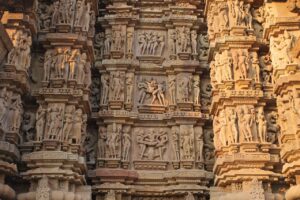
The temples of Khajuraho offer another layer of understanding. Far from being merely decorative, their sculptures reflect a worldview where spirituality includes the full range of human experience. This integration of philosophy, ritual, and life is precisely what Al-Biruni struggled to explain to readers unfamiliar with Indian thought.
In the Mathura and Braj region, culture appears not as doctrine but as lived practice—through music, storytelling, seasonal rhythms, and sacred landscapes. This helps modern travelers grasp what Al-Biruni meant when he described Indian traditions as embedded in daily life rather than confined to texts.
Many of these places are not monuments to be checked off, but environments to be read slowly—much as Al-Biruni read India itself.
5 Senses Tours offers private, carefully curated journeys to these regions, designed to help travelers experience India with the same patience and intellectual openness that defined Al-Biruni’s work. These tours emphasize context, conversation, and continuity—connecting landscapes, ideas, and lived traditions rather than reducing them to spectacle.
To explore India through an Al-Biruni–inspired journey, visit 5 Senses Tours.
Al-Biruni did not come to India to confirm what he already believed.
He came to change his understanding.
That may be his most enduring lesson—for travelers as much as for scholars
Leave a Reply