
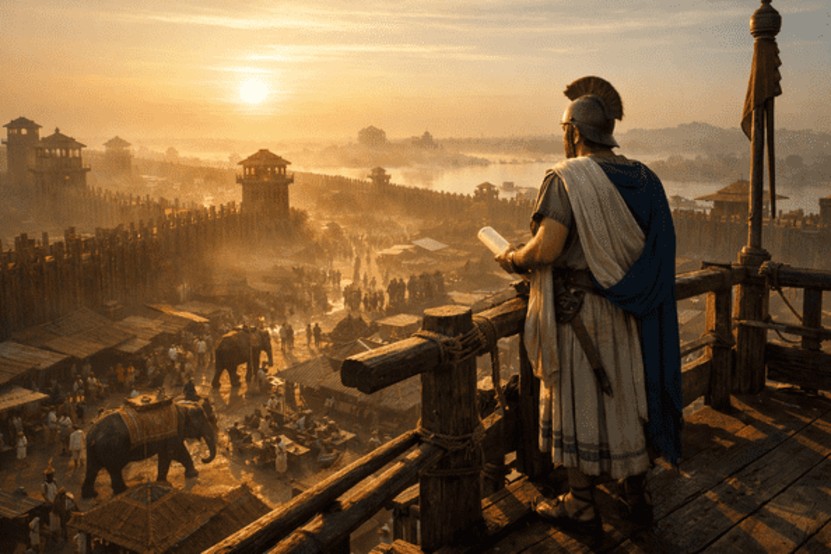
A man trained in the logic of Aristotle steps into a city larger than anything he has known. The air is thick with river mist. Wooden palisades stretch for miles. Officials move with practiced efficiency. Scribes record, guards watch, traders haggle, philosophers argue. This, in the late 4th century BCE, is Pataliputra, capital of the Mauryan Empire—and the Greek visitor watching all this is Megasthenes. This is the setting for Megasthenes Indica.
He came expecting the edges of the known world. What he found instead was administration.

Megasthenes was no wide-eyed wanderer. He was a diplomat, sent by Seleucus I Nikator, one of Alexander the Great’s successors, to the court of Chandragupta Maurya. His task was political, but what emerged from his stay was something far more enduring: Indica, the earliest detailed foreign account of India. The original text of Megasthenes Indica is lost, but fragments survive through later Greek writers like Strabo, Arrian, and Diodorus. Historians treat it cautiously, but not dismissively. Where Megasthenes exaggerates, archaeology often gently corrects him. Where he observes, he is startlingly precise.
What shook him was not mysticism or strangeness. It was order.
For a guided tour of today’s Pataliputra, visit Patna Experience.

Greek political thought assumed that large empires decayed into corruption. Yet Megasthenes Indica described a capital city laid out with mathematical care. According to his account, Pataliputra was nearly 14 kilometers long, protected by a moat and 570 towers. Archaeological excavations near modern Patna—particularly the remains of wooden fortifications at Kumrahar—support the idea of a vast, carefully planned urban center. Wood, not stone, dominated architecture, which explains why so little survives above ground.
But administration survives in description.

Megasthenes Indica talks about the city was governed by a council divided into boards, each responsible for a specific function: trade, industry, foreigners, births and deaths, public works. Modern historians point out that while his numbers may be stylized, the concept of bureaucratic specialization is entirely consistent with the Arthashastra, a contemporaneous Indian text on governance attributed to Kautilya. This convergence between an Indian political treatise and a Greek observer is not coincidence—it is corroboration.
What unsettled Megasthenes most was that this complexity did not appear fragile. He claimed that India had no slavery, a statement debated by scholars today. While bonded labor certainly existed, Megasthenes may have been struck by the absence of chattel slavery as practiced in Greece. His confusion reveals more about Greek assumptions than Indian reality, and that tension is precisely what makes his account valuable.

Even more intriguing was his observation of Indian philosophers. He divided them into groups—Brahmins and Sramanas—distinguishing between householders and renunciants. Greek readers would have recognized echoes of their own philosophical schools, yet here philosophy was not confined to elite debate. It spilled into daily life, ritual, and ethics. Philosophy in India, Megasthenes realized, was not just speculative—it was lived.
Megasthenes Indica also remarks on India’s relationship with time. Where Greek historiography prized linear chronology, Megasthenes encountered a civilization comfortable with cycles, vast epochs, and repeating cosmic rhythms. This difference baffled him, but he reported it honestly. Modern Indologists see this as one of the earliest recorded encounters between linear and cyclical conceptions of history.

Of course, Megasthenes was not immune to fantasy. He wrote of gold-digging ants and fantastical races, borrowing from earlier Greek tropes about the East. Scholars today treat these passages as literary inheritance rather than eyewitness reporting. What matters is that these myths sit awkwardly beside otherwise sober observations—suggesting not deception, but a mind negotiating between what it sees and what it expects.
What emerges from Megasthenes Indica is not an exotic India, but a self-confident civilization that did not feel the need to explain itself to outsiders. Megasthenes sensed this. He noted that Indians rarely traveled abroad and showed little curiosity about foreign lands. This inward stability, historians argue, was the result of economic self-sufficiency, philosophical continuity, and political centralization under the Mauryas.
Two thousand three hundred years later, that logic has not vanished.
Stand along the Ganga in modern Patna at dawn and you will still see systems unfolding quietly: ritual bathing regulated by custom, informal economies functioning without written contracts, debates over ethics and duty echoing in classrooms and tea stalls. Visit Rajgir, once a Mauryan stronghold, and the hills still frame the city like natural walls. At Nalanda, the ruins whisper of an intellectual confidence that Xuanzang would later describe in awe, but whose roots Megasthenes had already sensed.
The great insight Megasthenes Indica left us is this: India was never chaotic waiting to be organized. It was already organized—just not according to Greek expectations.
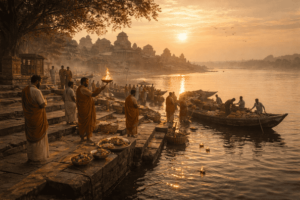
That lesson remains relevant for travelers today. India reveals itself slowly, not through monuments alone, but through patterns—how cities breathe, how rituals repeat, how arguments unfold without resolution. To experience the India Megasthenes encountered is to move beyond surface spectacle and pay attention to systems: administrative, philosophical, social.
Many of the places and ideas described in this account are not relics locked behind museum glass—they remain woven into everyday life across India. 5 Senses Tours offers private, guided journeys to the key landmarks and regions mentioned in this story, designed for travelers who want context, conversation, and lived experience rather than checklists.
For a guided tour of today’s Pataliputra, visit Patna Experience.
Bodhgaya, Nalanda and Rajgir are amazing destinations for heritage tours. Please visit Bodhgaya Tours for detailed itineraries.
For immersive culture walks in India visit 5 Senses Walks.
Leave a Reply