
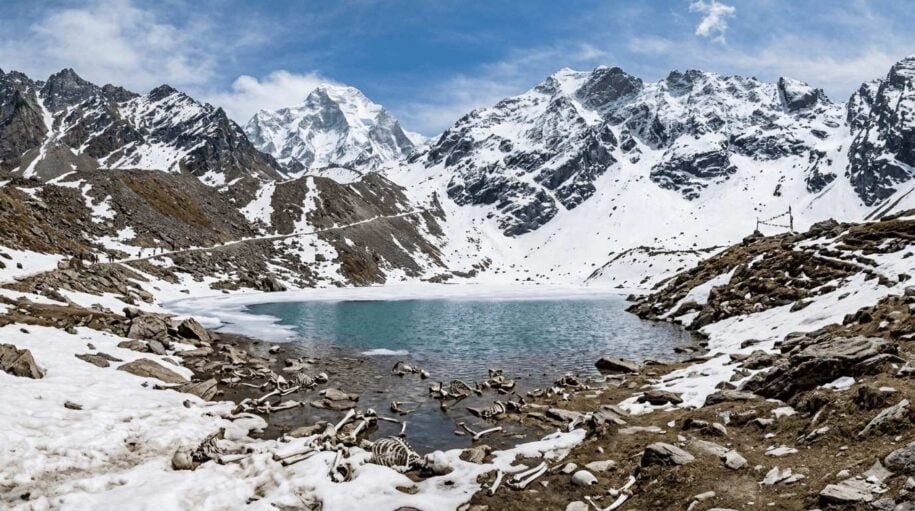
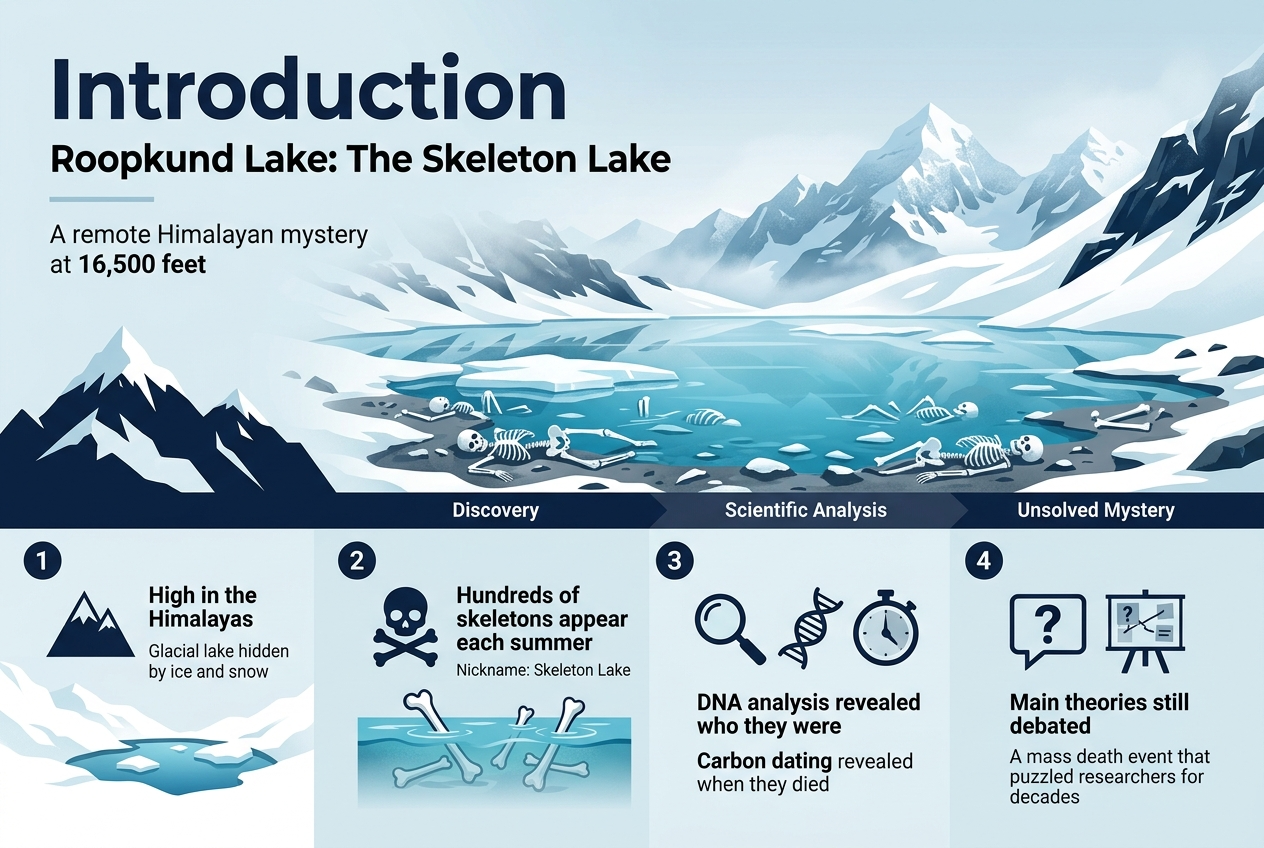
High in the Himalayas sits Skeleton Lake of Roopkund, a remote glacial pool that hides one of archaeology’s most chilling mysteries. When the ice melts each summer, hundreds of human skeletons emerge from the crystal-clear waters, earning it the nickname “Skeleton Lake.”
This guide is for adventure seekers, history buffs, and anyone fascinated by unsolved mysteries who want to understand what really happened at this eerie 16,500-foot-high lake.
We’ll dig into the shocking moment explorers first stumbled upon the bones that made headlines worldwide. You’ll also learn how cutting-edge DNA analysis and carbon dating have revealed surprising truths about who these people were and when they died. Finally, we’ll walk through the main theories scientists have proposed to explain this mass death event that has puzzled researchers for decades.
Discover the Mysterious High-Altitude Lake Hidden in the Himalayas
Locate Roopkund’s Remote Position in Uttarakhand’s Trishul Massif
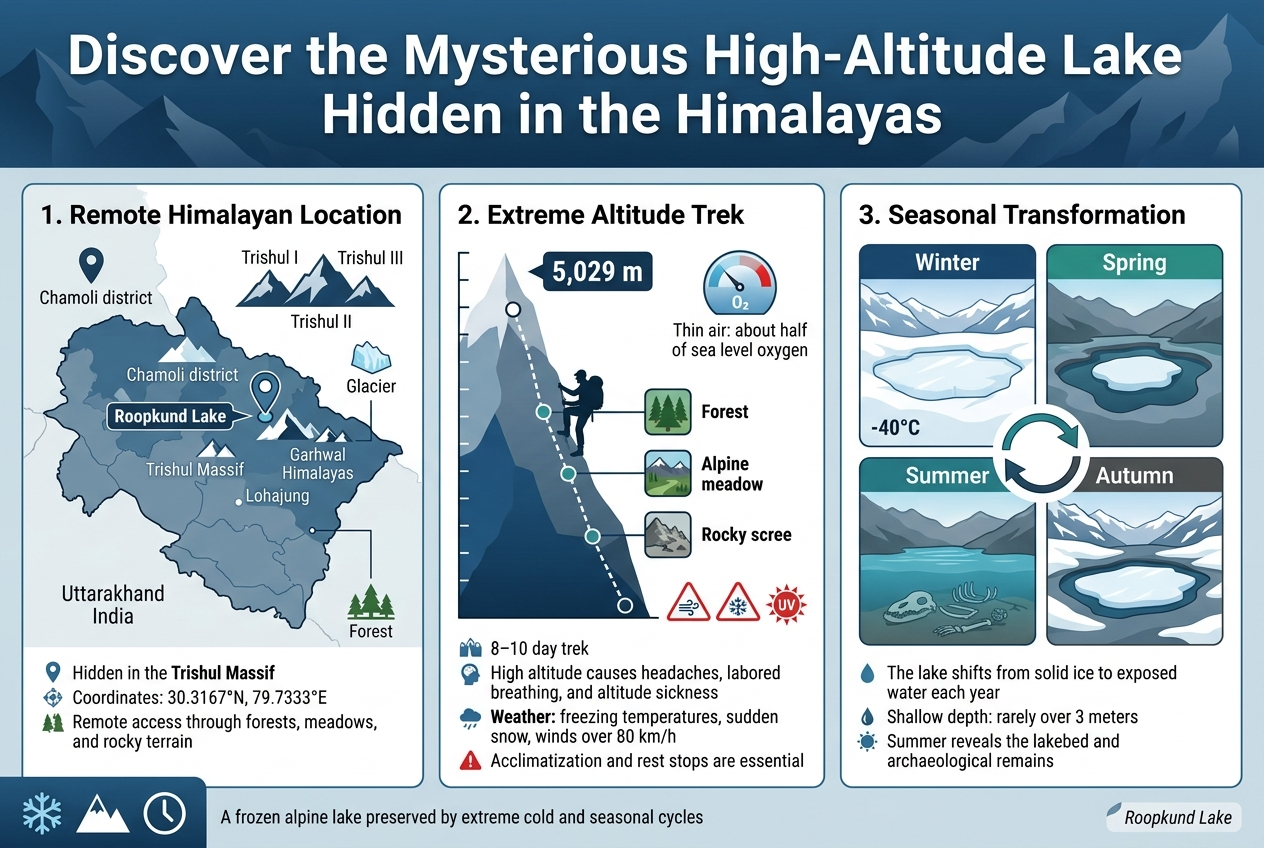
Deep within the Chamoli district of Uttarakhand, Roopkund Lake sits like a hidden jewel in the rugged terrain of the Trishul Massif. This glacial lake occupies a precarious position at coordinates 30.3167°N, 79.7333°E, surrounded by towering peaks that scrape the sky. The lake rests in a natural depression carved by ancient glacial activity, creating a perfect bowl-shaped basin that collects snowmelt and seasonal precipitation.
The Trishul Massif forms part of the greater Garhwal Himalayas, where three distinct peaks – Trishul I, II, and III – dominate the skyline. Roopkund nestles between these giants, protected from the harshest winds but exposed to the extreme conditions that characterize high-altitude environments. Access to this remote location requires traversing dense rhododendron forests, alpine meadows, and treacherous rocky terrain.
Nearest human settlements lie dozens of kilometers away, with the village of Lohajung serving as the closest significant outpost. The isolation has preserved both the lake’s pristine condition and its archaeological secrets for centuries. Mountain ranges stretch endlessly in every direction, creating a fortress of stone and ice that has kept Roopkund’s mysteries hidden from casual discovery.
Drawn to the mysteries of the Himalayas? Our private Haridwar and Rishikesh tours take you into the sacred Garhwal landscape with an expert cultural guide, hotel pickup and all arrangements included.
Navigate the Challenging 5,029-Meter Elevation Trek
Standing at 5,029 meters above sea level, Roopkund Lake exists in the death zone where oxygen levels drop to roughly half of what humans experience at sea level. The altitude creates immediate physiological challenges for visitors, with most experiencing symptoms of acute mountain sickness within hours of arrival. Breathing becomes labored, headaches develop, and even simple movements require extraordinary effort.
The trek to reach this elevation typically spans 8-10 days, following ancient pilgrimage routes through:
- Dense oak and rhododendron forests in lower elevations
- Alpine meadows dotted with vibrant wildflowers during summer months
- Rocky moraines and glacial debris fields
- Steep ascents over loose scree and boulder fields
- Narrow ridges with dramatic drop-offs on both sides
Weather conditions change rapidly at this altitude, with temperatures plummeting below freezing even during summer months. Snow can fall without warning, and fierce winds regularly exceed 80 kilometers per hour. The thin atmosphere provides little protection from intense ultraviolet radiation, creating additional hazards for unprepared trekkers.
Acclimatization becomes critical for survival, requiring careful pacing and strategic rest stops at intermediate elevations. Many attempt the journey but turn back due to altitude-related complications or deteriorating weather conditions.
Experience the Seasonal Transformation from Frozen to Exposed Waters
Roopkund undergoes a dramatic metamorphosis throughout the year, shifting between a solid ice sheet and a crystal-clear mountain lake. During winter months, temperatures drop as low as -40°C, freezing the entire surface into a thick ice cap that can support human weight. Snow accumulates several meters deep, completely obscuring the lake’s existence from casual observers.
Spring brings gradual warming that slowly melts the protective ice layer. As temperatures rise above freezing during daylight hours, the edges begin to thaw first, creating a ring of dark water around a shrinking ice center. This process reveals the lake’s true nature – a shallow body of water rarely exceeding 3 meters in depth.
Summer months between June and September offer the clearest views of Roopkund’s contents. The ice retreats completely, exposing the lakebed and its macabre collection of human remains visible through the transparent mountain water. Skeletal fragments become clearly visible, scattered across the rocky bottom like ancient puzzle pieces waiting to tell their story.
Autumn returns bring rapid re-freezing as temperatures plummet. The lake transforms back into its winter state, sealing away its secrets beneath layers of ice and snow until the next seasonal cycle begins. This annual pattern has preserved the archaeological evidence for hundreds of years while creating a natural refrigeration system that maintains the integrity of organic materials.
Uncover the Shocking Discovery That Made Roopkund World Famous
Witness Hundreds of Ancient Human Skeletons Scattered Around the Lake
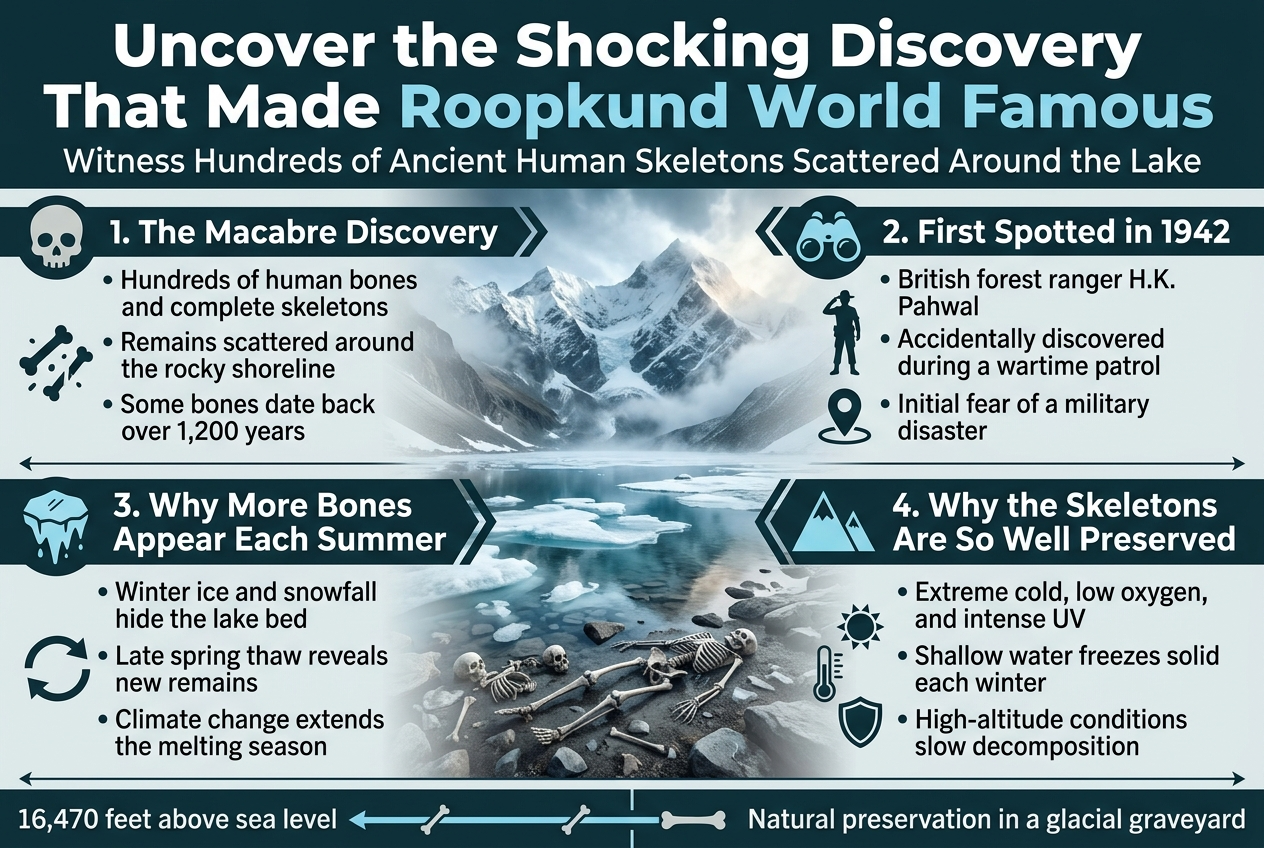
The glacial waters of Roopkund Lake hide one of the most macabre archaeological discoveries ever made. When the ice melts each summer, the shallow lake bed reveals a haunting sight: hundreds of human bones and complete skeletons littering the rocky shoreline. These ancient remains appear so fresh that many visitors initially mistake them for recent casualties of trekking accidents.
The skeletons tell a story spanning centuries, with some dating back over 1,200 years while others are surprisingly recent. Skulls, femurs, and rib cages peek through the crystal-clear water, creating an otherworldly graveyard at 16,470 feet above sea level. The sheer number of remains suggests a catastrophic event that claimed dozens, possibly hundreds of lives in this remote corner of the Himalayas.
What makes this discovery even more extraordinary is the random distribution of the bones. Unlike organized burial sites, the skeletons appear scattered haphazardly around the lake’s perimeter, as if the victims were caught off guard by sudden death. Some remains show signs of blunt force trauma to the skull, while others appear intact, adding layers of mystery to an already puzzling archaeological site.
Learn How British Forest Ranger H.K. Pahwal First Spotted the Remains in 1942
The world’s knowledge of Roopkund’s dark secret began with a routine forest patrol during World War II. British forest ranger H.K. Pahwal was conducting a survey in the remote Trishul massif when he stumbled upon what would become one of India’s most famous archaeological mysteries. The discovery happened almost by accident during the summer months when seasonal ice melt exposed the lake bed.
Pahwal’s initial reaction was alarm – he believed he had discovered evidence of a recent military disaster or border skirmish. The pristine condition of the bones and the remote location suggested to him that Japanese soldiers might have attempted a secret invasion through these treacherous mountain passes. His urgent reports triggered immediate investigation by British authorities who feared a security breach during wartime.
The investigation quickly ruled out any connection to contemporary military activity. Carbon dating technology didn’t exist in 1942, so early researchers relied on artifact analysis and local folklore to piece together the timeline. Pahwal’s discovery remained largely confined to official reports until decades later when scientific advances allowed researchers to unlock the true age and origin of these mysterious remains.
Understand Why Melting Ice Reveals More Bones Each Summer
Roopkund Lake operates on a seasonal cycle that acts like nature’s own archaeological reveal. During harsh Himalayan winters, thick ice and heavy snowfall bury the entire lake under several feet of frozen precipitation. The extreme cold preserves everything beneath in a natural deep freeze that can last six to eight months each year.
Come late spring and early summer, rising temperatures trigger a dramatic transformation. The ice begins its gradual retreat, slowly exposing the shallow lake bed and its grisly contents. This annual thaw happens gradually over several weeks, with different sections of the shoreline emerging at various times depending on sun exposure and elevation.
Each summer brings new discoveries as shifting ice and changing water levels reveal previously hidden remains. Trekkers and researchers often find bones that weren’t visible during previous visits, suggesting the lake still holds secrets beneath its deepest sections. Climate change has extended the melting season in recent years, giving scientists longer windows to study the site and potentially uncovering remains that have been frozen for centuries.
The cyclical nature of exposure and concealment has created a unique preservation system. Bones spend most of the year protected by ice, preventing rapid decomposition while occasional exposure allows for scientific study and documentation.
Examine the Pristine Preservation Conditions at High Altitude
The extraordinary preservation of Roopkund’s skeletal remains results from a perfect storm of environmental factors that create natural mummification conditions. At nearly 16,500 feet above sea level, the lake exists in an environment where decomposition processes slow to a crawl. Extreme cold, low oxygen levels, and intense UV radiation combine to create conditions hostile to bacteria and other organisms that normally break down organic matter.
The lake’s shallow depth – typically just a few feet deep – means remains freeze solid during winter months and experience only brief thaw periods. This freeze-thaw cycle actually helps preserve bone structure while preventing the complete decomposition that would occur at lower altitudes. The cold, dry air acts as a natural desiccant, removing moisture that bacteria need to survive and reproduce.
UV radiation at high altitude is intense enough to sterilize exposed surfaces, killing microorganisms that might otherwise accelerate decay. The rocky, alkaline soil around the lake creates chemical conditions that favor bone preservation over soft tissue decomposition. These factors work together to maintain skeletal integrity for centuries, allowing modern scientists to extract DNA samples and conduct detailed forensic analysis on remains that would have completely disappeared at sea level.
The pristine condition of many skulls and long bones has enabled researchers to identify specific injury patterns, determine approximate ages at death, and even extract genetic material for ancestry analysis.
Explore Scientific Breakthroughs in Ancient DNA and Carbon Dating Research

Review Genetic Evidence Revealing Multiple Population Groups
The genetic analysis of Roopkund’s skeletal remains completely revolutionized our understanding of who died at this remote lake. DNA extracted from bones revealed something nobody expected – these weren’t all people from the same group or even the same time period. The genetic signatures showed at least three distinct populations had met their fate here.
Scientists identified individuals with South Asian ancestry, likely locals from the region, alongside people of Mediterranean descent – possibly pilgrims from as far as Crete or Greece. A third group showed East Asian genetic markers, adding another layer to the mystery. This genetic diversity painted a picture far more complex than the simple mass casualty event researchers initially imagined.
The preservation of ancient DNA at such high altitude proved extraordinary. Cold temperatures and low oxygen levels created ideal conditions for genetic material to survive centuries. Advanced sequencing techniques allowed researchers to extract readable DNA from bones that appeared too degraded for analysis.
Analyze Carbon Dating Results Spanning Different Time Periods
Carbon dating results shattered the assumption that all deaths occurred simultaneously. The oldest remains dated back approximately 800-1000 years, while others were surprisingly recent – only 100-200 years old. This timeline revealed Roopkund as a recurring site of tragedy rather than a single catastrophic event.
The radiocarbon dating process involved testing collagen extracted from multiple bone samples. Each sample underwent rigorous preparation to remove contamination before measurement. Results consistently showed two main chronological clusters, with the older group representing the majority of remains.
Calibration curves helped refine these dates, accounting for atmospheric carbon-14 variations over time. The precision achieved through modern techniques provided confidence intervals that clearly separated the temporal groups.
Study Isotope Analysis Showing Diverse Geographic Origins
Strontium and oxygen isotope analysis of teeth enamel provided remarkable insights into where these individuals grew up. These isotopes reflect the geological and climatic conditions of childhood environments, creating a unique signature for different regions.
The South Asian individuals showed isotope signatures consistent with local Himalayan valleys, suggesting they were regional inhabitants. The Mediterranean group displayed isotope ratios matching coastal areas thousands of miles away, confirming their foreign origins. This evidence supported the genetic findings while adding geographical precision.
Tooth enamel forms during childhood and remains unchanged throughout life, making it an ideal recorder of early geographic location. The isotope signatures revealed migration patterns and confirmed that people traveled extraordinary distances to reach this remote location.
Discover How Modern Technology Solved Century-Old Mysteries
Mass spectrometry and next-generation DNA sequencing transformed what seemed like an unsolvable puzzle into a detailed historical narrative. These technologies allowed scientists to extract information from samples that previous generations of researchers couldn’t analyze.
Ancient DNA extraction techniques improved dramatically, enabling recovery of genetic material from highly degraded samples. Specialized clean rooms prevented contamination, while new chemical protocols increased DNA yield from minimal bone samples.
Computational advances in genetic analysis helped researchers distinguish ancient DNA from modern contamination. Database comparisons revealed population affinities across vast geographical distances, connecting Roopkund’s victims to their ancestral homelands.
The integration of multiple analytical approaches – genetics, chronology, and geography – created a comprehensive picture that no single technique could provide alone.
Investigate the Leading Theories Behind the Mass Deaths
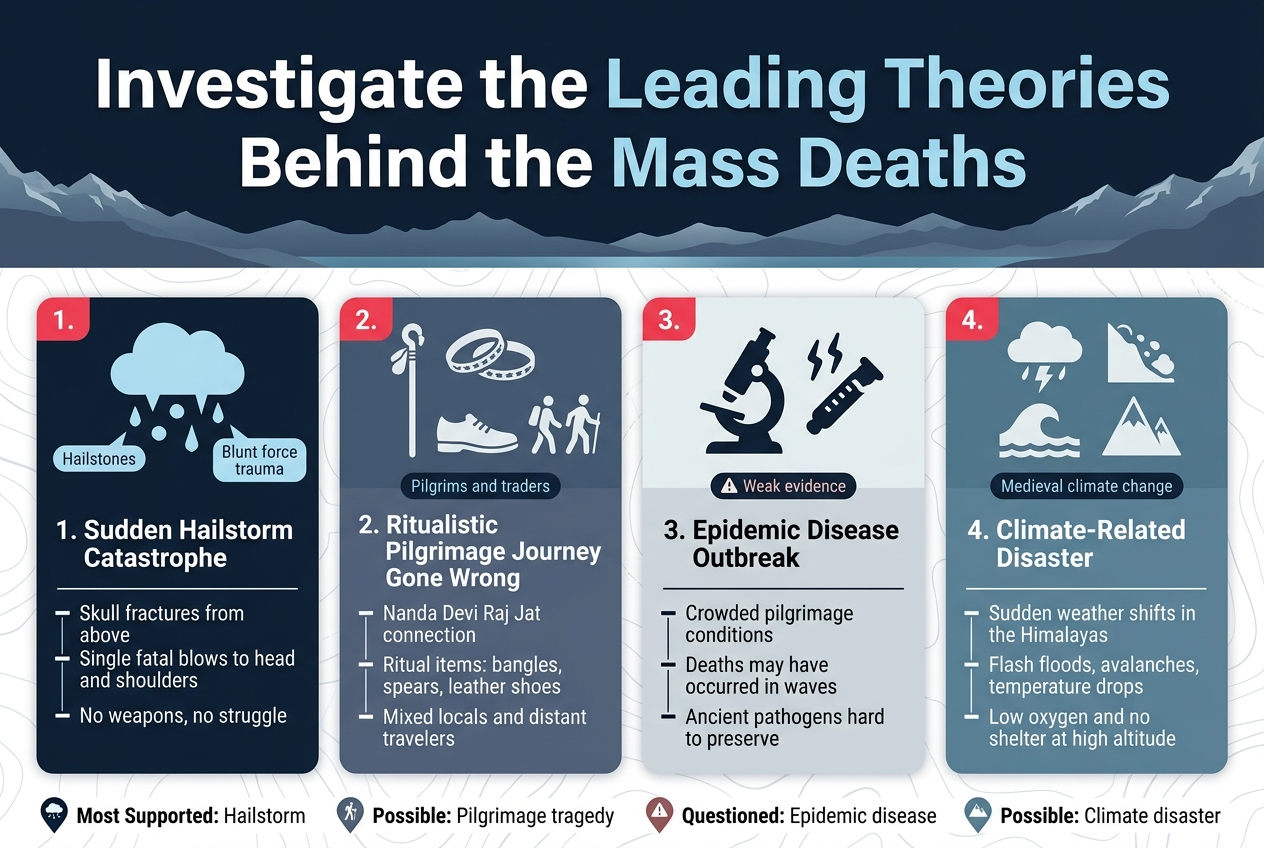
Examine Evidence for Sudden Hailstorm Catastrophe Theory
The most widely accepted explanation for the Roopkund deaths revolves around a catastrophic hailstorm that caught travelers completely off guard. Physical evidence strongly supports this theory – many skulls display distinctive fracture patterns consistent with blunt force trauma from above. These injuries show a specific pattern: single, fatal blows to the head and shoulders, suggesting objects falling from the sky rather than weapons or accidents.
Local folklore has long spoken of the wrath of Nanda Devi, the mountain goddess, who supposedly sends deadly hailstones to punish those who disturb her sacred realm. While modern science doesn’t embrace supernatural explanations, meteorological data reveals that the Himalayan region experiences sudden, severe weather changes that can produce hailstones large enough to kill.
The positioning of the bodies adds credibility to this theory. Most skeletons were found clustered together in the lake and surrounding areas, as if people sought shelter but found none in the barren landscape. The absence of defensive wounds or signs of struggle rules out warfare, while the random mix of men, women, and children suggests a group caught in a natural disaster rather than a targeted attack.
Consider Ritualistic Pilgrimage Journey Gone Wrong
Archaeological evidence points to Roopkund’s connection to religious pilgrimage, specifically the Nanda Devi Raj Jat, a festival that occurs every twelve years. This sacred journey involves thousands of pilgrims trekking through treacherous mountain paths to honor the goddess. The presence of ritualistic items like bangles, spears, and leather shoes among the remains suggests these people were on a spiritual quest.
The demographic composition of the dead tells a compelling story. Genetic analysis reveals multiple distinct groups – some local to the region, others from distant areas including the Mediterranean. This diversity mirrors typical pilgrimage patterns where devotees travel from far and wide to participate in sacred ceremonies.
Ancient trade routes passed through this region, and religious gatherings often coincided with commercial activities. The mixture of what appears to be both pilgrims and possibly traders or guides supports the theory that this was an organized religious expedition that met with disaster. The timing of their journey might have coincided with particularly harsh weather conditions, transforming a spiritual quest into a deadly trap.
Evaluate Epidemic Disease Outbreak Possibilities
Disease outbreaks present another plausible explanation, especially considering the crowded conditions typical of pilgrimage groups. High-altitude environments create perfect conditions for respiratory illnesses to spread rapidly, as the thin air already stresses the human body’s immune system. When large groups of people from different regions come together, they exchange pathogens their bodies haven’t encountered before.
The carbon dating results showing deaths occurring over different time periods could support an epidemic scenario. Rather than a single catastrophic event, the deaths might have occurred in waves as disease spread through the group. Weakened individuals would have been particularly vulnerable to the harsh mountain environment, creating a deadly combination of illness and exposure.
However, this theory faces significant challenges. Bacterial and viral pathogens rarely preserve well enough in ancient remains to provide conclusive evidence. Additionally, epidemic diseases typically affect the very young and elderly first, but the Roopkund remains show a fairly even distribution across age groups. The lack of signs pointing to chronic illness or wasting diseases in the bone analysis also weakens this hypothesis.
Assess Climate-Related Disaster Scenarios
Climate data from the medieval period reveals significant weather pattern changes that could have created deadly conditions in the Himalayas. The Medieval Warm Period followed by the Little Ice Age brought unpredictable weather systems that could trap travelers in rapidly changing conditions. Flash floods, avalanches, and sudden temperature drops all pose serious threats in high-altitude environments.
Glacial lake outburst floods represent a particularly dangerous phenomenon in the region. When glacial dams break, they release massive amounts of water that can sweep away everything in their path. The positioning of some remains suggests possible water damage, though this could also result from the lake’s natural seasonal changes over centuries.
Oxygen deprivation at extreme altitudes affects decision-making and physical capabilities, making people more vulnerable to environmental hazards. Combined with sudden weather changes, even experienced mountain travelers could find themselves in life-threatening situations. The lack of proper shelter or escape routes at Roopkund’s elevation would have made survival nearly impossible once disaster struck, regardless of the specific climate event that triggered the tragedy.
Experience the Dangerous but Rewarding Trek to Reach Skeleton Lake
Prepare for Extreme Weather Conditions and Altitude Sickness Risks
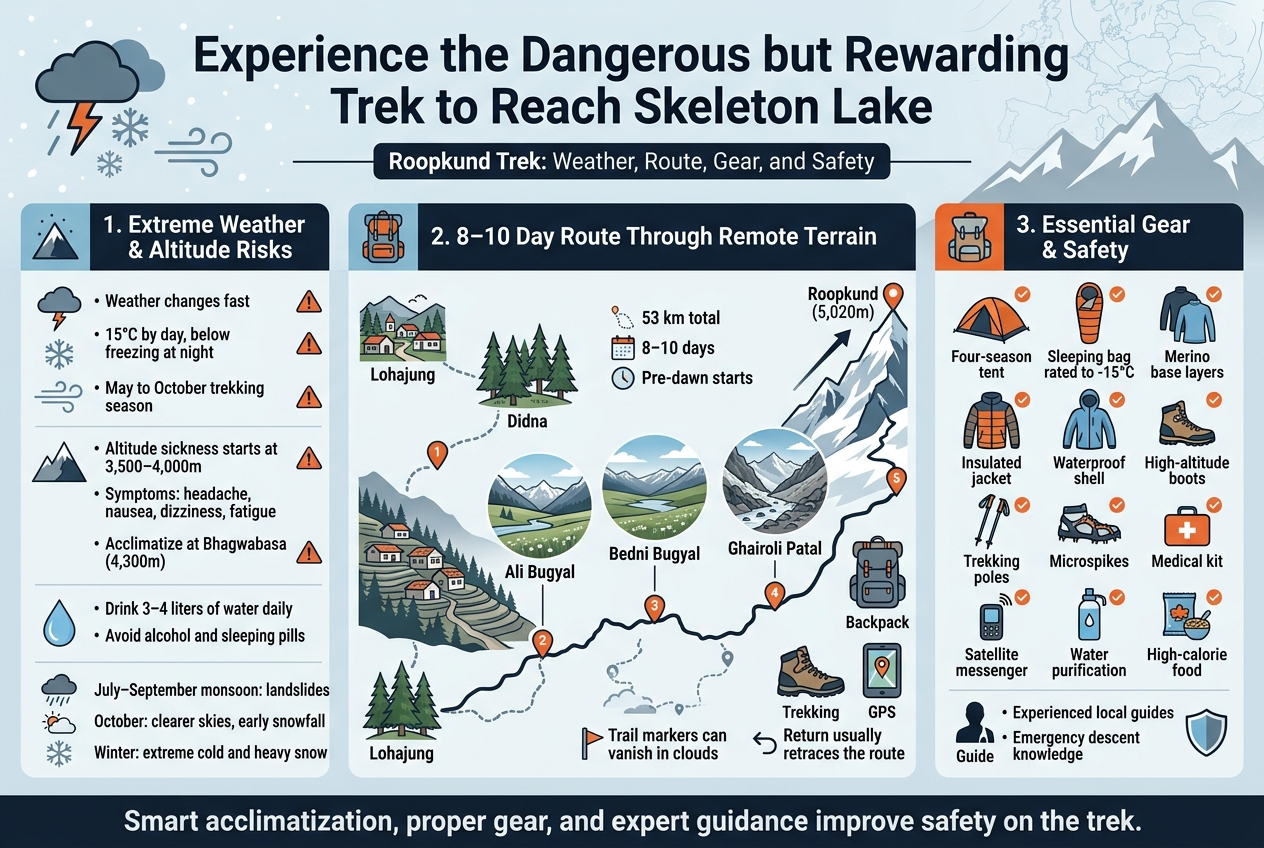
Weather at Roopkund changes faster than you can zip up your jacket. One moment you’re hiking in pleasant sunshine, the next you’re battling sudden snowstorms or bone-chilling winds that feel like ice daggers. Temperatures can plummet from 15°C during the day to well below freezing at night, even during summer trekking season from May to October.
Altitude sickness hits most trekkers between 3,500-4,000 meters, well before reaching Roopkund’s 5,020-meter elevation. Your body starts demanding more oxygen while your lungs struggle to deliver it. Headaches, nausea, dizziness, and fatigue become unwelcome hiking companions. Some trekkers experience severe symptoms requiring immediate descent.
Acclimatization becomes your best friend on this journey. Smart hikers spend extra days at intermediate camps like Bhagwabasa (4,300m) before pushing to the lake. Drinking 3-4 liters of water daily helps your body adjust, while avoiding alcohol and sleeping pills prevents complications.
Weather windows close quickly in these mountains. Monsoon rains from July to September make trails treacherous and increase landslide risks. Post-monsoon October offers clearer skies but brings early snowfall that can trap unprepared groups. Winter attempts are virtually impossible due to extreme cold and heavy snow coverage.
Follow the Multi-Day Hiking Route Through Remote Mountain Terrain
The classic Roopkund trek spans 8-10 days, covering roughly 53 kilometers of challenging Himalayan terrain. Your journey begins in Lohajung village, the last outpost of civilization before entering raw mountain wilderness.
Day one takes you through dense oak and rhododendron forests to Didna village, where local shepherds might share stories about the mysterious lake above. The trail winds upward through traditional Garhwali settlements where stone houses dot terraced hillsides.
Climbing higher, you’ll traverse the famous Bugyal meadows – vast alpine grasslands that stretch like green carpets between towering peaks. Ali Bugyal and Bedni Bugyal offer spectacular camping spots with panoramic mountain views, but weather can shift dramatically overnight.
The route becomes increasingly demanding after Ghairoli Patal. Rocky moraines replace grassy meadows as you approach the glacial zone. Steep ascents test your endurance while loose scree makes each step carefully calculated. Navigation becomes tricky when clouds roll in, hiding trail markers and landmarks.
Your final push to Roopkund involves pre-dawn starts to avoid afternoon weather deterioration. The last kilometer climbs steeply over rocky terrain where snow persists year-round. GPS devices become essential backup navigation tools when visibility drops to mere meters.
Return routes typically retrace your steps, though some experienced trekkers attempt longer circuits through alternate valleys.
Plan Essential Gear and Safety Precautions for High-Altitude Expedition
Your gear list makes the difference between adventure and survival nightmare. Start with a four-season mountaineering tent rated for extreme conditions – flimsy camping gear won’t survive Roopkund’s fierce winds and sudden storms. Sleeping bags rated to -15°C minimum keep you alive during frigid nights.
Layered clothing systems work better than heavy single pieces. Merino wool base layers wick moisture while insulating even when wet. Insulated down jackets provide warmth during rest stops, but synthetic fill performs better in wet conditions. Waterproof shells with full-zip ventilation help regulate body temperature during steep climbs.
High-altitude boots with rigid soles and crampon compatibility handle rocky terrain and potential snow fields. Trekking poles reduce knee strain during long descents while providing stability on loose surfaces. Microspikes or light crampons become necessary for icy sections near the lake.
Medical kits must include altitude sickness medications like acetazolamide, plus supplies for treating cuts, sprains, and hypothermia. Emergency communication devices like satellite messengers can summon rescue when cell towers disappear.
Water purification tablets or UV sterilizers ensure safe drinking water from mountain streams. High-calorie foods that perform in cold temperatures fuel your body’s increased energy demands at elevation.
Hiring experienced local guides familiar with current trail conditions and weather patterns significantly improves safety margins. Their knowledge of emergency descent routes and shelter locations proves invaluable when conditions deteriorate rapidly.
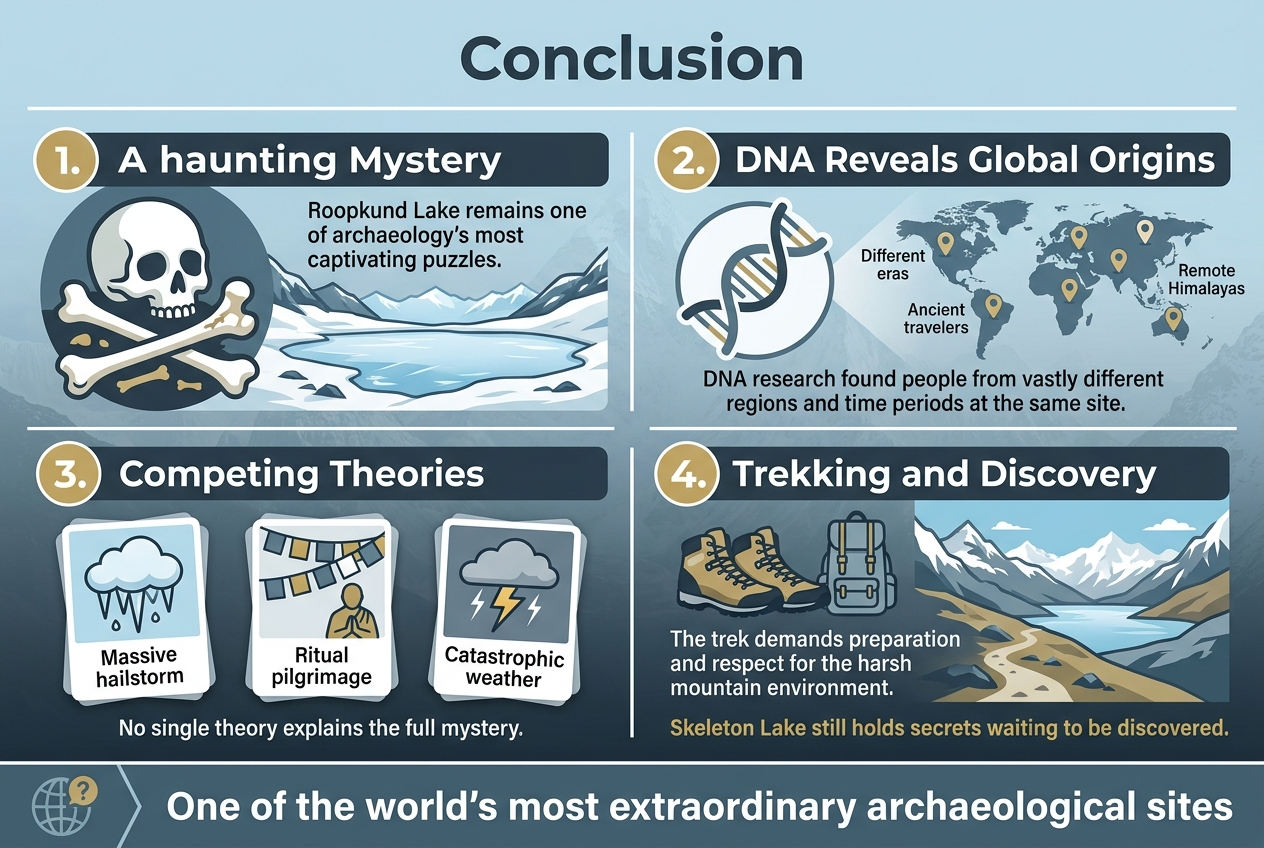
Roopkund Lake stands as one of archaeology’s most captivating mysteries, where ancient bones tell stories that continue to baffle scientists today. The groundbreaking DNA research has revealed that people from vastly different regions and time periods all met their fate at this remote Himalayan site, challenging everything we thought we knew about ancient travel patterns and historical events. The various theories about massive hailstorms, ritual pilgrimages, and catastrophic weather events each offer compelling explanations, yet none can fully account for the complex puzzle that these skeletal remains present.
For adventure seekers and mystery lovers alike, Roopkund offers an unforgettable journey that combines physical challenge with historical intrigue. The trek demands serious preparation and respect for the harsh mountain environment, but those who make it to the lake’s shores witness firsthand one of the world’s most extraordinary archaeological sites. As scientists continue their research and new technologies reveal more secrets, Skeleton Lake reminds us that our planet still holds countless mysteries waiting to be discovered.
Leave a Reply