
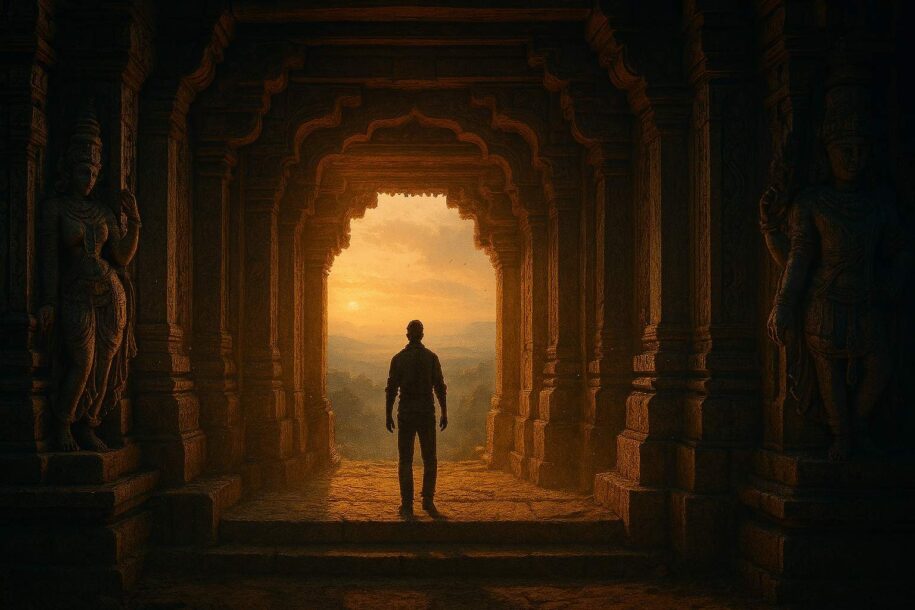
Forget the movies. The real Indiana Jones trail exists, and it runs straight through the heart of India.
It winds through an 800 year old temple that floats on sand. It passes through a fortress whose mines produced the most famous diamonds in the world, stones that now sit in the Crown Jewels of Britain and the Smithsonian in Washington. It leads through ruined cities of breathtaking grandeur, through silk weaving villages unchanged for centuries, and through forests where tigers still move silently between ancient trees.
This is not the India of tourist brochures. This is the India that archaeologists dream about, that historians argue over, and that travellers who discover it never stop talking about.
If you are planning a trip to India and you want something genuinely extraordinary, something that goes far beyond the Golden Triangle of Delhi, Agra and Jaipur, this guide is written for you.
Why This India Heritage Tour Goes Far Beyond the Golden Triangle
India contains more UNESCO World Heritage Sites than Egypt, Greece and Mexico combined. It was the source of the world’s most legendary diamonds. It built temples with engineering techniques that modern architects cannot fully explain. It sustained empires of a scale and sophistication that Europe would not match for centuries.
And yet the vast majority of international visitors see perhaps five percent of it.
The real Indiana Jones trail, the one that runs through lost cities, diamond fortresses and floating temples, lies in the Deccan plateau of southern India, centred on the extraordinary region around Hyderabad. This is where the most dramatic, the most mysterious and the most genuinely awe-inspiring stories in all of Indian history converge in one remarkable landscape.
Stop One: Ramappa Temple, the UNESCO Wonder at the Heart of Every India Heritage Tour
The Floating Foundation That Baffled Engineers for 800 Years
In 1213 CE, the architects of the Kakatiya Empire completed a temple that engineers still cannot fully explain.
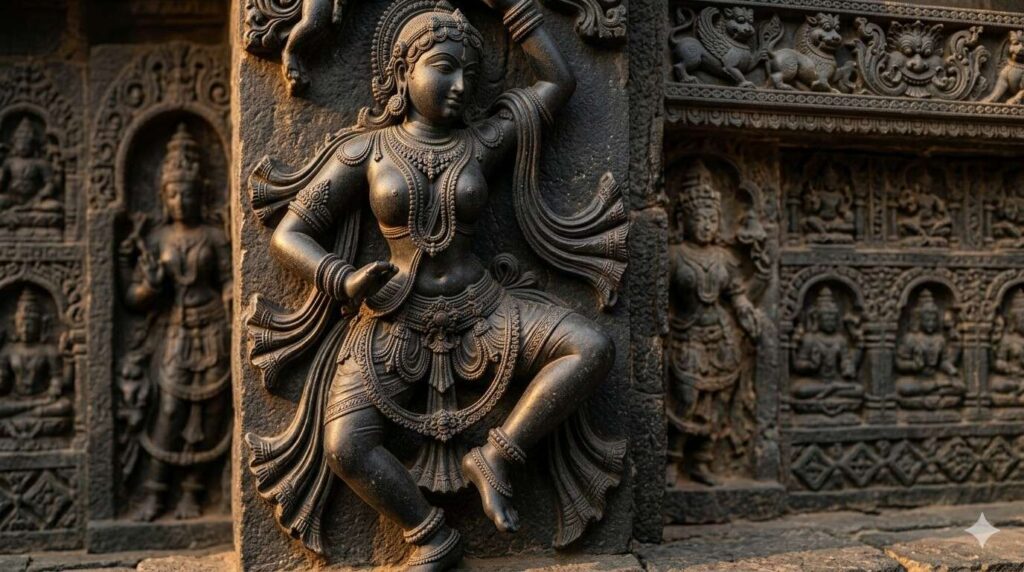
The Ramappa Temple, formally known as the Rudresvara Temple, stands in the village of Palampet in Telangana, and it represents perhaps the single most astonishing feat of structural engineering in medieval world architecture. The reason is simple and almost impossible to believe. The temple was built on a foundation of sand.
Not by accident. By design.
The Kakatiya architects understood, eight centuries before modern seismic engineering, that a floating foundation absorbs the energy of earthquakes rather than resisting it. They filled the foundation pits with a specially prepared mixture of sand, charcoal and organic material, creating a base that flexes rather than fractures. The temple has survived multiple major earthquakes over 800 years while stronger, more rigid structures around it collapsed to rubble.
The craftsmanship visible above that floating foundation is equally extraordinary. The bracket figures, known as Madanika, that adorn the temple’s exterior are considered among the finest figurative sculptures in the entire history of Indian art. Carved from a lightweight volcanic basalt unique to this region, they depict celestial dancers of such delicacy and movement that they appear to breathe. The stone itself, when placed in water, floats. It was chosen specifically for its low density, reducing the load on that ingenious sand foundation while allowing carvers to achieve a fineness of detail impossible in harder stone.
UNESCO recognised Ramappa Temple as a World Heritage Site in 2021, citing its outstanding universal value as a masterpiece of human creative genius. The citation noted that it represents the peak achievement of the Kakatiya school of temple architecture, a tradition that influenced sacred building across the entire Indian subcontinent.
Standing before it, you understand immediately why. This is not merely an old building. It is a statement of what human beings are capable of when art, science and devotion are pursued together without compromise.
Experience Ramappa Temple with an expert guide who brings every stone to life. Book your Ramappa UNESCO Temple Tour with 5 Senses Tours.
Stop Two: Golconda Fort, the Diamond Fortress That Funded an Empire

Exploring Golconda Fort on a Guided India Heritage Tour from Hyderabad
For two centuries, every significant diamond in the known world passed through one place.
Golconda Fort, rising dramatically from a granite hill on the western edge of Hyderabad, was the centre of the global diamond trade from the 14th to the 17th century. The mines of the Golconda region produced stones of a quality and size that no other source in the world could match, and the fort that controlled them became one of the wealthiest and most strategically important fortresses in Asia.
The diamonds that came from Golconda’s mines include the Koh-i-Noor, now set in the Crown Jewels of Britain and one of the most politically contested gemstones in the world. They include the Hope Diamond, the deep blue 45-carat stone that sits today in the Smithsonian National Museum of Natural History in Washington and draws millions of visitors every year. They include the Orlov Diamond in the Imperial Sceptre of Russia, the Regent Diamond in the Louvre in Paris, and the Nizam Diamond, once the property of the man who would become the richest individual in the world.
Every one of these stones began its journey here, at Golconda.
The fort itself is an engineering marvel of a different kind from Ramappa. Built across a series of granite hills and connected by massive concentric walls stretching over ten kilometres, Golconda was considered impregnable for centuries. Its acoustic system, through which a hand clap at the entrance gate could be heard at the royal apartments at the summit nearly a kilometre away, was engineered with a precision that guided tours still demonstrate to astonished visitors today.
Within the fort’s walls, the story of the Qutb Shahi dynasty unfolds across palaces, mosques, audience halls and the tombs of kings, all set against the dramatic backdrop of the Deccan plateau. The light at sunset turns the granite to gold and the views across Hyderabad stretch to the horizon.
Golconda Fort is included in our Tours from Hyderabad. Explore the full range of experiences we offer across the region.
Stop Three: Hyderabad Old City, Where the Greatest Fortune in History Was Built and Spent

The Nizam, the World’s Richest Man and the Hyderabad Old City Walking Tour
If Golconda produced the diamonds, Hyderabad is where they were spent.
The last Nizam of Hyderabad, Mir Osman Ali Khan, was certified by Time magazine in 1937 as the richest man in the world. His fortune, estimated in today’s values at over 200 billion dollars, was accumulated across generations of extraordinarily shrewd rule over a kingdom the size of France. He owned the 184-carat Jacob Diamond, the fifth largest diamond ever found, and kept it in a sock under his bed, occasionally using it as a paperweight.
The Old City of Hyderabad is where that wealth was built, displayed and embedded into the fabric of an urban landscape that remains one of the most historically rich and sensually overwhelming places on earth.
The Charminar, the great four-towered monument at the heart of the Old City, has anchored this neighbourhood since 1591. Around it, the markets of Laad Bazaar and Pathergatti still trade in pearls and bangles and textiles as they have for four centuries. The palaces of Chowmahalla, the royal seat of the Nizams, contain nineteen Belgian crystal chandeliers in their Darbar Hall, Italian marble floors, and the royal garages where forty Rolls-Royces once stood in climate-controlled splendour attended by European mechanics.
The Falaknuma Palace, perched on a hill above the city, is now a luxury heritage hotel. The Salar Jung Museum contains one of the largest personal art collections ever assembled by a single human being. And beneath many of the Old City’s ancient havelis, hidden compartments and false walls still conceal the architectural secrets of a civilisation that understood, above all else, the importance of protecting what was most precious.
Walking these streets with a guide who knows their stories is one of the great travel experiences available anywhere in the world today.
Discover the Nizam’s legendary city on our expert-led Hyderabad Old City Walking Tour. And when the history leaves you hungry, join our Hyderabad Food Street Walk for the biryani, Irani chai and street food that have made this city’s cuisine famous across the world.
Stop Four: Hampi, the Lost Capital of the Vijayanagara Empire
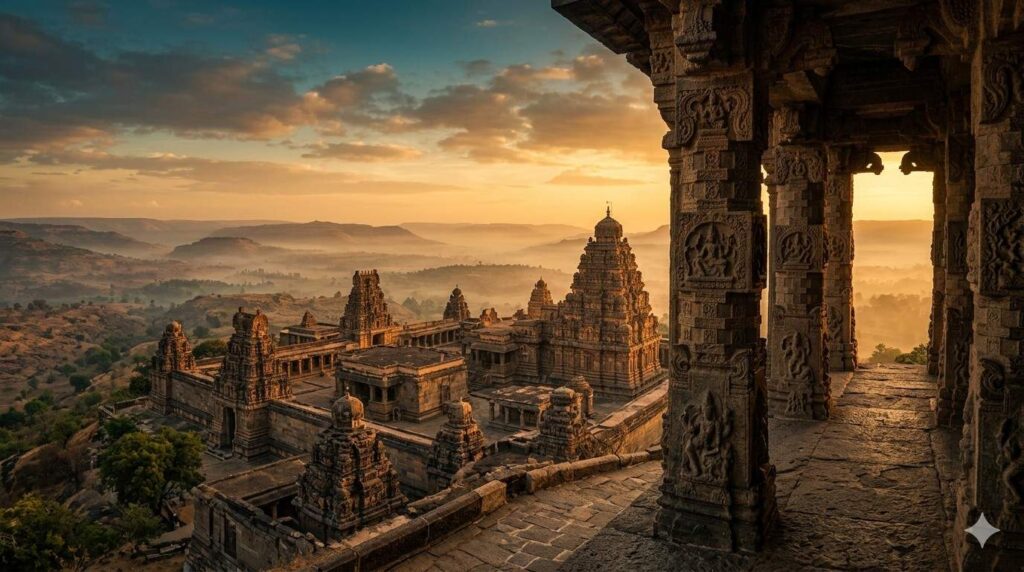
Hampi, Karnataka, UNESCO World Heritage Site
In the 14th century, the city of Vijayanagara was one of the largest cities on earth.
Contemporary visitors from Persia, Portugal and Arabia described a metropolis of extraordinary wealth and sophistication, with markets selling diamonds by the basketful, streets wide enough for elephants to pass four abreast, and temples of a beauty that left hardened travellers speechless. At its peak, Vijayanagara may have housed half a million people, making it comparable in scale to London or Paris at the same period but vastly richer in artistic achievement.
Today, its ruins spread across a landscape of surreal beauty near the town of Hampi in Karnataka, a vast open-air museum of crumbling gopurams, royal enclosures, sacred tanks and boulder-strewn riverbanks where the Tungabhadra flows as it always has.
At the centre of this ruined world stands Vittala Temple, home to the famous musical pillars. These 56 carved granite columns produce distinct musical notes when struck, each one tuned to a different note of the classical Indian scale through a feat of acoustic engineering that has never been satisfactorily explained. The stone chariot in the temple courtyard, its wheels still capable of turning, is one of the most photographed structures in India and one of the most astonishing.
Walking through Hampi is walking through the aftermath of one of history’s great catastrophes. In 1565, the city was sacked and burnt by a coalition of rival sultanates and never rebuilt. What was left behind is a monument not just to what was built but to what was lost, and to the almost incomprehensible scale of what the Vijayanagara Empire achieved during its two centuries of glory.
Walk these extraordinary ruins with our expert guides on our Hampi Tour from Bangalore.
Stop Five: Pochampally, Living Heritage on India’s Silk Weaving Trail

Pochampally Ikat Silk, a Living Tradition on the Heritage Trail
Not every stop on the Indiana Jones trail leads to ruins and fortresses. Some lead to something rarer still: a living tradition.
The village of Pochampally, an hour’s drive from Hyderabad, is the birthplace of Ikat, one of the most technically demanding textile traditions in the world. Ikat fabric is created through a process of resist dyeing the threads before they are woven, a technique that requires the weaver to calculate the precise position of every colour in the finished cloth before a single thread passes through the loom. The mathematical precision involved is extraordinary, and the patterns that result, geometric, jewel-like, shimmering with an almost optical complexity, have made Pochampally silk one of India’s most celebrated and collected textiles.
The Pochampally Ikat has a Geographical Indication tag, India’s equivalent of a French appellation, recognising it as a product uniquely tied to this place and these weavers. Walking through the village and watching the looms at work, understanding how a tradition of such complexity has been passed from generation to generation across centuries, is a profoundly moving experience.
It is also, for travellers who appreciate craft and design, one of the most genuinely unique shopping experiences available anywhere in India. These are not tourist market reproductions. These are the real thing, made by the families who invented them.
The Pochampally Silk Route is part of our Tours from Hyderabad portfolio. Explore all our Hyderabad and Deccan experiences in one place.
Stop Six: Amrabad Tiger Reserve, Where India’s Wild Deccan Comes Alive

Amrabad Tiger Reserve, Telangana
Every great adventure trail needs wilderness, and the Deccan plateau delivers it magnificently.
Amrabad Tiger Reserve, spreading across over 2600 square kilometres of the Nallamala Hills south of Hyderabad, is one of the largest tiger reserves in India and one of the least visited by international tourists. That combination of size and relative obscurity makes it, for the wildlife traveller who has done Ranthambore and wants something rawer and more authentic, one of the most exciting wildlife destinations in the country.
The reserve protects not just tigers but leopards, sloth bears, dholes, wolves, giant squirrels and over 300 species of birds. The landscape of dry deciduous forest, deep gorges and rocky plateaus is dramatically beautiful in its own right, quite different from the more famous tiger reserves of central India, and the experience of moving through it with a knowledgeable naturalist guide feels genuinely like exploration.
For international visitors building an itinerary around southern India, Amrabad offers a wildlife experience that can sit alongside the historical and cultural richness of Hyderabad, Ramappa, Golconda and Hampi without requiring a journey to a completely different region of the country.
Speak to us about adding an Amrabad wildlife experience to your Hyderabad itinerary. Explore all our Tours from Hyderabad.
How to Plan Your India Heritage Tour Itinerary from Hyderabad
The beauty of this trail is that every stop sits within a region compact enough to be explored in a single well-planned journey. Hyderabad is the natural base, well connected by direct flights from London, with excellent onward connections from Dubai, Singapore and the major Gulf hubs for travellers from the USA and Australia.
A ten to fourteen day itinerary built around this region could include two days in the Hyderabad Old City, a day at Golconda Fort, a day trip to Ramappa Temple, two days in Hampi, a morning in Pochampally and a two night wildlife stay at Amrabad, combining to create one of the most diverse, historically rich and genuinely extraordinary travel experiences available anywhere in Asia.
This is not the India everyone visits. It is the India that stays with you for the rest of your life.
Begin planning your journey with 5 Senses Tours. Explore our full range of Tours from Hyderabad or contact us directly to build a private itinerary tailored to your travel dates and interests.
Leave a Reply