
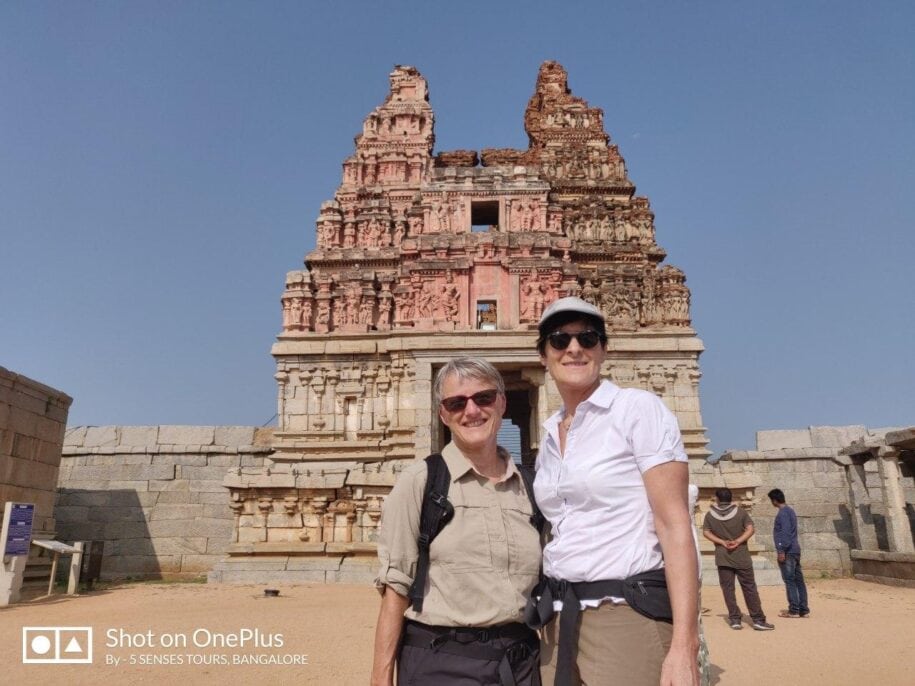
In 1500 AD Hampi was the second largest city in the world.
Only Beijing was bigger.
Its markets stretched for kilometres in every direction. Its temples were sheathed in gold. Its streets were thronged with merchants from Portugal, Persia, Arabia and China who had come to trade with the most powerful empire in South India. The Tungabhadra River flowed through its heart, its banks lined with ghats and gardens and the residences of a court whose wealth was so extraordinary that foreign travellers ran out of superlatives trying to describe it.
Today Hampi is a village of a few thousand people surrounded by over 1600 ancient monuments, spread across 4187 hectares of one of the most dramatically beautiful landscapes in India. Massive granite boulders pile upon each other in formations of surreal grandeur. Banana plantations line the river banks. Ruins of palaces, temples, stables and market streets extend in every direction across a terrain that looks like it was designed by a painter rather than shaped by geology.
Hampi is the most Google-searched tourist destination in Karnataka. It is a UNESCO World Heritage Site. It is one of the most extraordinary places in India and one of the most compelling heritage destinations in Asia.
This complete Hampi travel guide covers everything you need to know to plan your visit, every major monument, the stories behind them, the practical information and how to experience this extraordinary place with the depth and understanding it genuinely deserves.
Hampi Travel Guide: The Story of the Vijayanagara Empire That Built This Extraordinary City
You cannot understand Hampi without understanding the Vijayanagara Empire that built it. The ruins are not just beautiful. They are the physical record of a civilisation at the peak of its power, a culture of extraordinary artistic ambition, military genius and cosmopolitan sophistication that shaped the history of South India for over two centuries.
How the Vijayanagara Empire Rose to Become the Most Powerful Kingdom in South India

The Vijayanagara Empire was founded in 1336 AD by two brothers, Harihara and Bukka Raya, who established their capital on the banks of the Tungabhadra River at a site already considered sacred in the Ramayana tradition. The name Vijayanagara means City of Victory in Sanskrit, and from its founding the empire pursued an agenda of territorial expansion, cultural patronage and religious devotion that would make it the dominant power in the Indian subcontinent for over two centuries.
At its height under the great emperor Krishnadevaraya, who ruled from 1509 to 1529 AD, the Vijayanagara Empire controlled territory stretching from the Deccan plateau in the north to the tip of the Indian peninsula in the south. The court of Krishnadevaraya attracted scholars, poets, musicians and artists from across the Indian subcontinent and from as far afield as Portugal and Persia. The Telugu literary tradition reached its classical peak during his reign. The temple building programme he oversaw produced some of the most extraordinary examples of Dravidian architecture ever created.
The Portuguese traveller Domingo Paes, who visited Hampi during Krishnadevaraya’s reign, described a city so wealthy and so beautiful that it surpassed Rome in its splendour. The Persian ambassador Abdul Razzaq described a capital of unimaginable riches where the markets overflowed with rubies, diamonds and pearls. These were not the exaggerations of credulous travellers. They were accurate descriptions of a city at the absolute peak of its prosperity.
The Vijayanagara Empire’s extraordinary artistic tradition extended far beyond Hampi itself. The Hoysala dynasty that preceded it as the dominant power in Karnataka left an equally extraordinary architectural legacy at Belur and Halebid, whose soapstone temples represent the most intricately carved buildings in India. Our Belur and Halebid day trip from Bangalore takes you to these extraordinary monuments with expert cultural guides who bring the full story of the Hoysala artistic tradition to life. For those wanting to combine Belur, Halebid and Shravanabelagola in a single extended journey, our Stone Marvels Trail covers all three extraordinary sites over two days.
The Fall of Hampi and the Battle of Talikota: The Most Devastating Military Defeat in South Indian History
In January 1565 the combined armies of the five Deccan Sultanates met the Vijayanagara army at the Battle of Talikota, a confrontation that would end one of the greatest empires in Indian history in a single catastrophic afternoon.
The Vijayanagara army was enormous. Contemporary accounts estimate its strength at over 700,000 infantry, 100,000 cavalry and hundreds of war elephants. It should have been an overwhelming force. But the battle turned in a matter of hours. The Vijayanagara king Aliya Rama Raya was captured and immediately beheaded. His army, leaderless and demoralised, collapsed. The Deccan forces poured through the broken lines and headed for the capital.
What followed over the next six months was the systematic destruction of one of the greatest cities on earth. The temples were stripped of their gold. The palaces were demolished. The markets were burned. The population fled. The city that had taken two centuries to build was reduced to ruins in less than a year.
Those ruins are what we see today at Hampi. And understanding that what surrounds you was once a living, breathing, extraordinarily wealthy metropolis, not an archaeological site designed to be visited but a real city that was violently destroyed, transforms every visit to these extraordinary monuments into an encounter with genuine human tragedy as well as extraordinary human achievement.
The military culture of the Deccan plateau that produced both the Vijayanagara Empire and its eventual conquerors is written into the landscape of Karnataka in extraordinary ways. The Chitradurga Fort, built in stages between the 14th and 18th centuries across seven concentric walls covering 1500 acres of granite hillside with 19 gateways, 35 secret pathways and 2000 watchtowers, is one of the most extraordinary military structures in South India and a highlight of our Bewitching Ruins Trail from Bangalore that combines Hampi with Badami, Chitradurga and the Sloth Bear sanctuary at Daroji in a single extraordinary six-day journey.
Hampi in the Ramayana: The Sacred Geography Behind the Ruins

Long before the Vijayanagara Empire chose this site for its capital, the landscape of Hampi was considered one of the most sacred in South India. The area is identified in the Ramayana as Kishkinda, the kingdom of the monkey king Sugriva and his army of vanaras who helped Rama in his campaign to rescue Sita from the demon king Ravana.
The Matanga Hill that rises above the Vittala Temple complex is identified as the site where Hanuman was born. The Anjaneya Hill on the other side of the Tungabhadra is where Hanuman spent his childhood. The cave at the foot of the Hemakuta Hill complex is where Sugriva and his brother Vali fought their legendary duel. And the Tungabhadra River flowing through the heart of Hampi is where Shabari, the devoted old woman who waited a lifetime for Rama’s arrival, offered him berries she had tasted herself to ensure they were sweet.
This sacred geography is not just mythology. It is the reason the Vijayanagara kings chose this site for their capital, the reason they built their greatest temples here, and the reason that Hampi remains an active pilgrimage destination for Hindu devotees even today. The Virupaksha Temple at the centre of the ancient city has been in continuous worship since the 7th century and has never stopped being a living temple regardless of everything that has happened around it.
The Vijayanagara artistic tradition that reached its peak at Hampi also found extraordinary expression at Lepakshi in Andhra Pradesh, just 120 kilometres away, where the hanging pillar of the Veerabhadra Temple, a 20-ton granite column that has been suspended above the floor without touching the ground for 500 years, remains one of the most extraordinary engineering mysteries in ancient India. Our Lepakshi tour from Bangalore combines the extraordinary architecture, ceiling frescoes and monolithic Nandi bull sculpture of this magnificent temple with the complete story of the Vijayanagara artistic tradition that created it.
Our Hampi tours with 5 Senses Tours bring the complete story of the Vijayanagara Empire and the sacred geography of Kishkinda to life with expert cultural guides who transform every monument from a beautiful ruin into a chapter of one of the most extraordinary stories in South Indian history.
The Complete Hampi Tourist Places Guide: Every Major Monument Explained

Hampi stands as one of India’s most spectacular UNESCO World Heritage Sites, preserving the magnificent ruins of the Vijayanagara Empire across 4,187 hectares of boulder-strewn landscape, with over 1,600 surviving monuments that once comprised the world’s second-largest medieval city. Here is every major monument you need to visit, with the story behind each one.
Vittala Temple Complex: The Most Extraordinary Monument in Hampi
The Vittala Temple complex is the undisputed centrepiece of the Hampi travel guide and one of the most extraordinary architectural achievements in South Indian history. Built during the reign of Krishnadevaraya in the early 16th century, it represents the Vijayanagara architectural tradition at its absolute peak of ambition, technical mastery and artistic refinement.
The musical pillars of the Vittala Temple are 56 granite columns arranged in a mandapa of extraordinary beauty, each one carved from solid stone and each one tuned to a different note of the classical Indian musical scale. They are not hollow. There are no internal chambers or resonating spaces. They are solid granite. And when struck they produce clear, distinct musical tones that have not changed in 500 years of weathering. The engineering principle behind their acoustic properties remains a subject of active debate among musicologists and materials scientists.
The stone chariot at the entrance to the Vittala Temple complex is one of the most recognisable images in all of Indian heritage photography. Built at the scale of an actual processional chariot and decorated with extraordinary sculptural detail across every surface, it appears on the Indian fifty-rupee note and remains one of the most photographed monuments in the entire country.
The Vittala Temple complex is open from 8am to 6pm. Entry fees for foreign nationals are approximately Rs 600 with an additional charge for the Vittala Temple complex itself. The complex is best visited in the early morning when the light on the sculptural details is most dramatic and the crowds are at their thinnest.
Virupaksha Temple: The Living Heart of Ancient Hampi

While most of Hampi’s monuments are ruins, the Virupaksha Temple is a living, actively worshipped sacred site that has been in continuous operation since the 7th century AD. This extraordinary continuity makes it unlike any other monument in Hampi and gives it a spiritual atmosphere that the ruins, for all their beauty, cannot replicate.
The temple’s main tower, or gopuram, rises 50 metres above the ancient market street of Hampi Bazaar and is visible from most points in the central zone of the ruins. The morning puja at Virupaksha Temple, performed at 9am, is one of the most atmospheric experiences available in Hampi, with Sanskrit chanting, the ringing of bells and the smell of camphor and flower offerings filling the ancient stone corridors of a temple that has been performing this exact ritual for over thirteen centuries.
The temple elephant Lakshmi, who lives in the courtyard and blesses devotees by placing her trunk on their heads in exchange for a small offering, is one of Hampi’s most beloved residents and one of the most photographed subjects in the entire UNESCO site.
Karnataka’s living temple tradition extends far beyond Hampi. The Hoysala temples of Belur and Halebid, built between the 12th and 14th centuries from extraordinarily soft soapstone that has hardened over centuries into something close to metal, represent the Karnataka temple building tradition at its most technically extraordinary. The Chennakeshava Temple at Belur took 103 years to complete. Our Belur and Halebid day trip gives you both temples in a single extraordinary day from Bangalore with expert cultural guides who reveal the extraordinary details that most visitors walk past completely.
The Royal Enclosure and Zenana Complex: Where the Vijayanagara Court Lived
The Royal Enclosure covers an area of approximately one square kilometre at the heart of the ruined city and contains the remains of the palace structures where the Vijayanagara kings held court, administered their empire and conducted the daily business of ruling the most powerful kingdom in South India.
The Mahanavami Dibba, a massive stepped platform rising fifteen metres above the surrounding landscape, served as the royal viewing platform during the Mahanavami festival, the most important celebration in the Vijayanagara calendar. The platform’s surface is covered in extraordinarily detailed relief carvings depicting processions, hunting scenes, wrestling matches and the full ceremonial life of the royal court. Standing on its summit and looking out across the ruins of the city that once filled the plain in every direction gives you the most powerful sense of the scale of what Hampi once was.
The Lotus Mahal within the Zenana complex is one of the most architecturally distinctive structures in Hampi, a two-storey pleasure pavilion built in an extraordinary hybrid style that combines the pointed arches of Islamic architecture with the decorative vocabulary of Hindu temple design. The name comes from the lotus-bud finials that crown its multiple towers. It is one of the few structures at Hampi where the original plastered surfaces survive in sufficient condition to give a sense of how vividly coloured the original city must have been.
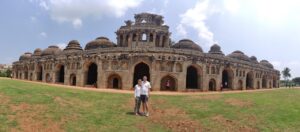
The Elephant Stables immediately adjacent to the Zenana complex are among the most photographed structures in Hampi, eleven enormous chambers with alternating domed and vaulted roofs that once housed the state elephants of the Vijayanagara court. The architectural quality of these stables reflects the extraordinary importance of war elephants in the military culture of the empire.
The royal and courtly heritage of Karnataka reaches another magnificent peak at Mysore, where the Mysore Palace, the former residence of the Wadiyar dynasty who ruled from 1350 to 1950, is one of the most visited monuments in India. Our Mysore Silk Tour from Bangalore combines the Mysore Palace with Asia’s largest silk cocoon auction and the royal silk weaving factory, creating a complete Mysore cultural experience that connects the living craft traditions of Karnataka to its extraordinary royal heritage.
Hemakuta Hill: The Most Undervisited Temple Complex in Hampi
Most visitors to Hampi spend their time at the Vittala Temple and the Virupaksha Temple and miss the Hemakuta Hill temple complex entirely. This is a significant oversight because Hemakuta Hill contains some of the earliest temples at Hampi, predating the Vijayanagara Empire itself, and offers one of the most extraordinary panoramic views of the ruins available from anywhere in the site.
The hill is covered in pre-Vijayanagara temples of a compact, elegant design that is completely different from the grand Dravidian style of the later empire period. Climbing to the summit of Hemakuta Hill at sunrise or sunset provides a view across the boulder landscape of Hampi that is genuinely breathtaking, with the Tungabhadra River winding through the scene and the gopuram of the Virupaksha Temple rising above the ancient market street below.
The Ugra Narasimha monolith at the base of Hemakuta Hill is one of the most powerful sculptures at Hampi, a six-metre carved granite image of the man-lion avatar of Vishnu that was originally housed within a temple structure that has since collapsed. The sheer scale and sculptural force of this figure, sitting cross-legged with its extraordinary multi-headed serpent canopy, makes it one of the most memorable individual monuments in the entire complex.
Karnataka has another extraordinary monolithic sculpture tradition that reaches its greatest expression at Shravanabelagola, where the 58-foot statue of Gomateswara, the son of the first Jain Tirthankara, was carved from a single block of granite in 981 AD and stands at an elevation of 2600 feet above sea level on a granite hill approached by 600 stone steps. Our Shravanabelagola tour from Bangalore includes the complete story of the Jain philosophical tradition that inspired this extraordinary monument alongside a guided exploration of the ancient town’s 2000 years of unbroken heritage. For those wanting to combine Shravanabelagola with Belur and Halebid in a single journey, our Belur Halebid and Shravanabelagola two-day tour covers all three extraordinary sites comprehensively.
Anegundi Village: The Living Heritage Across the River

Anegundi is the ancient village on the northern bank of the Tungabhadra that predates Hampi itself and is identified in the Ramayana as the capital of the monkey kingdom of Kishkinda. It is accessible from the Hampi side of the river by a short coracle ride across the Tungabhadra, one of the most enjoyable experiences available during a Hampi visit.
The round cane boats called coracles that navigate the Tungabhadra between Hampi and Anegundi have been used on this river since at least the 15th century and almost certainly for much longer. A coracle ride across the Tungabhadra is simultaneously a completely practical way to reach Anegundi and one of the most atmospheric experiences available during any Hampi visit.
Anegundi retains the character of a traditional Karnataka village to an extent that the heavily visited Hampi side of the river does not. Its narrow lanes, traditional houses, ancient temples and the extraordinary boulder landscape of the Anjaneya Hill create a completely different atmosphere from the heritage tourism zone across the river. The Kishkinda Trust, a community organisation based in Anegundi, has developed sustainable craft and cultural initiatives that provide a genuine encounter with the living community of this ancient landscape.
The climb to the Hanuman Temple on the summit of Anjaneya Hill, 575 steps rising through the extraordinary granite boulder landscape to a small temple with views across the entire Hampi valley, is one of the most rewarding physical experiences available during a Hampi visit and the single best vantage point for understanding the full geographical extent of the ruined city below.
Our Hampi tour from Bangalore and Hampi tour from Hyderabad include both the Vittala Temple and Anegundi in a comprehensive itinerary designed to give international travellers the complete Hampi experience with expert cultural guides who bring every monument to life.
Things to Do in Hampi Beyond the Monuments
Sunrise on Matanga Hill: The Most Extraordinary View in Hampi
The single most memorable experience available in Hampi does not require an entry ticket. It requires only an alarm clock set for 5am and the willingness to climb 575 steps in the dark.
Matanga Hill is the highest point in the central Hampi area, rising dramatically from the surrounding plain with views in every direction across the entire UNESCO zone. The sunrise from the summit of Matanga Hill, when the first light catches the Tungabhadra River and begins to illuminate the granite boulders and temple ruins spread across the landscape below, is one of the most extraordinary natural spectacles available anywhere in South India.
The hill is associated in the Ramayana with the sage Matanga, in whose hermitage Shabari waited faithfully for Rama’s arrival. Watching the sun rise over a landscape whose sacred significance stretches back to one of the oldest stories in Indian literature, from a hilltop where pilgrims have been gathering since before the Vijayanagara Empire existed, is an experience that combines natural beauty, historical depth and spiritual atmosphere in a way that very few places anywhere in the world can match.
Coracle Ride on the Tungabhadra: The Most Iconic Hampi Experience

The circular basket boats called coracles that navigate the Tungabhadra between Hampi and Anegundi are one of the most distinctive and most photographed sights in the entire Hampi landscape. These extraordinary vessels, made from bamboo and buffalo hide stretched over a circular frame, have been used on this river since at least the 15th century and almost certainly for much longer.
A coracle ride across the Tungabhadra is simultaneously a completely practical way to reach Anegundi from the Hampi side of the river and one of the most atmospheric experiences available during any Hampi visit. The crossing takes approximately ten minutes and offers extraordinary views of both river banks, the surrounding boulder landscape and the ancient ghats and temples that line the Hampi waterfront.
Rock Climbing and Boulder Hopping: Hampi’s Most Adventurous Activities
The extraordinary granite boulder landscape that surrounds Hampi is one of the finest rock climbing destinations in South Asia. The ancient volcanic geology that deposited these massive rounded granite formations has created a landscape where hundreds of natural climbing routes of varying difficulty are available within walking distance of the village centre.
The bouldering culture of Hampi has grown significantly over the past decade, with climbers from across India and internationally coming specifically to explore the extraordinary variety of problems available across the hillsides. The climbing season coincides with the archaeological tourism season from October to February, when the temperatures are comfortable and the rock is dry.
For visitors who want to experience the boulder landscape without the technical demands of climbing, boulder hopping across the hills surrounding Hampi provides an extraordinary perspective on the ruins, approaching temples and monuments across the boulders rather than along the tourist paths to reveal unexpected views, hidden shrines and the extraordinary sense of how the ancient Vijayanagara builders integrated their monuments into the natural granite landscape rather than imposing them upon it.
Hampi Bazaar and the Living Market Street
The Hampi Bazaar that runs from the Virupaksha Temple gopuram to the foot of the Matanga Hill follows the exact path of the ancient royal market street of Vijayanagara, where traders from across Asia once sold precious stones, silk textiles and exotic goods to the citizens of one of the world’s greatest medieval cities.
Today the bazaar is lined with small shops selling handicrafts, antique coins, embroidered textiles and the distinctive Lambani craft products that reflect the extraordinary tribal heritage of the surrounding region. One should buy items with Lambani prints as it is the speciality of the place.
The morning atmosphere of the Hampi Bazaar, before the tourist crowds arrive and the vendors begin their day in the shadow of the ancient temple gopuram, is one of the most evocative experiences available in Hampi, a living continuity of commercial activity on a street that has been used for exactly this purpose for over six centuries.
Plan Your Hampi Visit: The Complete Practical Hampi Travel Guide
Best Time to Visit Hampi
September to March is the season in Hampi, starting in September and peaking in December and January before ending by March. This is the time when the weather is the best in Hampi and allows you to spend more time outdoors.
October and November offer the ideal combination of comfortable temperatures, post-monsoon greenery and manageable tourist volumes. The landscape is at its most lush and photogenic in these months, with the Tungabhadra flowing high and the surrounding hills covered in vegetation that disappeared during the dry season.
December and January are the peak months for tourist volumes, particularly around Christmas and New Year when Hampi fills with both international and domestic visitors. Accommodation should be booked several months in advance for this period. The weather is at its most comfortable with cool mornings and mild afternoons, making it the best time for extended walking among the monuments.
February and March offer the best combination of comfortable temperatures and manageable crowds, with the post-peak-season reduction in visitors making these months ideal for photographers who want the monuments to themselves in the early morning.
The summer months of April and May bring unforgiving heat. Most businesses that depend on tourist inflow shut down for these months in Hampi and visiting in this period is strongly discouraged for anyone who plans to walk extensively among the monuments.
How to Reach Hampi From Bangalore, Hyderabad and Goa
The nearest railway station to Hampi is Hospet Junction, 13km away. Overnight trains run several times a week from Bangalore, Hyderabad and Goa. From Hospet the ruins are accessible by autorickshaw, taxi or local bus.
From Bangalore the journey to Hampi by road takes approximately five to six hours depending on traffic, covering approximately 340 kilometres. Overnight buses operated by Karnataka State Road Transport Corporation and multiple private operators cover this route daily, arriving in Hospet in the early morning in time for the sunrise at Matanga Hill.
From Hyderabad the journey takes approximately six hours by road, covering approximately 380 kilometres. Several overnight train options connect Hyderabad to Hospet Junction with reasonable frequency.
From Goa the journey takes approximately six to seven hours by road, covering approximately 340 kilometres. This makes Hampi a natural addition to any Goa itinerary for visitors with the time and curiosity to explore Karnataka’s extraordinary interior.
How Long to Spend at Hampi and How to Structure Your Visit
The most common question in any Hampi travel guide is how many days to allocate. The honest answer is that Hampi rewards as much time as you can give it but can be experienced at a basic level in a single day and at a genuinely satisfying level in two to three days.
A single day at Hampi, achievable as a long day trip from Bangalore with a very early departure, allows coverage of the Vittala Temple complex, the Virupaksha Temple and either the Royal Enclosure or the Hemakuta Hill complex. This is the minimum viable Hampi experience and leaves most visitors wishing they had stayed longer.
Two days allows the complete coverage of all major monuments across both the Sacred Centre and the Royal Centre zones, a coracle ride to Anegundi, the sunrise at Matanga Hill and sufficient time at each monument to genuinely absorb what you are seeing rather than simply photographing it.
Three days allows everything in the two-day itinerary plus the outlying monuments including the Achyutaraya Temple complex, the Sule Bazaar ruins and the more remote areas of the UNESCO zone that most single-day visitors never reach.
Entry Fees and Monument Logistics
Monument entry fees total Rs 110 for Indians visiting all ticketed sites, covering the Vittala Temple, Royal Center monuments and the Archaeological Museum. Foreign nationals pay Rs 1,700 combined for these three locations.
Most other temples and ruins throughout Hampi remain free to visit, including the active Virupaksha Temple, the Hemakuta Hill temple complex and the riverside monuments.
The Vittala Temple complex is the most visited site in Hampi and can become extremely crowded between 10am and 4pm during peak season. Arriving at the opening time of 8am is strongly recommended for the best combination of light quality, monument access and manageable visitor volumes.
Experiencing Hampi With 5 Senses Tours: The Expert Guide Difference
Why Hampi Requires an Expert Guide to Experience at Its Full Depth
Every experienced Hampi visitor says the same thing when asked what they would do differently on a return visit. They would hire an expert guide from the beginning.
Hampi is one of those rare heritage destinations where the visual experience of the monuments, extraordinary as it is, represents only a fraction of what is actually available to the visitor who arrives with the right knowledge and the right guide. The sculptural programmes of the Vittala Temple tell specific stories from the Mahabharata and Ramayana in a visual language that is entirely opaque without explanation. The engineering innovations of the Vijayanagara hydraulic system, which supplied water across the entire city through an extraordinary network of channels and tanks, is invisible to the naked eye without someone who knows where to look. The military logic of the fortification system, which enclosed an area of over 100 square kilometres, only becomes comprehensible when a guide traces its geography across the landscape.
A cultural evangelist with 5 Senses Tours does not just show you the monuments. They give you the political story of the empire that built them, the human story of the people who lived within them and the artistic story of the craftsmen whose genius created them. They take you to the details that most visitors walk past, the hidden inscriptions, the astronomical alignments, the structural innovations that modern engineers still study and the fragments of the original painted decoration that survive in sheltered corners of the oldest temples.
Book Your Expert Guided Hampi Tour With 5 Senses Tours

Our Hampi tour from Bangalore is available as a private two-day tour with expert cultural guide, private air-conditioned vehicle, one night accommodation in Hampi and all entry fees included. Pickup from your Bangalore hotel, sunrise at Matanga Hill, complete coverage of all major monuments across both days and return to Bangalore on day two.
Our Hampi tour from Hyderabad covers the same extraordinary experience from Hyderabad, combining the UNESCO ruins of Hampi with the extraordinary cultural heritage of Hyderabad city in a complete South India heritage itinerary that is available nowhere else.
For travellers wanting to combine Hampi with the wider Karnataka heritage circuit, our tours create extraordinary extended itineraries across the full depth of South India’s most remarkable monuments.
The Lepakshi tour from Bangalore takes you to the Vijayanagara-era temple whose gravity-defying hanging pillar, 500-year-old ceiling frescoes and monolithic Nandi bull are among the most extraordinary artistic and engineering achievements of the entire empire. Lepakshi sits 120 kilometres from Bangalore and just 15 kilometres from the Andhra Pradesh border, making it a natural complement to any Hampi itinerary for travellers approaching from the east.
The Belur and Halebid day trip from Bangalore covers the UNESCO-nominated Hoysala temples whose soapstone carvings are more intricate than Angkor Wat, more technically extraordinary than any medieval European cathedral and almost completely unknown to international tourists who have not made the journey to Karnataka’s interior. For the complete Hoysala and Jain heritage circuit, our Belur Halebid and Shravanabelagola two-day tour adds the world’s largest monolith at Shravanabelagola to create one of the most comprehensive and most rewarding heritage journeys available from Bangalore.
The Shravanabelagola tour takes you to the 58-foot granite monolith of Gomateswara, carved from a single block of stone in 981 AD, standing at 2600 feet above sea level on a hill approached by 600 ancient stone steps. The views from the summit across the Karnataka countryside and the complete story of the Jain philosophical tradition delivered by expert guides make this one of the most spiritually and visually powerful experiences available anywhere in South India.
The Mysore Silk Tour from Bangalore connects the royal heritage of the Wadiyar dynasty whose Mysore Palace is one of India’s most visited monuments to the living craft tradition of Mysore silk, combining Asia’s largest cocoon auction and the royal silk weaving factory in a single extraordinary day.
The Chitradurga Fort, built across seven concentric walls covering 1500 acres of granite hillside with 19 gateways, 35 secret pathways and 2000 watchtowers between the 14th and 18th centuries, represents the military engineering genius of the Deccan plateau at its most extraordinary and is a centrepiece of our Bewitching Ruins Trail that combines Hampi with Badami, Chitradurga and the extraordinary Sloth Bear sanctuary at Daroji in a single six-day journey across Karnataka’s most compelling interior heritage destinations.
And for travellers combining Hampi with a wider South India itinerary, the Pochampally silk weaving villages near Hyderabad, the UNESCO Ramappa Temple and the full living heritage of the Deccan are accessible through our Hyderabad tours portfolio.
For travellers who want to extend their Hampi journey into the even older temples of the Chalukya dynasty, our Hampi Badami Aihole and Pattadakal four-day tour combines the UNESCO ruins of Hampi with the extraordinary 6th century cave temples of Badami, the ancient school of temple architecture at Aihole where over a hundred stone temples dating from the 5th century onwards still stand, and the UNESCO World Heritage coronation site of Pattadakal whose Virupaksha Temple was built in 745 AD by Queen Lokamahadevi to celebrate her husband’s military victory over the Pallavas of Kanchi. Together these four destinations tell the complete story of Karnataka’s extraordinary ancient temple building tradition from its earliest origins to its most magnificent flowering and our Badami Aihole and Pattadakal standalone tour is also available for travellers who want to focus specifically on the Chalukya heritage circuit.
Leave a Reply