
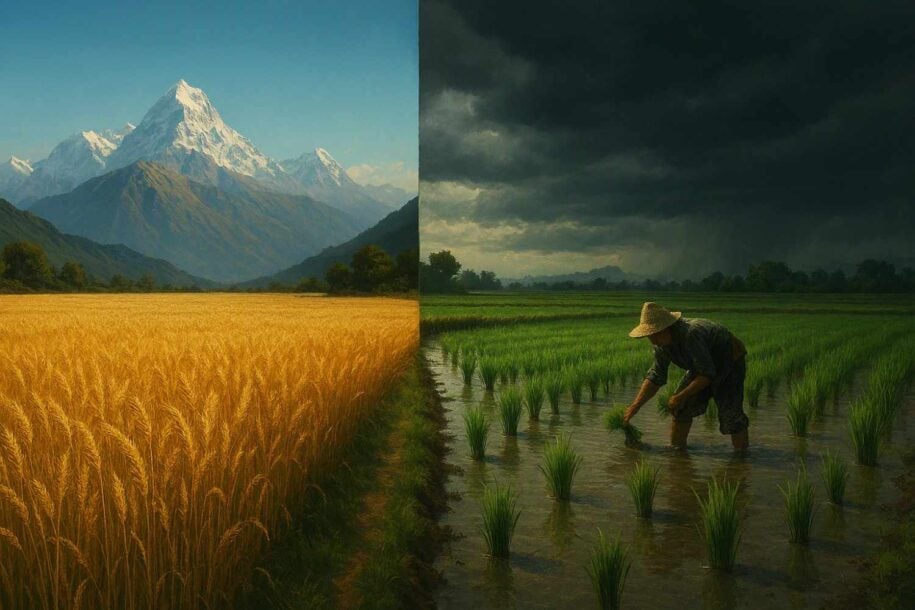
There is a question almost nobody asks about India, and it is more interesting than it first sounds.
Why does Punjab celebrate its new year in April with bonfires and a festival built around cut wheat, while Tamil Nadu celebrates its harvest festival in January, watching a pot of rice boil over with milk and jaggery.
Why do the temples of the south rise in towering gopurams visible from a distance, while many temples of the north sit smaller and more intimately set into a riverbank or hillside, each approach answering a different question about how a community wants to meet the divine.
Why does the north’s classical music tradition favour a single performer exploring a raga alone, while the south’s classical tradition favours an ensemble in constant, audible dialogue with itself.
One honest, well documented answer, among several that matter, turns out to be sitting on a plate in front of you at almost every meal.
It is the grain.
This is not a claim that one grain made one part of India somehow better, more advanced, or more anything than the other. It is a claim that two different staple crops, requiring two very different patterns of land, water and seasonal timing, quietly shaped two different calendars, cuisines and artistic traditions over thousands of years, on top of which language, religion, empire and trade then built the rest of India’s extraordinary regional character.
The Grain That Helped Shape Two Different Indias
Wheat and Rice Have Been Splitting the Subcontinent Since the Bronze Age
The division between India’s wheat growing north and rice growing south is not a modern agricultural accident. It is one of the oldest documented facts about the subcontinent, dating back to its very first farmers.
The Indus Valley Civilisation grew wheat and barley as its primary winter staples, while its summer crops included rice, millets and beans. Wheat and barley were rabi or winter crops, sown after the seasonal floods receded, while rice belonged to the kharif or summer season, requiring a different relationship with standing water, labour and the rhythm of the year.
Archaeologists working at the Indus city of Rakhigarhi have found that these Bronze Age farmers practised sophisticated multi-cropping based on seasonal awareness, growing rice, millet and beans in the summer monsoon and wheat, barley and pulses in the cooler winter months, a level of agricultural planning that predates comparable evidence from Mesopotamia or Egypt.
It was largely geography, not preference, that eventually settled the subcontinent into two grain economies. The plains fed by the Indus and the upper Ganga, the lands that would become Punjab, Haryana and Uttar Pradesh, had cooler, drier conditions well suited to wheat. The river deltas, monsoon coastlines and waterlogged plains of the south and east, the lands that would become Tamil Nadu, Kerala, Andhra Pradesh and Bengal, had exactly the abundant standing water that rice paddy cultivation requires and that wheat cannot tolerate.
The land largely made the choice. The people who settled it simply built their lives, and eventually their calendars, around what it allowed them to grow.
Why Wheat and Rice Follow Completely Different Calendars, and Why That Matters More Than It Sounds
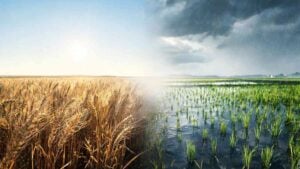
Wheat is a winter crop. It is sown after the monsoon recedes, grows slowly through the cooler months, and ripens all at once, in spring, across the entire wheat belt in roughly the same narrow window. Rice is a monsoon crop. It depends on standing water through the hot summer months, and because monsoon timing, transplanting schedules and local water availability vary considerably by region, rice harvests are staggered across a much wider stretch of the calendar, region by region, rather than arriving everywhere at once.
This single agricultural fact, more than almost anything else, explains one of the most striking things a traveller notices about India: it does not celebrate one harvest moment together. It celebrates many, each one timed precisely to when a particular grain in a particular region has actually come good.
How Wheat and Rice Left Their Mark on the Two Indias You Can Still See Today
Why North and South India Celebrate Their New Year at Completely Different Times of Year
Few things reveal the grain divide more vividly, or more harmlessly, than India’s calendar of harvest festivals, since the timing of nearly every major regional festival is fixed by the same simple fact, when a particular grain ripens in that particular region.
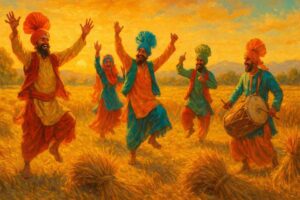
In Punjab, Baisakhi falls every April, marking the moment the winter sown wheat reaches full maturity and is ready to be cut. The festival is built entirely around this single agricultural fact, with farmers gathering in the fields to thank the land for the rabi harvest, and bhangra and gidda performed in the open fields where the wheat has just been cut, the dance steps themselves said to echo the physical motion of harvesting and threshing grain by hand. The same April date also marks the Punjabi new year and, for Sikhs, the founding of the Khalsa, layering agricultural, calendar and religious significance onto a single moment built around one grain reaching ripeness.
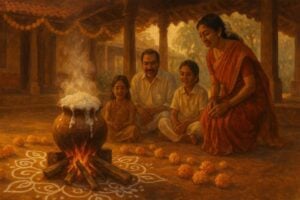
In Tamil Nadu, Pongal falls every January, an entirely different season, because rice on the Tamil plains follows an entirely different planting and ripening calendar, shaped by the southwest and northeast monsoons rather than Punjab’s winter rains. Pongal takes its name from the literal moment newly harvested rice, cooked with milk and jaggery in an earthen pot, boils over the rim, an overflowing pot read as a direct, visible symbol of abundance. The festival unfolds across four distinct days, each with its own focus, gratitude to the sun, gratitude to the cattle that work the rice fields, and a final day dedicated to extended family gathering, a structure shaped by the slower, more staged rhythm of a rice harvest compared to a single wheat cutting.
Kerala’s Onam, Assam’s Bihu, Odisha’s Nuakhai and Bengal’s Nabanna each follow this same underlying logic, each festival timed to a specific grain reaching readiness in that specific region’s specific climate. The result is a genuinely beautiful fact about India: the country does not celebrate one new year or one harvest moment together, because it was never actually farming on one single calendar to begin with. Wheat ripens once, in spring, across the north. Rice ripens at different points across the year depending on region and monsoon pattern. India’s extraordinary spread of harvest festivals across virtually every month of the calendar is, in the most literal sense, a direct map of when each region’s particular grain has historically come good.
The Cuisine Divide That Quietly Follows the Same Pattern
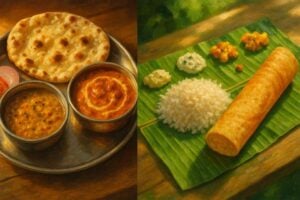
Stand at a thali restaurant in Amritsar and then at a meals house in Madurai, and you are looking at two different staple traditions, each one fully developed and equally central to the people who grew up eating it.
North Indian cuisine centres on wheat, with leavened breads baked in a tandoor, unleavened flatbreads cooked on a flat griddle, and rich, dairy based gravies built from ghee, butter, cream and slow cooked meat or paneer. South Indian cuisine centres on rice, with steamed rice, fermented rice batter dishes like idli and dosa, and lighter, tangier gravies built from coconut, tamarind, curry leaves and mustard seed.
There is a small, genuinely interesting detail in how each grain reaches the table, without it meaning one cuisine is eaten more communally than the other, since shared meals and generous hospitality are central to family life in both traditions. A wheat flatbread is individually rolled and cooked in minutes, while the fermentation that turns raw rice batter into idli or dosa batter is a slow, patient, overnight process that depends on conditions no single cook fully controls. These are two different relationships with preparation time, not two different relationships with hospitality.
What the Temples Reveal, and a Geography Far More Likely Than Character
The wheat and rice divide in India extends well beyond the kitchen and the calendar, and it maps onto one of the most visible architectural differences a traveller will notice moving from the Indo-Gangetic plain into peninsular India, a difference best explained by geography and history rather than by any claim about which region values community more.
The Nagara style: a temple built to look like a mountain.
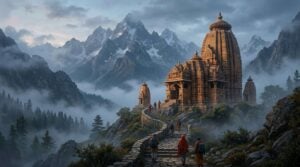
North Indian temple architecture, the Nagara style, is built around the shikhara, a curved tower rising in an organic silhouette deliberately echoing Mount Kailash or Mount Meru. Many of the great Nagara temples were built as remote pilgrimage destinations, reached by crossing rivers or climbing hills, so the temple does not dominate the landscape so much as emerge from within it. Once a visitor crosses the pillared mandapa hall, the final destination, the garbhagriha or sanctum, is typically small, dim and largely unadorned, built to hold only a handful of people at a time, with muffled acoustics that concentrate attention on a single quiet exchange between worshipper and deity.
It is also worth noting, separately from any question of temperament, that North India experienced repeated waves of invasion across the centuries, and a temple complex needs many generations of uninterrupted royal patronage to expand into a sprawling city sized institution. That kind of multi century stability was harder to sustain in much of the north than it was further south, which is a far more plausible explanation for the difference in scale than any claim about how northern and southern communities relate to one another.
The Dravidan style: a temple built to be seen from miles away.
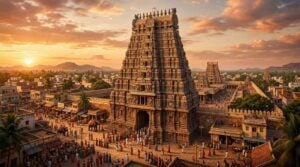
South Indian temple architecture, the Dravida style, takes the opposite approach to scale, rising in towering gopurams, monumental gateway towers visible from a considerable distance, built to draw an entire surrounding region toward a single point. A major Dravida complex such as the Meenakshi temple in Madurai or the Brihadisvara temple in Thanjavur is laid out in concentric courtyards called prakaras, often containing vast stepped water tanks known as kalyani, thousand pillared halls, and historically functioning as far more than a place of worship, doubling as a centre of grain storage, education and the arts. The wide open courtyards were built specifically to host the utsavam, the temple’s great annual festivals, when the deity is carried out of the sanctum on a massive wooden ratha or chariot and paraded through streets packed with singing, clapping devotees.
What Classical Music Actually Shows, and Why It Resists This Theory Neatly
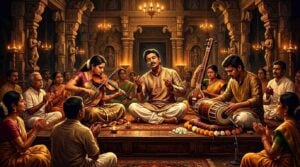
If this theory predicted a perfectly tidy pattern, the north’s classical music tradition would be the structured, group based one, and the south’s would be the individual, improvised one. India’s two great classical music traditions do not cooperate with that expectation, and the reason becomes obvious once you understand where each tradition actually grew up.
Hindustani music developed largely within the royal courts of the Mughal Empire and various princely states, performed for an intimate, elite audience, often in a baithak or salon setting. The goal of that setting was to evoke one specific mood or one specific time of day with total depth, which required an unhurried, deeply internalised musical journey rather than a public spectacle.
This courtly origin gave rise to the alap, the unaccompanied, rhythm free introduction that many musicians within the tradition consider its highest art form. A vocalist or sitarist may spend forty five minutes exploring a single raga entirely alone before the percussion even enters. The secondary musician, a harmonium or sarangi player providing a drone, deliberately avoids pulling focus. The soloist is, in effect, talking to themselves, testing the edges of the raga, while the audience quietly eavesdrops on what is close to a meditative, solitary process.
Carnatic music grew up in an entirely different setting, rooted in the temples of South India and shaped by the public, communal energy of the Bhakti devotional movement. Where the northern tradition prizes pure improvisation above all else, Carnatic music is anchored around the kriti, a highly structured, intricately composed piece passed down from named composers such as Tyagaraja and Muthuswami Dikshitar. Because every musician on stage already knows the precise blueprint of the composition, they can play directly off one another in real time.
This produces some of the most genuinely thrilling moments in any classical tradition anywhere in the world. The violinist in a Carnatic ensemble does not simply accompany the vocalist, but shadows them a split second behind, catching lightning fast melodic ornaments, called gamakas, as they happen. During the kalpanaswaram, the improvised section of a performance, the vocalist throws out a spontaneous melodic phrase like a puzzle, and the violinist must answer it instantly with an equal or better phrase of their own, an audible, real time exchange of musical wit. The percussionists, on mridangam, ghatam and kanjira, do not merely hold a steady rhythm but anticipate the vocalist’s phrasing with complex cross rhythms, building toward the thani avarthanam, a dedicated closing passage where the percussionists alone trade intricate rhythmic phrases back and forth between themselves.
Neither tradition is more skilled, more disciplined or more emotionally rich than the other. One grew from a solitary courtly art designed to be overheard rather than performed outward. The other grew from a public devotional art designed to be played, in the most literal sense, together.
There is a striking correspondence between each region’s temple form and its musical form, worth noticing without ranking either tradition.
North: Hindustani and Nagara
A single explorer, whether musician or worshipper, given a contained space for an unhurried, unaccompanied journey. Seen most clearly in the alap of a Hindustani raga and in the small, quiet sanctum of the Kandariya Mahadeva Temple at Khajuraho.
South: Carnatic and Dravidian
A coordinated group, whether ensemble or congregation, given an open space built for real time, large scale response. Seen most clearly in the kalpanaswaram exchange of a Carnatic concert and in the vast festival courtyards of the Brihadisvara Temple at Thanjavur.
This is not evidence that one region is more introspective or more communal as a matter of character, since both regions have produced art and architecture built for solitary contemplation and for enormous collective celebration in their own ways, the Mughal era qawwali tradition’s ecstatic communal gatherings in the north being one obvious example that sits outside this entire pattern.
The Honest Limits of This Theory, Stated Plainly
A responsible account of this idea has to include its limits clearly, because India makes a genuinely complicated case study, and the complications are part of what makes the country worth visiting slowly.
The wheat and rice divide explains festival timing with real precision, since festival dates are fixed by harvest, not interpretation. It explains the broad shape of regional cuisine with similar confidence. It explains temple architecture only partially, since dynastic history and available building stone matter just as much. And it does not explain classical music at all in the direction one might expect.
The accurate and useful way to describe this is not that wheat or rice decided who India’s people are. It is that two different staple crops, ripening on two different calendars and requiring two different farming rhythms, left a real and traceable imprint on when India celebrates, what India eats, and some of what India builds, while language, religion, empire, trade and countless individual histories did the much larger share of the work in building India’s extraordinary, irreducible regional diversity.
Experience the Two Indias With 5 Senses Tours
See the Wheat Belt and the Rice Belt for Yourself
There is no better way to encounter this divide thoughtfully than to travel from one belt into the other and watch the land, the festivals and the food shift, while keeping in mind that what shifts is rhythm and tradition, not which region is somehow richer in culture or accomplishment.
Our Delhi tours take you through the heart of India’s wheat belt, the Indo-Gangetic plain that has grown wheat for over four thousand years.
Travel further into our Kerala tours and you cross into the rice belt, where the August festival of Onam and centuries of cooperative paddy farming have shaped one of the most distinctive cultural landscapes anywhere in the world.
Our Kolkata tours and Kolkata city tour take you into rice growing Bengal specifically, where the Nabanna festival celebrates the new rice harvest each winter, on a calendar entirely its own.
5 Senses Tours is recognised by India’s Ministry of Tourism, winner of the Tripadvisor Travellers Choice Award and the Outlook Responsible Tourism Award. Every tour is private, expert guided and completely customised for your group.
Talk to a 5 Senses Tours expert about building a journey that traces this fascinating grain divide across India for yourself.
Ô
Leave a Reply