
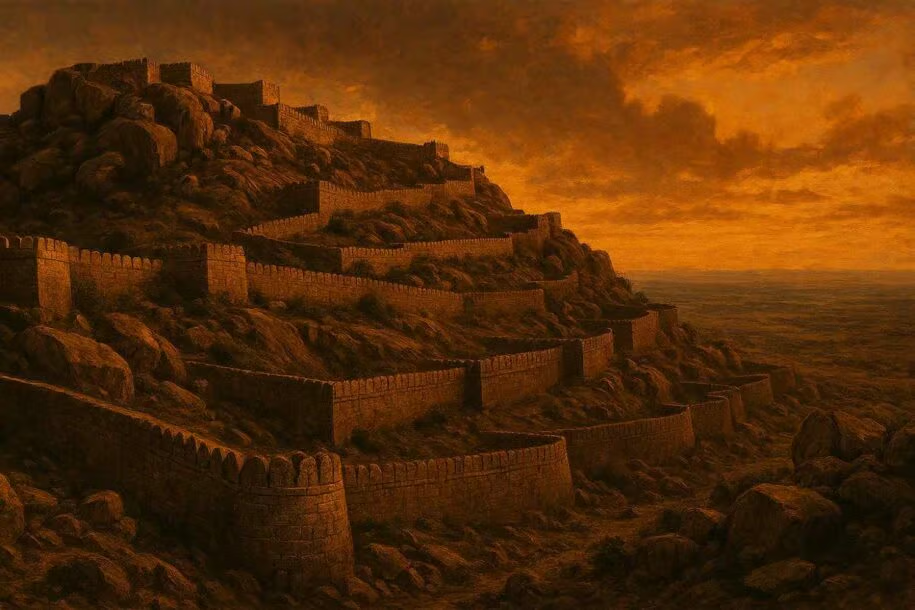
High above the windswept plains of Karnataka, where boulders rest like forgotten gods and the sky meets stone in a quiet embrace, Chitradurga Fort rises, unyielding, untamed, and utterly unforgettable.
It has seven concentric walls of fortification. Nineteen gateways. Thirty-eight postern gates. Thirty-five secret passages. Four entries so completely concealed that they are described in the historical record simply as invisible. Two thousand watchtowers. And a water harvesting system so sophisticated that the fort never ran out of water regardless of how long it was besieged.
The Nayaka rulers who built and expanded this fort between the 14th and 18th centuries were among the most skilled military engineers in the history of medieval India. They integrated the fort’s walls with the natural granite boulders of the hillside so completely that it is, in places, genuinely impossible to tell where the rock ends and the human construction begins. They designed zigzag pathways specifically to slow enemy troops and prevent the use of battering rams. They armoured the main gates with iron spikes to stop war elephants. They built underground escape tunnels. They constructed a cascade of interconnected reservoirs that filled one from the other as rainwater collected on the hillside and routed the overflow into the moat below.
And then, in 1779, after surviving three separate sieges across two decades of assault by one of the most formidable military commanders of the 18th century, the most sophisticated defensive system in Karnataka fell.
Not because the walls were breached. Not because the gates were broken. Not because the water ran out or the food gave way.
Because of a hole in the rock just large enough for one person to crawl through. And because the soldier who was supposed to be guarding it had gone home for lunch.
What happened in the minutes that followed is one of the most extraordinary stories in the military history of South India. The name of the woman at the centre of it is Onake Obavva. The weapon she used was the pestle she had brought to the pond to fetch water.
This is the complete story of Chitradurga Fort, one of the most extraordinary military structures in India and the most undervisited extraordinary fort in Karnataka.
Chitradurga Fort: The Complete History of the Fort That Held Out for Four Hundred Years
How Chitradurga Fort Became the Most Formidable Hill Fort in Karnataka
The Chitradurga Fort is locally known as the Elusuttina Kote, which means the fort of seven circles. The name describes the most immediately striking fact about its construction: seven concentric fortification walls, one inside the next, each one commanding a view over the lower walls outside it, so that a defender on any inner wall could see everything happening at the walls below.
The fort was built on rocky hills, and Timmana Nayaka, who was a commander under the Vijayanagar Empire, was given the rank of governor of Chitradurga as a reward for his military skills. The earliest systematic fortification of the hill dates from around 1562 CE under Kamageti Timmanna Nayaka, but the site’s strategic significance traces back considerably further. Based on inscriptions of the Chalukyas, the Hoysalas and the Vijayanagar kings found in this fort, the history of the site can be traced back to the Ashokan period. This places human activity and military awareness of this particular hill at the very beginning of recorded Indian imperial history.
The Nayaka dynasty that made Chitradurga its centre of power were originally feudatories of the Vijayanagar Empire, governors and military commanders who had been rewarded for their bravery with control of this strategically vital territory in the heart of Karnataka’s Deccan plateau. When the Vijayanagar Empire collapsed after the catastrophic Battle of Talikota in 1565, the Nayakas of Chitradurga found themselves suddenly independent, governing a territory that every major power in peninsular India wanted to control.
During the rule of Hoysala Empire and Vijayanagara Empire, they served as a feudatory. Later after the fall of the Vijayanagara Empire, they ruled at times as an independent kingdom and at other times as feudatory of the Mysore Kingdom, the Mughal Empire and the Maratha Empire. This constant political balancing act, shifting alliances between Mysore, the Marathas and the Mughals as each threatened to overwhelm the territory, required the Nayakas to maintain a fort of absolute impregnability as their ultimate guarantee of independence. The seven walls, the thirty-five secret passages, the two thousand watchtowers, the iron-spiked gates and the cascade of water reservoirs were not architectural ambition for its own sake. They were the engineering answer to four centuries of being a small but strategically vital kingdom surrounded by far larger powers.
The Engineering of Chitradurga Fort: A Military System Designed to Defeat Every Known Method of Attack
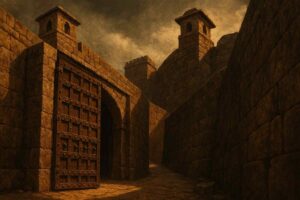
Locally known as Elusuttina Kote, the fort of seven circles, it is one of the most formidable hill forts in the country. Originally boasting 19 gateways, 38 postern gates, 35 secret entrances and four invisible entrances, it was built between the 11th and 13th centuries. Its doors were constructed from sturdy wooden beams reinforced with iron plates. The rugged terrain was strategically designed such that each line of fortification commanded a view over the others below. Zigzag pathways were laid out to prevent enemy advancement, while main gateways were fortified with iron spikes to deter elephants.
Every element of Chitradurga Fort’s design addresses a specific problem of medieval siege warfare. The seven concentric walls meant that breaching the outer wall gave an attacker nothing except exposure to fire from the second wall, and that breaching six walls in succession under sustained defensive fire from above was functionally impossible. The zigzag pathways prevented battering rams, which require a long straight run to build momentum. The iron spikes on the main gates stopped war elephants, which were the heavy artillery of medieval Indian warfare. The multiple postern gates and secret entrances gave the defenders constant ability to counterattack, resupply and move forces around the perimeter without exposing themselves to the main assault.
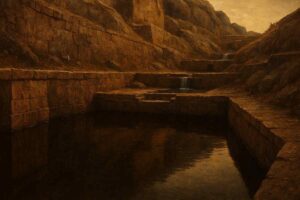
Chitradurga Fort is renowned for its sophisticated water harvesting system. Interconnected reservoirs collected and stored rainwater, which overflowed from each tank flowing into other tanks below it. Such an effective system ensured that the fort never ran out of water. After filling all these tanks, the water used to flow to the moats around the fort walls.
The water system deserves particular attention because it was the factor that made Chitradurga genuinely resistant to the most common and most reliably effective strategy of medieval siege warfare: simply waiting. Most forts fell not to assault but to thirst and starvation. Chitradurga’s cascade of interconnected natural depressions converted into cisterns, supplemented by purpose-built reservoirs at strategic elevations, gave it a water supply that was self-replenishing with every monsoon and large enough to sustain the entire garrison through multiple dry seasons. It was a system so effective that historians writing about the fort in the colonial period specifically identified it as one of the most impressive engineering achievements of any fort in peninsular India.
At the height of Nayaka rule, Chitradurga Fort had 18 temples, 19 gateways, 38 posterior entrances, 35 secret entrances, multiple reservoirs and warehouses, and 2,000 guard towers. The fort successfully repelled a near-constant stream of would-be invaders until 1779, when it fell to Hyder Ali of the Kingdom of Mysore.
Onake Obavva: The Woman Who Defended Chitradurga Fort Alone

This is the story that brings visitors from across Karnataka and increasingly from across the world to stand at the narrow passage in the rock that is still shown to every visitor as Onake Obavvana Kindi, the hole of Onake Obavva.
During the reign of Madakari Nayaka, the city of Chitradurga was besieged by the troops of Hyder Ali. A chance sighting of a man entering the Chitradurga Fort through a hole in the rocks led to a plan by Hyder Ali to send his soldiers through that hole. The guard, Kahale Mudda Hanuma, who was on duty near that hole, had gone home to have his lunch. During his meal he needed some water to drink, so his wife Obavva went to collect water in a pot from a pond which was near the hole in the rocks, halfway up the hill. She noticed the army trying to enter the fort through the hole. She used the Onake or pestle to kill the soldiers one by one by hitting them on the head and then quietly moving each corpse without raising the suspicions of the rest of the troops.
The details of this story are worth pausing on, because they are what makes it extraordinary rather than merely heroic.
Obavva was not a soldier. She was a guard’s wife who had walked to the pond to fetch water. She had no weapon. What she had was a pestle, the heavy wooden implement used to grind grain, which she happened to be carrying, and the presence of mind to understand immediately what she was seeing and what it meant.
She did not run for help. Running for help would have taken time she did not have and might have alarmed the soldiers coming through the hole into accelerating their entry, overwhelming the fort before any defence could be organised. Instead, alone and with no weapon beyond the implement in her hand, she positioned herself at the exit of the hole and dealt with each soldier as he emerged, one at a time, moving each body quietly before the next man came through.
Among the many heroes and heroines of Chitradurga, mention must be made of Onake Obavva, the wife of a common soldier, who, while fetching water during one of the several sieges of the fort, heard the muffled sound of enemy soldiers attempting to enter the fort walls through a small crevice that was just big enough for one person at a time to crawl through.
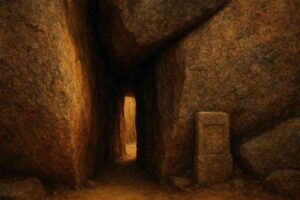
The hole that Hyder Ali’s soldiers were using was exactly the vulnerability that no military engineering system can completely eliminate: a natural fissure in the rock, invisible on any architectural plan, discovered by chance reconnaissance and exploited with the specific genius of Hyder Ali’s military intelligence. Against the most sophisticated fort in Karnataka, against seven walls and thirty-five secret passages and two thousand watchtowers, a natural hole in the granite was the decisive weakness. And a woman with a pestle was the decisive defence.
Amid the 1779 conflict, local folklore credits Onake Obavva, the wife of a fort guard, with repelling enemy soldiers by using a pestle at a secret tunnel entry, an act celebrated in Kannada legend. The Karnataka government formally recognised Onake Obavva Jayanti on November 11 in 2021, and a major sculpture commissioned by the government and executed by sculptor Ashok Gudigar now stands near the district office in Chitradurga, commemorating the woman whose name has been given to the passage itself.
The narrow opening in the rock, Onake Obavvana Kindi, is still shown to every visitor to Chitradurga Fort. Standing beside it, understanding how small it is, how completely it would have concentrated the entry of soldiers into a single, unavoidable chokepoint, makes the story simultaneously completely credible and completely astonishing.
How Chitradurga Fort Finally Fell and What Happened After

After three sharp clashes with Chitradurga in the 1760s and 1770s, Haidar Ali finally took the fort in 1779 and the region became a Mysore province. Madakari Nayaka IV, the last ruler of Chitradurga, and his family were imprisoned at Shrirangapattana, where they died.
The fort’s fall in 1779, despite Obavva’s defence during an earlier phase of the siege, came through the combination of Hyder Ali’s persistent military pressure, the accumulated exhaustion of a kingdom that had been fighting for its survival across three decades of sustained assault, and ultimately political betrayal. Having been betrayed by the Marathas and some local officers, Madakari Nayaka was defeated by Hyder Ali, taken prisoner and killed.
The fort was taken over for a short while by Hyder Ali at Chitradurga in 1779. The fort was captured by the British forces twenty years later, when they defeated his son Tipu Sultan. The British garrisoned troops at Chitradurga between 1799 and 1809, after which it reverted to the Mysore government and has remained under the administration of the Archaeological Survey of India ever since.
Today, Chitradurga Fort is a beloved landmark in Karnataka, but it is little-known in the rest of India, let alone the rest of the world. While much of its history has been marked by bloodshed, it serves as a cultural monument and place of unity for Kannadigas.
Inside Chitradurga Fort: What You Will Actually See
The Seven Walls, Nineteen Gateways and the Complete Military Landscape
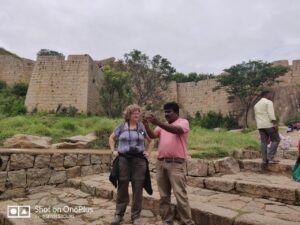
Walking through Chitradurga Fort is unlike walking through any other fort in Karnataka, and arguably unlike any other fort experience available anywhere in South India. The integration of the natural granite boulder landscape with the constructed fortification walls means that the fort is not a building you walk around but a landscape you walk through, with the walls appearing and disappearing into the rock and the boulders themselves becoming walls at certain points.
The fort has zigzag pathways to slow down enemies entering the fort. The doors here are made of thick wood and fastened with iron plates. It also has a sophisticated water harvesting system that ensures that the fort never runs out of water. Apart from all this, the Chitradurga Fort also has a total of sixteen temples within it. Some famous temples are Hidimbeshwara, Ekanthamma, Phalguneshvara, Gopalkrishna, Anjaneya, Subbaraya and Basava. Another essential element of this fort is the Onake Obavvana Kindi.
The nineteen gateways are each designed with the same principle of the zigzag approach: you cannot see what is directly inside any gate from outside it, because the passage bends. An attacker who breached a gate would find himself not in an open space but facing a stone wall at close range with defenders positioned above and on both sides. The geometry of the gateways is a masterclass in the application of medieval defensive thinking to specific topographical conditions.
The Temples, the Masjid and the Remarkable Hidimbeshwara Temple
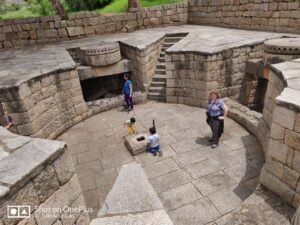
The fort has numerous temples like the Sampige Siddheshwara, Hidimbeshwara, Ekanathamma, Phalguneshvara, Gopalakrishna, Anjaneya, Subbaraya and Basava. A big piece of bone has been kept in the Hidimbeshwara Temple and is shown as the tooth of the demon Hidambasura, and a cylinder of iron plates, six feet high and ten feet in circumference, as the bheri or kettle-drum of Bhima.
The Hidimbeshwara Temple is the oldest and most historically interesting temple within the fort complex. Its connection to the Mahabharata tradition, specifically to the demon Hidamba whose encounter with the Pandavas is one of the more memorable episodes of the epic, demonstrates the extent to which the Chitradurga landscape carries mythological associations that significantly predate its history as a military fortification.
The Eakanatheswari temple, constructed by Matti Thimmanna Nayaka in the 15th century, features a Deepa stambha (lamp pillar) and a Uyyale Khamba (swing arch) prominently displayed at its entrance. A masjid was established during the reign of Hyder Ali. The presence of both Hindu temples and a mosque within the same fort complex, the former representing the Nayaka tradition and the latter the brief period of Hyder Ali’s rule, makes Chitradurga Fort one of the most quietly interesting examples of layered religious heritage available at any single Karnataka heritage site.
5 Senses Tours takes international travellers to Chitradurga Fort as part of the most complete Karnataka heritage journey available from Bangalore. If this story has moved you, the passage where Onake Obavva stood is still there, the walls she defended are still standing and the fort that held out for four hundred years is exactly as dramatic in person as it sounds in the telling. Plan your Chitradurga heritage experience with 5 Senses Tours.
Experience Chitradurga Fort With 5 Senses Tours

The Chitradurga Fort Day Tour From Bangalore
Chitradurga Fort is located approximately 200 kilometres north of Bangalore, a journey of approximately three and a half hours by road through the Karnataka Deccan landscape. It is one of the strongest hill forts in the country and is at an approximate distance of 200 kilometres from the state capital Bengaluru.
Our Chitradurga Fort tour from Bangalore is a full-day private experience with an expert cultural guide, private air-conditioned vehicle, breakfast and lunch included, covering the complete fort complex with the depth and storytelling that transforms Onake Obavvana Kindi from a hole in a rock into the most dramatic single moment in the fort’s extraordinary military history.
The tour is also available by Royal Enfield motorcycle for travellers who want to experience the Karnataka Deccan landscape in a more visceral and atmospheric way than a car journey can provide.
Combine Chitradurga With the Complete Karnataka Heritage Circuit
Chitradurga Fort sits within the most extraordinary concentration of heritage destinations in Karnataka, and our tours connect it naturally to the broader Karnataka circuit.
Our Bewitching Ruins Trail is the most complete way to experience Chitradurga alongside the wider Karnataka heritage landscape, combining the fort with the UNESCO World Heritage ruins of Hampi, the Daroji Sloth Bear Sanctuary and the extraordinary Chalukya cave temples of Badami, Aihole and Pattadakal across six extraordinary days from Bangalore.
For travellers who want the complete Karnataka heritage circuit from Bangalore, our Must Visit Places in Karnataka tour covers Bangalore, Mysore, Hampi, Badami, Belur, Halebid, Aihole, Pattadakal, Talakadu and Chitradurga across eight extraordinary days, the most comprehensive single Karnataka heritage journey available from any tour operator in India.
5 Senses Tours is recognised by India’s Ministry of Tourism, winner of the Tripadvisor Travellers Choice Award and the Outlook Responsible Tourism Award. Every tour is private, expert-guided and completely customised for your group.
Talk to a 5 Senses Tours expert about including Chitradurga Fort in your Karnataka itinerary today.
Contact 5 Senses Tours to begin planning your Chitradurga heritage experience today