
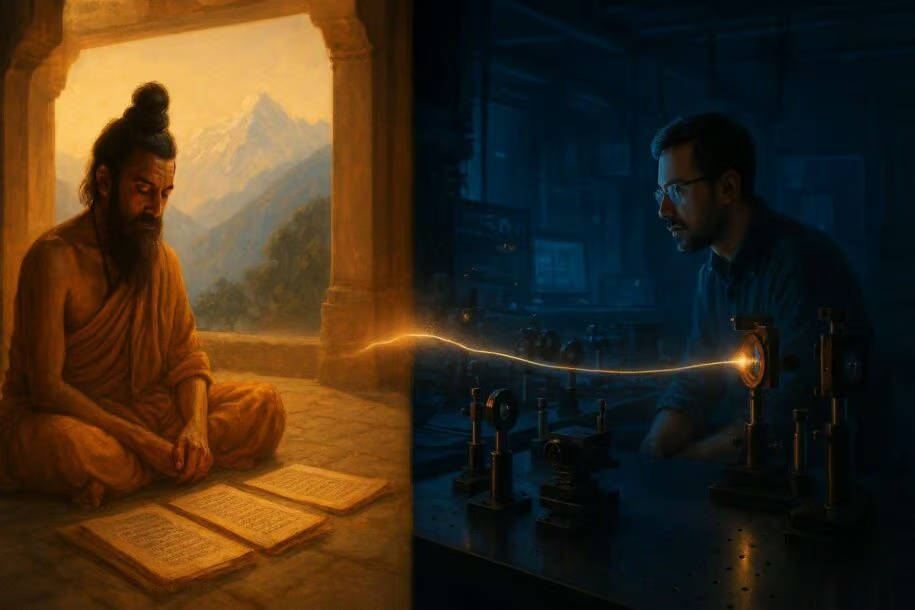
In October 2022 the Royal Swedish Academy of Sciences awarded the Nobel Prize in Physics to three scientists, Alain Aspect, John F. Clauser and Anton Zeilinger, for experiments with entangled photons, establishing the violation of Bell inequalities and pioneering quantum information science.
What they proved, with a precision and rigour that has now definitively settled one of the most consequential debates in the history of science, is that two particles can be connected across any distance in a way that no classical understanding of physical reality can explain. Measure one, and the other responds instantly, regardless of how far apart they are. Not because they are sending signals to each other. Not because one is physically influencing the other. But because, at some fundamental level, they are not actually separate at all.
What happens to one particle in an entangled pair determines what happens to the other, even if they are really too far apart to affect each other.
Einstein hated this. He called it spooky action at a distance. He spent the last decades of his life insisting that quantum mechanics must be incomplete, that there must be some hidden local variables, some undiscovered mechanism that would restore common sense to physics and eliminate the need to believe that the universe permits this kind of non-local connection.
The three 2022 Nobel laureates proved, across fifty years of increasingly rigorous experiment, that Einstein was wrong. Quantum mechanics cannot be replaced by a theory that uses hidden variables. The universe is genuinely non-local. Separation, at the quantum level, is not quite what it appears to be.
Two thousand five hundred years earlier, ancient Indian philosophy had said something that sounds remarkably similar.
Advaita Vedanta, the non-dual school of ancient Indian philosophy associated most prominently with the 8th-century philosopher Adi Shankaracharya, proposes that the apparent separateness of individual things and persons is a feature of maya, of our perceptual experience, rather than a fact about ultimate reality. According to this view, everything is woven into a singular consciousness, and the perceived separateness of entities is an illusion.
This blog is the complete story of what the 2022 Nobel Prize in Physics actually proved, what ancient Indian philosophy actually says, where the two traditions genuinely and specifically converge, and where the honest limits of that comparison lie. Because this comparison is made carelessly and enthusiastically in too many places, and the interesting truth requires being precise about both what is similar and what is entirely different.
What the 2022 Nobel Prize Proved About Quantum Physics and Ancient Indian Philosophy

The Einstein-Bohr Debate: The Disagreement That Set Up the Nobel Prize
To understand what the 2022 Nobel laureates actually proved, you need to understand the disagreement that their experiments were designed to settle.
In 1927 Niels Bohr and Albert Einstein began one of the most consequential intellectual arguments in the history of science. The argument was about what quantum mechanics actually meant, about what kind of reality the equations were describing.
Quantum mechanics had established that before a particle is measured, it does not have a definite value for certain properties. A photon does not have a definite polarisation until you measure it. An electron does not have a definite position until you look at it. The wave function that describes the particle contains multiple possible values simultaneously, and measurement collapses this wave function to a single definite outcome.
Bohr accepted this as a fundamental feature of physical reality. The universe genuinely does not have definite values for quantum properties until those properties are measured. Reality is, in a deep sense, indeterminate until observed.
Einstein rejected this entirely. He believed the universe must have definite properties at all times regardless of whether they are being observed. If quantum mechanics said otherwise, then quantum mechanics was incomplete. There must be hidden variables, undiscovered physical quantities, that predetermine the outcomes we observe. The universe does not play dice.
In 1935 Einstein, together with Boris Podolsky and Nathan Rosen, published what became known as the EPR paradox. They described a thought experiment in which two particles interact and are then separated by a large distance. If you measure one particle and it has a definite value for a property, the other particle instantly acquires the opposite value regardless of the distance between them. Einstein argued this proved that the values must have been predetermined from the moment the particles separated, carried as hidden variables by each particle, because the alternative, that measuring one particle physically affects the other instantaneously across any distance, would violate relativity and the principle that nothing can travel faster than light.
What Clauser, Aspect and Zeilinger Actually Showed the World

In 1964 the physicist John Stewart Bell developed a mathematical theorem that transformed this philosophical dispute into an experimentally testable question. Bell’s theorem showed that if hidden variables existed, if particles carried predetermined values for their properties, then correlations between measurements on entangled particles could only be as strong as a specific mathematical limit, known as a Bell inequality.
If quantum mechanics was right and no hidden variables existed, experiments would violate this inequality. If Einstein was right, experiments would respect it.
John Clauser developed John Bell’s ideas, leading to a practical experiment. When he took the measurements, they supported quantum mechanics by clearly violating a Bell inequality. This means that quantum mechanics cannot be replaced by a theory that uses hidden variables.
Alain Aspect developed the setup further, using it in a way that closed an important loophole. He was able to switch the measurement settings after an entangled pair had left its source, so the setting that existed when they were emitted could not affect the result.
Using refined tools and long series of experiments, Anton Zeilinger started to use entangled quantum states. Among other things, his research group has demonstrated a phenomenon called quantum teleportation, which makes it possible to move a quantum state from one particle to one at a distance.
What these three scientists collectively established is that local realism is not a property of our universe. The 2022 Nobel Prize in Physics was awarded specifically for confirming this experimentally, the most precise and consequential experimental result in the history of quantum mechanics.
Local realism is the combination of two assumptions Einstein believed to be obviously true. Locality: that a measurement in one place cannot instantly affect something in another place. Realism: that objects have definite properties independent of whether they are being measured.
The Nobel Prize rewarded the experimental proof that the universe violates at least one of these. The Nobel Committee member Eva Olsson said the work has opened doors to another world, and it has also shaken the very foundations of how we interpret measurements.
What Ancient Indian Philosophy Actually Says About the Nature of Reality
The Core Claim of Ancient Indian Philosophy: Non-Duality and Brahman
Advaita Vedanta is one of the six classical schools of Hindu philosophy and one of the most rigorously argued systems in the entire history of ancient Indian philosophy. Its name means literally non-dual Vedanta, the interpretation of the Vedas and Upanishads that holds that ultimate reality is non-dual, that apparent multiplicity and separateness are features of experience rather than features of ultimate reality itself.
The foundational claim is this. Brahman, the ultimate reality, is one, indivisible and without attributes or distinctions. The individual self, the atman, is not separate from Brahman. The experience of individual selfhood, of being a distinct entity in a world of other distinct entities, is the product of maya, a term that means neither simple illusion nor full reality but something between, the way a dream is neither fully real nor simply nothing.
In Advaita Vedanta, non-duality posits that the ultimate reality transcends all dualistic distinctions, such as subject-object or self-other. According to this view, everything is woven into a singular consciousness, and the perceived separateness of entities is an illusion.
The Upanishads express this through the famous formulation Tat Tvam Asi, meaning That thou art. The individual consciousness and the universal consciousness are not separate things that have come into relationship. They were never separate. The appearance of separation is the product of avidya, of ignorance, and moksha, liberation, is the experiential recognition that this separation was never real.
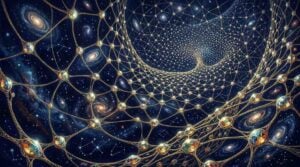
The Buddhist tradition offers a complementary image in the metaphor of Indra’s Net, a vast cosmic net in which every node holds a jewel, and every jewel reflects every other jewel, so that the entire net is contained in each single jewel. No part is independent of the whole. Every element contains every other element.
How Ancient Indian Philosophy Described the Illusion of Separation
The Mandukya Upanishad, one of the shortest and most philosophically dense texts in the ancient Indian philosophical tradition, describes four states of consciousness and concludes that the deepest level of reality, turiya, the fourth, is a state in which the conventional distinctions between self and world, between knower and known, between subject and object, dissolve entirely into a single undivided awareness.
This is not a claim about particle physics. It is a claim about the nature of consciousness and the nature of reality at the level of direct experience. Ancient Indian philosophy developed this claim through argument, through commentary, through centuries of philosophical debate within the tradition and with rival schools of thought. Adi Shankaracharya’s commentaries on the Brahma Sutras, the Upanishads and the Bhagavad Gita are among the most rigorously argued philosophical texts produced in any tradition before the modern era.
The claim is that what appears to be a world of separate, independent, locally real objects is not the deepest or most complete account of what is actually there. That the experience of separation is produced by a particular mode of cognition, avidya, ignorance, rather than by reality itself.
Erwin Schrödinger, the Upanishads and the Quantum Physics Connection

The connection between ancient Indian philosophy and quantum physics is not a recent invention of New Age enthusiasts. It was noticed and taken seriously by some of the founders of quantum physics itself.
Erwin Schrödinger was deeply influenced by Advaita Vedanta. In What Is Life? published in 1944, he writes about the unity of all life, echoing the Vedantic idea that the self is the same as the universal. He believed that life is not separate from the universe, but one with it.
Schrödinger wrote explicitly about the Upanishads and their concept of consciousness as a basis for his thinking about what quantum mechanics implied about the relationship between observer and observed. Werner Heisenberg, whose 1929 meeting with Rabindranath Tagore in Kolkata has been described in detail in an earlier 5 Senses Tours blog, engaged seriously with Indian philosophy during his India visit. David Bohm, who developed the theory of implicate order as an interpretation of quantum mechanics, was in explicit dialogue with the Vedantic tradition.
These were not casual comparisons. They were serious engagements by serious physicists with a philosophical tradition they recognised as addressing the same foundational questions their physics was forcing them to confront.
Ancient Indian Philosophy and Quantum Physics: Where They Genuinely Converge
The First Convergence: Both Challenge the Independence of Separate Things
Quantum entanglement demonstrates that two particles that have interacted and been separated retain a form of correlation that cannot be explained by any information they carry independently. The measurement of one is non-locally correlated with the measurement of the other in a way that has no classical explanation.
Ancient Indian philosophy proposes that the apparent independence and separateness of individual entities is a feature of experience, maya, rather than a feature of ultimate reality.
Both are challenging the same naïve intuition: that things which appear separate actually are fully independent of each other. This is a genuine and specific convergence, not a vague poetic resonance.
The Second Convergence: Both Question the Reality of Everyday Perception
 The 2022 Nobel Prize rewarded the proof that the universe does not satisfy local realism, the combination of locality and realism that our everyday experience strongly suggests. Ancient Indian philosophy’s non-dual ontology similarly denies what we might call everyday realism, the assumption that the ordinary experiential world of distinct, separate objects is the deepest or most complete account of reality.
Both are telling us that our default picture of a world of separate, fully independent things is, in some important sense, incomplete. Neither the science nor the philosophy is saying the everyday world does not exist. Both are saying the everyday world is not the whole story.
The Third Convergence: Both Take the Observer Seriously
Quantum mechanics has forced a sustained engagement with the question of what measurement means and what role the observer plays in determining or revealing physical reality. The Copenhagen interpretation suggests that quantum properties are not definite until measured. Ancient Indian philosophy places consciousness as the fundamental ground of reality, with the phenomenal world arising within consciousness rather than consciousness arising within the world.
Both Vedanta and quantum mechanics point toward the same radical conclusion: reality is not simply out there waiting to be observed by a separate consciousness.
Ancient Indian Philosophy and Quantum Physics: Where the Honest Limits Are

Quantum Physics Does Not Involve Consciousness in the Way Ancient Indian Philosophy Does
The majority of physicists would explicitly reject the claim that quantum measurement requires or involves human consciousness in any essential way. A detector, a camera, a particle accelerator, any physical interaction that creates a permanent record constitutes a measurement in the quantum mechanical sense.
The role of the observer in quantum mechanics is a profound and genuinely unsettled interpretive question, but it is not the same as the Advaitic claim that consciousness is the fundamental ground of all reality. One is a question about the mechanics of measurement. The other is a metaphysical claim about the ultimate nature of existence. These are not the same question and the answer to one does not answer the other.
Quantum Entanglement Cannot Transmit Information and Ancient Indian Philosophy Does Not Claim This Either
When two wave-particles become entangled, they stay connected no matter how far apart they are, and changing one instantly affects the other. This appears to conflict with Einstein’s theory of special relativity, which says that nothing can affect something else faster than the speed of light.
But crucially, while the correlation between measurements is instantaneous, you cannot use quantum entanglement to send information faster than light. The non-locality that quantum entanglement reveals is real and remarkable, but it is not the same as the universal interconnectedness of all things that ancient Indian philosophy describes. The two claims operate at completely different levels.
Two Completely Different Methods Asking Two Completely Different Questions

Quantum mechanics is an empirical theory built on experimental evidence, mathematical prediction and falsifiable claims. Ancient Indian philosophy is a philosophical and spiritual framework built on textual interpretation, logical reasoning and, in its traditional context, the testimony of enlightened experience.
These are not competing theories about the same thing. They are different kinds of inquiry conducted with different tools aimed at different questions. The fact that their conclusions seem to converge in certain respects is philosophically interesting. It does not mean one proves the other in either direction.
The Scale Problem That Separates Quantum Physics From Ancient Indian Philosophy
Quantum entanglement is a phenomenon that occurs at the subatomic scale. Whether quantum effects scale up to the level of everyday experience, of human consciousness, of tables and trees and persons, is a genuinely unsettled scientific question. Most physicists would say that quantum effects are washed out at macroscopic scales by decoherence. Ancient Indian philosophy makes its claims about the ultimate nature of reality at every scale including the human.
While the parallels between quantum physics and Indian philosophy are intellectually stimulating, scholars urge caution in drawing equivalences. One major concern is a possible category error when one mixes scientific constructs with metaphysical or spiritual doctrines.
What the Honest Comparison Is Worth Saying

Having stated the limitations clearly, here is what can be said honestly.
The 2022 Nobel Prize in Physics established that the universe at the quantum level cannot be fully described by any theory that assumes full local independence between separated things. The universe has a non-local character that our everyday intuitions about separate, independent objects do not capture.
Ancient Indian philosophy, developed through centuries of philosophical and contemplative inquiry, proposed that the apparent full independence and separateness of things is not the ultimate nature of reality.
These two traditions, using completely different methods, asking different questions and operating at different levels of analysis, arrived at conclusions that share a common direction. Neither the science validates the philosophy nor the philosophy predicts the science. What they share is a challenge to the same naïve default assumption: that the world of separate, independent, locally real objects that our ordinary experience presents to us is the complete and final truth about reality.
That is worth saying. It is worth saying precisely. And it is interesting precisely because the methods are so different and yet the challenge to naïve separateness runs through both.
The Deeper Story: Ancient Indian Philosophy, Quantum Physics and the Indian Heritage Trail

Tagore, Heisenberg and the Conversation That Ancient Indian Philosophy Started a Century Ago
This conversation between modern physics and ancient Indian philosophy is not new. Werner Heisenberg came to Calcutta in 1929 specifically to meet Rabindranath Tagore. The conversation they had about the nature of reality and the relationship between observer and observed has been cited by Heisenberg himself as a source of comfort and framework, a way of making sense of what quantum mechanics seemed to be saying about the world.
Satyendra Nath Bose, whose 1924 paper gave the boson class of fundamental particles its name, worked within a tradition that through the Bengal Renaissance was deeply engaged with the question of how the ancient Indian philosophical tradition related to modern western science. India’s nuclear physicist Raja Ramanna openly said the discovery of quantum mechanics showed him that the old Vedantic truth that the whole universe is one is essentially correct.
These are not fringe voices. They are some of the most distinguished Indian scientists of the 20th century, engaging seriously with a tradition of ancient Indian philosophy that they had grown up within and that the questions of quantum physics were forcing them to revisit.
Where to Experience Ancient Indian Philosophy and Quantum Physics Heritage in India Today

The philosophical tradition of Advaita Vedanta was not produced in isolation. It was developed through specific lineages, specific places and specific practices that are still alive and accessible to international visitors in India today.
Rishikesh in Uttarakhand, situated at the point where the Ganges descends from the Himalayan foothills onto the plains, is the most significant accessible centre of Vedantic learning and practice in contemporary India. The ashrams and teaching institutions along the Ganges at Rishikesh include lineages that trace directly to the Advaita Vedanta tradition of Adi Shankaracharya. Our Rishikesh tours connect international travellers to the living tradition of ancient Indian philosophy in one of its most beautiful and most accessible settings.

Varanasi, the ancient city on the Ganges that has been a centre of Sanskrit scholarship and philosophical inquiry for over three thousand years, is where several of the most significant debates in the history of ancient Indian philosophy were conducted. Our Varanasi tours cover the complete heritage of the oldest continuously inhabited city on earth, from the Ganges ghats at dawn to the extraordinary Sanskrit scholarly tradition that has made Varanasi the most significant centre of classical Indian intellectual life for three millennia.
For travellers who want the complete conversation between ancient Indian philosophy and modern science, the journey connects Kanada’s birthplace near Dwaraka in Gujarat, where atomic theory was proposed 2600 years before Dalton, to our Ahmedabad tours, through the Bengali scientists of Presidency College via our Kolkata tours, who reshaped 20th-century physics, to the Vedantic ashrams of Rishikesh and the Sanskrit scholarly tradition of Varanasi. It is the most sustained and most intellectually ambitious tradition of fundamental inquiry about the nature of reality that any civilisation has produced, available across the physical landscapes where it actually happened.
5 Senses Tours is recognised by India’s Ministry of Tourism, winner of the Tripadvisor Travellers Choice Award and the Outlook Responsible Tourism Award. Every tour is private, expert-guided and completely customised for your group.
Contact 5 Senses Tours to begin planning your ancient Indian philosophy heritage journey today