
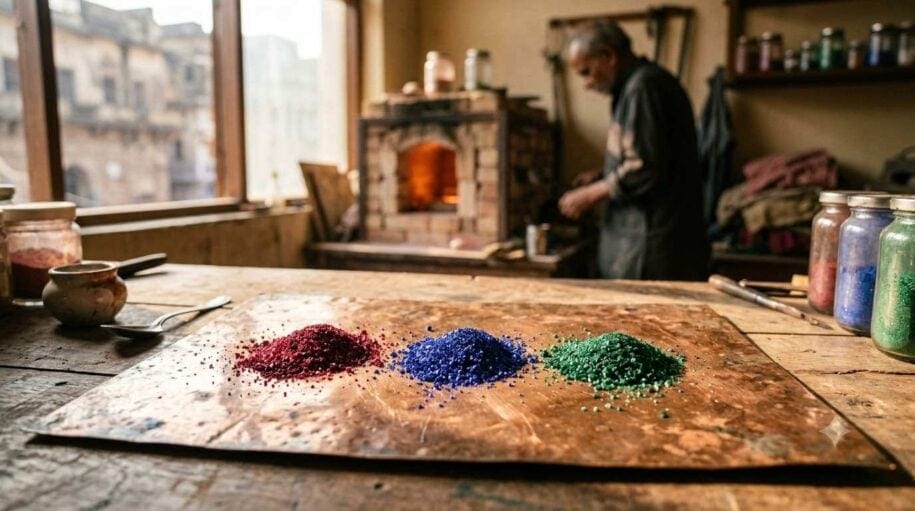
There is a colour that changed the history of art on three continents. It is called the Purple of Cassius, named after the 17th century German alchemist Andreas Cassius who first documented its production, though craftspeople in Persia and India had been making something very similar for centuries before he wrote a word about it. It is produced by dissolving gold in a mixture of nitric acid and hydrochloric acid and precipitating the result onto tin oxide. The colour it produces is a deep, translucent, luminous crimson red that when fused into glass at high temperature creates a surface unlike anything that can be mixed from pigment alone. It glows from within. It has depth rather than surface. It looks, to the uninitiated, like something that should not be possible.
This colour is one of the reasons that Varanasi enamelling reached the enamel houses of Limoges. And it is one of the reasons that what happens in a working studio in Varanasi on weekend mornings is connected to a story that spans three thousand years and five continents.
This is the complete history of enamelling as a global craft tradition, from its origins in Mycenaean Greece around 1450 BCE through its spread across ancient Egypt, the Persian court, Byzantine Constantinople, the meenakari tradition of Mughal India and the painted enamel houses of Limoges in France, to its living presence today in the working studios of Varanasi and its unexpected echo in the fragile silver heritage of the Andaman coast. It is also the story of why Varanasi, a city with an unbroken relationship with fire for over three thousand years, is the right place to encounter this craft in its most living form.

Book the Andaman Way Enamelling Workshop in Varanasi
What Enamelling Actually Is: The Art of Making Colour Permanent
Enamelling fuses powdered glass onto metal at temperatures between 750 and 850 degrees Celsius, creating a coloured surface that is chemically bonded to the metal and effectively permanent on any human timescale. The result is simultaneously the hardness of glass and the permanence of metal, resistant to corrosion, immune to fading, capable of colours of extraordinary depth and luminosity that no paint or dye can replicate because the colour is not applied to the surface but fused into it.
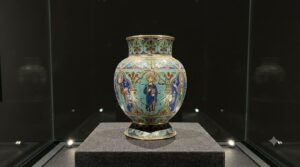
To understand why this matters, consider what every other method of applying colour actually does. Paint, dye, ink and pigment are essentially coatings. The colour sits on the surface of the material and is therefore subject to everything the surface is subject to: light, heat, moisture, abrasion, time. Even the most carefully preserved paintings fade. Even the most carefully stored textiles lose their colour. The pigments that produced the vivid blues and greens of medieval manuscript illuminations are mostly gone now, visible only under ultraviolet light.
Enamelled colour does not fade because it is not a coating. It is the surface itself. The colour, which comes from metallic oxides added to the glass powder before firing, is suspended within the glass. Copper oxide produces blue-green. Iron oxide produces yellows and browns. Gold, suspended in glass through the Purple of Cassius process, produces that deep luminous red that appears in the jewellery of the Mughal court, the reliquaries of the medieval European church and the painted enamel miniatures of Limoges. The same chemistry. Different hands. Different centuries. The same imperishable result.
The Oldest Known Enamelled Objects: Mycenaean Greece to Ancient Egypt
The earliest known enamelled objects in the world date to Mycenaean Greece around 1450 BCE, six golden rings found in Cyprus whose surfaces carry inlaid enamel in a technique now called cloisonné, where thin metal wires create compartments that are filled with powdered glass and fired. Within a few centuries the technique had reached Egypt, where it was incorporated into the jewellery and funerary objects of the pharaohs. By the first millennium CE it had spread through Persia, Byzantine Constantinople, Tang dynasty China and Mughal India, each culture adapting the fundamental chemistry of glass fused to metal into a distinct visual language.
The cloisonné technique is particularly revealing because it was developed independently in Mycenaean Greece, in Tang dynasty China and in the Byzantine Empire within overlapping periods, by craftspeople who had no known contact with each other. Each civilisation was solving the same technical problem, how to keep different colours of molten glass from running together during firing, and each arrived at the same solution: thin metal walls between colour fields. This pattern of independent convergence appears throughout the history of enamelling. Human hands working with the same materials and the same physical laws arrive at the same solutions across cultures that have no connection. What this tells us is that enamelling is not merely a cultural tradition. It is a human response to the fundamental properties of glass and heat.
The Persian Court, the Purple of Cassius and the Road to Limoges
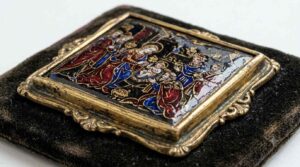
The connection between the Persian court tradition and the enamel houses of Limoges in France is one of the more surprising chapters in the global history of this craft, and the Purple of Cassius is at its centre.
Limoges became the centre of European enamel production in the medieval period and remained so for centuries, producing the painted enamel work that decorated the churches, courts and collections of Europe. The painted enamels of Limoges, made between the 12th and 17th centuries, are now held in the major museum collections of the world including the Louvre in Paris, the Victoria and Albert Museum in London and the Metropolitan Museum of Art in New York. What made Limoges pre-eminent was partly the quality of the local copper deposits and partly the accumulated technical knowledge of its craftspeople, but the particular red that both the Limoges tradition and the Persian court tradition valued most highly was the Purple of Cassius.
The trade routes that carried silk and spices between India and Europe also carried technical knowledge, and the knowledge of how to produce particular colours in enamel was among the most valuable of all. A craftsperson who could produce the Purple of Cassius reliably had a skill that courts and patrons across the known world would pay for. The Persian enamel tradition, which had itself absorbed influences from Byzantine and earlier Central Asian sources, was carried westward into Europe and eastward into India through exactly these trade routes, arriving in Mughal India in the 16th century with the Persian craftspeople who came to the court of Emperor Akbar.
How Varanasi Enamelling Became Part of This Global Story

Varanasi enamelling is part of the meenakari tradition, the Persian word for enamelling, which reached northern India through the Mughal court in the 16th century when Emperor Akbar brought Persian craftspeople to work alongside Indian artisans. The tradition took root most deeply in Jaipur, where it became associated with the jewellery of the Rajput courts, but Varanasi developed its own distinctive approach informed by the city’s particular relationship with metalwork, glass and fire.
Varanasi is one of the oldest continuously inhabited cities on earth, with a recorded history of continuous settlement stretching back over three thousand years and a living craft tradition that encompasses silk brocade, woodwork, stone carving and metalwork of extraordinary refinement. Within this ecosystem, enamelling occupies a particular position: it is both local and global in a way that most Indian craft traditions are not. The Varanasi enamellist is working in a tradition that arrived from Persia, which arrived from Byzantium, which arrived from the ancient Mediterranean world, and that simultaneously carries the specific character of a city whose relationship with fire, colour and permanence is unlike any other on earth.
The connection between Varanasi’s enamelling and the enamel houses of Limoges is not a direct historical relationship. It is a family resemblance. Two branches of the same ancient tree, growing in different soils, shaped by different hands, but sharing the same root chemistry and the same fundamental understanding that colour fused into glass is colour that lasts forever.
The Andaman Connection: Where Craft Histories Converge Unexpectedly

The fragile silver heritage of the Andaman coast is one of the least known chapters in the history of Indian craft, and its connection to the enamelling tradition is one of the most unexpected.
The Andaman Islands were a colonial penal settlement for much of the 19th and early 20th centuries, and the communities that settled there after independence brought with them craft traditions from across India and Southeast Asia. Among these was a distinctive silver jewellery tradition that shows clear traces of enamel influence, the result of the extraordinary mixing of craft knowledge that happened when people from Rajasthan, Bengal, Tamil Nadu and Burma found themselves building a new community on a remote island archipelago.
This convergence produced something that could not have been produced anywhere else. The silver work of the Andaman coast carries traces of Burmese repoussé work, Tamil Nadu’s temple jewellery tradition and the enamel influences that arrived through the meenakari tradition of northern India. It is a physical record of the meeting of cultures that produced, despite the circumstances that brought them together, something of genuine beauty and craft intelligence.
Artist Soma Pradhan, who leads enamelling workshops in Varanasi, traces a direct line between this Andaman silver heritage and the broader global story of enamelling. Her book The Andaman Way, available on Amazon, takes its name from this connection, and her practice is explicitly built on the idea that understanding where a craft has been is inseparable from understanding what it is in your hands today.
Why Enamelled Objects Last Three Thousand Years: The Permanence Behind the Craft
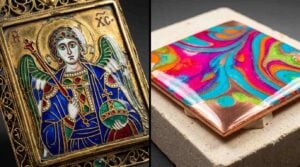
Enamelled objects last three thousand years because the colour is not applied to the surface but fused into it, suspended within glass that has bonded chemically with the metal beneath it at temperatures that approach the melting point of the metal itself.
The Byzantine enamelwork that survived the sack of Constantinople in 1204 and again in 1453 is still visible today in the Treasury of San Marco in Venice and the Kunsthistorisches Museum in Vienna, the colour as deep and luminous as the day it was fused. The enamel jewellery found in Mycenaean graves still carries the colour it was given three thousand years ago. This is not the result of careful preservation. It is the inherent nature of the material.
When you make an enamel piece, you are making something that will almost certainly outlast you. The decisions you made about colour and composition, the pressure of your hands on the copper, the particular way the glass spread when you worked it, these are all recorded in the surface of the piece as permanently as the glass itself. In a world of objects designed for obsolescence, made to be replaced within a few years, making something designed to last for centuries is an act with a weight to it that most contemporary craft experiences do not carry.
The craftspeople who have practised enamelling across three thousand years understood this instinctively. The pharaoh’s jeweller, the Persian court enamellist, the medieval painter of Limoges, the meenakari artist of the Mughal court, all of them were making objects for permanence, for the explicit purpose of outlasting the moment of their making and communicating something durable about the hands that made them.
What Hands Learn That Eyes Cannot: The Knowledge Inside Varanasi’s Enamelling Tradition

There is a particular kind of knowledge that cannot be transmitted through observation or description, and enamelling contains more of it than almost any other craft.
You can watch a skilled Varanasi enamellist work for hours and understand intellectually what they are doing. You can read everything ever written about the chemistry of enamel fusion, the history of the meenakari tradition, the technical vocabulary of cloisonné and champlevé and painted enamel. And you will still not know, until your own hands are on the copper and your eyes are on the kiln, what it actually feels like to make something permanent from something as fragile as powdered glass.
The sensation of spreading crushed glass on copper with a small spatula, the resistance of the material, the way it settles when you get the pressure right and skids when you do not, the sound the kiln makes as it reaches temperature, the particular quality of light that tells you the glass is beginning to fuse. These are not things that can be described with sufficient precision to convey what they actually feel like. They can only be felt.
This is the knowledge that Varanasi’s enamelling tradition carries most deeply and that is most at risk of being lost. The number of working enamellists in Varanasi has fallen significantly over the past three decades. The younger generation faces the same calculation that the children of craft communities across India face: the knowledge is available to be learned, but the economic return on learning it does not obviously justify the years of apprenticeship required. When an enamellist in Varanasi stops working, what is lost is not simply a skill that can be learned from a book. It is a body of embodied knowledge that exists only in their hands and can only be transferred by those hands to another pair of hands in the same room at the same kiln.
Varanasi as the Right Place for This Encounter

Varanasi is the right city for a craft that transforms fragile things in fire, and it is the right city for enamelling specifically, for reasons that go beyond the historical presence of the meenakari tradition here.
The ghats of Varanasi have been lit by cremation fires continuously for over three thousand years, without interruption. Fire in Varanasi is not merely a tool or a source of energy. It is a philosophical presence, the agent of transformation, the boundary between states of being. The Hindu understanding of fire as the mediator between the material and the immaterial has shaped the city’s relationship with every craft that involves it. And enamelling is the most fire-dependent craft of all. Something fragile goes in. Something permanent comes out. The fire is the necessary intermediary.
Varanasi is also structurally built to preserve ancient knowledge. It has been a centre of learning, religion and commerce for long enough that its inhabitants have developed an almost instinctive relationship with the knowledge that belongs to them. The Banarasi weaver who can identify the origin of a brocade thread by feel alone. The pundit who has memorised texts transmitted orally across a hundred generations without being written down. The metalworker whose understanding of alloy and fire comes not from a textbook but from standing beside a parent who learned it from their parent. Varanasi is a city where craft knowledge does not merely survive. It is held. And enamelling in Varanasi, at this moment in its history, needs to be held more than ever.
This is where responsible tourism and craft preservation meet most directly. When a visitor books a session with a working enamellist in Varanasi rather than purchasing a finished piece in a government emporium, they are not simply buying an experience. They are creating the economic signal that tells the next generation of potential craftspeople that this knowledge is valued by the world outside Varanasi. The difference between a craft that is held and a craft that is merely preserved in a museum is exactly this: someone, somewhere, is still paying for the living version of it.