
What Was Found at Adichanallur and Why It Changes Everything
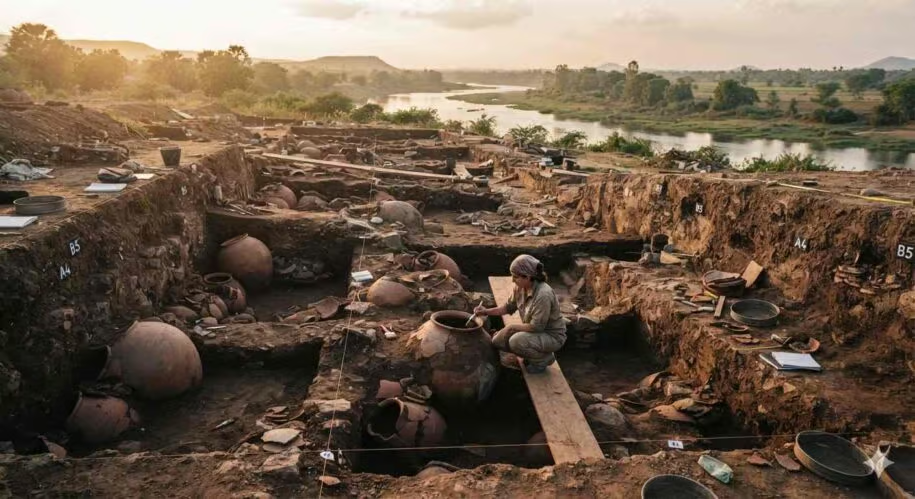
Adichanallur is an archaeological site located approximately 12 kilometres from Tirunelveli in Tamil Nadu, on the southern banks of the Tamirabarani River, and it has been producing extraordinary finds since German archaeologist Friedrich Jagor first excavated here in 1876. What Jagor found then, hundreds of burial urns containing human skeletal remains alongside iron artefacts, was significant enough to attract continued attention but not enough to rewrite the global history of iron. What the Tamil Nadu State Department of Archaeology found when it resumed excavations in the 21st century was something else entirely.
Carbon dating conducted on organic materials found alongside iron artefacts at a depth of 220 centimetres at Adichanallur returned dates averaging 2,613 BCE. This is not a marginal adjustment to an existing timeline. It is a displacement of approximately 1,400 years from the conventionally accepted beginning of the global Iron Age in Anatolia. But the Adichanallur dates are not even the most extraordinary finding from this cluster of sites. That distinction belongs to Sivagalai.
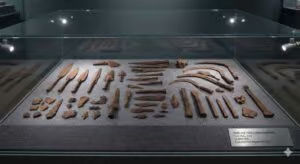
At Sivagalai, a village in the Srivaikuntam taluk of Thoothukudi district, formal excavations commenced in 2019 supported by the Tamil Nadu government and the Archaeological Survey of India. In these excavations, 160 burial urns were unearthed containing iron artefacts whose associated organic material returned carbon dates of 3,345 BCE. This single date, confirmed through radiocarbon analysis and reported in the Tamil Nadu State Department of Archaeology’s publication The Antiquity of Iron, places the beginning of iron smelting in Tamil Nadu at over 5,300 years ago, making it one of the earliest confirmed iron-using cultures anywhere on earth.
The finding prompted Tamil Nadu Chief Minister M K Stalin to declare, citing artefacts tested in laboratories abroad: “Iron Age began on Tamil soil 5,300 years ago.”
The Claim That Rewrites the Harappan Timeline
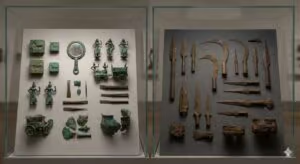
The Harappan civilisation, also known as the Indus Valley Civilisation, is considered one of the four great river valley civilisations of the ancient world alongside Mesopotamia, Egypt and China. At its peak between approximately 2600 BCE and 1900 BCE, it was the largest of the four, covering an area larger than the other three combined. It is also consistently described as a Bronze Age civilisation: its material culture was built on copper and its alloys, and iron does not appear in the Harappan archaeological record.
If the Tamil Nadu dating is correct, then while the Harappan civilisation was at its peak in the Indus Valley working in copper and bronze, the communities on the Tamirabarani River in what is now Tamil Nadu were already smelting iron, a technology the Harappan civilisation never developed. The two civilisations were not in contact with each other in any way that current archaeology has established. They were developing different technological capabilities in parallel, separated by the entire breadth of the Indian subcontinent.
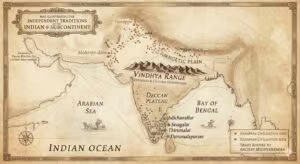
Archaeologist K. Rajan, an advisor to the Tamil Nadu State Department of Archaeology, has offered a compelling explanation for why this might be so. He posits that the Iron Age in South India developed independently, likely because of the scarcity of copper ore south of the Vindhyas. The Vindhya range forms a natural geological and cultural boundary across India, and the communities south of it did not have access to the copper deposits that drove the Bronze Age in northern India and the broader ancient world. Necessity drove innovation: without copper, South Indian communities worked directly with iron, and they apparently mastered it earlier than anyone else.
Adichanallur and the Skull Gold: What the Burial Urns Reveal
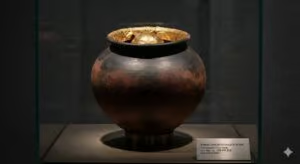
The 1876 excavations at Adichanallur by Friedrich Jagor and the subsequent excavations by the British colonial archaeological establishment produced one of the most haunting finds in Indian archaeology: burial urns containing human skulls covered in thin sheets of beaten gold. This practice, unique in the Indian subcontinent, suggests a burial tradition of extraordinary sophistication, one that involved the deliberate deposition of valuable materials with the dead and a clear understanding of gold as a marker of status or significance in the afterlife.
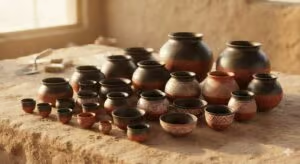
The black-and-red ware pottery found in these burial urns is one of the defining features of the Adichanallur civilisation and is also the pottery type that links Adichanallur to Sivagalai and to the more recently excavated site of Thirumalapuram. Archaeological excavations at Thirumalapuram, reported in 2025, unearthed an Iron Age burial site dating to the early to mid-third millennium BCE whose artefacts, burial methods and ceramic styles closely resemble those at Adichanallur. Black-and-red ware vessels decorated with white-painted motifs, a feature previously considered distinctive to Adichanallur, appeared at Thirumalapuram in identical form. The implication is that Adichanallur was not an isolated phenomenon but the most visible node of a broader Iron Age cultural network spread across the Tamirabarani river valley.
The Tamirabarani is one of the oldest named rivers in Tamil literature, mentioned in Sangam poetry and in the ancient Greek text of the Periplus of the Erythraean Sea as a river where high-quality iron was produced and exported. If the carbon dating at Sivagalai is correct, this river was a centre of iron production for over three thousand years before the Sangam poets wrote about it.
Why South India May Have Invented the Iron Age Independently
The conventional history of iron technology assumes a single origin point in Anatolia from which the knowledge spread outward. This diffusionist model has been the dominant framework in archaeological thinking about iron for over a century, and it has shaped not just the history of technology but the broader narrative of how human civilisations develop and share knowledge.
The Tamil Nadu findings do not merely push the date of Indian iron smelting backward. They raise the possibility that iron smelting in South India was not a received technology at all but an independent invention, a separate solution to the problem of how to produce hard, durable tools and weapons from the materials available in a specific landscape.

The evidence for this independence argument is geological and cultural rather than merely chronological. South India has abundant iron ore deposits, particularly in the ancient megalithic regions of Tamil Nadu and Karnataka, but almost no copper ore. Every other major ancient civilisation passed through a Copper Age and then a Bronze Age before arriving at iron because copper is easier to smelt and was widely available in the regions where those civilisations developed. South India may have skipped the Copper Age entirely because the geology made it irrelevant. The Tamirabarani communities may have moved directly from stone to iron not because they were technologically advanced in some abstract sense but because iron was what their landscape offered them.
This theory of independent invention is supported by archaeologist K. Rajan’s analysis and is the working hypothesis of the Tamil Nadu State Department of Archaeology. It has not yet achieved full consensus in the international archaeological community and the debate continues actively among scholars. But the carbon dates from Sivagalai have not been credibly challenged, and the weight of the physical evidence is behind the independence argument.
The Tamirabarani River Civilisation: Older Than We Thought

The Tamirabarani River is 128 kilometres long, rising in the Agasthyamalai hills of the Western Ghats and emptying into the Gulf of Mannar near Tirunelveli. It is one of the few perennial rivers of Tamil Nadu, fed by both the southwest and northeast monsoons, and its reliable water supply made the Tamirabarani valley one of the most continuously inhabited regions of South India.
The Tamil Nadu government’s archaeological report on the Tamirabarani river civilisation concluded that the civilisation was at least 3,200 years old based on the Adichanallur findings before the Sivagalai carbon dates extended that estimate to 5,300 years. The Periplus of the Erythraean Sea, a 1st century CE Greek maritime text, specifically mentions the Tamirabarani as a source of iron exported to the ancient world. Roman coins, amphorae and other artefacts of Mediterranean origin have been found in excavations along this river, confirming that its products reached the furthest trading networks of the ancient world.
The extraordinary density of significant archaeological sites along a single 128-kilometre river, Adichanallur, Sivagalai, Thirumalapuram and others still being excavated, suggests that the Tamirabarani valley was not a peripheral edge of ancient Indian civilisation but a centre of technological and cultural innovation that operated entirely outside the frameworks through which Indian history has traditionally been understood.
What These Discoveries Mean for the Story of India
India’s ancient history has long been understood primarily through the lens of the northern civilisations: the Harappan culture, the Vedic tradition, the Gangetic plain kingdoms that produced the texts and empires whose records have been most extensively studied. South India appears in this narrative primarily as a recipient, a place that received agricultural practices, religious traditions and technological knowledge from the north and from the ancient world through maritime trade.
The Adichanallur and Sivagalai findings challenge this narrative at its foundation. If South India was smelting iron before the Harappan civilisation discovered copper, then South India was not a technological recipient. It was a pioneer. The communities of the Tamirabarani valley were solving problems that the rest of the ancient world had not yet identified, using resources that their specific landscape provided, developing a material culture whose sophistication is only now beginning to be understood.
This matters beyond the narrow question of who invented iron first. It matters because it changes the story of human civilisation in a way that gives South India its proper weight in the global narrative: not as a beneficiary of ancient trade networks but as a contributor to them, not as a peripheral region that received the Iron Age from Anatolia but as a possible originating point from which iron technology may have spread outward.
The Tamil word for iron, irumbu, has no known cognate in the Dravidian language family that could be traced to a borrowing from another language. It appears to be an original Tamil word for an original Tamil discovery.
The Sites Today: What Visitors Can See
Adichanallur is located in Thoothukudi district, approximately 24 kilometres from Tirunelveli and accessible by road from both Tirunelveli and Madurai. The site itself is not yet developed as a formal heritage tourism destination but the excavations are ongoing and the surrounding landscape of the Tamirabarani valley is itself historically significant. A dedicated museum housing the Adichanallur finds, including the gold-covered skulls and the iron artefacts, is currently being developed by the Tamil Nadu government at a site near Adichanallur.
Sivagalai is located in Srivaikuntam taluk of Thoothukudi district, approximately 35 kilometres from Tirunelveli. The excavation at Sivagalai commenced in 2019 and is ongoing. The site is not yet open to public visitors in a formal sense but awareness of its significance is growing rapidly as the implications of the carbon dating become more widely understood.
The broader Tamirabarani heritage circuit, which includes the ancient Pandya kingdom capital of Korkai near Tirunelveli, the temple towns of the Tirunelveli district and the coastline of Thoothukudi, is one of the most archaeologically rich and least visited stretches of Tamil Nadu. For a traveller interested in encountering ancient South India at a depth that most India tours never reach, this region offers something genuinely irreplaceable.
The Debate That Makes This Story Honest
Any responsible account of the Adichanallur and Sivagalai discoveries must acknowledge that the findings are contested in some quarters of the international archaeological community.
The carbon dating itself is not disputed. The dates returned from the Tamil Nadu State Department of Archaeology’s excavations have been confirmed through laboratory analysis including testing at institutions abroad. What is discussed among scholars is the interpretation: whether the presence of iron artefacts at these depths necessarily implies iron smelting as opposed to the use of meteoric iron, whether the context of the organic materials dated is sufficiently secure to tie the dates definitively to the iron artefacts found alongside them, and whether independent invention is the correct interpretation or whether there might be as yet undiscovered evidence of earlier connections between South India and other iron-using cultures.
These are legitimate scholarly questions and they are being actively investigated. The Tamil Nadu State Department of Archaeology and the Archaeological Survey of India are conducting ongoing excavations at multiple sites in the Tamirabarani valley, and the picture will become clearer as more data accumulates.
What is not contested is the significance of what has been found. Even if the most conservative interpretation of the evidence is correct and the iron smelting at Adichanallur dates only to 2,613 BCE, it still predates the conventionally accepted global Iron Age by approximately 1,400 years. The more extraordinary possibility, that the Sivagalai date of 3,345 BCE represents genuine iron smelting by an independent tradition, would make Tamil Nadu the earliest known centre of iron technology on earth.
Either interpretation rewrites the history of human civilisation in South India. The honest position is to hold both possibilities with appropriate intellectual humility and follow the evidence as it accumulates.