
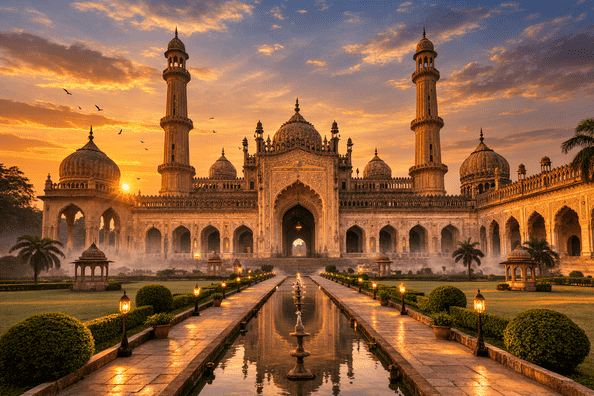
The Monument That Fed a Starving City
In 1784, famine swept across North India. Crops failed. Grain prices soared. Entire villages in Awadh faced starvation.
At the center of this crisis stood a ruler often remembered for his love of poetry, refinement, and courtly culture — Asaf-ud-Daula, the Nawab of Awadh.
What followed became one of the most extraordinary chapters in Bara Imambara history — a story where architecture became economic relief, and a monument became a lifeline.
Today, visitors admire the grandeur of Bara Imambara in Lucknow. Few realize that this architectural marvel was not built to celebrate victory, religion, or royal ego.
It was built to prevent starvation.
Understanding the true Bara Imambara history changes how you see its soaring arches and labyrinthine corridors. It transforms stone into testimony.
For visiting Bara Imamdara, please visit Lucknow Experience.
The Great Famine of 1784 and the Crisis in Awadh

The famine of 1784 — sometimes linked to the wider Chalisa famine affecting North India — devastated agricultural regions across the Gangetic plain. Historical climate research suggests abnormal monsoon failures, likely connected to El Niño patterns and broader climatic irregularities of the late 18th century.
Awadh, one of the richest provinces in India at the time, was not spared.
Asaf-ud-Daula had recently shifted his capital from Faizabad to Lucknow. The city was expanding. Artisans, laborers, and migrants were arriving in search of work. When the famine struck, the urban poor were the first to suffer.
Food relief through direct charity was limited and politically delicate. But there was another method — one rooted in dignity rather than dependency.
Public works.
Why Was Bara Imambara Built? A Monument as Famine Relief

When people search “Why was Bara Imambara built,” the answer usually mentions religion. It is true that the structure served Shia commemorative purposes. But that is only half the story.
The deeper truth in Bara Imambara history is economic strategy.
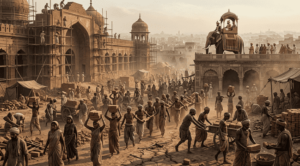
Asaf-ud-Daula commissioned the construction of Bara Imambara in 1784 as a massive employment project. Tens of thousands of laborers were hired. The project provided wages instead of handouts.
There is even a widely repeated account that laborers worked during the day, while aristocrats dismantled portions at night so construction could continue — ensuring sustained employment. While historians debate the literal accuracy of this detail, it reflects something culturally powerful: the Nawab’s intent to preserve dignity.
In Awadhi folklore, a proverb emerged:
“Jisko na de Maula, usko de Asaf-ud-Daula.”
(One whom even God does not provide for, Asaf-ud-Daula will.)
Whether embellished or not, the proverb captures how people remembered him.
Engineering Marvel — The Architectural Genius of Bara Imambara

The architectural dimension of Bara Imambara history is just as fascinating as its humanitarian roots.
The central hall of Bara Imambara is one of the largest arched constructions in the world built without iron beams or supporting girders. The vaulted ceiling relies purely on interlocking brickwork and lime mortar — an example of advanced Indo-Islamic engineering.
Modern structural analysis confirms that the load-bearing system distributes weight through thick walls and layered arches, a design technique seen in Persian and Mughal architecture but executed here on a monumental scale.
Above the main hall lies the famous Bhulbhulaiya — a labyrinth of narrow corridors designed both for structural lightening and defensive strategy.
What looks ornamental was also mathematical.
The monument is not simply beautiful. It is intelligent.
Lucknow’s Transformation Under Asaf-ud-Daula

To fully grasp Bara Imambara history, you must understand Lucknow’s transformation during this period.
When Asaf-ud-Daula moved his capital to Lucknow in 1775, the city began evolving into a cultural powerhouse. Persian poetry, Kathak dance, culinary refinement, and architectural patronage flourished.
Bara Imambara became the symbolic heart of this new capital.
Its construction stimulated brick kilns, lime production, artisan workshops, calligraphy, carpentry, and decorative arts. In economic terms, it triggered multiplier effects — where one major project fuels multiple industries.
This is not speculation. Urban economic studies show large infrastructure projects historically stabilize economies during crisis by generating distributed labor demand.
In other words, Bara Imambara was an 18th-century stimulus package.
The Human Story Behind Bara Imambara History

When tourists stand inside the central hall today, they look upward in awe.
But imagine standing there in 1784.
Imagine being a laborer who arrived with no grain left in his village.
Imagine earning wages to feed your family.
Imagine knowing that this massive structure rising from the earth was your survival.
That emotional dimension rarely appears in travel brochures.
Yet it is what makes Bara Imambara history resonate globally. Around the world, monuments often symbolize power. Here, it symbolized protection.
The building was not raised to intimidate. It was raised to employ.
How Bara Imambara Compares to Other Famine Relief Efforts in History
Globally, rulers have responded to famine in different ways.
In 19th-century Ireland, during the Great Famine, public works were introduced — though often inefficient and politically constrained.
In Mughal India, earlier emperors occasionally opened royal granaries during shortages.
What makes Bara Imambara history distinct is scale combined with architectural ambition. It was not a temporary ditch-digging project. It was a permanent urban landmark.
The Nawab could have built something modest. Instead, he created one of the defining monuments of North India.
Crisis produced culture.
Visiting Bara Imambara Today — Seeing the Story Beneath the Stone

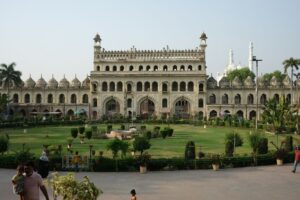
When you visit Bara Imambara in Lucknow today, you walk through more than corridors.
You walk through 18th-century economic policy.
You walk through famine memory.
You walk through the ambition of a ruler who chose construction over collapse.
Understanding Bara Imambara history transforms a sightseeing stop into an encounter with resilience.
The dramatic gateways, the echoing chambers, the intricate passages — they all gain weight when you know they once echoed with the sounds of chisels striking stone for survival.
Why This Story Matters to Modern Travelers
Travel today is shifting. Cultural travelers are no longer satisfied with surface-level photography. They want context. They want meaning.
Bara Imambara history offers exactly that.
It is a story of:
- Leadership during crisis
- Architecture without steel
- Urban growth during famine
- Dignity through employment
In an era where governments still debate stimulus spending during economic downturns, the decision of Asaf-ud-Daula feels unexpectedly modern.
Lucknow is often described as a city of etiquette and refinement. But beneath that grace lies a history of resilience.
And Bara Imambara stands as its greatest metaphor.
For a guided tour, please visit Bara Imamdara experience.
The Monument That Still Feeds Curiosity
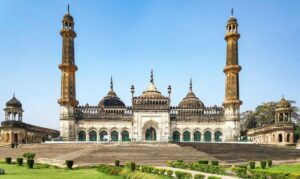
More than two centuries later, Bara Imambara continues to feed people — not with grain, but with curiosity.
It feeds historians.
It feeds architects.
It feeds travelers seeking depth beyond postcard images.
The next time someone searches “Bara Imambara history” or “Why was Bara Imambara built,” they may expect dates and architectural details.
What they deserve is this story.
A story where a Nawab faced famine not with indifference, but with bricks.
And those bricks still stand in Lucknow’s skyline — quiet witnesses to a moment when compassion took architectural form.
For immersive culture walks in India, visit 5 Senses Walks.
Leave a Reply