
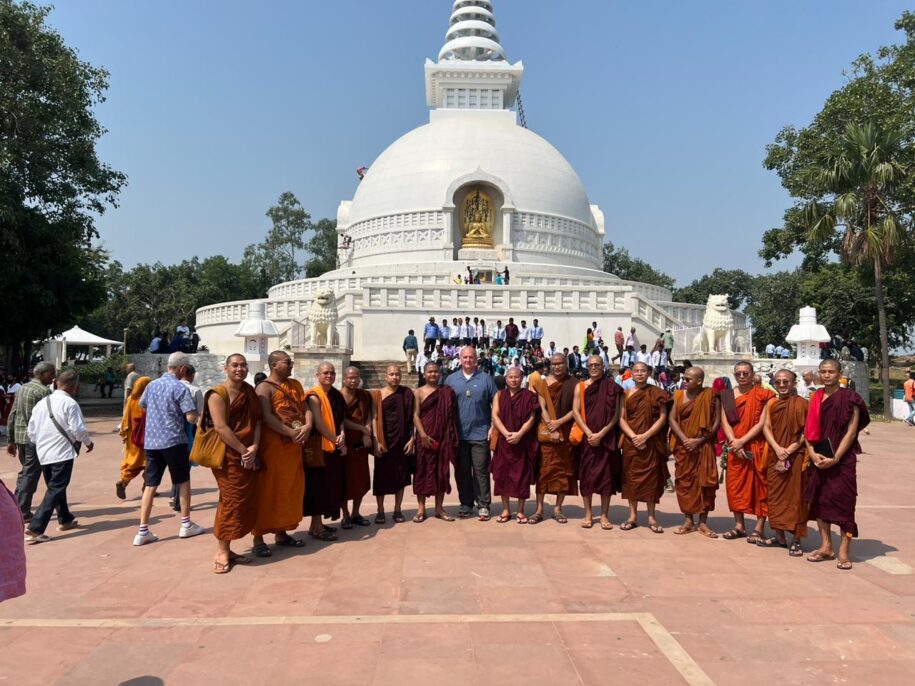
Travellers arrive in Bodh Gaya expecting a peaceful religious site. What they don’t expect is how curiously fascinating the place becomes once you start tugging at its loose threads. This tiny town in Bihar isn’t just a spiritual landmark; it’s a historical puzzle, a meeting point of global cultures, and one of India’s most quietly dramatic archaeological tales.
Walk a little slower here, and the place reveals its secrets like a storyteller who enjoys suspense.
A Tree That Is Practically a Biological Time Capsule
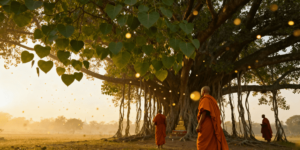
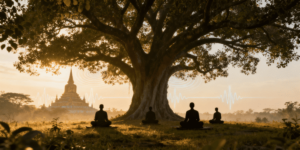
The Bodhi Tree you see today stands in the exact spot where Siddhartha Gautama meditated 2,500 years ago. Its species—Ficus religiosa—is known for extreme longevity, often living centuries by continually regenerating itself through aerial roots. Botanists studying the tree describe its lineage as a “living bridge” through time. The current tree is a direct descendant of the original, preserved through monastic tradition and confirmed through botanical studies.
It feels less like a tree and more like a slow-growing witness.
A Temple Built Like a Stone Flame
The Mahabodhi Temple’s soaring pyramid looks simple at first, then grows stranger the longer you stare. Archaeologists point out that its vertical symmetry imitates the ascent of consciousness described in ancient Indian cosmological texts. The structure follows mathematical ratios from the Śilpaśāstras, architectural manuals so precise that modern architects can chart them like equations.
It’s a visual metaphor for awakening carved in stone.
The Diamond Throne: Ashoka’s Gift to Eternity
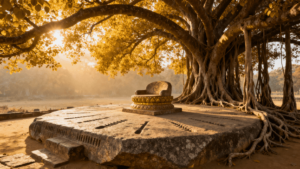
Beneath the Bodhi Tree lies the Vajrasana, or Diamond Throne—a Mauryan granite platform placed by Emperor Ashoka. Granite barely ages. Choosing it was an act of design brilliance, ensuring the “seat of enlightenment” would outlast the ambitions of dynasties and centuries of monsoons. Archaeologists studying its carvings can still trace Mauryan tool marks.
Ashoka built many monuments, but this one feels like a signature carved into time.
The Sacred Site That Went Missing

Bodh Gaya vanished from collective memory for centuries. Political changes dimmed the region’s Buddhist presence, the temples quietened, and the site slipped into obscurity. In the 1800s, scholars started following the travel diaries of Chinese monks—especially Xuanzang, whose descriptions were so detailed they read like ancient GPS coordinates.
Matching his writings with Bihar’s landscape slowly brought Bodh Gaya back into focus, like a forgotten painting being restored.
A Passport-Free World Tour of Buddhist Cultures
Within a short walk, you can step into Japanese, Tibetan, Thai, Bhutanese, Sri Lankan, Mongolian, and Vietnamese monasteries—each a different expression of devotion. Anthropologists call Bodh Gaya “a living museum of global Buddhism,” a rare place where multiple lineages meet daily.
It’s a cultural tapestry stitched by travellers from across the world.
Meditation Feels Different Here—And Research Gives Clues
Long-term meditation studies reveal thickened prefrontal cortex regions (attention), calmer amygdala activity (stress regulation), and brainwave patterns that slip easily into synchrony. People often say the air in Bodh Gaya feels meditative. Part of that comes from psychology—what researchers call “meaning effect”—and part from the natural acoustics of the temple complex.
Silence here behaves like a physical presence, not an absence.
The Architecture of Quiet
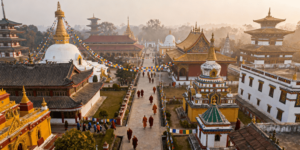
The Bodhi Tree’s dense canopy softens sound. The courtyard scatters noise instead of reflecting it. The stone walls around the temple act like acoustic buffers. Without ever planning it, nature and masonry combined to create a natural meditation chamber.
Scientists could model it; monks simply use it.
Even the Soil Has a Backstory
The land around the Niranjana River is known for geological stability. Sediment layers remain largely undisturbed for thousands of years. A coincidence scientifically, yet it adds a poetic charm: enlightenment took root on steady ground.
A Night Lit by a Thousand Lamps
During festivals, the Mahabodhi Temple appears to float in a sea of lamps. Each flame carries symbolism—clarity, impermanence, awakening. The visual spectacle is just the surface. Underneath is a philosophical idea expressed through fire.
Why These Stories Matter to Travellers
A visit to Bodh Gaya becomes memorable when the place is allowed to unfold slowly. The tree, the silence, the monasteries, the ancient stones—they all reveal layers that reward curiosity. Travellers leave with more questions than they arrived with, but they are gentler questions, the kind that open the mind rather than weigh it down.
For travellers who want the stories behind the stones, the symbolism behind the rituals, and the archaeology behind the legends, a private guided experience brings the place alive. 5 Senses Tours curates immersive journeys through Bodh Gaya—slow, personal, and rich with the hidden layers that most visitors miss. Visit Bodhgaya tours to know more.
Bodh Gaya is quiet, but its stories carry a long echo. The journey continues long after you leave its sacred courtyard.
Leave a Reply