
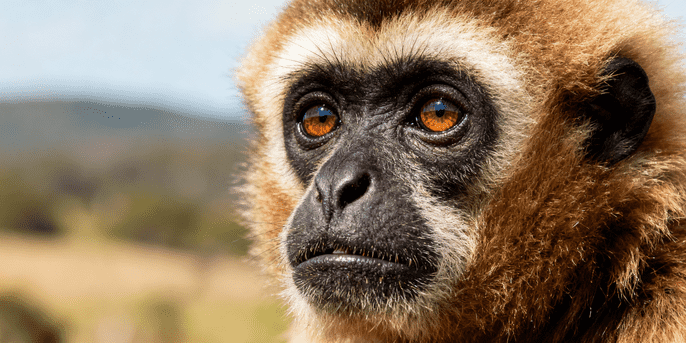
For wildlife enthusiasts, certain encounters feel less like sightseeing and more like a conversation with the natural world. Watching a tiger cross a jungle path, or meeting the eyes of a tusker in the half-light, can feel like reading a secret chapter of Earth’s biography. But there is a quieter, rarer experience waiting in the forests of Assam—one that doesn’t roar or trumpet, but sings. This is the world of the Hoolock Gibbon, India’s only ape, and one of the most graceful acrobats of the canopy.

Hidden inside the emerald folds of Hoollongapar Gibbon Sanctuary, these remarkable creatures live in a world strung between treetops—moving like swift shadows through the branches, announcing dawn with haunting calls that drift through the forest like ancient music. For travellers who chase unique wildlife moments across continents, a visit to the gibbon forests of Assam promises something genuinely special.
Why the Gibbons of Assam Matter

The Hoolock Gibbon is unlike any other wild being in the Indian landscape. Unlike monkeys, it doesn’t leap; it swings. Its arms, long and elegant, are designed for a style of movement called brachiation, letting it glide effortlessly from branch to branch at speeds that would impress even the most seasoned climber. Scientists often describe gibbons as “masters of the canopy,” and watching one move is as close as humans get to witnessing flight without wings.
Beyond their athleticism, gibbons have an extraordinary social life. They pair for life, raise families with tender coordination, and begin each morning with a duet—male and female calling together in a rising, echoing chorus to declare territory and reaffirm their bond. These calls, scientifically studied for their complexity, act as communication systems and social glue within the forest.
Then there’s the sanctuary itself. Hoollongapar is a biological island surrounded by tea gardens and railway tracks—a place where ancient rainforest survives in pockets of green. This patch of forest is one of the last safe spaces for seven different primate species, including stump-tailed macaques, pig-tailed macaques, and capped langurs. But the gibbons remain its undisputed stars.
A 2-Day, 1-Night Journey from Guwahati
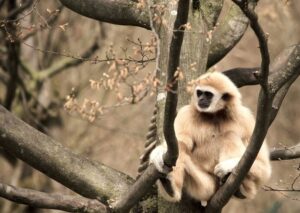
For travellers with limited time, a well-crafted 2-day circuit from Guwahati offers a perfect window into this world. You’ll travel across landscapes where tea bushes roll like green waves and mist clings to the branches at dawn. More importantly, you’ll reach the forest early enough to witness the gibbons while they’re active, vocal, and most visible.
5 Senses Tours, known for their immersive cultural and nature-based experiences across India, curates this journey with care for both visitor and habitat—ensuring ethical viewing, expert guides, and a deep understanding of the forest’s rhythm.
Day 1: Guwahati to Jorhat – Journey into the Green
Your adventure begins with a morning departure from Guwahati. As the city gives way to open fields, palm-fringed villages, and slow rivers, you gradually enter the tea country of Upper Assam. The air grows cooler, the roads quieter, and the horizon greener.
By afternoon, you reach Jorhat, often called the “tea capital of India.” This laid-back town becomes your base for the night. After settling in, you can explore local markets, walk through leafy tea estates, or simply rest before the next morning’s early start.
5 Senses Tours arranges comfortable accommodations near the sanctuary, ensuring you’re close enough for a pre-sunrise departure—essential for catching the gibbons at their most active.
Day 2: The Gibbons at Dawn – A Meeting in the Canopy

Dawn in Hoollongapar feels like a curtain rising. The forest begins in silence, then slowly fills with calls—some sharp, some soft, and then, finally, the long, rising notes of the gibbons. Their voices carry over a kilometre, curling through the trees like a chorus from another era. Naturalists suggest that these calls evolved as territorial markers, but travellers often describe them as musical and strangely moving.
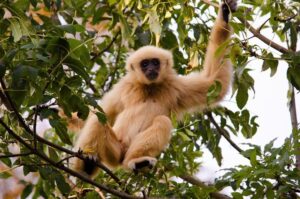
Walking into the forest with an expert guide, you begin scanning the treetops. Then, with a soft rustle, they appear. A male gibbon swings effortlessly across branches, his black fur absorbing the light. A female follows, her lighter coat glinting like honey through the leaves. Their youngster clings to her belly, a tiny shape in constant motion.
Watching them move is unforgettable. Each swing is precise, silent, and fluid. Their hands reach out for branches they seem to sense rather than see. Their family moves as one coordinated unit—feeding, playing, calling, and sometimes pausing to peer curiously downward. Observing this behaviour isn’t just thrilling; it also provides a glimpse into a primate social system that anthropologists often reference while studying early human evolution.
The forest is alive in other ways too. You might spot troop after troop of macaques, each with its own social hierarchy. Brightly coloured butterflies flicker across shafts of sunlight. If you’re lucky, the elusive slow loris might reveal itself—a small, nocturnal primate with one of the most unique toxic defence systems on Earth, a feature that has fascinated researchers for decades.
As the morning progresses and the heat rises, the gibbons retreat deeper into the canopy. You return to your accommodation for a relaxed breakfast before preparing for your journey back to Guwahati.
By late evening, you are back in the city—carrying with you the echo of forest calls that linger long after the journey ends.
What Makes This Journey Special

Travellers often describe tiger safaris or elephant sightings with adrenaline-filled excitement. The gibbons evoke a different emotion—one of quiet awe. There is something humbling about meeting a creature so agile, so ancient, and so rare, especially in a forest that survives despite being hemmed in by plantations and rails.
From a conservation perspective, visiting the sanctuary responsibly helps generate awareness and local support—important for protecting a species listed as endangered due to shrinking habitats. Every visitor becomes a storyteller, carrying the gibbons’ tale into the world.
For a guided tour of Hoolock Gibbons, visit Call of the Gibbons.
Extend Your Adventure: Add Kaziranga and Majuli
 For those who want a deeper taste of Assam, this gibbon experience blends beautifully with other iconic destinations. A visit to Kaziranga National Park, home to the world’s largest population of one-horned rhinoceroses, offers thrilling safaris and a chance to witness some of the richest grassland biodiversity in Asia. From there, you can journey to Majuli, the world’s largest river island, famous for its monasteries, masks, arts, and serene landscapes.
Together, these places form a trio—gibbons, rhinos, and river culture—that makes Assam one of India’s most compelling travel experiences
Leave a Reply