
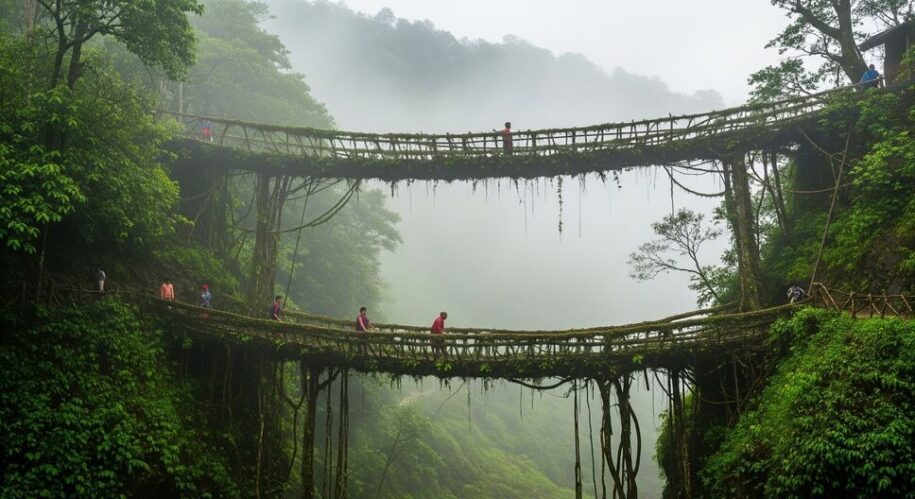
Ever stood on a bridge that’s alive and still growing? Not metaphorically—I mean an actual living structure that breathes, strengthens, and adapts over centuries. Across Northeast India’s rainforests, over 100 living root bridges defy everything we thought we knew about architecture.
The living root bridges of Meghalaya represent ingenious bioengineering at its finest. Khasi and Jaintia tribes have spent generations guiding rubber fig tree roots across rivers, creating natural crossings that strengthen with age instead of deteriorating.
Unlike concrete bridges that crumble after decades, these natural marvels last 500+ years and can support 50 people at once. They’re waterproof, self-repairing, and perfectly harmonious with their environment.
But what exactly happens when modern engineering meets ancient wisdom? The answer might completely change how we build our future.
The Origins and History of Living Root Bridges
Ancient Engineering of the Khasi and Jaintia Tribes
Deep in the misty valleys of Meghalaya, the Khasi and Jaintia tribes developed something truly magical about 500 years ago. They didn’t just adapt to their monsoon-drenched homeland—they transformed it using nothing but patience and profound ecological wisdom.
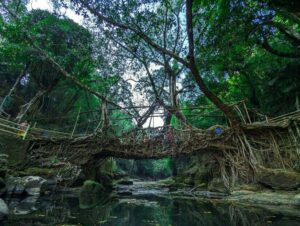
Picture this: Instead of chopping down trees to build bridges that would rot away in a few years, they guided living roots across rivers. The process began with hollowed-out betel nut trunks placed across streams. Young, flexible rubber fig tree roots were then carefully threaded through these natural “scaffolds,” slowly growing and strengthening with each passing season.
What makes this engineering truly mind-blowing? The tribes didn’t work with blueprints or calculations. They worked with time. A living root bridge takes 15-30 years to become fully functional, but once established, it continues strengthening itself for centuries.
Traditional Knowledge Passed Through Generations
“Watch the roots, guide them gently, and they will grow strong enough to hold your grandchildren’s grandchildren.”
This wisdom echoes through generations of Khasi and Jaintia families. Bridge-building knowledge wasn’t written down—it was lived, demonstrated, and passed from elder to child through hands-on apprenticeship.
Young tribe members learned to:
- Select the right Ficus elastica (rubber fig) trees with the strongest root systems
- Carefully manipulate new growth without damaging the living tissue
- Reinforce weak sections by weaving in secondary roots
- Create protective barriers against flood damage
No engineering degree required—just decades of observation and a close relationship with the forest.
Cultural Significance in Northeast Indian Communities
These bridges aren’t just practical crossings—they’re sacred connections between villages, families, and generations.
In Khasi culture, the bridges represent the unbreakable bond between humans and nature. Many communities perform rituals before beginning a new bridge, asking permission from forest spirits and ancestors. The bridges often become community gathering places, where elders share stories and children play.
The very act of creating something that won’t reach its full potential in your lifetime demonstrates a cultural commitment to future generations that’s increasingly rare in our modern, instant-gratification world.
Evolution of Bridge-Building Techniques Over Centuries
The living architecture of Meghalaya hasn’t remained static. Over centuries, the techniques have adapted and evolved:
Early bridges were simple single-span structures, but later designs incorporated multiple levels, handrails, and even benches formed from trained roots. Some innovative bridges now include stone steps embedded within the living structure.
The famous “double-decker” bridge near Nongriat village shows this evolution in action—a second level was added when the original bridge couldn’t handle increasing foot traffic.
Modern challenges have sparked new innovations. With tourism growing, some communities now incorporate steel cables to provide temporary support while new bridges develop. This blending of traditional wisdom with contemporary needs ensures these remarkable living structures will continue serving communities for generations to come.
Where to Find These Natural Wonders
Meghalaya: The Land of Living Root Bridges
The northeastern state of Meghalaya isn’t called “the abode of clouds” for nothing. But beyond its misty mountains lies something even more magical – living architecture that grows stronger by the day.
Most of these natural wonders are found in the Khasi and Jaintia Hills, particularly around villages like Nongriat, Mawlynnong, and Riwai. What makes this region perfect for these structures? Simple – it’s got the right combo of heavy rainfall (Meghalaya is one of the wettest places on Earth) and the presence of rubber fig trees with their incredibly strong roots.
The local Khasi and Jaintia tribes have perfected this engineering technique over generations. They don’t just build bridges; they grow them. And Meghalaya has over 100 of these living connections spanning rivers and streams across its lush valleys.
Famous Bridges: Double-Decker Root Bridge of Nongriat
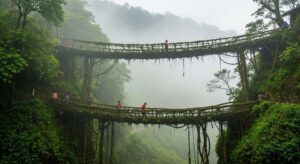
The crown jewel of Meghalaya’s living architecture has to be the Double-Decker Root Bridge in Nongriat village. This natural skyscraper isn’t just any bridge – it’s two levels of intertwined roots stretching across the Umshiang River.
Estimated to be about 200 years old, this engineering masterpiece extends roughly 100 feet across the river and can support the weight of 50 people at once. Talk about natural strength! The lower level sits about 10 feet above the river, while the upper deck offers more spectacular views about 20 feet higher.
Getting here takes commitment – a challenging trek involving 3,500 steps down from Tyrna village. But everyone who’s made the journey swears it’s worth every drop of sweat.
Lesser-Known Root Bridges Worth Exploring
The Double-Decker gets all the fame, but Meghalaya’s hiding plenty more green treasures for those willing to venture off the beaten path.
The Ritymmen Root Bridge near Pynursla is actually longer than the famous Double-Decker, stretching a massive 100 feet across a gorge. Then there’s the Ummunoi Root Bridge in the remote Kudeng Rim village – fewer travelers make it here, meaning you might have this natural wonder all to yourself.
In the village of Mawlynnong (which holds the title of “Asia’s Cleanest Village”), you’ll find another beautiful specimen called the Wahthyllong Root Bridge. The trek here is easier than Nongriat, making it perfect for those wanting to experience these marvels without the grueling hike.
The most fascinating might be the “living root ladder” near Nongriat – yes, they don’t just grow bridges but ladders too!
Accessibility and Trekking Routes to Reach These Marvels

Getting to these natural wonders isn’t always a walk in the park, but that’s part of their charm.
The journey typically begins in Shillong, Meghalaya’s capital. From there, you’ll need to reach Cherrapunji (also called Sohra) or Tyrna, depending on which bridge you’re aiming for.
For the Double-Decker Bridge, start at Tyrna village and brace yourself for those 3,500 steps I mentioned. The trek takes about 2-3 hours one way, winding through dense forests and crossing steel hanging bridges before reaching Nongriat village.
The Umshiang Root Bridge is more accessible, with a relatively easier 1-2 hour trek from the village of Laitkynsew.
For the more adventurous souls, multi-day treks let you experience several bridges in one journey. The popular “Root Bridge Circuit” connects villages like Nongriat, Mynteng, and Tynrong, letting you see up to seven different living bridges.
Best Seasons to Visit for Optimal Experience
Timing is everything when planning your root bridge adventure.
The winter months from November to February offer the most pleasant experience. The weather’s cool (averaging 10-15°C), skies are clear, and most importantly, the trails are dry and manageable.
October to March generally marks the dry season, making trekking routes safer and more accessible. The post-monsoon period (October-November) is particularly magical – everything’s lush green, waterfalls are flowing vigorously, but the heavy rains have subsided.
Avoid the monsoon season (June-September) if possible. While Meghalaya looks absolutely stunning draped in rain, the trails become extremely slippery and dangerous. Some routes might even be closed due to landslides.
If you’re a photography enthusiast, early morning visits provide the best lighting conditions, with fog lifting from the valleys and sunlight filtering through the canopy onto these architectural marvels.
How Living Root Bridges Are Created

The Science Behind Root Manipulation
Ever wondered how locals create these incredible living structures? It all starts with understanding the right trees. The Ficus elastica (rubber tree) isn’t just any tree – it’s got aerial roots that can grow from branches and reconnect with the ground. This natural tendency makes them perfect bridge-building material.
What makes these roots so special is their ability to strengthen under stress. When properly guided, they actually grow stronger where they’re needed most. Think of it like your muscles – they build up where you use them. The same principle applies to these remarkable roots.
Local Khasi and Jaintia tribes discovered centuries ago that these roots contain natural latex that makes them incredibly flexible when young but rock-solid when mature. They’ve perfected methods to direct these roots without killing the tree – a truly remarkable balance of manipulation and respect for nature.
Training Roots of the Ficus Elastica (Rubber Tree)
The training process is both art and science. Villagers first plant young rubber trees on opposite banks of rivers or streams. Once the trees reach about 10-15 feet, they place bamboo scaffolding across the gap.
Here’s where the magic happens. They gently guide the young, tender aerial roots along the bamboo, sometimes splitting them to create parallel supporting structures. The roots are manually woven and twisted together to create stronger connections.
During training, villagers:
- Direct new growth using bamboo guides
- Wrap roots around each other for strength
- Insert rocks and soil at connection points
- Prune unwanted growth to focus energy
The roots naturally fuse together through a process called inosculation – basically, they recognize each other as the same organism and join forces.
Time-Intensive Process: From Planting to Crossing
Building a living root bridge isn’t for the impatient. These aren’t weekend projects – they’re intergenerational commitments.
The initial growth phase takes 15-20 years before a bridge can support even limited human weight. But that’s just the beginning. Most bridges take 50-100 years to reach their full strength and stability. The famous double-decker bridge in Nongriat took over 150 years to complete!
The timeline looks something like this:
| Time Period | Development Stage |
|---|---|
| 1-5 years | Initial tree growth and root development |
| 5-15 years | Root guidance along scaffolding |
| 15-30 years | Limited crossing possible with reinforcement |
| 30-50 years | Increasing strength and stability |
| 50-100+ years | Full maturity and maximum strength |
What’s incredible is that unlike conventional bridges that weaken over time, living bridges grow stronger each year. Some of the oldest bridges can support 50+ people at once!
Tools and Techniques Used by Local Bridge Builders
The tools used to create these natural wonders are surprisingly simple. Khasi bridge builders rely primarily on:
Handmade knives and machetes for pruning and cutting guide materials. No power tools, just generations of craftsmanship.
Bamboo serves multiple purposes – as scaffolding, to create hollow root guides, and sometimes as temporary support while the bridge develops.
Stones aren’t just placed randomly – they’re strategically positioned where roots need to join, creating natural anchors and encouraging fusion points.
What’s fascinating is how locals use betel nut husks and leaves to protect young roots from damage and disease during the early guidance stage.
Perhaps the most important technique isn’t a physical tool at all – it’s the knowledge passed down through generations. Bridge builders teach their children and grandchildren the subtle signs of healthy root growth, when to guide and when to let nature take its course.
For listening to a podcast on India Travel, please visit Incredible India.
Architectural and Engineering Brilliance
A. Natural Structural Integrity That Withstands Monsoons
The living root bridges of India aren’t just pretty to look at—they’re engineering marvels that laugh in the face of extreme weather. While modern concrete bridges in Meghalaya often crumble after a few monsoon seasons, these natural wonders have stood firm for centuries.
What makes them so resilient? The answer lies in their responsive design. As the roots grow, they adapt to environmental stresses. During monsoons, when the region receives upwards of 467 inches of rainfall annually (that’s about 15 times more than Seattle!), the bridges actually strengthen rather than weaken. The living tissue absorbs shock, flexes with water movement, and redistributes force throughout the structure.
Unlike rigid modern bridges that fight against nature, these living structures work with it. The roots create a complex network of natural tension and compression elements—nature’s own implementation of tensegrity principles that modern architects spend years studying.
B. Self-Strengthening Properties Over Time
Most man-made structures begin deteriorating the moment they’re completed. Living root bridges? They’re just getting started.
These bridges actually get stronger year after year. New roots continuously grow and intertwine with existing ones, creating an increasingly dense network. Think of it as nature’s own reinforcement system that never stops improving.
The Ficus elastica trees (rubber fig) that form these bridges have a remarkable property—secondary roots that grow from branches and fuse together when they touch. This process, called inosculation, creates natural grafts where two roots become one unified structure. It’s like having a bridge that heals its own cracks and reinforces weak points automatically.
When villagers notice a thin spot, they guide new roots to that area, essentially “patching” the bridge naturally. Some bridges are over 500 years old and still growing stronger—a timeframe that makes modern infrastructure look like temporary installations.
C. Weight-Bearing Capacity and Longevity
The Double-Decker Root Bridge near Nongriat village can support the weight of 50 people at once. That’s impressive for any bridge, let alone one made entirely of living plant material!
This remarkable strength comes from the adaptive growth response of the living roots. When regularly subjected to stress (like people walking across), the roots actually grow thicker and stronger in response—similar to how human muscles develop when exercised.
The most fascinating aspect of these bridges is their longevity. While a typical concrete bridge in this region might last 50-100 years before requiring major renovation, living root bridges commonly survive for centuries:
| Bridge Type | Average Lifespan | Maintenance Required |
|---|---|---|
| Living Root | 500+ years | Minimal, self-healing |
| Concrete | 50-100 years | Regular, expensive |
| Steel | 75-100 years | Frequent, rust-prone |
Some of these bridges have witnessed the rise and fall of empires, outlasting countless human generations and the structures they built.
D. Comparison to Modern Engineering Solutions
Modern bridges follow a “build it and forget it” approach until maintenance becomes unavoidable. Living root bridges flip this concept on its head with their “grow it and watch it improve” philosophy.
Contemporary engineering prioritizes rapid construction and immediate functionality. A concrete bridge might take months to build but is usable immediately. Root bridges require 15-30 years of growth before they’re fully functional—but then serve for centuries with minimal intervention.
The carbon footprint comparison is striking too. Modern bridge construction:
- Produces massive CO₂ emissions
- Requires extracting and transporting materials
- Disrupts ecosystems
- Leaves waste materials
Meanwhile, living root bridges:
- Actively sequester carbon
- Source materials on-site
- Enhance local ecosystems
- Create zero waste
Engineers are finally catching on. The emerging field of “bio-mimicry” now studies these bridges to develop more sustainable approaches to modern construction. Some architects are even experimenting with “grown” structures that incorporate living materials alongside conventional ones.
These ancient solutions to infrastructure challenges are teaching us that sometimes the most advanced technology isn’t technology at all—it’s nature itself.
Environmental Benefits and Sustainability

Harmony with Local Ecosystems
The root bridges of Meghalaya aren’t just tourist attractions—they’re masterclasses in ecological integration. Unlike conventional concrete structures that disrupt wildlife corridors and natural water flows, these living bridges actually enhance their surroundings. The Ficus elastica trees continue their biological functions while serving as infrastructure, providing habitat for countless insects, birds, and small mammals.
What’s truly remarkable is how these bridges create their own microecosystems. As the roots grow and intertwine, they trap organic matter, creating new soil pockets where ferns, moss, and other epiphytes flourish. This vegetation layer then attracts pollinators and seed-dispersing animals, completing a virtuous ecological cycle.
Local Khasi villagers understand this relationship intimately. They’ve observed how areas with root bridges maintain higher biodiversity than surrounding regions without them. The bridges actually strengthen the forest’s ecological resilience rather than weakening it.
Zero Carbon Footprint Architecture
Concrete bridges? They’re carbon nightmares—producing roughly 800kg of CO2 per cubic meter. Steel bridges aren’t much better. But these living root structures? They’re actually carbon negative.
As the trees grow, they sequester carbon dioxide through photosynthesis, storing it in their expanding biomass. A mature root bridge can lock away several tons of carbon over its lifetime. And here’s the kicker—the older and stronger the bridge gets, the more carbon it captures.
No industrial manufacturing processes. No transportation emissions. No construction waste. Just patient guidance of natural growth. The bridges represent perhaps the purest form of green architecture on the planet.
Resilience Against Extreme Weather Conditions
Meghalaya isn’t called the “abode of clouds” for nothing. The region receives some of the highest rainfall on Earth—up to 467 inches annually in some areas! Standard bridges would deteriorate rapidly in such conditions, requiring constant maintenance.
Root bridges, however, thrive in this environment. Their living nature means they:
- Get stronger with each passing monsoon
- Self-repair minor damage
- Adapt to changing water levels
- Resist soil erosion through their expanding root networks
- Maintain flexibility during storms
During the devastating 2014 floods that destroyed numerous conventional bridges in Northeast India, the centuries-old living root bridges remained largely intact. Their resilience during extreme weather events offers valuable lessons as climate change brings increasingly unpredictable conditions worldwide.
Living Examples of Sustainable Infrastructure
The root bridges aren’t just sustainable—they’re regenerative. While modern infrastructure typically degrades over time, these structures strengthen with age. Some bridges are estimated to be over 500 years old and can support the weight of 50+ people simultaneously.
Their maintenance requirements? Minimal. Villagers occasionally guide new root growth or prune unwanted offshoots—a far cry from the intensive upkeep conventional bridges demand. And when a bridge does eventually reach the end of its useful life (after centuries), it simply returns to the forest, leaving no waste.
These bridges represent a paradigm shift in how we think about infrastructure. Rather than imposing human designs on nature, they work with natural processes. Rather than depleting resources, they generate them. And rather than requiring increasing maintenance as they age, they become more self-sufficient.
As our world grapples with climate change and resource depletion, these ancient engineering marvels offer profound inspiration for reimagining our relationship with the built environment.
Preservation Challenges and Conservation Efforts
A. Impact of Increasing Tourism
The secret’s out about India’s living root bridges, and that’s causing some real headaches. Tourist numbers have skyrocketed over the past five years, with the Umshiang Double-Decker Bridge seeing almost 300 visitors daily during peak season—up from just 50 a decade ago.
This sudden popularity comes with consequences. Excessive foot traffic compacts the soil around root systems, making it harder for new roots to grow. Some tourists (despite signs everywhere) still can’t resist carving initials or hanging from delicate secondary roots.
I visited last month and watched a guide stop someone from cutting a small piece of root as a “souvenir.” Crazy, right?
Local villagers report increased erosion along pathways leading to the bridges, while some trash inevitably gets left behind despite efforts to maintain cleanliness.
B. UNESCO Recognition and Protection Initiatives
The global spotlight turned toward these incredible structures in 2022 when UNESCO finally added the living root bridges to its Tentative List for World Heritage status. About time!
This recognition triggered several protection measures:
- Buffer zones extending 100 meters around each bridge
- Mandatory guides for all visitors
- Strict limits on daily visitor numbers
- Documentation of traditional knowledge
The Meghalaya state government partnered with the Indian National Trust for Art and Cultural Heritage to create comprehensive management plans for each bridge. They’ve installed monitoring equipment to track subtle changes in the bridges’ structures and health.
C. Local Community Involvement in Preservation
The Khasi communities aren’t just standing by—they’re driving the preservation efforts.
Village councils now receive training in sustainable tourism management and conservation techniques. Many families earn income as guides, sharing traditional knowledge while ensuring visitors follow preservation guidelines.
The “Guardians of the Living Bridges” program started in 2023 employs local youth to monitor bridges, perform basic maintenance, and document changes using smartphones and simple apps.
What’s really cool is how the elders play a critical role. They’re the ones teaching younger generations the ancient techniques of root manipulation and bridge maintenance. Monthly workshops in villages connect these knowledge keepers with interested young people.
D. Balancing Development with Conservation
This is where things get tricky. The region desperately needs economic development, but at what cost to these natural wonders?
Some villages have opted for strict visitor caps and higher entrance fees. Others have expanded accommodations but implemented strict waste management systems and rainwater harvesting.
The “Bridge Burden” tax introduced in 2024 adds a small fee to all tours, generating funds for conservation. Smart move.
Infrastructure improvements present the biggest challenge. Better roads mean easier access but potentially more visitors than the ecosystem can handle. The current compromise: improved trails rather than vehicle roads, with rest stations strategically placed to avoid congestion near the bridges themselves.
E. Educational Programs for Future Generations
Education might be the secret weapon in this conservation battle. The “Living Heritage” curriculum now runs in 45 schools across Meghalaya, teaching students about the botanical, cultural, and economic importance of these structures.
Bridge-building workshops give hands-on experience to interested students during summer breaks. Kids literally learn to grow bridges from scratch in controlled environments.
The “Young Bridge Architects” program pairs students with master bridge cultivators for multi-year mentorships. Some graduates have already started experimental bridges in new locations.
Digital preservation efforts capture the knowledge through videos, interviews, and 3D modeling. The Living Bridges Digital Archive, launched last year, makes this information accessible worldwide while protecting traditional knowledge rights.
All these efforts share one goal: ensuring these incredible feats of botanical engineering amaze visitors for another 500 years.
For Immersive culture walks in India, please visit 5 Senses Walks
Living Root Bridges in Modern Context
Inspiration for Contemporary Bio-Architecture
The ancient wisdom of Meghalaya’s living root bridges isn’t just fascinating history—it’s actively shaping our future. Architects and designers worldwide are now looking at these natural marvels thinking, “Why didn’t we think of this sooner?”
Companies like Terreform ONE in New York are pioneering buildings that incorporate living materials, directly inspired by these centuries-old bridges. Their “Fab Tree Hab” concept uses grafted trees to create actual living homes. Unlike conventional construction that fights against nature, these designs work with it.
Baubotanik, a movement in Germany, takes this a step further by creating structures where steel supports gradually give way to strengthening plant matter—mimicking exactly how the Khasi people train those initial root systems.
Research and Innovation Based on Root Bridge Principles
The science behind these bridges has sparked some seriously cool research.
Engineers at MIT have developed what they call “programmable materials”—essentially teaching plants to grow in specific patterns just like the Khasi did centuries ago. But instead of bridges, they’re looking at creating living infrastructure that could heal itself after damage.
The University of Stuttgart’s Institute for Computational Design is using algorithms inspired by root growth patterns to create self-optimizing structures. Their computer models simulate how roots naturally distribute load—something the Khasi people understood intuitively.
Even NASA has taken notice. Their Advanced Plant Habitat research explores how plants might one day help construct habitats on Mars, drawing direct inspiration from these natural engineering marvels.
Similar Natural Engineering Around the World
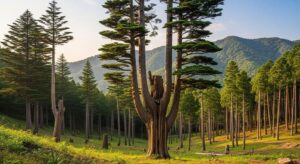
Living root bridges aren’t completely unique to India. Around the world, people have developed their own versions of working with nature rather than against it:
- In Japan, the ancient art of daisugi involves pruning cedar trees to grow straight, uniform lumber directly from a living tree
- Indonesia’s Baduy people create living bamboo bridges that strengthen as they grow
- The Incan civilization built grass bridges across valleys that could be “regrown” seasonally
What makes Meghalaya’s bridges stand out is their scale, durability, and sophistication. While other examples typically last decades, some of these living root bridges have survived for centuries—proving they’re in a class of their own.
Future Applications of Living Architecture
The potential applications of this technology go way beyond just making cool-looking buildings.
Carbon capture is one obvious benefit. A neighborhood of living structures could potentially absorb tons of CO2 while providing housing. Cities like Singapore are already exploring “sponge city” concepts with vertical forests inspired by natural engineering principles.
Infrastructure resilience is another huge opportunity. Imagine roads with living edges that repair themselves after floods or earthquakes—exactly what happens naturally with the root bridges during monsoon season.
The most exciting frontier might be responsive architecture. Scientists at the University of Southern Denmark are developing buildings that could actually adapt to changing conditions like the root bridges do—growing stronger where stress is detected and responding to environmental changes.
By 2030, we could see the first fully permitted living buildings in major cities. The ancient wisdom of Meghalaya’s root bridge builders may end up being key to creating truly sustainable 21st century cities.
The Marvel of Living Root Bridges
India’s living root bridges stand as a testament to human innovation in harmony with nature. These magnificent structures, found primarily in the northeastern state of Meghalaya, represent centuries of traditional knowledge passed down through generations. From their ingenious creation process—guiding rubber fig tree roots across rivers—to their remarkable engineering that withstands monsoon floods, these bridges demonstrate sustainable architecture at its finest. Their environmental benefits extend beyond transportation, creating entire ecosystems while requiring zero carbon footprint.
As we face growing environmental challenges worldwide, these living bridges offer profound lessons in sustainable development and cultural preservation. While tourism brings economic opportunities to local communities, it also presents conservation challenges that must be carefully balanced. By supporting local preservation efforts and approaching these natural wonders with respect, we can ensure that India’s living root bridges continue to inspire generations to come. These bridges aren’t just pathways across rivers—they’re bridges between our past and a more sustainable future.
For India travel planning advise, please visit India Travel.
Leave a Reply