
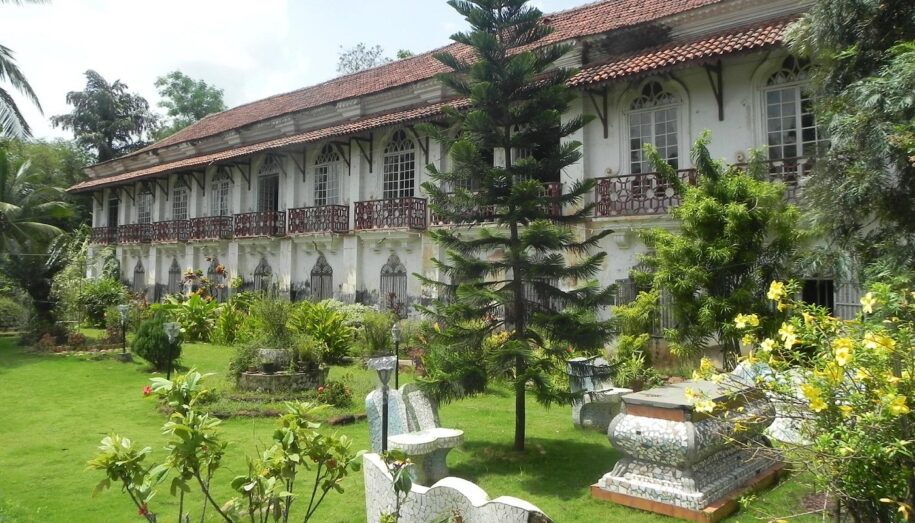
Some histories are written in stone and proclaimed from towers. Others live more quietly, behind wooden doors, in courtyards where light moves slowly across tiled floors. Goa’s grand mansions belong to this second kind of history. They are not monuments in the conventional sense; they are inhabited archives, where architecture, memory, and daily life intersect.
Among the most evocative of these homes are Braganza House in Chandor and the Sara Fernandes House in Loutolim. Visiting them is not about admiring wealth, but about understanding how Goan society adapted, negotiated identity, and learned to live between worlds.
The Mansion as a Cultural Strategy
Indo-Portuguese mansions emerged during a period of profound transition. From the 16th century onward, elite Goan families navigated colonial rule, religious change, and new social hierarchies. Architectural historians emphasize that domestic architecture often reveals more about adaptation than public buildings, because homes reflect how people actually lived, not how they wished to be seen.
These mansions blend European aesthetics—symmetry, furniture styles, chandeliers—with Indian environmental intelligence. Thick walls, high ceilings, verandas, inner courtyards, and shaded windows are responses to climate, not ornament. Environmental science supports this: passive cooling techniques like cross-ventilation and thermal mass significantly reduce indoor heat in tropical regions.
The result is architecture that feels stately without being oppressive, grand without being alien to its surroundings.
Braganza House: Scale, Continuity, and Influence
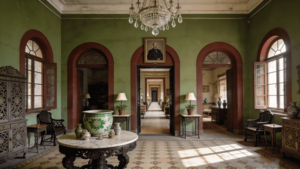
Braganza House in Chandor is one of Goa’s largest surviving mansions, divided between two branches of the same family. Its sheer scale is striking, but its real significance lies in continuity. The house has been inhabited for generations, functioning as a living institution rather than a preserved relic.
Walking through its rooms reveals layers of time. European furniture sits alongside local objects. Family portraits chart changing fashions, alliances, and identities. Private chapels coexist with spaces once used for Hindu rituals, reflecting Goa’s complex religious history.
Sociological studies of elite households show that such homes often acted as semi-public spaces—venues for political discussion, education, and social negotiation. Braganza House fits this pattern. It was not merely a residence; it was a node of influence.
A guided visit is crucial here. Without context, the scale can overwhelm. With interpretation, the house becomes readable—each room revealing how power, faith, and family life intersected under colonial rule.
Sara Fernandes House: Intimacy and Social Life
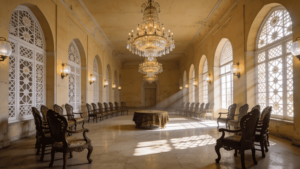
If Braganza House speaks of scale, Sara Fernandes House speaks of intimacy.
Located in Loutolim, this mansion offers a more personal lens into elite Goan life. The architecture is elegant but restrained. What stands out is how space is organized around social interaction—drawing rooms, music spaces, inner courtyards designed for conversation and performance.
Cultural historians note that Goan mansions often functioned as cultural salons. Music, poetry, debate, and education were integral to domestic life. These homes nurtured Goa’s unique intellectual culture, which blended European education with local traditions.
From an anthropological perspective, such spaces played a key role in shaping identity. They allowed families to participate in colonial modernity while preserving a sense of rootedness. The Sara Fernandes House exemplifies this balance.
Architecture That Responds to Climate and Culture
Both mansions demonstrate a deep understanding of environment. High windows release hot air. Verandas buffer interiors from harsh sunlight. Courtyards regulate temperature and light while serving as social hubs.
Building science confirms the effectiveness of these designs. Passive architectural strategies reduce reliance on mechanical cooling and create healthier indoor environments. Long before sustainability became a buzzword, these homes practiced it quietly.
The materials—laterite stone, lime plaster, timber—were locally sourced and climatically appropriate. This was not imitation architecture; it was adaptation through knowledge.
Why These Homes Must Be Experienced, Not Just Seen
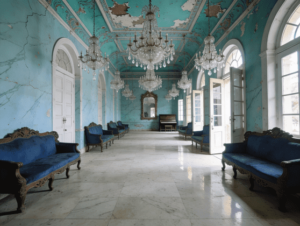
Photographs flatten these spaces. The experience of walking through them—feeling temperature shifts, noticing sound changes, observing how light moves—is essential to understanding their intelligence.
Heritage studies consistently show that guided interpretation enhances emotional connection and comprehension, especially in domestic spaces where meaning is subtle. A guide helps decode symbols: why certain rooms face particular directions, why furniture is arranged as it is, why some spaces feel formal and others intimate.
This is where a private guided experience transforms the visit from observation into understanding.
Experiencing Goa’s Mansions with 5 Senses Tours
With 5 Senses Tours, visits to Braganza House and the Sara Fernandes House are curated as private, respectful experiences. Access is managed thoughtfully, pacing is unhurried, and storytelling connects architecture to lived history.
Rather than presenting these mansions as frozen in the past, the experience emphasizes continuity—how families lived, adapted, and still remember.
Visit Grand Mansions of Goa for a private tour.
Leave a Reply