
For centuries, the global story of civilization has followed a familiar map. Mesopotamia. Egypt. The Indus Valley. China. Greece. Rome. South India, if mentioned at all, appears much later—usually as a land of temples, trade, and medieval kingdoms.
Keeladi quietly shatters that timeline.
On the banks of the Vaigai River in Tamil Nadu lies Keeladi (also spelled Keezhadi), an archaeological site that has forced historians and archaeologists to rethink when, how, and where complex urban life emerged in the Indian subcontinent. What makes Keeladi extraordinary is not just its age—but what it reveals about literacy, social organization, and everyday life more than 2,500 years ago.
For travelers seeking places that change how we understand the ancient world, Keeladi is not a footnote. It is a turning point.
A City Beneath the Soil

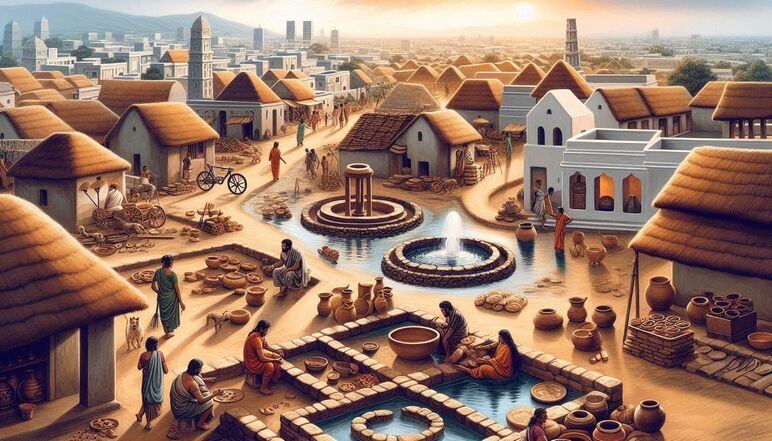
Systematic excavations at Keeladi began in 2014, and what emerged was not a scattered settlement but the remains of a planned urban habitation dating to around the 6th century BCE, based on stratigraphy and radiocarbon dating. This places Keeladi in the same broad historical window as Classical Greece and early Rome.
Archaeologists uncovered brick houses, ring wells, drainage systems, industrial workspaces, and evidence of specialized crafts. These features are widely accepted archaeological indicators of urban life—long thought to have declined in the Indian subcontinent after the fall of the Indus Valley Civilization over a thousand years earlier.
Keeladi fundamentally alters that assumption. It shows that urban traditions in India did not disappear—they evolved, particularly in the Tamil region.
Literacy Beyond Elites

One of Keeladi’s most groundbreaking discoveries is the abundance of Tamil-Brahmi inscriptions etched onto pottery shards. Tamil-Brahmi is an early script used to write Old Tamil, and its widespread presence suggests literacy was not confined to priests or ruling elites.
Linguistic research places these inscriptions earlier than many dynasties traditionally associated with Tamil culture. This aligns closely with Sangam literature, a corpus of early Tamil poetry that describes cities, trade guilds, marketplaces, and civic life in remarkable detail.
From a scientific perspective, widespread writing implies administrative systems, economic complexity, and cultural continuity. For travelers interested in the origins of language and literature, Keeladi offers something rare: archaeology and classical literature reinforcing one another.
An Urban Culture Without Kings
Unlike many ancient civilizations defined by palaces, royal tombs, or monumental temples, Keeladi reveals no clear markers of centralized kingship. Instead, the site is dominated by domestic spaces, workshops, and shared infrastructure.
Anthropologists interpret this as evidence of a relatively egalitarian urban society, where civic life revolved around trade, craftsmanship, and community rather than divine rulers. This interpretation finds literary support in Sangam poetry, which celebrates merchants, farmers, poets, and ethical governance rather than god-kings.
Keeladi invites travelers to imagine an ancient city built on social cooperation rather than spectacle—a rare perspective in early urban history.
The concept of an egalitarian urban society was also seen in Indus Valley. Travellers will enjoy a visit to Lothal and Dholavira from Ahmedabad.
Trade Without Conquest

Artefact analysis from Keeladi points to long-distance trade networks. Beads made from semi-precious stones, industrial ceramics, and material parallels with coastal Tamil sites suggest economic integration across regions.
Classical texts such as the Periplus of the Erythraean Sea describe Tamil ports as thriving nodes in Indian Ocean trade. Keeladi provides the inland urban counterpart to this maritime world—a place where goods were produced, processed, and distributed.
This matters because it reframes ancient India not as an isolated civilization, but as a participant in global exchange driven by commerce rather than conquest.
Grounded in Science, Not Speculation
What makes Keeladi especially compelling is the scientific discipline behind its interpretation. Radiocarbon dating, ceramic typology, stratigraphic excavation, and material analysis underpin its chronology. These conclusions are drawn from archaeological method, not mythology.
Where literary sources such as Sangam poetry are referenced, they are used as cultural context rather than proof. This careful balance allows Keeladi to be appreciated as a site where multiple lines of evidence converge without collapsing into romantic exaggeration.
Heritage tourism research consistently shows that travelers value destinations grounded in credible scholarship. Keeladi earns that trust.
Why Keeladi Matters Today
Keeladi is not just significant for Tamil Nadu or India—it reshapes how we understand the trajectory of civilization itself. It challenges the idea that urban complexity follows a single rise-and-fall pattern and instead reveals regional resilience and innovation.
By extending the story of Indian urbanism well beyond the Indus Valley, Keeladi adds a vital chapter to world history—one that is still being written.
For travellers, this means encountering a place that is not frozen in time, but actively influencing how the past is understood.
Keeladi is just 12 KM from Madurai, and travellers can combine a visit to Madurai and Rameshwaram. Another way to explore Madurai is through an immersive culture walk.
Visiting Keeladi: A Thoughtful Journey
Keeladi is not about towering ruins or dramatic monuments. It is about interpretation and imagination—walking through excavation zones, visiting local museums, understanding river-based settlement patterns, and connecting archaeology with living Tamil culture.
When experienced with context, Keeladi transforms a journey through South India into something deeper: an exploration of how societies thrive without empires, how languages endure without conquest, and how cities can exist without kings.
For those interested in private, in-depth guided journeys to Keeladi, including archaeological context and cultural immersion, curated experiences can be arranged by writing to contact@5sensestours.com or visit 5 Senses Tours.
Keeladi reminds us that history does not always announce itself with monuments. Sometimes, it waits patiently beneath the soil—until curious travelers arrive, ready to listen.
Leave a Reply