

India is a land of mysteries. Some are hidden in stories, some in stones, and a few — in the very geometry of the Earth. One such wonder is a sacred alignment that has baffled pilgrims, historians, and scientists alike: a chain of Shiva temples that seem to stand along the same longitude — as if connected by an invisible cosmic thread.
A Sacred Line Across India
Imagine spreading out a map of India. Now draw a straight north-to-south line around the 79° East longitude. To your surprise, you’ll notice something extraordinary — some of the most revered Shiva temples fall almost exactly along this axis.
From the icy silence of Kedarnath in the Himalayas…
to the bustling ghats of Kashi Vishwanath in Varanasi…
to the ancient seat of time at Mahakaleshwar, Ujjain…
to the cosmic dance at Chidambaram…
and finally, to the ocean embrace of Rameshwaram.
All of them, like beads on a sacred mala, are strung on one longitude.

Coincidence, or Ancient Science?
How did temple builders thousands of years ago achieve such precision without satellites or GPS? Could it really be just coincidence? Or did they tap into knowledge we are only beginning to rediscover?
Scholars and seekers have offered fascinating theories:
- Astronomical Wisdom: Ancient Indian astronomers calculated planetary paths with astonishing accuracy. Aligning temples along a meridian could have been a way to harmonize Earth with cosmic rhythms.
- Geomagnetism: Some believe these temples were built on powerful geomagnetic lines of the Earth, amplifying the spiritual energy felt by devotees.
- The Prime Meridian of India: In Ujjain, long before Greenwich, astrologers used this longitude as a reference for timekeeping. Could the temples be part of a grand, scientific-spiritual design?
What Travelers Feel
For pilgrims, the alignment is not just geography — it is energy. Travelers often describe a sense of connectedness when moving from one shrine to another, as if walking down the spine of India’s spiritual body.
At Kedarnath, the mountains hum with silence.
At Kashi, the river glows with fire and chants.
At Mahakaleshwar, time itself feels suspended.
At Chidambaram, space dances in golden rhythms.
At Rameshwaram, the sea whispers ancient legends.
A Journey Waiting to be Taken
For the modern traveler, this isn’t just a pilgrimage. It’s a chance to explore the intersection of faith and science. To follow an ancient meridian, tracing stories carved in stone and starlight. To wonder if our ancestors built more than temples — perhaps they mapped a cosmic code into the very land of India.
So when you next look at the map, don’t just see places. See a line.
A mysterious alignment.
A story waiting for you to walk it.
For a guided tour of temples with a scientific connection, please visit Cosmic Temples Tour.
Kedarnath: The Northern Anchor of Shiva’s Sacred Longitude

High in the Himalayas, where oxygen thins and silence deepens, stands Kedarnath, one of the holiest temples of Lord Shiva. At an altitude of over 11,700 feet, this shrine feels less like a man-made structure and more like a doorway into the cosmic wilderness.
But Kedarnath isn’t just important spiritually. It also marks the northern anchor of a mysterious alignment — a line of Shiva temples that run almost perfectly along the 79° East longitude.
The Mythic Story
Legend says the Pandavas, after the Mahabharata war, sought forgiveness for their sins. Shiva, unwilling to meet them, disguised himself as a bull and vanished into the mountains. At Kedarnath, his hump emerged, becoming the site of this temple.
Since then, millions of pilgrims have braved the harsh climb, believing that just one glimpse of Kedarnath can liberate the soul.
The Science
When we plot Kedarnath on a modern GPS map, something fascinating emerges: this Himalayan shrine sits almost directly on the same longitude as temples thousands of kilometers to the south — including Kashi, Ujjain, Chidambaram, and Rameshwaram.
How did ancient builders manage such alignment?
- Astronomy: Himalayan skies are a natural observatory. Yogis and astronomers could have tracked stars to calculate meridians.
- Sacred Geography: The Himalayas themselves were seen as Shiva’s abode. Positioning Kedarnath here may have been a cosmic marker to align the rest of the spiritual “spine” of India.
- Energy Fields: Some researchers suggest Kedarnath lies on geomagnetic zones, amplifying its aura of stillness and intensity.
The Traveler’s Experience
Reaching Kedarnath is not easy — and that’s the beauty of it.
- The Trek: A 16 km climb from Gaurikund, with snow peaks unfolding as you ascend.
- The Temple: Ancient stone walls, believed to be over 1,200 years old, standing resilient even against floods and avalanches.
- The Atmosphere: The chants of pilgrims, the ringing bells, and the ever-present sound of the Mandakini River below.
For many, the moment of standing before Kedarnath’s sanctum is less about religion and more about feeling time, nature, and eternity blur into one.
Why Start Here
As the northernmost temple in this longitude alignment, Kedarnath is the beginning of a remarkable journey. It reminds us that pilgrimage is not only about reaching a destination — it’s about following invisible lines, both on Earth and within ourselves.
Kashi Vishwanath: The City of Cosmic Energy
Varanasi — older than history, older than tradition, and older even than legend. At its heart lies Kashi Vishwanath, where Shiva is worshipped as the Lord of the Universe. The city itself is said to rest on Shiva’s trident, untouched even when time devours all else.
Science
Varanasi is one of the oldest continuously inhabited cities in the world. Yet remarkably, this temple falls almost directly on the same longitude line as Kedarnath. Ancient astronomers used Kashi as a prime observatory to track planetary motions, reinforcing its role as a cosmic center.
Traveler’s Experience
- Witness the Ganga Aarti at Dashashwamedh Ghat.
- Wander through labyrinthine lanes, savoring Banarasi paan and chai.
- Experience the buzz of silk weaving workshops.
Mahakaleshwar, Ujjain: Where Time Stands Still
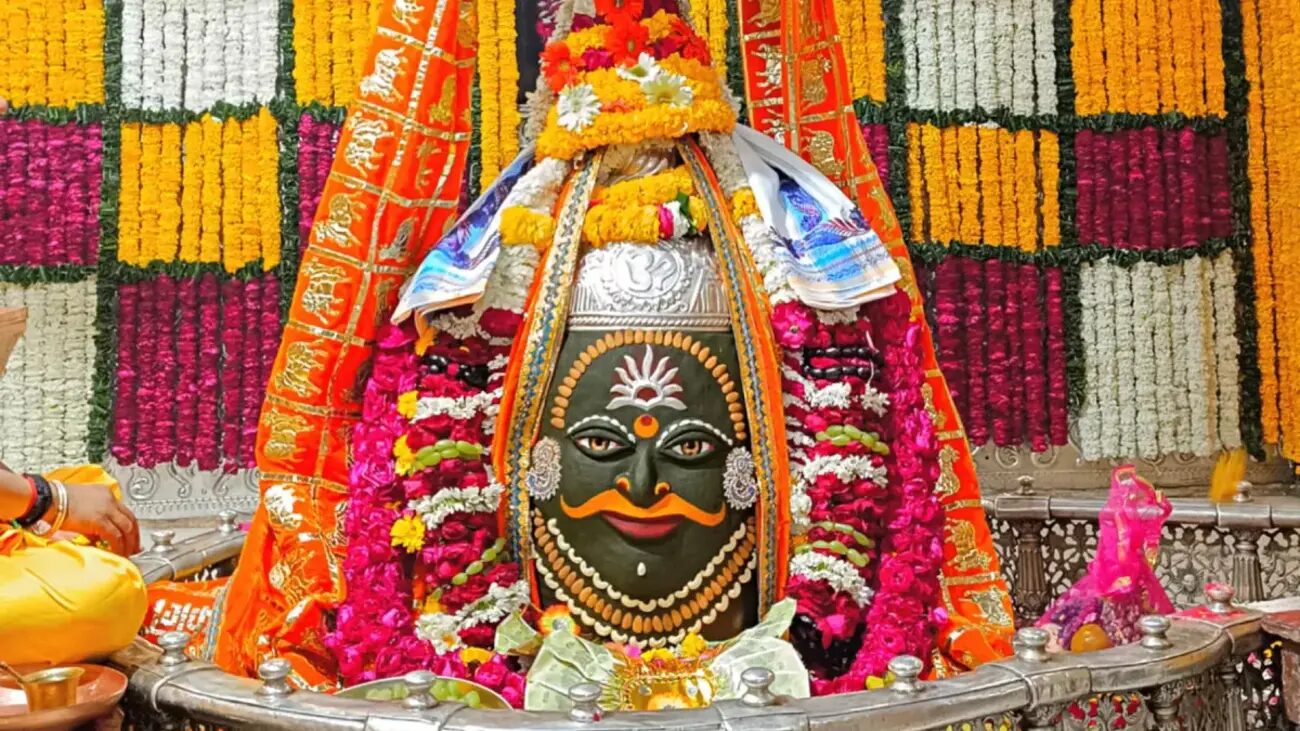
Here, Shiva is Mahakal, the Lord of Time itself. In Ujjain, dawn breaks differently — with the famous Bhasma Aarti, where sacred ash is offered to Shiva, symbolizing life’s impermanence.
Science
Ujjain was the Greenwich of ancient India. Astronomers here used this very longitude to calculate planetary positions and keep time for the entire subcontinent. That the Mahakaleshwar temple stands here is no accident — it’s a marriage of cosmic science and devotion.
Traveler’s Experience
- Attend the pre-dawn Bhasma Aarti.
- Visit the Jantar Mantar observatory nearby.
- Walk the Shipra ghats during evening prayers.
Srisailam: The Southern Heart
Deep in Andhra’s forests lies Srisailam Mallikarjuna Temple, where Shiva and Parvati dwell together. It’s one of the twelve Jyotirlingas, wrapped in myths of devotion and divine union.
Science
Srisailam too sits on the longitude line. Its position links the Himalayan north to the deep southern plateau, suggesting temple builders saw this not as isolated shrines, but as a continuous sacred spine of India.
Traveler’s Experience
- A boat ride across the Krishna River to reach the temple.
- Explore forested hills and caves nearby.
- Witness temple rituals blending Dravidian and Vedic traditions.
Chidambaram: Where Space Dances

At Chidambaram, Shiva is Nataraja, the Cosmic Dancer, who performs the Ananda Tandava — the dance of creation and dissolution. Here, even the sanctum is unusual: it represents ākāsha (space), the subtlest of the five elements.
Science
The temple’s architecture encodes astronomical truths. Its roof is plated with gold aligned to constellations. The number of pillars and steps reflect cosmic counts. And yes, it too aligns to the same longitude.
Traveler’s Experience
- Witness classical dance performances inspired by Nataraja.
- Hear Carnatic music echoing in the temple corridors.
- Visit the Dikshitar priests, custodians of unique traditions.
Rameshwaram: The Ocean Gateway
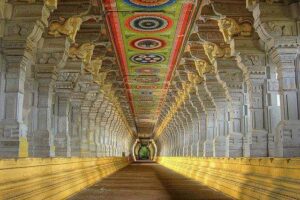
At the tip of India lies Ramanathaswamy Temple, Rameshwaram. Here, Rama worshipped Shiva before building the legendary bridge to Lanka. The temple’s corridor — the longest in Asia — feels like walking into infinity itself.
Science
This is the southern anchor of the longitude alignment. With Kedarnath in the north and Rameshwaram in the south, the line spans India’s length, connecting mountains, rivers, and seas — as if marking the axis of India’s sacred geography.
Traveller’s Experience
- Walk the thousand-pillared corridor at dawn.
- Visit the sea and the point where Rama’s bridge is believed to have begun.
- Experience temple rituals in a vibrant Tamil cultural setting.
The Spine of Shiva
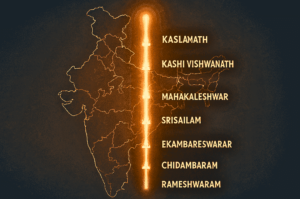
From the icy Himalayas to the roaring seas, from Kedarnath to Rameshwaram, the temples form a mysterious, precise alignment. A line that is not just geographic, but spiritual — the spine of Shiva, running through India.
Science & Wonder
Did ancient builders understand Earth’s meridians and magnetic fields? Did they encode astronomy in stone? Or did they simply follow intuition, aligning shrines with cosmic rhythms?
We may never know for sure. But travellers who walk this longitude find something undeniable — a sense of continuity, connection, and timelessness.
The Journey Awaits
This is not just a pilgrimage. It is a path where science meets myth, where longitude meets legend. It is India’s ancient wisdom, carved into its very geography, waiting to be walked by the seekers of today.
For a guided tour of temples with a scientific connection, please visit Cosmic Temples Tour.
Leave a Reply