
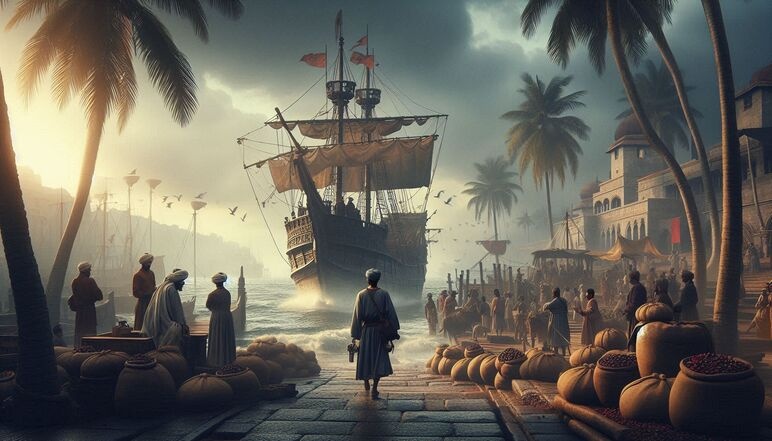
Marco Polo in India
Marco Polo in India is a fascinating tale to be told.
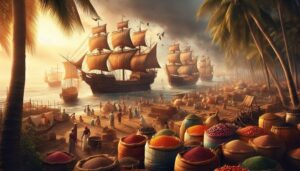
Pepper, cardamom, cloves, indigo—the air of India’s coastal towns, as he described it in the late 13th century, carried commerce before it carried meaning. For Polo, India was not a philosophical puzzle or a moral system. It was movement: ships arriving, goods circulating, wealth changing hands. Where earlier travelers wrote of governance or compassion, Polo wrote of flow.
India, in his account, is not the edge of the world.
It is the hinge.

By the time Marco Polo reached the Indian Ocean trade sphere, India had already been a commercial powerhouse for over a millennium. Archaeological evidence shows Roman coins in South India, Tamil inscriptions in Southeast Asia, and Indian textiles mentioned in Egyptian records. Polo did not discover this system—he walked into something ancient, efficient, and astonishingly global.
What struck him most was scale.
Spices of India
Polo describes port cities along India’s western and southern coasts—often identified by historians as places like Calicut (Kozhikode), Quilon (Kollam), and towns along the Coromandel Coast—as crowded, wealthy, and relentlessly active. Ships arrived from Arabia, Persia, East Africa, Southeast Asia, and China. These descriptions align closely with maritime archaeology and Arab travel accounts such as those of Ibn Battuta.
Pepper dominates Polo’s narrative, and for good reason. Modern economic historians confirm that black pepper was one of the most valuable commodities of the medieval world. It preserved food, masked spoilage, and symbolized wealth in European kitchens. India did not just grow pepper—it controlled its production, processing, and export.
Polo exaggerates quantities, as he often does. But exaggeration here signals importance, not falsehood.
More revealing than the goods themselves was how trade functioned. Polo notes that Indian merchants operated under systems of trust, credit, and contract without European-style banking institutions. Historians now recognize these as sophisticated commercial norms governed by guilds, family networks, and religious ethics. India did not lack capitalism—it practised a different version of it.

Textiles of India
Textiles receive special attention in the account of Marco Polo in India. Polo writes of cotton cloth so fine it seemed unreal to European readers. Modern textile historians confirm that Indian cottons dominated global markets until the industrial age. They were not raw exports. They were finished, branded products—luxury goods woven with mathematical precision.
Marco Polo in India observed shipbuilding. Indian Ocean vessels were designed for monsoon winds, seasonal travel, and heavy cargo. This knowledge, accumulated over centuries, allowed Indian ports to function as predictable nodes in a vast trading system. Trade followed the rhythm of winds, not empires.
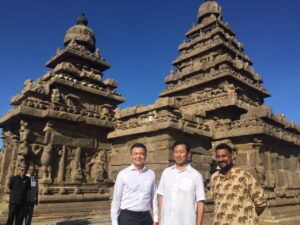
Mahabalipuram
Marco Polo In India wrote of a remarkable coastal site on India’s eastern seaboard, known to foreign sailors as the Seven Pagodas—a name that persisted in European maps and maritime lore for centuries. Scholars widely associate this reference with present-day Mahabalipuram on the Coromandel Coast, a Pallava-era port town renowned for its stone temples and rock-cut monuments. While the idea of seven fully submerged temples belongs partly to later legend, marine archaeology and historical records confirm that Mahabalipuram was an active port with prominent shore temples visible from the sea, serving as navigational markers for Indian Ocean traders. Polo’s mention reflects how such monumental architecture functioned not only as religious space but as maritime infrastructure—signposts in a global trade network linking India’s textile-producing hinterlands to the wider world. Today, Mahabalipuram’s UNESCO-listed Shore Temple and sculpted landscapes preserve this convergence of art, commerce, and oceanic exchange that so captivated medieval travelers. For a private guided tour, visit Poetry on Stone. You can also take an immersive walking tour of Mahabalipuram at 5 Senses Walks.

Religion, interestingly, remains peripheral in Polo’s writing. He mentions temples, rituals, and customs, but rarely lingers. This is not ignorance—it is bias. Polo was a merchant at heart. What mattered to him was reliability: ports that worked, rulers who protected trade, markets that delivered.
That perspective gives us something rare—a view of India not as spiritual abstraction, but as economic reality.
Modern historians often caution readers not to take the account of Marco Polo in India literally. He compresses geography. He inflates numbers. But when cross-checked against Arab sources, Chinese records, and archaeological data, his central claim holds firm: India was indispensable to the medieval world economy.
And that indispensability shaped culture.
Walk through Kerala today and you’ll still see the aftershocks of that trade world: synagogues, mosques, churches, and temples within walking distance; food flavored by spices once traded for gold; coastal towns that feel outward-facing rather than insular. The global arrived early here—and never fully left.
India did not wait for Europeans to globalise it.
It was already global.
Marco Polo’s greatest contribution is not accuracy in detail, but accuracy in orientation. He places India where it belongs—at the center of circulation, not the margins of mystery.
Many of the places and ideas described in this account of Marco Polo in India are not relics locked behind museum glass—they remain woven into everyday life across India. The historic port town of Kozhikode, long recognized by scholars as the pepper hub Marco Polo alluded to, still carries the rhythms of maritime trade in its markets and waterfronts. The wider Malabar Coast continues to reveal how a continuous chain of ports once functioned as a single economic ecosystem, shaped by monsoon winds and ocean currents.
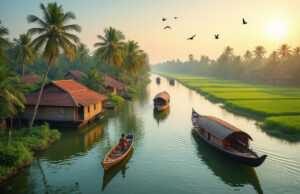
Inland, the forested spice regions around Thekkady preserve the ecological foundations of the trade Polo found so astonishing, where pepper, cardamom, and other spices still grow in landscapes governed by the same seasonal logic he indirectly observed. 5 Senses Tours offers private, guided journeys through these regions, thoughtfully connecting coastal heritage, spice cultivation, and historical context for travellers who value insight, conversation, and lived continuity over checklists.
For a privately curated journey exploring the key landscapes and trade worlds described in this blog, visit 5 Senses Tours
Leave a Reply