
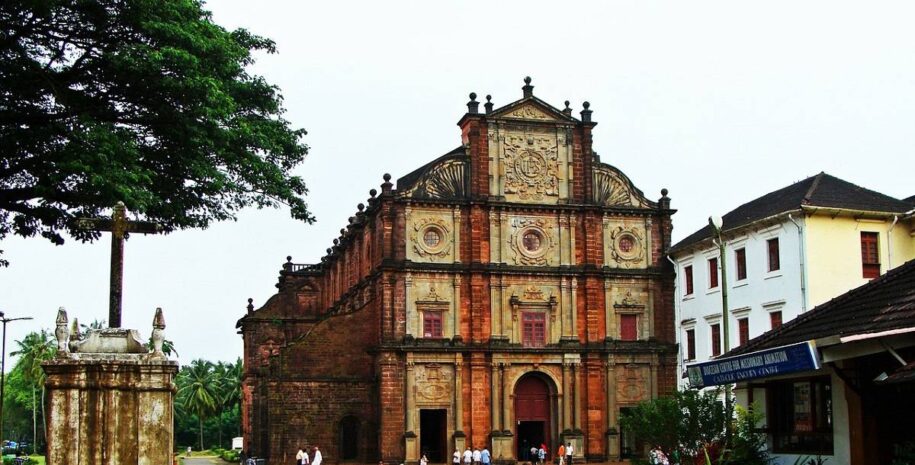
Old Goa heritage walk does not greet visitors the way living cities do. There is no hum of traffic, no tight weave of daily routines. Instead, there is space—wide, deliberate, almost unsettling. This was once one of the richest cities in the world, a capital so powerful in the 16th century that it was compared to Lisbon. Today, its grandeur stands largely uninhabited, preserved in stone and silence. A heritage walk through Old Goa is not about what remains alone, but about understanding why a city of such scale was ultimately left behind.
Visit Rediscover Old Goa for a guided, immersive culture walk in Old Goa.
When Old Goa Ruled the Seas

Old Goa rose to prominence as the capital of Portuguese India in the early 16th century, strategically positioned along the Mandovi River. Historical economic studies show that port cities like Old Goa thrived when they controlled trade routes, taxation, and religious authority simultaneously. Old Goa did all three.
Ships from Africa, Arabia, and Europe docked here. Spices, textiles, precious metals, and people moved through its streets. The city became a center of administration, commerce, and missionary activity, earning its reputation as the “Rome of the East.”
In this Old Goa heritage walk, the vast distances between structures hint at how densely populated the area once was. Urban archaeology reveals that what survives now represents only a fraction of the original city, much of which was lost to neglect, dismantling, and environmental pressure.
Architecture as Authority

Old Goa’s churches were not built merely for worship; they were built to project power. Architectural historians note that scale, symmetry, and ornamentation were tools of ideological dominance. Structures like the Basilica of Bom Jesus and the Sé Cathedral were designed to awe, instruct, and convert.
The choice of materials—laterite core with lime plaster—reflects adaptation to local conditions, while the stylistic vocabulary remained firmly European. This architectural duality mirrored colonial strategy: impose authority while relying on local resources and labor.
On a Goa heritage walk, the spatial arrangement becomes crucial. Churches were placed to dominate sightlines, processions were choreographed through open spaces, and religion was woven directly into civic life. Walking these routes restores the original logic of the city.
Why the City Was Abandoned

Despite its wealth, Old Goa was deeply vulnerable. Historical medical research and colonial records document repeated outbreaks of malaria, cholera, and plague, exacerbated by poor drainage and stagnant water. As trade patterns shifted and health crises mounted, the city became increasingly difficult to sustain.
By the 18th century, administrative functions began moving to Panjim, which offered better ventilation, sanitation, and accessibility. Old Goa was not destroyed; it was slowly emptied. This pattern aligns with urban decline models studied in historical geography, where environmental stress rather than political collapse often drives abandonment.
What remains today is a monumental shell—impressive, but no longer lived in.
Silence as Historical Evidence
Silence in Old Goa is not emptiness; it is evidence.
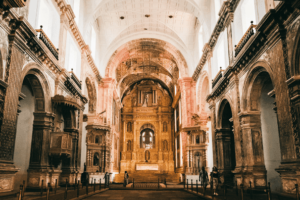
Environmental psychology suggests that quiet spaces amplify reflection and emotional response. Without crowds or daily noise, visitors become more aware of scale, proportion, and absence. The wide lawns, the towering facades, and the echoing interiors experienced in this Old Goa heritage walk, all reinforce the sense of a city designed for mass gatherings that no longer occur.
This is why Old Goa is best experienced on foot and without haste. A heritage walk allows visitors to feel the distances, the transitions between structures, and the gradual withdrawal of urban life.
The Role of Goa Heritage Walk
Old Goa cannot be understood from a single viewpoint or photograph. Its story lives in movement—between churches, across open grounds, along paths once lined with houses, markets, and schools.
Heritage conservation studies emphasize that interpretive walking is essential in abandoned cities. Without narrative, ruins feel disconnected. With context, they become legible.
A guided Goa heritage walk explains not only what stands, but what once stood between these monuments. It connects architecture to trade, religion to politics, and disease to urban planning.
Experiencing Old Goa with 5 Senses Tours
With 5 Senses Tours, the Old Goa heritage walk is offered as a thoughtfully paced experience. The journey emphasises understanding over spectacle, allowing guests to absorb the city’s scale and silence without distraction.
Visit Rediscover Old Goa for an immersive culture walk.
What Old Goa Leaves Behind
Old Goa heritage walk teaches a difficult lesson: power does not guarantee permanence. Cities rise not only on wealth and belief, but on ecology, health, and adaptability.
Walking through Old Goa is an encounter with ambition, faith, and vulnerability—all preserved in stone. For travelers seeking more than photographs, this heritage walk offers something rare: a chance to stand inside history’s echo and listen carefully to what it still has to say.
For private tours to Chandor, the old capital, Tamdi Surla, the forest shrine, and 8000-year-old rock art, visit Heritage tours of Goa.
Leave a Reply