
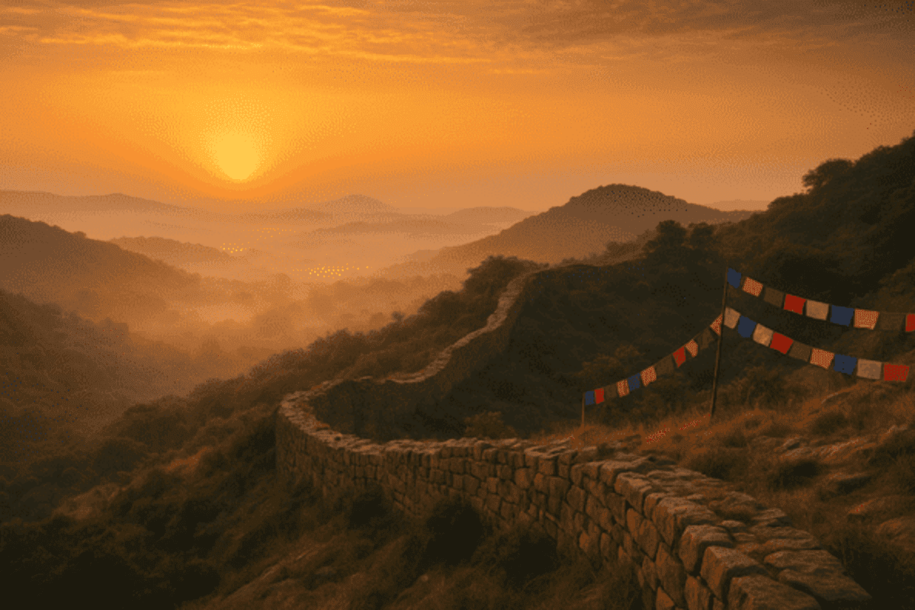
In the folds of Bihar’s rugged hills lies Rajgir — a town that hums with memory. Here, every rock and hot spring, every winding path through sal forest seems to murmur stories from another age. Long before Patna rose as an imperial capital, Rajgir was the heart of the Magadha Empire, where kings, monks, and philosophers shaped the early moral spine of India.
For a private guided tour of Rajgir and Nalanda visit Rajgir day trip from Bodhgaya.
The Buddha’s Hill

Climb the stone steps to Griddhakuta, the Vulture’s Peak, and you’ll stand where the Buddha once taught. The view stretches across the valley, golden in morning light, while prayer flags flutter like whispers of ancient vows. It was here, nearly 2,500 years ago, that the Buddha delivered his famous Lotus Sutra and laid down teachings that would travel across Asia. The caves below still hold traces of his meditations — a geography of enlightenment carved into the hillside.
Modern visitors reach the top by ropeway, gliding over trees and temples — India’s very first aerial lift, built to reach this sacred summit. At the crest stands the Vishwa Shanti Stupa, a gleaming white dome built by Japanese monks in 1969 to remind humanity of peace after Hiroshima. Its golden Buddha statues glint in the sun — an intersection of ancient wisdom and modern hope.
Walls Older Than Empires
Few realize that Rajgir once lay behind vast fortifications known as the Cyclopean Walls — a 40-kilometer ring of rough-hewn stone, stacked without mortar, older even than the Mauryas. These walls date to the 6th century BCE, and archaeologists have compared their dry-stone precision to the Mycenaean citadels of Greece. They encircle five hills — Vaibhara, Vipula, Ratna, Saila, and Chhatha — turning Rajgir into a natural fortress. Standing among these boulders feels like standing inside a fossilized city, preserved in time.
The Hot Springs of the Gods

Down in the valley, where steam curls from hidden fissures, lie the Brahmakund hot springs — sacred to Hindus and visited by pilgrims for centuries. The water is sulfur-rich, its warmth arising from geothermal activity beneath the Himalayas. Scientists say these waters can soothe the skin and joints; locals believe they purify the soul. Each pool is dedicated to a different deity, merging science and sanctity in one warm breath of earth.
Echoes of Jain and Hindu Legends

Rajgir’s sanctity doesn’t belong to one faith alone. For Jains, it is where Mahavira, the 24th Tirthankara, spent fourteen monsoon seasons preaching. For Hindus, it is the arena of epic legend — the place where Bhima wrestled Jarasandha, and where Yudhishthira performed the Rajasuya Yajna to mark his kingship. The myths seem to run beneath the soil like hidden streams, feeding everything above.
Geology Meets Faith

Beyond its temples, Rajgir fascinates geologists. The surrounding Rajgir Hills are among India’s oldest rock formations — over a billion years old. Layers of quartzite and phyllite tell of ancient seas, tectonic collisions, and the slow birth of the Indian subcontinent. Few places allow you to touch both cosmic and human history in the same breath.
Why Rajgir Matters Today
To visit Rajgir is to experience India’s spiritual evolution in one landscape. The same hills that once heard the Buddha’s voice now echo with temple bells and camera clicks. Yet its essence endures: a place where time folds in on itself, and the sacred, the scientific, and the mythic coexist without contradiction.
For a private guided tour of Rajgir and Nalanda visit Rajgir day trip from Bodhgaya.
Leave a Reply