
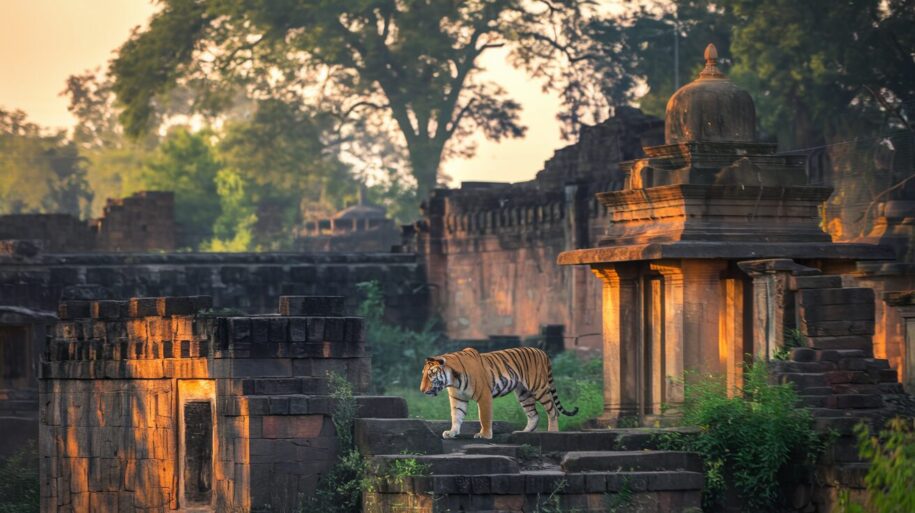
When dawn breaks over the jungles of Ranthambore, mist curls through ancient banyan trees and peacocks cry out like trumpets of an unseen court. The air smells of wild jasmine and dust. Somewhere beyond the tall grass, a tiger stirs. But Ranthambore is not only the kingdom of the tiger—it is also a land where myths, memories, and royal pride breathe alongside the roar of the forest.
For a private guided tour of Ranthambore, please visit Ranthambore Tiger Safari.
The Fort That Refused to Fall

Crowning a rocky hill in the heart of Rajasthan, Ranthambore Fort is not merely a ruin—it’s a chronicle carved in stone. Built nearly a thousand years ago by the Chauhan rulers, the fort once guarded a land of brave warriors and indomitable queens. The most enduring tale belongs to Raja Hammir Deo Chauhan, whose defiance against Alauddin Khilji in the 13th century became immortal.
When Khilji’s mighty army surrounded the fort, Hammir chose resistance over surrender. The siege dragged on for years; food ran out, but not courage. In a moment of terrible beauty, the women of the fort performed jauhar—self-immolation to protect their honor—while Hammir and his men rode out to their final battle. The fort fell, but Hammir’s spirit never did. His story, preserved in the Hammir Mahakavya, still echoes through Rajasthan’s folk songs, reminding every traveler that Ranthambore’s soil was once watered with valor.
Walk through those gates today and you’ll feel it—the hush of reverence, the strange gravity that clings to places where history refused to die.
The Blessing of the Three-Eyed Lord

As you climb through the fort’s winding paths, the air fills with the chant of “Ganpati Bappa Morya!” Here stands the Trinetra Ganesh Temple, dedicated to the three-eyed form of Lord Ganesha. Legend says that during the siege, Raja Hammir dreamt of Ganesha, who promised that help was on its way. The next morning, supplies inexplicably appeared at the gate, and the enemy retreated—at least for a while.
To commemorate that miracle, Hammir built this temple. Even today, it remains one of India’s few temples where Ganesha is worshipped with three eyes, symbolizing foresight. Every year, thousands of devotees send letters and wedding invitations addressed simply to “Shri Ganesh Ji, Ranthambore Fort.” Postal workers know exactly where to deliver them.
The Queen Who Became a Tiger

Ranthambore’s forest doesn’t just echo with royal footsteps—it whispers of transformation. Locals still tell the story of Rani Padmavati of Ranthambore, whose jeweled anklet was said to bring fortune to her kingdom. When a Mughal noble tried to seize it, the queen cursed him: “May you be devoured by what you cannot conquer.” Days later, he was found mauled by a tiger near Padam Talao. The villagers say it wasn’t coincidence—the queen had returned in the form of the great cat to protect her realm.
To this day, many locals believe that the tigresses of Ranthambore—especially the legendary Machhli, once the most photographed tiger in the world—carry the spirit of the ancient queen. Wildlife biologists may attribute their boldness to strong maternal instincts, but among villagers, they’re called Raniji—the Queens of the Jungle.
The Ghost Who Walks at Dusk

Every guide in Ranthambore has heard of her—the “Ranthambore ki Rani”, the woman in white who appears at twilight near the Padam Talao lake. Some say she’s the spirit of a noblewoman who once lived in the fort, waiting eternally for her husband who never returned from battle. Others whisper that she’s the soul of the forest itself, guarding the land from greed and harm.
Whether real or imagined, the story lingers. Many rangers have reported seeing a faint glow near the lake, moving as gracefully as mist. Science calls it bioluminescent insects—but in the jungle’s stillness, even logic feels haunted.
The Monk and the Tiger

One of Ranthambore’s gentlest legends is that of a wandering monk who meditated near the forest centuries ago. It is said that a tiger often came and sat beside him in silence, guarding him while he prayed. When a hunter tried to shoot the tiger, his gun misfired, and the monk declared, “This land shall forever be a refuge—for those who come in peace, not for those who seek to conquer.”
Perhaps that’s why Ranthambore’s tigers, despite their power, so often walk calmly beside tourist jeeps. The jungle remembers the monk’s blessing.
The Living Epic of Ranthambore

Today, Ranthambore is one of India’s premier tiger reserves—a sanctuary of biodiversity and history intertwined. Tigers prowl through crumbling pavilions; banyan roots embrace forgotten temples. The ruins themselves seem alive, whispering stories from a thousand years ago.
Yet beyond the myths, there’s a profound truth supported by science: Ranthambore’s ecosystem is a model of successful wildlife recovery. The park’s tiger population has steadily risen over the last two decades, thanks to conservation efforts, community partnerships, and careful eco-tourism. The same forests that once echoed with war drums now resound with birdcalls and camera shutters—a peaceful transformation born from respect.
Why Travelers Fall in Love Here

To walk in Ranthambore is to step into a living museum—one curated not by human hands, but by time and nature. It is where every sunrise feels cinematic, every ruin has a story, and every rustle in the tall grass could be both tiger and ghost.
Visitors come seeking wildlife and leave having witnessed something deeper—a connection between myth, memory, and wilderness. Ranthambore is not a place you simply see; it’s a place that stays with you, quietly reminding you that the line between legend and reality is often just the edge of the forest.
For a private guided tour of Ranthambore, please visit Ranthambore Tiger Safari.
Leave a Reply