
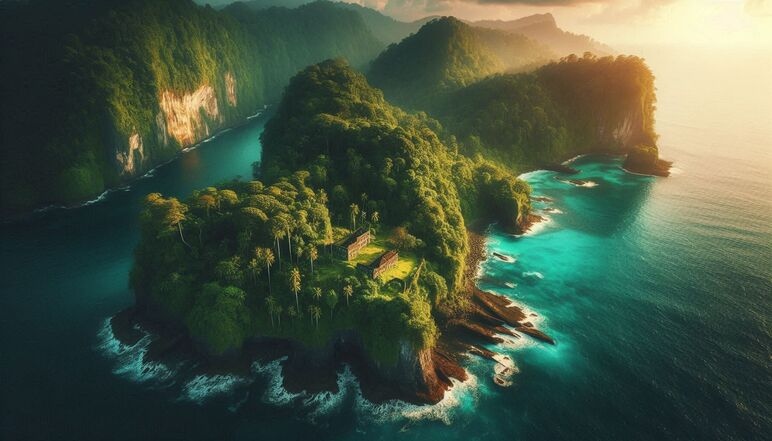
Step onto Ross Island and the air shifts. The breeze carries a faint tang of salt, but beneath it lies something stranger—an undertone of moss, wet stone, and stories that have spent decades hiding under the roots of giant banyan trees. Few places in India feel as though they’re balancing between two eras at once. Ross Island is one of them. What stands here today is not just an island—it’s a memory palace, partly preserved and partly undone by nature’s quiet, tireless persistence.
For private guided tours of the Andaman Islands, please visit Port Blair Tours.
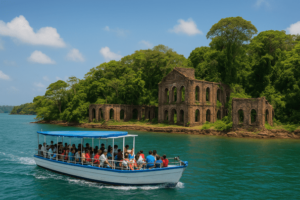
The island once served as the administrative headquarters for the British in the Andamans. From 1858 until an earthquake in 1941 shook its very bones, this tiny strip of land ruled over the entire penal colony of the archipelago. It had everything a colonial regime would want: neat bungalows, manicured gardens, a church, a printing press, tennis courts, a bakery that produced fresh loaves every morning, and an imposing Chief Commissioner’s home nicknamed the “Paris of the East.” Written accounts from the late nineteenth century describe Ross Island as a place of iron-fisted order wrapped in tropical elegance.
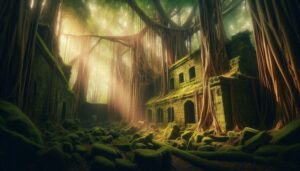
Then the forest came back.
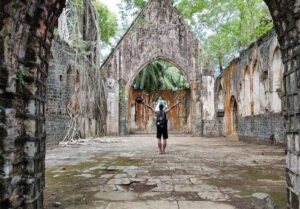
Not in a dramatic Hollywood rush, but in a slow, patient reclamation that would make any naturalist smile. Roots began to snake through the windows of the bakery. The roofs of officers’ quarters grew soft with moss before collapsing altogether. Ferns colonised the gutters. Every crack became a doorway for green life. Today, banyan trees have swallowed entire walls, their roots cascading like frozen waterfalls over bricks once placed by convicts who lived under the harshest conditions.
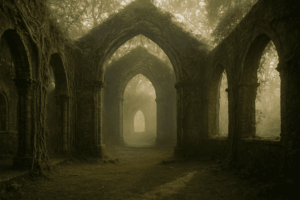 Visitors walking through these ruins experience something unusual: the sensation of seeing time doing its work openly. Historic decay is not hidden behind barriers here. It surrounds you, creeps up behind you, and frames every archway like a scene from a tropical gothic novel. The forest is the island’s most prolific artist, sculpting hallways out of roots and making picture frames out of vines.
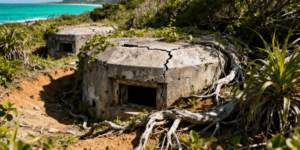
Yet the story of Ross Island isn’t only about ruins—or even about nature’s triumph. It is also a story of human survival and shifting power. When the Japanese occupied the Andamans during World War II, they took control of Ross Island and left behind bunkers and tunnels that still remain. These low concrete structures, stark and functional, contrast sharply with the romantic ruins draped in greenery. Their presence turns the island into a layered museum of colonial ambition, wartime strategy, and ecological renewal.
One of the island’s most striking scientific fascinations lies in how animals adapted to its changing environment. During the British era, deer were brought here for aesthetic reasons—essentially living lawn ornaments. Without predators and with the island eventually abandoned, the deer population expanded and adapted to the quietly reclaiming ecosystem. Seeing them now, grazing between crumbling archways or walking along mossy paths, creates an image that borders on surreal: wildlife threading itself through the architecture of empire.

There’s also the matter of the island’s geology. The Andamans sit near a tectonically active zone, part of the same long arc that ties the Indonesian archipelago to the Himalayas through slow-motion continental drama. The 1941 earthquake that led to the island’s abandonment was not random; it was part of a vast system where island arcs collide with oceanic crust, reshaping coastlines over millennia. The Andamans are young in geological terms. Ross Island is a mere momentary outcrop in the larger narrative of drifting plates and rising land.
Walking through the island today, you might also notice the quality of the light. It filters through the huge leaves like stained glass—golden in the mornings, turning silvery by late afternoon. Photographers often fall silent here because the ruins don’t simply “look” good. They feel like they’ve been constructed by some imaginative collaboration between nature and history, a co-authored manuscript of stone and vine. It’s the kind of place where you half expect a forgotten file or ledger to lie open under a root, its ink still faintly visible.
If you follow the main path through the island, you reach the remains of the British church—St. Andrew’s. The church once held polished pews and echoed with hymns rising over the ocean wind. Today, only its skeleton remains. Arches stand without ceilings. The roof beams are gone, replaced by branches. The effect is strangely uplifting, a place that once echoed with colonial rituals now open to the sky and sea.
There is a scientific curiosity here too—how microclimates form in ruins. Cracks in old walls collect water, which encourages small ferns; those ferns invite insects; insects attract birds. The entire island becomes a textbook case of ecological succession, a phenomenon that explains how nature recolonises land after disturbance. Ecologists studying the Andamans have long pointed out how islands like Ross serve as natural laboratories for observing how life creeps back into disrupted ecosystems.
The Japanese bunkers, meanwhile, add an entirely different texture to the island. Built for strategic defence and carved partly into the rocky surface, these structures let you imagine how the island once bristled with wartime tension. Evidence from wartime records suggests that the Japanese presence here was significant enough to change the island’s infrastructure. Some of their tunnels and defensive positions remain accessible, making Ross Island one of the rare Indian destinations where colonial and wartime histories sit almost face to face.
What makes Ross Island unforgettable is the way all these layers—colonial glamour, harsh penal histories, Japanese bunkers, earthquake scars, and nature’s unstoppable artistry—come together without clashing. The landscape feels like a slow, unhurried conversation between past and present. The ruins stand not as monuments to loss, but as reminders that time does not erase stories; it simply changes the handwriting.
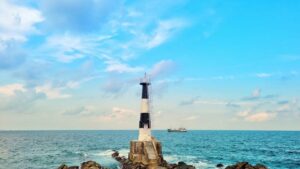
Visitors often linger near the water’s edge at the end of their walk. The sea is a brilliant turquoise, a colour that feels almost impossible until you’ve seen it. The breeze carries the scent of seagrass and distant rain. Boats hum in the distance. And the island, which once sought to impose order, now rests in a state of beautiful, dignified surrender to the natural world.
Ross Island is a place where history is not locked behind glass; it’s alive, breathing through roots and echoing through ruins. It is a rare gift for anyone who travels not just to see places, but to feel their stories rise from the stone beneath their feet. It invites you to slow down, listen, and let the forest’s whispers fill in the gaps that history books leave behind.
And long after you’ve left, the island stays with you—like a photograph etched not onto paper, but into memory.
For private guided tours of the Andaman Islands, please visit Port Blair Tours.
Leave a Reply