


If you’re an explorer—of worlds and of wisdom—India offers more than just its palaces, cuisine, and dazzling landscapes. Hidden in its ancient texts is a science so advanced, it continues to mystify and inspire. At the heart of this legacy is the Surya Siddhanta, attributed to the legendary sage and architect, Mayasura. This treatise reveals how India once mapped the cosmos, calculated time, and marveled at the interplay between math and myth—making it a pilgrimage site for the curious traveler.
The Legend and Lore: Mayasura, the Sage of the Sun
Long before telescopes and satellites, Mayasura is believed to have received divine instructions from Surya, the Sun God. Tradition places this revelation at the close of the Satya Yuga, positioning Mayasura as the progenitor of a scientific revolution. To this day, his legacy resonates through rituals, temples aligned to solstices, and the continued use of his principles in Panchangas (Indian calendars).
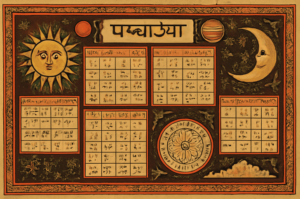
Often called the “manual of astronomy,” the Surya Siddhanta was composed in ancient Sanskrit, blending rigorous observation with poetic logic. Its 14 chapters, nearly 500 verses, and mathematical methods make it one of the world’s earliest and most influential scientific documents.
Revolutionary Concepts:
- Spherical Earth: The treatise describes Earth’s roundness and even discusses forces like gravity—centuries before Newton.
- Trigonometry: The “jya” function (proto-sine) makes its mathematical debut, empowering calculations of angles and distances.
- Time Calculations: It measures vast cycles (“Yugas”), calendars, solstices, and equinoxes, influencing millions of lives even today.
Mayasura: The Unsung Father of Trigonometry
While the term “father of trigonometry” is often credited to the Greek astronomer Hipparchus, modern scholarship and astronomical simulations strongly suggest that Mayasura—through the Surya Siddhanta—was the earliest and true pioneer of this discipline. India’s trigonometric tradition began not only centuries but millennia before its comparable development in the West, making India’s ancient science a compelling reason for travelers and enthusiasts to marvel at its extraordinary heritage.

Why Is Mayasura the Father of Trigonometry?
- Earliest Definition and Use of Sine (Jya)
- The Surya Siddhanta introduces the sine function (jya), and provides detailed sine tables and operations centuries prior to their appearance in Western texts.
- It defines not just the sine, but also the cosine (kojya), versine (utkrama-jya), and even tangents and secants, and offers instructions for practical applications such as sundial shadows and planetary positioning.
- Spherical Trigonometry for Astronomy
- Mayasura’s treatise applies spherical trigonometry—a sophisticated branch dealing with the geometry of spheres—to calculate celestial positions, eclipse predictions, planetary orbits, and time cycles. This was essential for mapping the heavens and solved problems the Greeks approached geometrically but not algebraically.
- These spherical methods predate and heavily influence later Islamic and European developments, becoming the theoretical backbone of global astronomy.
- Accurate Trigonometric Tables
- The Surya Siddhanta’s sine tables, covering intervals of 3.75°, were more accurate and comprehensive than those compiled centuries later by Hipparchus or Ptolemy.
- Aryabhata, Varahamihira, and subsequent Indian astronomers refined—but did not originate—these methods; the root lies in Mayasura’s Surya Siddhanta.
- Practical Innovations: Calendar, Timekeeping, Ritual
- Trigonometric calculations were central to Indian calendars (Panchangas), enabling precise prediction of eclipses, solstices, and planetary movements. These still inform Indian festivals, agricultural activities, and temple alignments today.
- By using chords as half-angles, and innovating algorithms for planetary positions, Mayasura revolutionized both astronomy and daily life.
- Global Influence and Transmission
- The Surya Siddhanta was translated into Arabic, Persian, and later Latin, becoming a foundational reference in Islamic and European astronomy.
- The sine (jya) became “jiva” in Arabic, which later morphed into “sine” in Latin, directly linking Mayasura’s work to global mathematical vocabulary.
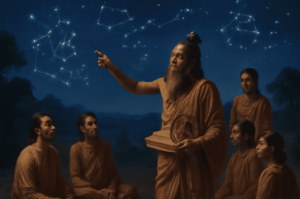
Celestial Engineering: Mathematics Meets Myth
The Surya Siddhanta isn’t static—it’s a living manuscript that inspired temple constructions, timekeeping, and navy navigation across ancient India. Complex algorithms in the text allowed scholars to forecast eclipses, chart planetary movements, and construct astronomical instruments with astonishing precision.
| Feature | Description |
|---|---|
| Planetary Orbits | Accurate methods for calculating positions of Sun, Moon, and planets |
| Measuring Earth | Estimated diameter and circumference with stunning accuracy |
| Eclipses | Mathematical predictions of solar and lunar eclipses |
| Sine Tables | Introduction of trigonometric sine tables centuries before Europe |
| Time Cycles | Definitions of day, month, year, and cosmic eras (“Yuga” cycles) |
| Astronomy in Ritual | Temple alignments, rituals, and festivals rooted in celestial cycles |
Surya Siddhanta in Practice
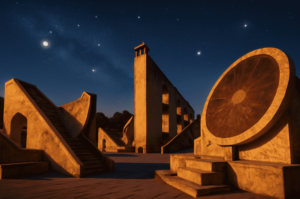
Ancient Sites Await Travelers:
- Jantar Mantar: These UNESCO-listed observatories in Jaipur and Delhi showcase the blend of art and astronomy pioneered by ancient Indian science.
- Temples Aligned to the Sun: Visit the Konark Sun Temple in Odisha or the Brihadeeswarar Temple in Tamil Nadu—each marvels of architecture and astronomical alignment.
- Village Calendar Makers: In rural India, local scholars still calculate eclipses and festival dates using Surya Siddhanta’s tables and methods.
Surya Siddhanta’s Global Influence
The reach of Surya Siddhanta transcended India’s borders. Translated into Arabic (“Sindhind”) and later into Latin, its principles found their way into Islamic and European astronomy during the Middle Ages. Modern scientists have even confirmed the treatise’s advanced calculations, with NASA simulations echoing the accuracy of Mayasura’s celestial records.
- Astro-Mathematical Legacy: Its trigonometric and astronomical principles remain relevant even in today’s digital calculations.
- India’s Calendar: Religious festivals, agricultural activities, and daily rituals are still guided by Surya Siddhanta’s precise planetary tables.
- Cultural Impact: The blend of science and spirituality—where mathematical genius meets devotion—enchants both locals and visitors.
In the Footsteps of the Ancient Skywatchers: Your Indian Adventure Awaits
India invites you to not just witness its past, but participate in a living tradition:
- Attend a solar festival: Join thousands at sunrise ceremonies, marveling as temples align perfectly with celestial events.
- Visit an observatory: Stand in the shadow of monumental sundials, astronomical towers, and celestial globes. Delhi and Jaipur have medieval observatories called Jantar Mantar.
- Meet local scholars: Discover the living practice of astronomy and calendar-making, passed down through generations.
For guided tours in India please visit 5 Senses Tours.
Whether you’re a scientist, historian, spiritual seeker, or simply in awe of the cosmos, India’s Surya Siddhanta is your gateway to an extraordinary tale—a fusion of intellect, artistry, and celestial wonder. Step beneath the Indian sky, and you’ll find that every star and shadow weaves together the story of a civilization that asked big questions, and found answers written in the language of the universe.
Let the Surya Siddhanta be your beacon. Journey to India, where the cosmos and culture meet, and where every traveler can rediscover what it truly means to seek—and find—the stars.
For immersive culture walks in India, please visit 5 Senses Walks.

Leave a Reply