

In the mist-kissed heart of India’s Northeast, where the Brahmaputra flows like liquid silver and hills rise from the horizon in waves of green, lies a forgotten epic — the story of the Ahoms, the rulers who defied conquest for six hundred years. Their tale is not one of plunder or vanity, but of resilience, ingenuity, and integration — a kingdom that thrived while the rest of India was shaped and reshaped by invasion.
It all began in 1228 CE, when a Tai prince named Sukaphaa crossed the rugged Patkai hills from what is now Myanmar. He didn’t come as a conqueror; he came as a cultivator and builder. With his followers, he brought the sophisticated knowledge of wet-rice cultivation and the will to create, not destroy. As he settled in the fertile Brahmaputra Valley, he didn’t displace the locals — he befriended them. Over time, Sukaphaa’s Tai lineage blended harmoniously with the indigenous Assamese culture, giving birth to the Ahom civilization, a rare example of peaceful cultural synthesis.
For a private guided tour of Assam, visit immersive experiences from Guwahati.

Under his descendants, the Ahom kingdom blossomed into one of South Asia’s most remarkable indigenous states. They mastered administration, recorded history meticulously in chronicles called Buranjis, and constructed intricate irrigation systems and monumental architecture that still stand today. Their polity was both advanced and inclusive — a kingdom where merit could outshine birth.
The Warriors of the Brahmaputra
The Ahoms were as formidable in battle as they were wise in governance. Over centuries, they resisted seventeen Mughal invasions, turning Assam into the one corner of India that imperial ambition could never subdue.

The most legendary of these triumphs came in 1671 at the Battle of Saraighat. As Mughal forces advanced along the Brahmaputra, the Ahom general Lachit Borphukan led his smaller fleet into the fray. Using brilliant guerrilla and naval tactics, he turned the river itself into a weapon. His words before the battle — “My king’s honour is worth more than my life” — became eternal. The Ahoms emerged victorious, and Assam remained unconquered.
This wasn’t just a battle; it was a statement — that courage and strategy could triumph over empire.
The Living Heart of an Empire: Sivasagar
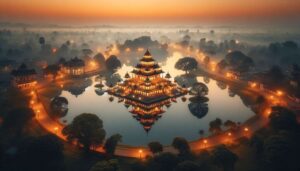
At the kingdom’s core lay Sivasagar, once the Ahom capital. Even today, the town breathes history. The elegant Rang Ghar, often called Asia’s oldest amphitheatre, once hosted royal games and celebrations. The Talatal Ghar, a palace complex of secret tunnels and multiple levels, stands as a masterpiece of medieval engineering. The massive Sivasagar tank, created without modern tools, still glimmers like a mirror to the past.
Nearby, the Namdang Stone Bridge, carved from a single piece of rock in 1703, continues to bear traffic — a silent monument to Ahom craftsmanship and endurance. Each of these sites is a living classroom, telling tales of kings, artisans, and architects who turned a wetland valley into a powerhouse of culture.

The Buranjis: Assam’s Time Capsules
Long before colonial historians arrived, the Ahoms were already writing their own story. Their chronicles, the Buranjis, recorded everything from royal decrees to weather patterns, rituals, and diplomacy. They stand among the earliest examples of systematic historiography in India. To read them is to step into the mind of a civilization that valued both record and reason.
Where Spirit and Nature Meet
Yet, Assam’s appeal isn’t bound to royal ruins. It is a land where spirit, story, and wilderness intertwine effortlessly.
In Guwahati, high on the Nilachal Hills, stands the Kamakhya Temple, one of India’s most powerful Shakti Peethas. Dedicated to the goddess of creation and fertility, Kamakhya is more than a temple — it’s a cosmic symbol of feminine energy. During the Ambubachi Mela, the temple turns into a sea of devotion, where ascetics, pilgrims, and mystics gather to celebrate the sacred cycle of nature itself.

A few hours east, the world’s oldest wilderness plays out in Kaziranga National Park, a UNESCO World Heritage Site. Here, one-horned rhinoceroses graze in misty meadows, elephants wade through riverine forests, and bar-headed geese cut across pink dawn skies. Kaziranga is not just wildlife — it’s a reminder that the balance between man and nature, once upheld by the Ahoms through their reverence for land and water, still survives.
Further downstream lies Majuli, the world’s largest river island and the spiritual cradle of Assamese culture. In its serene monasteries — the Satras founded by saint-philosopher Srimanta Sankardev — monks preserve living traditions of dance, mask-making, and storytelling known as Sattriya. Visiting Majuli feels like entering a living poem — where art is prayer and time moves with the river.

And if you venture toward Jorhat, you’ll find emerald tea gardens, colonial-era bungalows, and a quieter rhythm of life — a perfect pause between Assam’s royal past and its vibrant present.

The Legacy That Lives On
The Ahoms’ reign finally came to an end in 1826 with the Treaty of Yandabo, when the Burmese wars destabilized Assam. But what they left behind was far more enduring — a culture of inclusivity, scholarship, and unyielding spirit.
Every monument in Sivasagar, every folk song about Lachit Borphukan, every ritual at Kamakhya, and every rhino grazing in Kaziranga carries whispers of that same message: Assam never bowed.
To travel through Assam is to move through layers of time — from royal chronicles to sacred hills, from wildlife sanctuaries to river islands — all tied by a single thread: the land’s refusal to be ordinary.
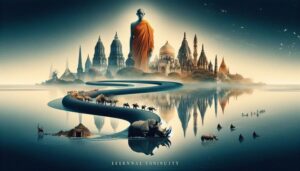
The Ahoms didn’t just rule Assam; they became it. And even today, the Brahmaputra carries their story, flowing endlessly through a kingdom that never truly fell.
For a private guided tour of Assam, visit immersive experiences from Guwahati.
What to See in Assam
-
- Sivasagar: Explore Rang Ghar, Talatal Ghar, Sivasagar Tank, and the Namdang Stone Bridge — architectural marvels of the Ahom era.
-
- Guwahati: Visit Kamakhya Temple, take a sunset cruise on the Brahmaputra, and explore Umananda Island.
-
- Kaziranga National Park: Safari through wetlands to see one-horned rhinos, elephants, and tigers in their natural habitat.
-
- Majuli Island: Experience Vaishnavite monasteries, mask-making traditions, and Sattriya dance performances.
-
- Jorhat: Stay amid tea gardens, explore heritage bungalows, and visit the Tea Research Centre
Leave a Reply