
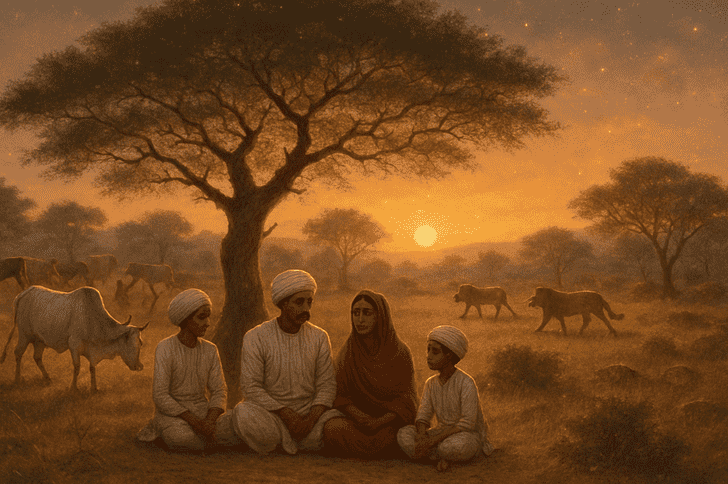
At dawn, when mist still clings to the teak trees of Gir, the forest stirs with the sound of cattle bells. A Maldhari herdsman, clad in his traditional black robe and silver jewelry, guides his buffaloes to graze. Just a few yards away, the golden form of a lion stretches lazily in the grass. To an outsider, this feels like danger waiting to unfold. But here, in the world of the Maldharis, it is simply another day—man, beast, and cattle bound together by centuries of coexistence.
This is Gir—the only place in the world where humans and lions have shared a home for centuries.
The Maldharis, a pastoral community, live inside the forest in clusters of thatched huts called neses. Their lives revolve around their livestock, which provide milk, ghee, and trade. But the forest is also home to over 600 Asiatic lions. Their livelihood depends on their cattle, which graze freely in the lion’s domain. Elsewhere, this overlap might mean conflict. In Gir, it has given birth to a relationship as rare as it is inspiring.
The Lion as Neighbor and Protector
For the Maldharis, lions are not enemies but rightful lords of the forest. They call them “malik”—protectors. When a lion takes a buffalo, the Maldhari do not curse their fate. Instead, they accept it as part of the natural order. “The forest feeds all, even the king of the forest,” they say. This faith allows them to live without resentment, seeing the lion’s power not as a threat but as a blessing.
Old Maldhari folktales tell of lions guarding villages, keeping away jackals and even cattle thieves. Some families recognize individual lions and give them names based on their looks or behavior. A lion with a distinctive scar might be called Dhablo (spotted), remembered in stories like a familiar neighbor.
Story of Coexistence
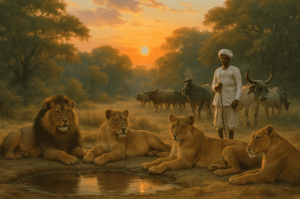
There are countless anecdotes of how seamlessly this bond plays out in daily life. Herdsmen recall lions lying down under an acacia tree while their buffaloes grazed nearby, neither disturbed by the other. During hot summers, lions and cattle often share the same watering holes, with lions waiting until the livestock finish before stepping forward to drink—as if honoring an unspoken code of respect.
One Maldhari elder tells of a night when lions rested right outside his ness. “I could hear their breathing in the dark,” he says, smiling. “But I did not fear. They were my guests, resting close to my cattle. By dawn, they walked away.”
For Maldhari children, lions are not mythical beasts but part of their everyday landscape. They walk to school through forest paths where lions roam, carrying only the lessons of their elders: walk with respect, never with fear.
A Vanishing Way of Life
The Maldharis are also custodians of culture. Their clothing—black turbans, flowing tunics, and heavy silver ornaments—contrasts sharply with the tawny lions. Their folklore and songs carry references to the lion, to the forest, to balance between man and nature. Sitting with them in a ness, sipping fresh buttermilk, you begin to understand that Gir is not just about the roar of lions—it is also about the voices of people who have kept them safe through quiet resilience.
A Lesson for the World
Modern conservation often relies on fences and separation. But in Gir, the Maldharis remind us that harmony is possible through respect and acceptance. They have lived side by side with lions for centuries, showing the world that coexistence between humans and predators is not a dream—it is a lived reality.
When you come to Gir, don’t just look for the lions. Listen to the stories of the Maldharis. In their words, you will hear something profound: the heartbeat of a forest where man and beast still walk the same path.
WHY SHOULD YOU VISIT GIR
A trip here isn’t just a safari; it’s a cultural journey. As you watch a lion stride across the forest, remember—these aren’t just wild animals, they are neighbours of the Maldharis, protectors of the land, and symbols of harmony. By visiting Gir, you witness not just nature’s raw power, but also the delicate human bond that has kept it alive.
For a private tour of Gir Forest from Ahmedabad, visit Asiatic Lion Tour.
Leave a Reply