
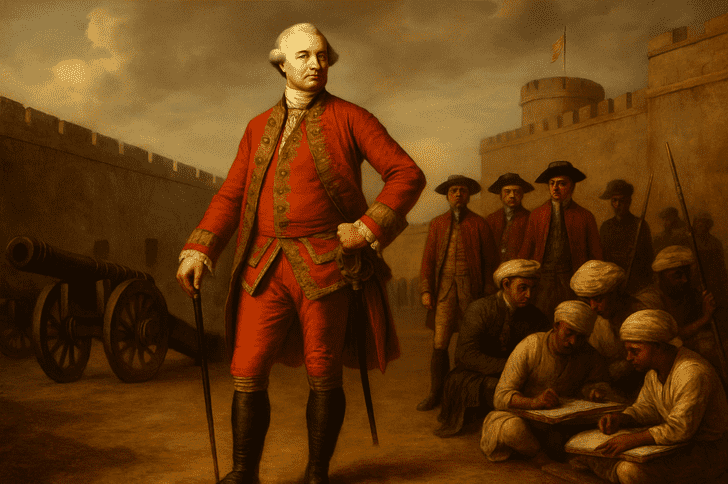
On a sun-soaked morning along the Coromandel Coast in the 1640s, the Bay of Bengal shimmered like molten silver. Sailing ships from distant lands dotted the horizon, their masts swaying against the salty winds. To the men on board—English merchants of the East India Company—the shore was more than just another stop on their perilous voyage. It was hope. It was survival. And it was destiny.
This, dear traveller, is how Fort St. George came into being—the first English fort in India, and the birthplace of modern Chennai. To step into its walls today is to walk through nearly four centuries of stories: of merchants turned empire builders, of soldiers and saints, of weavers and warriors, of marriages and betrayals.
For a guided walk through Fort St George, visit Georgetown Heritage Walk.
Let us journey back in time, where it all began.
A Fort Rises from the Sea
The East India Company was still young in the early 17th century. It had trading posts along the western coast but sought a secure foothold in the east, where the Coromandel Coast offered two irresistible advantages—fine cotton textiles and a natural harbor.
After negotiations with the local Nayak ruler of Chandragiri, the English secured a small strip of land by the sea. On this sandy stretch, in 1644, they began building a fortified settlement. Stone by stone, the walls rose, sturdy enough to withstand rivals and the whims of the sea.
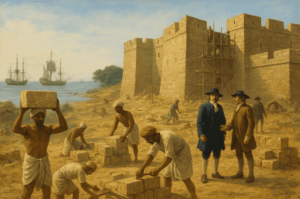
It was christened Fort St. George, after England’s patron saint. But to locals, it was simply the White Town. Outside its walls, Indian settlements sprang up, called Black Town by the colonists—a bustling hub of weavers, traders, and artisans whose textiles would clothe half of Europe.
What began as a warehouse for trade soon grew into something much larger: the nucleus of a city.
Bazaars, Weavers, and the City That Sprang to Life
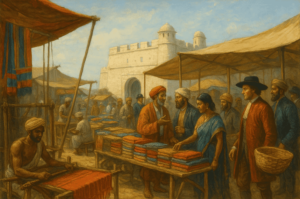
Imagine yourself in 17th-century Madraspatnam, just outside the fort walls. The air hums with activity. Weavers work at looms, their rhythmic clatter blending with the calls of hawkers. Spices—pepper, cardamom, nutmeg—fill the air with intoxicating aromas. Markets buzz with people speaking Tamil, Telugu, Persian, Portuguese, and English.
Inside the fort, English factors (traders) meticulously record accounts of cloth shipments. Bales of muslin, calico, and chintz are packed for ships that will carry them across oceans to Europe. These fabrics, light and colorful, become a craze in London and Paris, shaping global fashion for decades.
Life wasn’t only about trade. Families lived here, children were born here, and churches rose among warehouses. In 1680, St. Mary’s Church was consecrated—the oldest Anglican church in India. Its whitewashed walls still stand, having witnessed weddings, baptisms, and even the union of Robert Clive, the “Clive of India,” whose ambitions would later alter the destiny of the subcontinent.
 A Stage for Intrigue and Conflict

The story of Fort St. George isn’t just about peaceful trade—it’s a tale of rivalry, power, and shifting fortunes.
In the 18th century, when European powers vied for dominance in India, the fort became a contested prize. The French, entrenched in Pondicherry, saw it as a threat. Wars raged—the Carnatic Wars—where Fort St. George was both fortress and pawn in a larger game.
One of the fort’s most dramatic moments came in 1746 when the French actually captured it. For three years, the British lost their jewel of the Coromandel. But treaties and battles restored it, and the Union Jack once again fluttered proudly above its ramparts.
Within these walls, decisions were made that rippled far beyond Chennai. Fort St. George wasn’t merely a trading post anymore—it was an administrative seat, the first step in a chain of events that would lead to the establishment of British India.
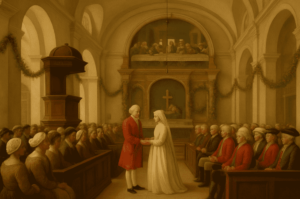
Amidst the bustling trade and military intrigues, Fort St. George also witnessed moments of quiet humanity. One such moment unfolded in 1753 inside St. Mary’s Church, when a young and restless Robert Clive—then only beginning his rise in the East India Company—stood at the altar to wed Margaret Maskelyne. The church, with its simple whitewashed walls and arched ceilings, glowed softly with candlelight as hymns echoed through the hall. To the small gathering, it was a solemn marriage; but in hindsight, it marked the beginning of a partnership that would accompany Clive during his meteoric ascent to power. St. Mary’s, now the oldest Anglican church in India, still holds the memory of that day, reminding visitors that within these walls history was not only fought and negotiated—it was also lived, loved, and sanctified.
 Whispers of Ghosts and Forgotten Tales
But beyond politics and power, Fort St. George has its share of whispered legends.
Locals still tell tales of restless spirits wandering near the ramparts at night—soldiers who fell in battles, sailors lost at sea. Some say the corridors of St. Mary’s Church echo with ghostly footsteps of long-gone governors.
And then there are curiosities tucked in the museum: ancient letters bearing the signatures of King George and Queen Victoria, coins that once jingled in colonial pockets, maps drawn with painstaking detail. Each object is a doorway to a forgotten moment, waiting to be rediscovered by curious eyes.
From Fort to City
Perhaps the most remarkable legacy of Fort St. George is that it gave birth to a city.
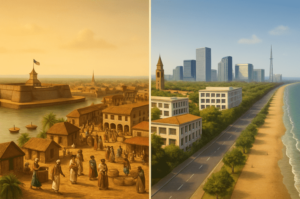
What was once a fishing hamlet called Madraspatnam grew, over centuries, into Madras, one of the great colonial capitals of India. Streets, markets, and neighborhoods spread out from the fort like ripples in a pond. Merchants from Armenia, Portugal, and Persia made it their home. Schools, printing presses, and clubs soon followed.
Today’s Chennai—with its IT corridors, film studios, and Marina Beach—owes its beginnings to those very walls. Fort St. George is the seed from which the metropolis blossomed.
Fort St. George Today: Walking Through History
Visiting Fort St. George today is like stepping into a time capsule. The Fort Museum greets you with treasures: sepia portraits of governors, faded uniforms, weapons once brandished in battles, and treaties that changed the map of India.
St. Mary’s Church, serene and elegant, still opens its doors to visitors. The ramparts, though weathered, continue to stand guard over the Bay of Bengal. The Secretariat, built within the fort, bustles with government offices, reminding us that this is not just a relic but a living institution.
As you walk its corridors, imagine the traders negotiating, the cannons thundering, the church bells ringing. Imagine the weavers outside the walls, their cloth sailing away to far-off lands. Imagine the birth of a city beneath your very feet.
Why You Should Visit
Fort St. George is not merely about colonial history. It is about the origins of Chennai, about the intertwining of cultures, and about the very first English footprint on Indian soil.
For the traveller, it offers:
-
- A museum rich in stories and artefacts.
-
- The oldest Anglican church in India.
-
- The thrill of standing where empires were forged.
-
- And above all, the experience of being at the spot where Chennai itself began.
To visit Fort St. George is to peel back layers of time—to encounter ambition, rivalry, resilience, and human enterprise.
So the next time you’re in Chennai, don’t just walk Marina Beach or sip filter coffee. Step inside these white walls. For here, history isn’t locked away—it lives, breathes, and beckons.
For a guided walk through Fort St George, visit Georgetown Heritage Walk.
Leave a Reply