
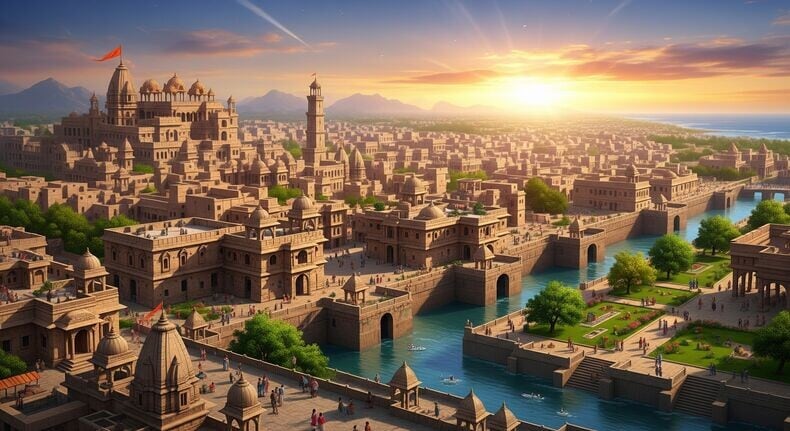
The name Dwarka resonates with the grandeur of ancient India, echoing tales of divine intervention, mythical kingdoms, and a civilization lost to the ceaseless march of the ocean. Situated on the rugged western coast of Gujarat, this sacred city holds an unparalleled position in the heart of Hindu spirituality, revered as one of the four cardinal pilgrimage sites (Char Dham) and one of the seven holy cities (Sapta Puri). But Dwarka is more than just a pilgrimage destination; it is a tapestry woven from threads of profound mythology, tantalizing historical clues, and compelling archaeological discoveries, all converging to paint a picture of a past both wondrous and elusive.
For guided tour of Dwarka and other heritage sites in Gujarat, please visit Ancient Gujarat.
The Divine Founding
At the very core of Dwarka’s allure lies its intimate connection with Lord Krishna, one of the most beloved and complex deities in the Hindu pantheon. According to epic narratives like the Mahabharata, Bhagavata Purana, and Harivamsa, Krishna, after his dramatic departure from Mathura to escape the tyranny of Jarasandha, sought a new home for his Yadava clan. The scriptures describe how he chose a site on the Saurashtra coast, then a small coastal village, and transformed it into a magnificent metropolis.
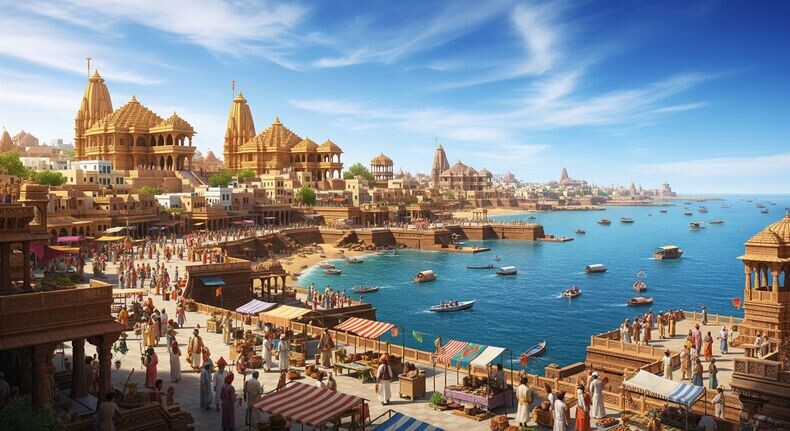
The descriptions of Dwarka in these ancient texts are breathtaking. It was depicted as a city of unparalleled splendor, built on reclaimed land from the sea, showcasing an extraordinary feat of engineering and divine architecture. The Vishnu Purana describes Dwarka as being constructed by Vishwakarma, the divine architect, adorned with golden palaces, sprawling gardens, and intricate fortifications. The city was said to be strategically located, protected by mountains on one side and the vast Arabian Sea on the other, making it an impregnable fortress.
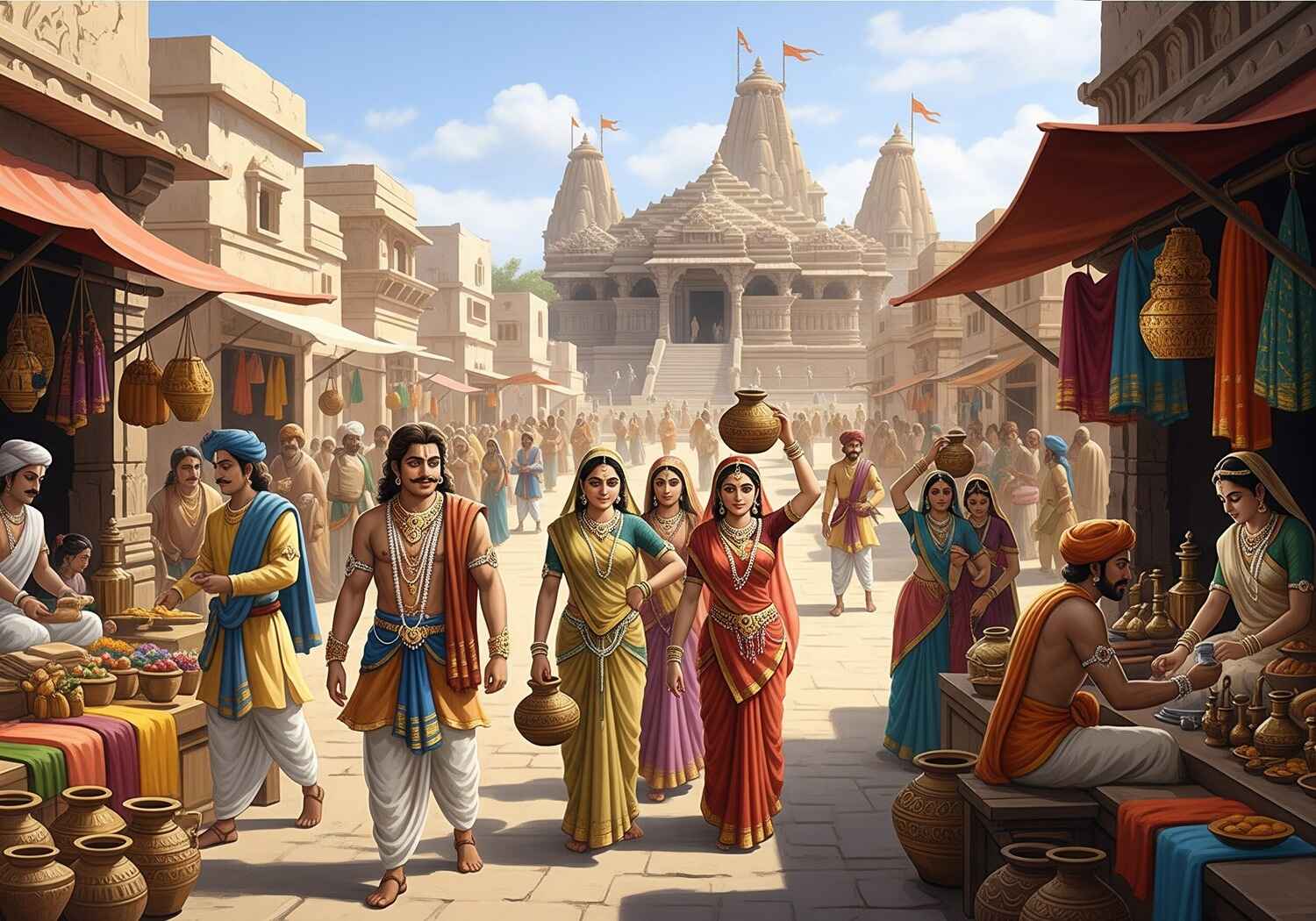
Under Krishna’s benevolent and wise rule, Dwarka flourished into a vibrant political, economic, and cultural powerhouse. The Yadava kingdom achieved unprecedented prosperity, fostering trade, arts, and intellectual pursuits. It was an era of peace, justice, and spiritual enlightenment, where Krishna’s counsel guided the Yadavas in all aspects of life. Dwarka became a symbol of righteousness and an ideal kingdom, embodying the principles of Dharma and good governance. The tales of Krishna’s exploits, his political acumen, and his divine leelas (playful acts) within the confines of Dwarka form a significant part of Hindu mythology, deeply influencing religious thought and artistic expression across centuries.

The Cataclysmic End
Just as its rise was legendary, so too was Dwarka’s dramatic demise. The scriptures narrate that after Lord Krishna ascended to his celestial abode, a series of ominous events began to unfold. The Yadava clan, once unified under Krishna’s charismatic leadership, became embroiled in internal conflicts and vices. This moral decay, combined with a prophecy of destruction, set the stage for Dwarka’s ultimate fate.
The most vivid accounts of Dwarka’s submergence are found in the Mausala Parva of the Mahabharata. It describes how Arjuna, one of the Pandava brothers, visits Dwarka after Krishna’s departure and witnesses the terrifying spectacle of the ocean reclaiming the city. The sea, with roaring waves, steadily encroaches upon the land, swallowing palaces, mansions, and temples, leaving behind no trace of the magnificent city. The survivors, led by Arjuna, are forced to abandon their ancestral home and migrate northward. This event, often referred to as a jalaplavana (great flood), marks a poignant and tragic end to a glorious era.
This mythological account of a city submerged by the sea has fascinated scholars and common people alike, often prompting questions about its historical veracity. Could such a magnificent city truly have existed and then vanished without a trace, leaving only these ancient narratives?
Archaeological Pursuits
The enduring legends of Dwarka, particularly the narrative of its submersion, have spurred significant archaeological interest, especially in marine archaeology. The coastal waters off modern Dwarka became a prime focus of exploration, driven by the desire to reconcile myth with tangible evidence.
One of the most prominent figures in the archaeological exploration of ancient Dwarka was Dr. S.R. Rao, a pioneering Indian marine archaeologist. Beginning in the late 1980s and continuing into the early 2000s, Rao and his team from the National Institute of Oceanography (NIO) conducted extensive underwater excavations off the coast of Dwarka. Their findings were revolutionary and sparked considerable debate.
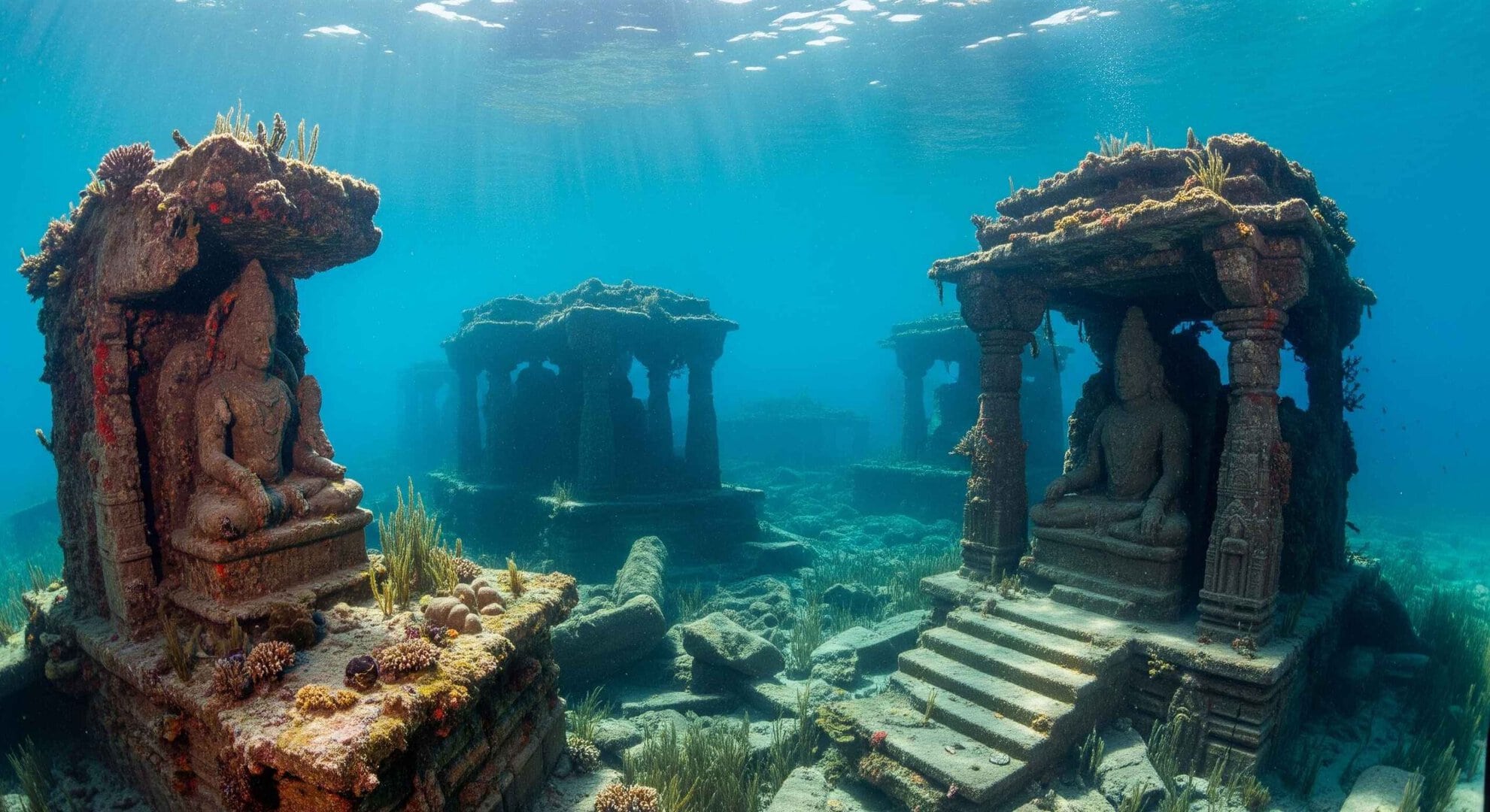
The excavations revealed a series of submerged stone structures, including what appeared to be city walls, pillars, blocks, and other architectural remains. These findings were spread across several layers, indicating different phases of construction and destruction. Artifacts recovered from these sites included pottery shards (some identified as “Red Ware,” often associated with the Late Harappan period), lead anchors, and grinding stones. The presence of these structures at varying depths and distances from the current shoreline suggested successive submergences over time.
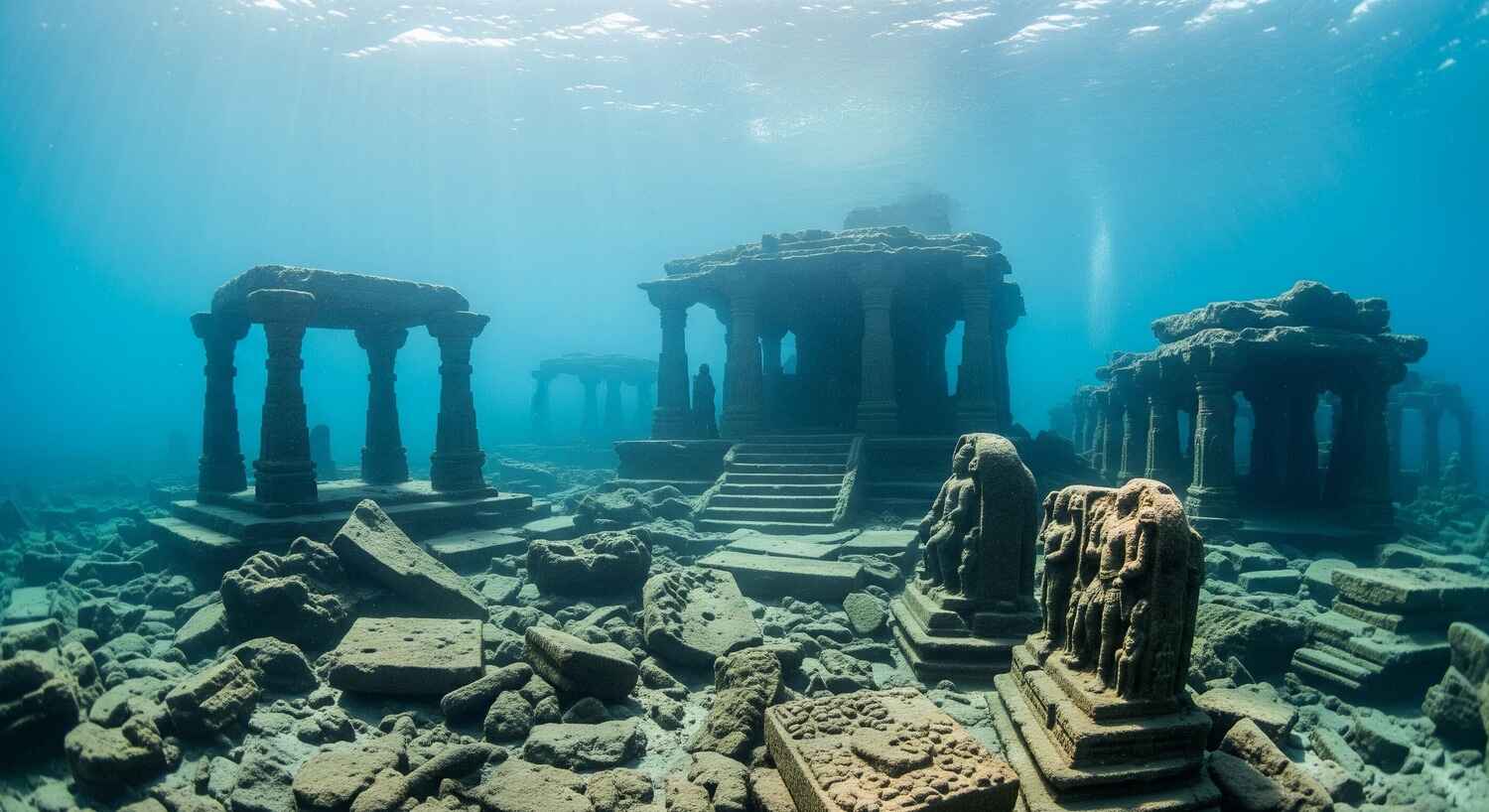
Carbon dating of some of the recovered artifacts, particularly from wooden objects found alongside the stone structures, provided dates ranging from roughly 15th century BCE to the early centuries CE. These dates, while still debated and subject to interpretation, broadly align with the timeline suggested by some interpretations of the Puranic accounts for Krishna’s era.
While these archaeological findings strongly indicate the existence of an ancient, submerged port city off the coast of modern Dwarka, establishing a definitive link to the mythological Dwarka of Lord Krishna remains a complex challenge. Scholars approach this with varying degrees of certainty. Some argue that the archaeological evidence provides compelling corroboration for the literary accounts, suggesting that the legend is rooted in a historical reality of a thriving coastal settlement that indeed faced inundation. Others maintain a more cautious stance, emphasizing that while ancient sites have been found, direct archaeological proof of a divine city of the scale and splendor described in the scriptures is inherently difficult to obtain. Geological factors such as sea-level changes over millennia, land subsidence, and seismic activity could all contribute to the submergence of coastal settlements, regardless of their mythical associations.
The Modern City: A Living Legacy of Faith
Despite the ongoing archaeological debates, the modern city of Dwarka thrives as a vibrant center of faith and culture. The majestic Dwarkadhish Temple, also known as the Jagat Mandir (Universal Temple), stands as the spiritual heart of the city. Though legends attribute its original construction to Vajranabha, Krishna’s great-grandson, the current imposing structure is believed to have been built around the 11th-12th century CE, with numerous subsequent additions and renovations.
The temple’s architecture is a testament to centuries of devotion, featuring intricate carvings, towering spires (often reaching over 40 meters), and a sense of profound sanctity. Pilgrims throng to the temple to offer prayers to Lord Krishna, here worshipped as Dwarkadhish, the “King of Dwarka.” The daily rituals, the chanting of hymns, and the vibrant festive atmosphere, especially during Janmashtami (Krishna’s birthday) and Diwali, immerse visitors in a timeless spiritual experience.
Beyond the main temple, Dwarka is dotted with other significant sites, including Rukmini Devi Temple (dedicated to Krishna’s chief queen), Bet Dwarka (an island believed to be Krishna’s actual residence and where he met Sudama), and Nageshwar Jyotirlinga Temple (one of the 12 sacred Jyotirlingas of Lord Shiva). These sites collectively reinforce Dwarka’s significance as a pivotal pilgrimage destination.
For immersive culture walks in India, please visit 5 Senses Walks.
Conclusion: Dwarka – Where Myth and Reality Intertwine
The story of Dwarka is a powerful testament to the enduring human fascination with lost civilizations and divine narratives. It is a place where the grandeur of myth meets the tangible clues of history, constantly challenging and enriching our understanding of the past. The ancient texts paint a picture of a golden city, a beacon of justice and prosperity under Lord Krishna’s rule, tragically consumed by the very ocean that once nurtured it. The marine archaeological discoveries, while not providing unequivocal proof of a mythical city, strongly suggest that a significant ancient settlement indeed existed in the area and faced inundation, lending a compelling layer of realism to the ancient legends.
Dwarka stands as a living legacy of faith, a vibrant spiritual hub where millions continue to seek solace and connect with the divine. It reminds us of the cyclical nature of time, the rise and fall of kingdoms, and the profound impact of human stories and spiritual beliefs on our collective memory. The mystery of Dwarka persists, inviting us to explore the depths of both the ocean and our own cultural heritage, ensuring that the echoes of its golden age continue to resonate for generations to come.

One Day Chennai Tour, How to Spend Your Layover Before or After a Cruise
If you have just one day in Chennai, the question is not whether there is enough to see, it is how to choose wisely. This city sits at the meeting point of two thousand years of temple building, colonial trade, … Read More

Nilgiri Mountain Railway: The UNESCO Toy Train Guide to India’s Blue Mountains
In 1854 a British engineer looked up at the Nilgiri Hills and proposed building a railway to the top. His superiors said no. He proposed it again. They said no again. He proposed it a third time. No. A fourth … Read More

Bodhgaya Buddhist Pilgrimage Tour: The Complete Guide to the Most Sacred Site in the Buddhist World
Plan your Bodhgaya Buddhist pilgrimage tour covering the Mahabodhi Temple, Bodhi Tree, Rajgir and Nalanda with 5 Senses Tours. The complete sacred India guide. … Read More
Leave a Reply