
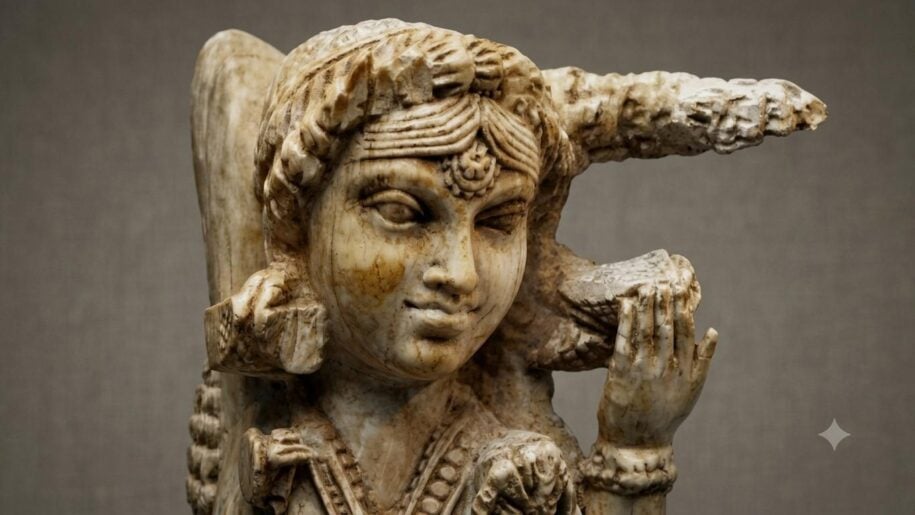
On the morning of August 24 in the year 79 CE, Mount Vesuvius erupted.
By the following day the Roman city of Pompeii, which had been one of the most prosperous trading cities in the Mediterranean world, was buried under four to six metres of volcanic ash and pumice. Its buildings, its streets, its citizens and everything they owned were sealed beneath the debris of one of the most catastrophic volcanic eruptions in recorded history. The city would not be properly excavated for nearly seventeen centuries.
When Italian archaeologist Amedeo Maiuri and his team were excavating a house in Pompeii in 1938, they found an ivory statuette in many pieces, which was painstakingly reassembled by conservators.
The statuette, along with the city, had remained buried under volcanic ash since Mount Vesuvius had erupted in 79 CE. Its discovery established the existence of flourishing trade networks spanning the Indian Ocean and Mediterranean Sea.
The statuette was Indian. Carved from a single elephant tusk, 25 centimetres tall and 5 centimetres wide. A primary female figure, nude except for a girdle around her waist and heavy jewellery including elaborate conical earrings, flanked by two smaller female attendants. The base features a letter in Kharosthi script reading “śi,” suggesting the object originated in or passed through the Gandhara region before reaching Italy.
An Indian goddess, or spirit, or luxury object, had been sitting in a private home in the Roman city of Pompeii when the volcano buried everything in 79 CE. She had been there since the first century of the common era. She had travelled from somewhere in India, across the Indian Ocean, through the trading ports of the ancient world, to a wealthy Roman’s house in one of the Mediterranean’s most commercially active cities.
And then she had waited, under the ash, for nineteen centuries, until Amedeo Maiuri’s team found her in 1938.
This is the complete story of the Lakshmi of Pompeii, what she is, where she came from, how she got there, and what she tells us about the scale and sophistication of ancient India’s commercial world at the height of the first century CE.
Lakshmi of Pompeii: What the Statuette Actually Is
Who or What Does the Lakshmi of Pompeii Represent
The name Lakshmi of Pompeii is the name by which this statuette became famous around the world after its discovery, and it is also the name that has been debated most intensely by the scholars who have studied it.
While debates over the statuette’s representation have ranged from Lakshmi, the Hindu goddess of fertility, beauty and wealth, and the guardian spirit of Yakshi to even a syncretic version of Venus-Sri-Lakshmi from an ancient exchange between Classical Greco-Roman and Indian cultures, it is the former depiction that is widely acknowledged around the world and hence the nomenclature.
The honest scholarly picture is more complicated. In 2021 the Naples National Archaeological Museum relabelled the artifact from “Pompeii Lakshmi” to “Ivory statuette representing an Indian goddess,” citing the absence of canonical Lakshmi elements such as elephant attendants or multiple arms. Proponents argue that the statuette’s stylistic parallels with yakshi carvings from sites like Bharhut and Sanchi, combined with its likely function as a mirror handle or decorative object, better support this identification over a divine one.
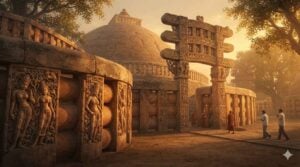
A yakshi in Indian art is a female nature spirit associated with fertility and abundance, a figure that appears with extraordinary frequency and beauty in the railings and gateways of the great Buddhist stupas at Sanchi and Bharhut, always full-figured, richly ornamented and connected to the living world of trees, water and earth. The famous yakshi at Didarganj in Patna, one of the most beautiful sculptures in the entire history of Indian art, belongs to this same tradition. So does the woman on the mirror handle found in Pompeii.
Whether she is Lakshmi, a yakshi, or a syncretic figure blending Indian and Roman iconography, she is definitively and unmistakably Indian in origin, and she was definitively and unmistakably sitting in a Roman home on the day the volcano buried the city. The name Lakshmi of Pompeii has stuck in the world’s imagination and it is accurate enough to use. What matters more than the precise identification of the figure is the extraordinary story of how she got there.
What the Lakshmi of Pompeii Looks Like and How She Was Made
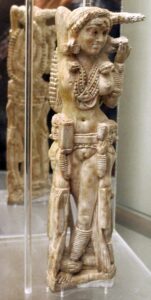
The artifact measures approximately 25 cm in height and 5 cm in width, depicts a principal nude female figure adorned with jewellery and flanked by two smaller attendants, all carved from a single piece of ivory, with stylistic elements including lotuses and a bored hole at the top suggesting it may have served as a mirror handle or furniture component.
The level of carving skill required to produce this object from a single piece of ivory is extraordinary. The primary figure and both attendants, their jewellery, their individual facial expressions and the spatial relationship between them, all carved from one tusk. The elaborate conical earrings bear a resemblance to ones depicted on terracotta figurines prominent in eastern India during the third and second centuries BCE, and a shell replica of the same earring style was discovered at the site of Kausambi in northern India.
The statuette was found in many pieces and was painstakingly reassembled by archaeologists and conservators. The explosion that buried Pompeii had shattered it. The seventeen centuries of volcanic ash that followed had compressed the pieces. What Maiuri’s team found was a puzzle in ivory that told its story only once the conservators had put it back together.
Lakshmi of Pompeii: Where She Came From
The Three Competing Origins of the Lakshmi of Pompeii
It was initially assumed that the statuette had been produced at Mathura, but according to Dhavalikar, it is now thought that its place of production was Bhokardan since two similar figurines were discovered there.
Bhokardan, in what is now the Jalna district of Maharashtra, was the third richest city in the Satavahana period after Pratishthana and Ter. It was a significant inland trading city connected to the network of routes that moved goods from the Deccan plateau to the western ports and from there into the Indian Ocean trade system. The discovery of female ivory figurines similar to the Pompeii statuette at Bhokardan is the strongest physical evidence linking this specific object to this specific place of production.
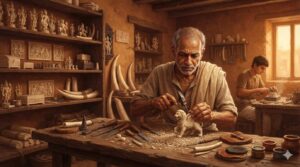
However the Kharosthi inscription on its base introduces a complication. A Kharosthi inscription on the base suggests the artifact travelled from the Gandhara region in ancient India, present-day Pakistan or Afghanistan, before reaching Italy. Kharosthi was the script used in the northwestern regions of the subcontinent, associated with the Gandhara cultural zone and the overland Silk Road connections between India and the Mediterranean world. An object bearing a Kharosthi inscription need not have been made in Gandhara. It could have passed through Gandhara on its way from Maharashtra to the northwest, or it could have been made in Gandhara using an artistic style influenced by the Deccan tradition.
All of these centres did interact with each other, thus the statuette’s style is probably a mixture of influences, making it difficult to attribute an exact origin to it. It is generally assumed that the figure was produced in the early half of the first century CE and subsequently brought to Pompeii, probably via a port on the west coast such as Bhrigukaccha, present-day Bharuch.
The honest conclusion is that the Lakshmi of Pompeii is a first-century CE Indian ivory object whose specific place of manufacture remains debated, whose route to Pompeii involved at least the port of Bharuch or a comparable western Indian trading port, and whose Kharosthi inscription suggests a connection to the northwestern trade networks of the subcontinent. She is definitively Indian, definitively first-century CE, and definitively present in Pompeii before the eruption of 79 CE.
The House Where She Was Found
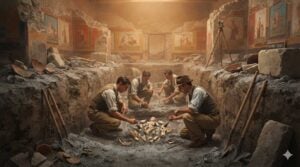
The house where the statuette was found is now named the House of the Indian Statuette. It was recovered from a house next to a large dye house, suggesting that indigo could be one of the commodities traded between Rome and India in ancient times.
This detail is worth dwelling on. The Lakshmi of Pompeii was not found in the grandest house in Pompeii, not in the House of the Faun with its famous Alexander mosaic, not in any of the palatial properties associated with Pompeii’s wealthiest families. She was found next to a dye house. In a working commercial neighbourhood. The implication is that the person who owned her was a merchant or a dyer, someone whose daily business involved exactly the kind of trade goods that came from India, and who perhaps owned this Indian ivory object as both a personal treasure and a professional talisman from the world he traded with.
The indigo connection is particularly evocative. Indigo, the blue dye derived from the Indigofera plant, was one of the most prized commodities in the ancient trade between India and Rome. The Roman name for it, indicum, is simply the Latin word for Indian. A dyer who worked with Indian indigo, owning an Indian ivory goddess. In Pompeii, in the first century CE.
Lakshmi of Pompeii: How She Got There

The Trading World That Carried the Lakshmi of Pompeii From India to Rome
The Lakshmi of Pompeii did not travel alone. She was one object in one of the most sophisticated long-distance trading systems that the ancient world produced, a system documented with extraordinary precision in a Greek merchant’s guide written in the first century CE called the Periplus of the Erythraean Sea.
The archaeological evidence suggests that the height of trade between Rome and India appears to have been the first and second centuries CE. This trade took place along several routes, both overland as documented by Isidore of Charax’s Parthian Stations, and by sea as the merchant guide known as the Periplus Maris Erythraei reveals.
The Periplus, written by an unknown Greek merchant navigator, is essentially a guidebook for traders sailing from Roman Egypt down the Red Sea, across the Indian Ocean to the ports of western India. It describes the ports, their rulers, the goods available at each port, the seasonal winds to exploit and the shallow waters to avoid, with the matter-of-fact precision of a working professional writing for other working professionals.
The Indian Ports and the Trade Routes That Connected Them to Rome
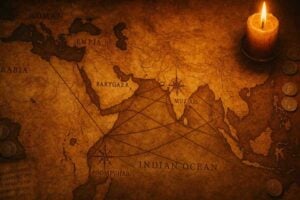
Bharuch, known as Barygaza in the Periplus, was the greatest western emporium of the Periplus of the Erythraean Sea, exporting cotton, spikenard and ivory and importing Roman wine and coin.
Bharuch, at the mouth of the Narmada river in Gujarat, was the single most important western Indian port in the entire Indo-Roman trade network. Ships from Roman Egypt, after navigating the Red Sea and crossing the Indian Ocean using the monsoon winds that Greek navigator Hippalus had systematised into a reliable sailing schedule, arrived at Bharuch carrying wine, copper, tin, lead, coral and glassware. They left with cotton, pepper, ivory, carnelian, muslin and the luxury objects, like the ivory goddess, that the craftsmen of the Deccan had produced.
The inland routes that fed Bharuch were equally well documented. The Periplus says that goods were carried by wagon between Paithan and Ter in the Deccan and Bharuch, a distance of 150 km. The inland routes plied the bullock carts and wagons of traders.
Paithan, the ancient Pratishthana on the Godavari river in Maharashtra, was the capital of the Satavahana dynasty. Ter, the ancient Tagara, was ten days further south. Both were major production and collection centres for the goods that eventually made their way to Bharuch and from Bharuch to the Roman Mediterranean.
The Periplus says that all kinds of mercantile goods from throughout the Deccan Plateau were brought to Tagara and from there conveyed in carts to Bharuch.
If the Lakshmi of Pompeii was made at Bhokardan in Maharashtra, she would have moved from there through this same network of Deccan trade routes, through Paithan or Ter or Bhokardan’s own connections to the western ports, to Bharuch or a comparable port, onto a Roman merchant ship, across the Indian Ocean and the Red Sea, through Alexandria or another Egyptian port, and finally to Pompeii, where a merchant who worked with Indian goods placed her in his home, probably as a mirror handle or a piece of decorative furniture, and where she stayed until the ash buried everything in 79 CE.
With shipments of nard, ivory and textiles, it is clear from the archaeological evidence that Roman trade with the East peaked in the first and second centuries CE. This time period also witnessed a material shift among Roman craftsmanship, which rapidly began to favour imported ivory over traditional bone for use in furniture, musical instruments, accessories and more. The insatiable desire for artisan ivory work even led to the creation of a politically powerful guild of Roman ivory workers: the Eborarii.
The Lakshmi of Pompeii was not an exotic curiosity brought to Rome by an adventurous traveller. She was a luxury commodity in a sophisticated, high-volume international trade system, carried by professional merchants along well-established routes, sold at well-established ports, purchased by well-connected buyers. She was, in the most precise commercial sense, a product of the global economy of the ancient world.
The Indian Sites That Made This Trade Possible
 Where to Experience the Ancient Indian Trade Heritage Today
The story of the Lakshmi of Pompeii has physical counterparts in India that can be visited today. The ports, the inland cities and the archaeological sites that formed the Indian side of this extraordinary trading network are still accessible, and several of them have been excavated to reveal exactly the kind of material evidence that confirms the scale of what was happening.
Roman coins recently discovered at Ter lend weight to the fact that it traded with the outside world, especially Greece and Rome, and the site reached the height of its commercial prosperity during the Satavahana period.
The port of Bharuch in Gujarat, the Barygaza of the Periplus and the most likely departure point for the Lakshmi of Pompeii’s journey to Rome, still exists. Modern Bharuch sits at the same mouth of the Narmada where Roman merchant ships loaded ivory and cotton two thousand years ago.
Our Ahmedabad tours cover the complete Gujarat heritage circuit that includes the region where Bharuch was the ancient world’s most commercially active Indian port. The same Gujarat coast that sent ivory goddesses to Pompeii also produced the extraordinary Indus Valley Civilisation cities of Dholavira and Lothal, which our dedicated Dholavira tour and Lothal tour cover in full, connecting four thousand years of Gujarat’s maritime commercial heritage in a single journey.
The ancient port of Muziris on the Kerala coast, mentioned in the same Periplus and now identified with the Pattanam archaeological site near Kodungallur, is the southern Indian counterpart to Bharuch in the Indo-Roman trade network. Characterized as the great pepper emporium of the Periplus and the Muziris papyrus, it has yielded Roman gold-coin hoards and amphorae from intense first-century Indo-Roman trade. Our Kochi tours cover the complete Kochi and Muziris heritage circuit, connecting the Roman-era port directly to the extraordinary layered heritage of Fort Kochi and the living culture of the Malabar Coast.
Arikamedu near Puducherry on the Coromandel Coast, identified as the Poduke of the Periplus, was the major Indo-Roman trading station on the eastern side of the subcontinent. Excavations there have produced Arretine ware from Italy, Roman amphorae and rouletted pottery, physical proof of the same trading network that carried the Lakshmi of Pompeii to Italy. For travellers interested in this southern dimension of the ancient trade story, our tours of South India can be extended to include the Arikamedu archaeological site near Pondicherry.
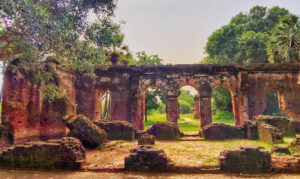
The Satavahana dynasty that presided over this extraordinary commercial network also built the great Buddhist stupa at Amaravati in Andhra Pradesh, one of the most significant Buddhist monuments in India and one whose ivory carved yakshi figures are the closest stylistic relatives of the Lakshmi of Pompeii herself. For travellers who want to see, in person, the artistic tradition that produced the figure now sitting in a Naples museum, the Amaravati sculpture collection at the Government Museum in Chennai is one of the most underappreciated collections of ancient Indian art accessible to international visitors.
The Lakshmi of Pompeii as a Window Into Ancient Indian Globalisation

The Lakshmi of Pompeii is the most evocative single object in the entire story of ancient Indo-Roman trade, because she is not an abstract piece of evidence. She is a specific object made by a specific craftsman in a specific Indian city, carried along a specific route through a specific network of ports and overland trails, purchased by a specific Roman merchant in a specific house in Pompeii, and preserved by the specific catastrophe of a volcanic eruption for nineteen centuries until she was found again.
She is proof that the world was already global in the first century CE. That the artisans of Maharashtra were making objects specifically for the luxury market of imperial Rome. That the merchants of Bharuch were loading ships with exactly what wealthy Romans wanted. That the winds of the Indian Ocean were being used with the same systematic precision that modern airlines use flight paths. And that a piece of carved ivory made somewhere in India in the first century of the common era could end up in a private home in the Roman Mediterranean, where it sat until a mountain buried everything in 79 CE.

She is now in the National Archaeological Museum in Naples. But the ports that sent her, the inland cities whose craftsmen made her, and the trading tradition that carried her are still part of the living heritage of India. And 5 Senses Tours takes international travellers to exactly these places.
5 Senses Tours is recognised by India’s Ministry of Tourism, winner of the Tripadvisor Travellers Choice Award and the Outlook Responsible Tourism Award. Every tour is private, expert-guided and completely customised for your group.
Contact 5 Senses Tours to begin planning your ancient Indian trade heritage journey today