
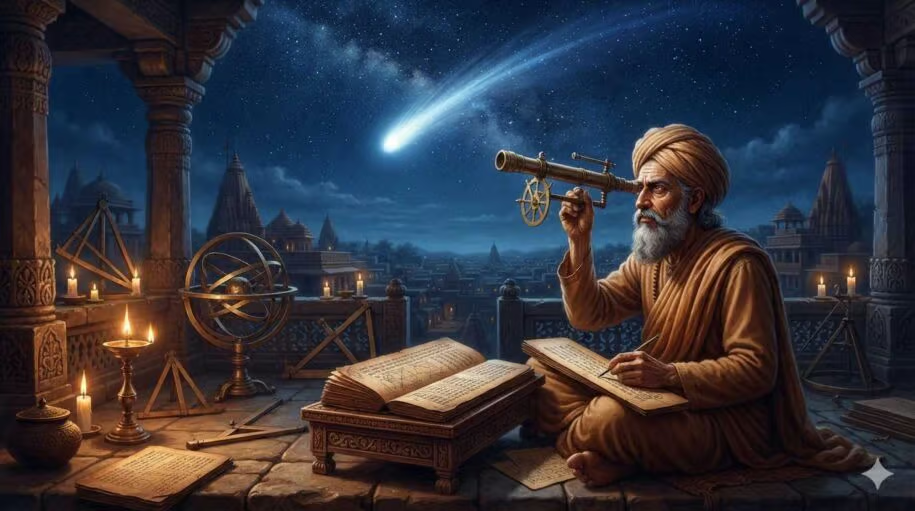
In the 6th century CE, in the city of Ujjain in what is now Madhya Pradesh, a scientist sat down to write an encyclopaedia.
Not an encyclopaedia of abstract philosophy or sacred text. An encyclopaedia of the observable, physical world. Rainfall and cloud formation. Planetary movements and eclipse prediction. Earthquake precursors and the behaviour of animals before seismic events. Groundwater location using plants and insects as indicators. Comet cataloguing and periodicity. Architectural orientation using solar direction. Agricultural timing by stellar events. Gemology and botany and meteorology.
In one book. By one man. In the 6th century CE.
His name was Varahamihira. A towering 6th-century polymath from Ujjain, Varāhamihira synthesized ancient astronomical knowledge in his seminal works, the Pancha-siddhantika and Brihat-Samhita. He was one of the nine jewels of the court of Emperor Vikramaditya, the most celebrated intellectual court in ancient India. He had met Aryabhata in Kusumapura, the encounter that set him on the path of astronomy. And he worked in Ujjain, the Greenwich of ancient India, the zero meridian from which time and space were measured.

What he produced in that city, in a lifetime of systematic observation and rigorous documentation, is one of the most extraordinary bodies of scientific work in the ancient world. Most of the world has never heard his name.
This is his complete story.
Varahamihira Astronomer Ujjain: Who Was He and What Was His World
Who Was Varahamihira and Why Ujjain Shaped Everything He Did
Varahamihira, also known as Varaha or Mihira, was born during the early 6th century in the Avanti region and brought up in Ujjain in Madhya Pradesh. A meeting with the renowned scholar Aryabhata in Kusumapura inspired him to pursue studies in astronomy and astrology.
The meeting with Aryabhata is worth pausing on. By the time the young Varahamihira encountered him, Aryabhata had already written the Aryabhatiya, the text that calculated the Earth’s rotation to within one-hundredth of a second of the modern value, that correctly explained solar and lunar eclipses as shadow phenomena, and that calculated pi to four decimal places. To meet Aryabhata was to encounter the most advanced astronomical mind of the age.
Varahamihira returned to Ujjain and spent his life there. Ujjain was not just a city. It was the intellectual capital of ancient India’s astronomical tradition. The meridian that Indian astronomers used as their prime meridian, the equivalent of modern Greenwich, passed through Ujjain. Every significant astronomical calculation in ancient India was oriented around the city. Every major astronomer of the period either worked in Ujjain or was trained in the tradition it established.
Varahamihira flourished in the intellectual crucible of Ujjain, becoming one of history’s great synthesizers of knowledge, weaving together indigenous Indian traditions with the sophisticated astronomical systems of the Hellenistic world.
He was not simply a follower of earlier traditions. He was a critical and comparative scholar who tested different astronomical systems against each other, identified their errors and proposed corrections with the confidence of someone who understood the mathematics deeply enough to know when a calculation was wrong.
The Nine Gems of Vikramaditya’s Court
Varahamihira was one of the nine jewels of the court of Emperor Yashodharman Vikramaditya of Malwa. The Navaratna, the nine gems of the Vikramaditya court, is one of the most celebrated intellectual gatherings in the history of ancient India. Kalidasa, the greatest Sanskrit poet, was among them. The court at Ujjain under Vikramaditya represented the Gupta Golden Age at its most culturally concentrated, a single court simultaneously housing the greatest poet, the greatest astronomer and several of the most accomplished scholars of the era.
Varahamihira was the only well-known astronomer, mathematician, and astrologer from India whose name gained widespread recognition in his native country. The title Varaha, meaning boar, was bestowed on him by King Vikramaditya himself, impressed by one of his predictions. It was a mark of the highest royal regard.
Varahamihira Astronomer Ujjain: The Pancha Siddhantika and the Art of Comparing Traditions
What the Pancha Siddhantika Actually Was and Why It Was Extraordinary
Varahamihira is renowned for compiling the Pancha-Siddhantika, a comprehensive work that brings together astronomical knowledge from Greek, Egyptian, Roman, and Indian traditions.
The Pancha Siddhantika is not a single astronomical system. It is a comparative study of five different astronomical traditions, the Paitamaha, Vasishtha, Romaka, Paulisha and Saura schools, presented side by side with their calculations tested against each other.
He did not simply list them. He analysed their strengths and weaknesses, corrected their errors, and proposed his own improved calculations, particularly regarding the ayanamsa, or the precession of the equinoxes. The Pancha-siddhantika is a masterclass in scientific scholarship, demonstrating a mind that valued empirical accuracy and intellectual honesty above adherence to a single dogma.
This is the intellectual move that makes Varahamihira genuinely modern in his sensibility. He did not simply inherit one tradition and repeat it. He gathered five traditions, tested them against each other and against observation, identified which calculations were more accurate and why, and proposed corrections. This is the scientific method of comparison and falsification applied to astronomy in the 6th century CE.
He was the first Indian scholar to acknowledge Greek astronomical influences explicitly, and the first to systematically cross-reference them with native Indian calculations. This intellectual openness to external traditions while maintaining the rigour to test and correct them is one of the defining characteristics of his work.
Varahamihira Astronomer Ujjain: The Brihat Samhita and the Science of Everything
What the Brihat Samhita Actually Contains
If the Pancha-siddhantika reveals the astronomer, the Brihat-Samhita unveils the polymath. This encyclopedic work is a breathtaking survey of the knowledge and culture of 6th-century India.
The Brihat Samhita is one of the most extraordinary documents produced in the ancient world because it is not a text about a single subject. It is a systematic attempt to document everything that an educated person of the 6th century CE needed to know about the observable, physical world and how it behaves.
His encyclopedic Brihat Samhita covered meteorology including predicting rain from cloud formations, wind directions, and animal behaviour, earthquakes, comets, architectural orientation by solar direction, agricultural timing by stellar events, and the behaviour of plants in relation to celestial cycles. He was, in the most literal sense, a scientist of the natural world, a man who believed that the sky and the Earth formed a single interconnected system, and that understanding one illuminated the other.
How Varahamihira Astronomer Ujjain Predicted Earthquakes in 550 CE
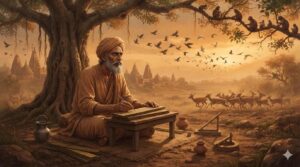
The earthquake chapter of the Brihat Samhita is the most remarkable single section of the entire text for a modern reader, because what Varahamihira describes is not mythology or superstition. It is systematic observation of earthquake precursors, the environmental signals that precede seismic events, documented with the same methodical attention that a modern seismologist would bring to the same question.
In the Brihat Samhita, he described earthquake causes, debunked myths, and linked astronomical observations to weather patterns, including monsoon predictions.
The specific earthquake precursors Varahamihira documented include the abnormal behaviour of animals before seismic events, changes in the behaviour of well water, unusual cloud formations, and atmospheric electrical phenomena. All of these are now recognised by modern seismology as genuine earthquake precursors. The mechanisms Varahamihira proposed for some of them are not all correct by modern understanding, but the observations themselves are.
A 6th-century scientist in Ujjain was systematically documenting the observable signals that precede earthquakes. The modern science of seismology, which uses seismographs and satellite monitoring, is addressing the same fundamental question. The observational tradition that Varahamihira was contributing to is the same tradition from which modern earthquake prediction science descends, separated by fifteen centuries of methodological improvement but connected by the same underlying recognition that earthquakes are preceded by observable physical signals.
How Varahamihira Astronomer Ujjain Found Groundwater Using Plants and Insects

One of the most practically significant contributions of the Brihat Samhita is its system for locating underground water using ecological indicators.
He was among the first to propose that termites and certain plants indicate underground water, a concept now validated by modern science.
The specific plants and insects that Varahamihira identified as indicators of subsurface water correspond, in modern hydrogeological terms, to species whose root systems penetrate to water table depth or whose habitat requirements make them dependent on near-surface water availability. Modern groundwater exploration in some parts of India still uses plant indicator species as one component of preliminary survey, the same principle that Varahamihira was applying in the 6th century.
This is not guesswork or folk wisdom recorded as curiosity. It is systematic empirical observation of the relationship between surface ecology and subsurface hydrology, documented with sufficient precision to be applicable in the field.
The Comet Catalogue That Predated Modern Astronomy by Centuries
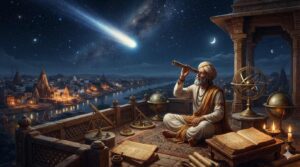
Varahamihira’s description of comets in the Brihat Samhita remains remarkable. He catalogued 101 types of comets, described their orbital characteristics though not in modern terms, and noted that some comets recur on predictable timescales.
The identification of comet periodicity, the recognition that some comets return to the same region of the sky on predictable schedules, is the foundational insight of modern comet science. Edmond Halley’s identification of the comet that now bears his name as a recurring object, published in 1705, is celebrated as the beginning of modern comet science. Varahamihira was documenting comet recurrence in the 6th century.
His catalogue of 101 comet types is not a match to the modern classification system, but the underlying observational programme, systematic recording of comets including their appearance, behaviour and periodicity, is precisely the kind of empirical cataloguing that modern astronomy builds on.
Varahamihira Astronomer Ujjain and the Ujjain Observatory Heritage
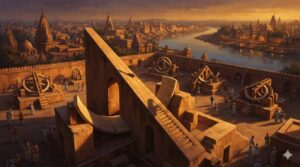
Why Ujjain Was the Centre of Indian Astronomy for Centuries
Ujjain was the Greenwich of ancient India, the zero meridian from which time and space were measured. The astronomical significance of Ujjain stretches from before Varahamihira’s time through the centuries after him. Brahmagupta, who would formalise the rules for arithmetic with zero in 628 CE, also worked within the Ujjain astronomical tradition. The Vedic meridian of ancient Indian astronomy passed through the city. Every planetary calculation, every astronomical table, every eclipse prediction in the classical Indian tradition was referenced to the prime meridian of Ujjain.
The Jantar Mantar observatory that the Maharaja Jai Singh II built in Ujjain in the 18th century, one of five observatories he constructed across India, stands on the same ground where the ancient Ujjain astronomical tradition that Varahamihira embodied was practised. The tradition of systematic astronomical observation in Ujjain is not interrupted between the 6th century and the 18th century. It is continuous, one of the longest documented traditions of observational astronomy in the world.
The Mahakaleshwar Temple and the Sacred-Scientific City
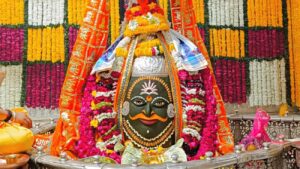
Ujjain is one of the seven sacred cities of Hinduism and the location of the Mahakaleshwar Jyotirlinga, one of the twelve most sacred Shiva shrines in India. The same city that was the scientific capital of ancient India, the meridian from which all astronomical calculation was oriented, the workplace of Varahamihira and Brahmagupta, is also the city that houses one of the most significant Shiva temples in the country.
This is not a coincidence. In the intellectual tradition of ancient India, the sacred and the scientific were not separate domains. The astronomical precision that made Ujjain the prime meridian of ancient Indian calculation was connected to the ritual precision that made the Mahakaleshwar temple one of the most significant sacred sites in the country. The astronomical observations that Varahamihira made from Ujjain served both the calculation of planetary positions for scientific purposes and the determination of auspicious timings for religious ceremonies.
The city is an extraordinary living example of the integration of scientific and sacred knowledge that characterises the best of the ancient Indian intellectual tradition.
Experience Varahamihira Astronomer Ujjain Heritage With 5 Senses Tours
Ujjain: Where Ancient Astronomy and Sacred Heritage Share the Same Ground
The city where Varahamihira mapped 101 comets, predicted earthquake precursors and found underground water using plants is still there. Ujjain in Madhya Pradesh is a city of extraordinary layered heritage where the ancient astronomical tradition, the sacred Mahakaleshwar Jyotirlinga and the living cultural tradition of the Simhastha Kumbh Mela that draws millions of pilgrims every twelve years all coexist on the same ancient ground.
The Jantar Mantar observatory built by Jai Singh II in the 18th century gives the most physically tangible encounter with the Ujjain astronomical tradition available to a modern visitor. The Vedha Shala, the observation platform, stands in the city whose astronomical reputation was established by Varahamihira fourteen centuries before Jai Singh built his instruments there.
Our Varanasi tours and our wider Madhya Pradesh heritage circuit connect international travellers to the complete intellectual and sacred heritage of the Gangetic and Deccan plateau landscape. Ujjain sits within the same circuit as the Khajuraho temples, the Sanchi stupa and the Bhimbetka rock shelters, all accessible as part of a customised Madhya Pradesh heritage journey.
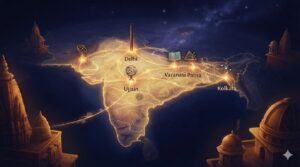
For travellers who want the complete ancient Indian science heritage trail, Varahamihira’s Ujjain connects to Aryabhata’s Patna and Nalanda through our Bodhgaya tours, to Sushruta’s Varanasi through our Varanasi tours, to the Iron Pillar’s Delhi through our Delhi tours and to the God Particle’s Kolkata through our Kolkata tours.
5 Senses Tours is recognised by India’s Ministry of Tourism, winner of the Tripadvisor Travellers Choice Award and the Outlook Responsible Tourism Award. Every tour is private, expert-guided and completely customised for your group.
Contact 5 Senses Tours to begin planning your Ujjain and ancient Indian science heritage journey today