
Every metal has a shelf life.
Leave a piece of iron in the open air and the process begins almost immediately. Oxygen from the atmosphere combines with moisture from rain and humidity. A thin film of iron oxide forms on the surface. More oxygen reaches the metal below through the oxide layer and the process accelerates. Within weeks the surface is visibly rusty. Within years the rust penetrates deep into the structure. Within decades the metal is compromised.
This is so universal and so well understood that the entire modern steel industry is built around preventing it, through alloys, coatings, galvanisation and paint.
And yet.
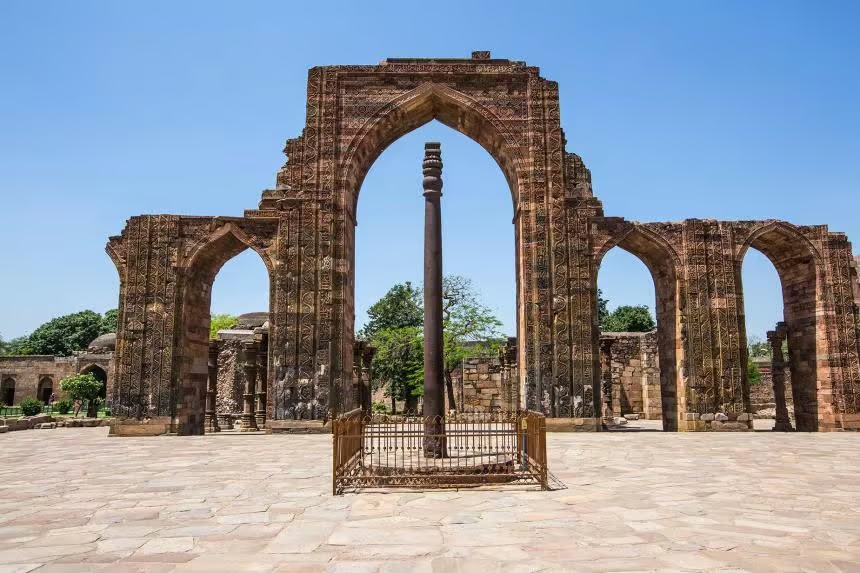
In the courtyard of the Qutb Complex in Mehrauli, Delhi, a pillar of wrought iron 7.2 metres tall and weighing over six tonnes has been standing in the open air, exposed to Delhi’s monsoon rains and summer heat and winter dew, for over sixteen hundred years.
The Iron Pillar of Delhi has fascinated scientists for decades because it has remained virtually rust-free for over 1,600 years, despite being exposed to the open air and monsoon rains of Delhi.
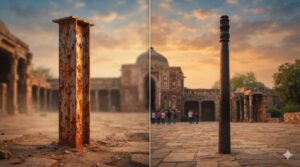
Not virtually rust-free in the sense that it is well preserved for its age. Virtually rust-free in the sense that the surface of this pillar looks, to a casual observer, like iron that has been standing for a few decades rather than sixteen centuries. There is even evidence that it was hit at close range by a cannonball which merely put a dent in it.
For most of the sixteen hundred years since the pillar was erected, the explanation for this was mysterious. Theories ranged from a lost alloy to divine protection to the specific spiritual energy of the site. None of them was satisfactory to a scientist, and none of them explained what was actually happening at the molecular level on the surface of the iron.
Then, in the year 2000, a metallurgist at the Indian Institute of Technology in Kanpur sat down with a sample from the pillar’s surface and a journal called Corrosion Science and published an analysis that finally solved the mystery.
The answer was not supernatural. It was not a lost technology. It was phosphorus. And the story of how ancient Indian ironmakers ended up with phosphorus in their iron, entirely by accident, and how that accident created a chemical chain reaction that has been protecting the pillar for sixteen centuries, is one of the most quietly extraordinary stories in the history of materials science.
Iron Pillar Delhi: Who Built It, When and Why
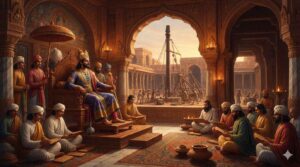
Chandragupta II (Vikramaditya) Commissioned the Iron Pillar Delhi
The oldest inscription on the pillar is that of a king named Chandra, generally identified as the Gupta emperor Chandragupta II.
This requires a clarification that matters for accuracy, because Chandragupta is a name shared by two of the most significant rulers in ancient Indian history, separated by seven centuries and two completely different empires.
The Chandragupta who commissioned the Iron Pillar is Chandragupta II Vikramaditya, who ruled the Gupta Empire from approximately 375 to 415 CE. He is not Chandragupta Maurya, the founder of the Mauryan Empire who lived around 321 BCE and was the king whose administration Chanakya designed in the Arthashastra. These are entirely different rulers in entirely different dynasties. They share a first name and nothing else relevant to this story.
Chandragupta II, also known by his title Vikramaditya, was the emperor of the Gupta Empire from approximately 375 until his death in approximately 415 CE. Modern scholars generally identify him with King Chandra of the Delhi iron pillar inscription.
The legendary figure of Vikramaditya is probably based on Chandragupta II, and the noted Sanskrit poet Kalidasa may have been his court poet. His reign is considered the high point of the Gupta Empire, which is itself described as the Golden Age of India, a period of extraordinary achievement in mathematics, astronomy, literature and the arts. The Iron Pillar was commissioned at the absolute apex of this Golden Age.
The Iron Pillar was originally erected as a Vishnudhvaja, a standard of Lord Vishnu, on a hill called Vishnupadagiri. The pillar was likely first installed in Udayagiri near Vidisha in Madhya Pradesh, where it may have been part of a Vishnu temple, before being moved to its present location in Mehrauli. Its relocation is believed to have occurred during the reign of the Tomar or Chauhan dynasties, though the exact timeline remains uncertain.
The inscription on the pillar, composed in Sanskrit in the shardulvikridita metre, describes the king as a devoted worshipper of Vishnu, records his military victories across the subcontinent and declares that the pillar was erected on the hill of Vishnupada. It does not mention Delhi. It does not mention Mehrauli. The pillar arrived at its current location centuries after it was made, carried there by a later dynasty who presumably found the world’s most impressively rust-free iron pillar worth relocating to their own capital.
What the Iron Pillar of Delhi Actually Is
The Iron Pillar, located in the Qutb Complex in Delhi, is a 7.2-meter tall pillar made of wrought iron. It stands 23.5 feet above ground with a 41-centimetre diameter. The pillar weighs approximately 6,000 kilograms.
To make sense of what this means as a manufacturing achievement, consider that it is generally believed that no other country had the capability to produce an iron mass of this size and purity until the Industrial Revolution of the 18th century. A single piece of wrought iron, six tonnes in weight, forged to a height of over seven metres, in the 4th or early 5th century CE. This was not a decorative ornament. It was an engineering statement, a demonstration of metallurgical capability that no other civilisation on earth could have made at the same moment.
The pillar is made of forge-welded iron blooms, small pieces of iron produced in a bloomery furnace and hammered together while hot into a single unified structure. The skill required to weld six tonnes of iron blooms into a straight, structurally sound pillar of this height, without any of the buckling or misalignment that might be expected from the process, is itself a remarkable demonstration of the craft knowledge of the Gupta-era ironsmiths of central India.
Iron Pillar Delhi: The Chemistry That Kept It Rust-Free for Sixteen Centuries
What Rust Actually Is and Why Iron Normally Cannot Resist It
To understand what makes the Iron Pillar of Delhi exceptional, you first need to understand what normally happens to iron.
When iron meets oxygen and water, it forms iron oxide, the reddish compound we call rust. The chemistry is straightforward. Iron atoms on the surface of the metal react with oxygen molecules from the air and water molecules from moisture to form hydrated iron oxides. The rust layer that forms is porous, meaning it does not seal the surface of the metal. Oxygen and moisture continue to reach the fresh metal below through the pores in the rust layer. The corrosion continues. It is self-perpetuating and essentially unstoppable unless the iron is either sealed from the atmosphere or alloyed with elements that change the chemistry of the surface reaction.
Modern metallurgy solves this problem in several ways. Stainless steel incorporates chromium, which forms a dense, non-porous oxide layer that genuinely does seal the surface. Galvanised steel is coated with zinc, which sacrifices itself to protect the iron below. Painted steel is simply sealed from the atmosphere mechanically. None of these solutions were available to the ironmakers of 4th-century India.
And yet the Iron Pillar of Delhi does not rust. Something else is happening on its surface.
The IIT Kanpur Discovery: Misawite and the Phosphorus Paradox

In 2000, R. Balasubramaniam published a detailed analysis of the thin layer on the surface of the pillar in the journal Corrosion Science and showed that the explanation lies there.
What Balasubramaniam found was a thin passive film on the surface of the pillar, a compound of iron, oxygen and hydrogen that has been protecting the metal below since approximately three years after the pillar was first erected. Metallurgists at IIT Kanpur discovered that a thin layer of misawite, a compound of iron, oxygen and hydrogen, has protected the cast iron pillar from rust. The protective film took form within three years after erection of the pillar and has been growing ever so slowly since then. After 1,600 years, the film has grown just one-twentieth of a millimetre thick.
One-twentieth of a millimetre. That is the thickness of the layer that has kept six tonnes of iron rust-free for sixteen hundred years in the open air of Delhi. A layer so thin it is invisible to the naked eye, and yet so chemically stable that it has not broken down, not been washed away by monsoon rain, not been disrupted by extreme heat or extreme cold, for a hundred generations.
More specifically, detailed analyses describe a passive film composed of iron oxyhydroxides and iron phosphates. This film formed slowly and naturally due to the pillar’s chemistry and the repeated cycles of humidity, dust and light over centuries.
The specific compound at the heart of the film is iron hydrogen phosphate hydrate, whose chemical formula is FePO4·H3PO4·4H2O. This compound, unlike ordinary iron rust, is not porous. It forms a dense, continuous layer on the surface of the metal that genuinely seals it from further contact with atmospheric oxygen and moisture. Each cycle of wet monsoon and dry summer thickens and strengthens the layer slightly, so that the pillar has in effect been self-protecting and self-repairing for sixteen centuries, getting more corrosion-resistant with every passing year rather than less.
Why the Ancient Indian Ironmakers Had Phosphorus in Their Iron Without Knowing It
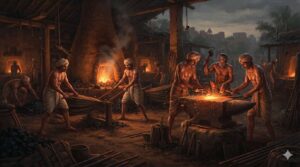
This is the most interesting part of the chemistry, because the high phosphorus content of the Iron Pillar is not the result of a deliberate metallurgical decision. It is the accidental consequence of a specific iron-making process that ancient Indian ironmakers had developed through practical experience, without any understanding of the underlying chemistry.
The iron of the column contains an unusually high amount of phosphorus, about one percent, compared to barely hundredths of a percent in modern steel. Today, this element is purposefully removed during production because it makes the metal brittle. However, the ancient blacksmiths did not have this knowledge. Their methods of treating iron with charcoal and the lack of modern additives that extract phosphorus are the reason for the atypical chemical composition. It is this flaw that becomes armour.
The mechanism is precisely understood. Ancient Indian smiths did not add lime to their furnaces. The use of limestone as in modern blast furnaces yields pig iron that is later converted into steel; in the process, most phosphorus is carried away by the slag. The absence of lime in the slag and the deliberate use of specific quantities of wood with high phosphorus content during the smelting induces a higher phosphorus content than in modern iron produced in blast furnaces.
The wood used in the smelting process, specifically species like Cassia auriculata, contained high levels of phosphorus. When burned as fuel and reductant in the bloomery furnace, this phosphorus transferred into the iron. The ancient smiths had no concept of phosphorus as a chemical element. They had no understanding of why certain fuel woods produced better iron than others. They had simply discovered, through generations of practical experiment, that certain combinations of ore, fuel and technique produced iron that behaved differently from other iron. The chemistry behind that difference was completely invisible to them.
Modern metallurgy, in its refinement of the iron-making process through the Industrial Revolution, deliberately removed this phosphorus because it does indeed make iron more brittle in bulk. The very improvement that made modern iron stronger in one respect eliminated the accidental property that made the ancient Indian iron corrosion-resistant in another.
The pillar is in a very specific sense the product of a mistake that turned out to be genius. The ancient ironmakers of the Gupta era did not know they were creating a self-sealing corrosion-resistant alloy. They were simply making the best iron they knew how to make. And what they produced by following their craft knowledge faithfully has outlasted every piece of iron produced by the Industrial Revolution that superseded it.
Delhi’s Climate as an Unexpected Partner

Balasubramaniam warns that the fragile equilibrium that preserved the column for so long depends on the environment, and the increasing air pollution in Delhi may disrupt the balance that the ancient craftsmen unwittingly achieved.
This warning points to the third factor in the pillar’s extraordinary survival, one that is easy to overlook. The chemistry of the misawite layer requires specific environmental conditions to form and maintain itself. Delhi’s intense monsoons followed by extreme dry heat provide the perfect rhythm for this protective skin to strengthen over centuries. Because the pillar is so massive, it does not cool down quickly at night, which prevents dew from forming on its surface, further reducing the risk of corrosion.
The pillar was placed, whether by design or by fortune, in a climate that cycles between exactly the wet and dry conditions needed to build and maintain the misawite layer, while being massive enough to avoid the condensation that would accelerate corrosion on a smaller piece of the same metal.
The ancient ironmakers of Udayagiri chose a specific ore, a specific fuel and a specific process. The Gupta-era administrators chose a site whose microclimate happened to be ideal for maintaining what the iron’s chemistry had created. And the misawite layer has been doing its work ever since, imperceptibly, one molecular layer at a time, in the open air of Delhi.
Visiting the Iron Pillar Delhi With 5 Senses Tours
The Iron Pillar Delhi in the Context of the Qutb Complex
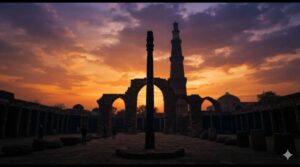
The Iron Pillar of Delhi stands today in the courtyard of the Quwwat-ul-Islam mosque in the Qutb Complex at Mehrauli, the same complex that contains the Qutb Minar, the tallest brick minaret in the world. The juxtaposition is one of the most visually and historically layered encounters available at any heritage site in India.
The Qutb Complex was built in the late 12th and early 13th century by Qutb-ud-din Aibak, the founder of the Delhi Sultanate, largely from the materials of demolished Hindu and Jain temples. The Iron Pillar, which predates the mosque by over seven centuries, was already standing here when the mosque was built around it. The Gupta-era iron pillar at the centre of a Mamluk-era Islamic mosque in the UNESCO World Heritage Qutb Complex is a physical monument to the extraordinary layering of Indian history in a single square kilometre of Delhi’s southern suburbs.
Standing before the Iron Pillar and understanding what is actually happening on its surface, not mystery and not legend but the extremely precise chemistry of a phosphate film one-twentieth of a millimetre thick that has been growing since the 5th century CE, gives the encounter a completely different character from the vague wonder of looking at something impressively old. It becomes a specific, verifiable, scientifically documented story of what ancient Indian craft knowledge actually achieved, measured not in superlatives but in parts per million of phosphorus and nanometres of crystalline film.
Our Delhi tours cover the complete heritage of the Qutb Complex alongside the Red Fort, Humayun’s Tomb, the Lodhi Garden tombs and the extraordinary street food tradition of Old Delhi, with expert cultural guides who bring the complete historical, scientific and architectural context of every site to life for international visitors.
The Iron Pillar Delhi and the Complete Ancient Indian Science Heritage Trail
The Iron Pillar of Delhi sits within a much larger story of ancient Indian scientific achievement that 5 Senses Tours has been documenting across a complete blog series connecting physical heritage destinations to the intellectual traditions that produced them.
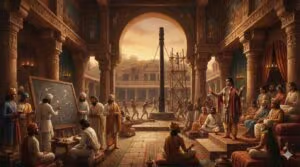
The metallurgical knowledge that produced the Iron Pillar was the craft tradition of the Gupta era, the same Golden Age that produced Aryabhata’s calculation of the value of pi to four decimal places and his correct model of the earth rotating on its axis, Brahmagupta’s rules for arithmetic with zero and negative numbers, and Kalidasa’s Sanskrit poetry at the court of the same Chandragupta II who commissioned the pillar.
For travellers who want to connect this story to the wider arc of ancient Indian intellectual achievement, our Kolkata tours cover the Bengali scientists heritage trail where Satyendra Nath Bose, whose 1924 paper Albert Einstein personally translated, developed the quantum statistics that gave the boson class of particles its name, including the Higgs boson, the God Particle, discovered at CERN in 2012. Our Kochi tours cover the Kerala heritage where Madhava of Sangamagrama invented calculus two centuries before Newton. And our Ahmedabad tours cover the Gujarat landscape where Kanada proposed atomic theory 2600 years before Dalton.
The Iron Pillar of Delhi is not an isolated curiosity. It is one chapter in the most sustained and most consistently underrecognised tradition of scientific and technical achievement that any civilisation produced before the modern era.

5 Senses Tours is recognised by India’s Ministry of Tourism, winner of the Tripadvisor Travellers Choice Award and the Outlook Responsible Tourism Award. Every tour is private, expert-guided and completely customised for your group.
Contact 5 Senses Tours to begin planning your Delhi heritage experience today