Mysore
Join us on a day trip from Bangalore to the Royal Kingdom of Mysore to experience the grandeur.
6 day interaction with Weavers, Tur Dal Farmers, Silversmiths of Bidar, Bangle Makers of Hyderabad and Temple Priests.




This is not a tour of monuments. It is six days spent in the company of the people still keeping the Deccan’s oldest trades alive, a weaver, a farmer, a silversmith, a bangle maker and a priest, each of them paid directly for the morning they give you.
There is a small stone house in Guledagudda, in the Bagalkot district of north Karnataka, where fewer than sixty hand pit looms are left standing against four thousand power looms that have already replaced the rest. On one of those sixty looms, a weaver will let you sit beside her and try, with your own hands, to pass a single silk thread through a pattern her family has kept alive since the eighth century. You will fail the first time. Everyone does. That failure, and the patience with which she corrects it, is worth more than any photograph you will take on this trip.
Four days later you will stand in a workshop near Hyderabad’s Charminar and watch a craftsman hammer pure silver into a foil so thin it can be eaten, a craft called warq that has clothed Hyderabadi sweets for four centuries and that almost nobody outside the old city has ever watched being made. Between those two mornings lie sixth century cave temples cut into a sandstone cliff, a fort whose very soil turns metal black, and grasslands where blackbuck still outrun the wind at dawn.
What you carry home from this trail is not a list of places visited. It is the specific memory of hands, yours and theirs, doing something together that neither of you could have done alone.
🧵 Traditional Weaving
🌾Tur Dal Farming
🔨 Bidriware Craft
💍 Bangle Making
🛕 Temple Priests
Loom to Lac moves in a single unbroken arc across six days, from the Bahmani forts of Kalaburagi and the whispering dome of Bijapur, through the weaving villages and rock cut temples of Bagalkot district, into the blackbuck grasslands and Bidriware workshops of Bidar, and finally into the bazaars of old Hyderabad. Every stop sits on the actual working route between two cities. Nothing is a staged detour built only for tourists.
This is architected as responsible tourism, not marketed as it. Every artisan, farmer and weaver you meet is paid directly by 5 Senses Tours at the time of the visit, built into the cost of your journey rather than left to whatever a guest chooses to buy afterward. Nothing you see is scripted for a camera. The weaving happens whether you are there or not, and you are simply welcomed into it for a morning.
You will spend your first hours in India inside a fort built when the Bahmani Sultanate ruled the Deccan, six centuries before Hyderabad existed as a city. Gulbarga Fort still carries the scars of siege in its walls, but its true surprise is the Jama Masjid inside its grounds, one of a very small number of mosques anywhere in India built entirely under a single continuous roof, its rows of small domes said to echo the Great Mosque of Cordoba half a world away. Walk its arcades in the low light of late afternoon, when the stone turns gold and the fort empties of everyone but you.
You will arrive here after a morning drive west out of Hyderabad, watching the city give way to the black cotton soil plains of the Deccan plateau, a landscape that will define almost everything you eat and everyone you meet for the next five days.
Fifty kilometres south of Kalaburagi, the Bhima and Amarja rivers meet at a spot called Sangam Kshetra, and for the pilgrims who travel here from across India, this confluence is one of the holiest points in the Deccan. Hindu tradition holds that Narasimha Saraswati, the second incarnation of the sage Dattatreya, bathed here every morning at this very meeting point of waters, and devotees still come at dawn believing that a bath at the Sangam clears a lifetime of burden. You do not need to share the belief to feel the weight of it. Stand at the riverbank in the quiet of a weekday morning and watch a woman fold her hands toward the current exactly as her grandmother did.
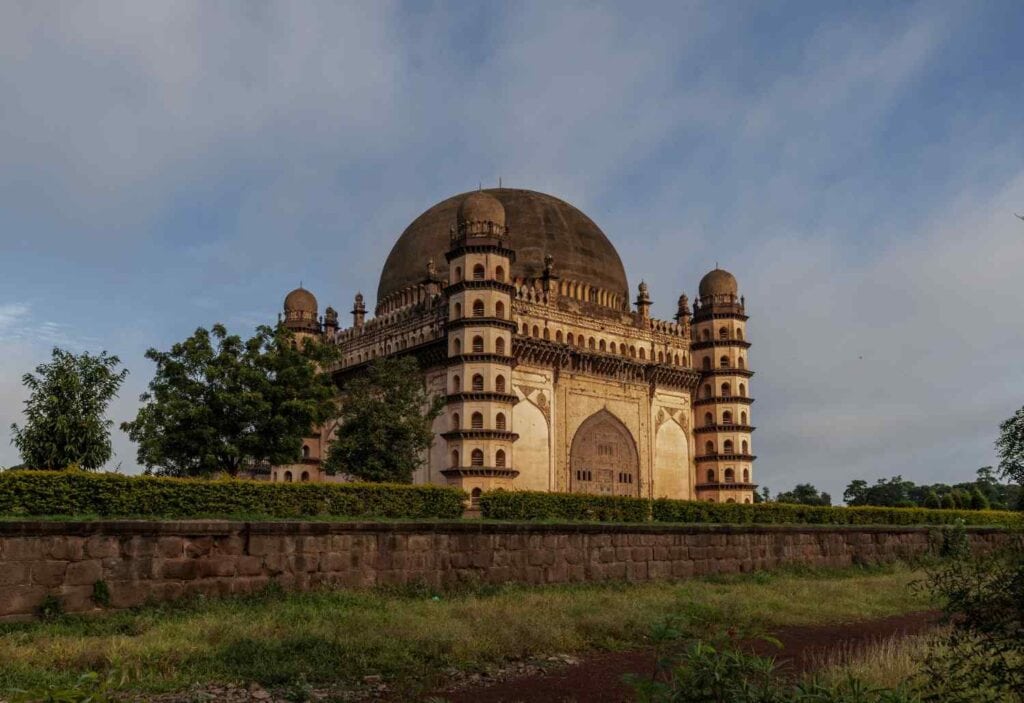
Gol Gumbaz is, quite simply, one of the largest domes ever built without steel reinforcement anywhere in the pre modern world, the mausoleum of Sultan Mohammed Adil Shah, and its whispering gallery is not a gimmick invented for tourists. Whisper against the curved wall on one side of the dome and a companion standing more than thirty metres away, on the opposite side, will hear you as though you were beside them. It works because of an accident of seventeenth century acoustics nobody has ever fully improved on.
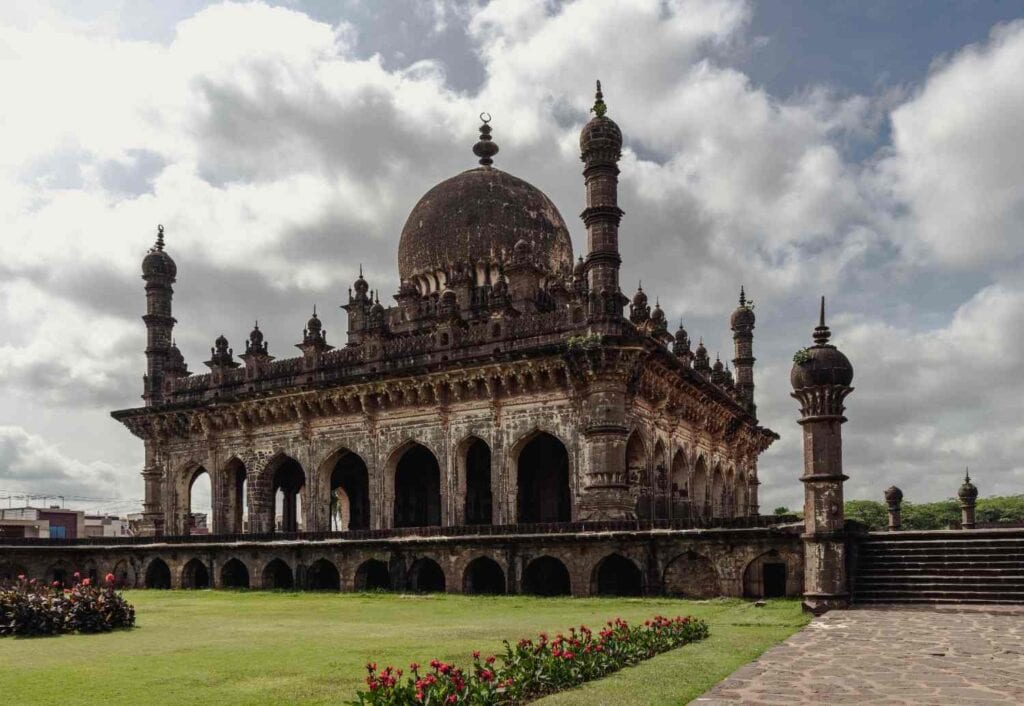
A short drive away, Ibrahim Rauza holds a gentler kind of grandeur, the tomb complex Ibrahim Adil Shah II built for his queen and, later, for himself, its minarets and filigree stonework so refined that generations of historians have argued it may have influenced the Taj Mahal itself, built decades later under a different dynasty entirely. Walk between the two monuments in a single afternoon and you walk through the full emotional range of Adil Shahi architecture, from thunderous scale to quiet devotion.
Guledagudda is a small, stone built town in Bagalkot district that once paid more tax to the state than almost any other town its size, entirely on the strength of a single fabric called khun, or khana, woven exclusively here since at least the eighth century, through the era of the Chalukya dynasty. Khun is unmistakable, a silk warp and cotton weft fabric with tiny white motifs set against a reddish purple border, traditionally woven for saree blouses and paired with the equally celebrated Ilkal sari from the neighbouring town. Fewer than sixty hand pit looms remain here today, against roughly four thousand power looms that have taken over the wider trade, and the families still working the old looms do so inside the same courtyard houses their weavers have lived and worked in for generations.
You will be welcomed with an aarthi at the door, then guided through the entire process of weaving a saree from raw thread to finished cloth. You will walk a street of hundred year old stone houses with the family who has lived among them their whole lives. Depending on the hour, a bullock cart will carry you between one weaver’s home and the next. Lunch is cooked and served inside a weaver’s own house, not a restaurant built to look like one.
Then the day becomes entirely yours to do with your hands. Milk fresh cow’s milk and turn it into tea or coffee the way the household does every morning. Print a pattern onto cloth using blocks the family has carved themselves. Wear a length of hand woven cotton or khun cloth, and spin raw cotton into thread on a charkha, the same wheel that once powered a national movement.
A short drive from Guledagudda, the town of Badami sits beneath a sandstone escarpment where the early Chalukya dynasty carved four temples directly into the rock face in the sixth century, more than a thousand years before either Bijapur or Bidar existed as centres of power. Climb the steps cut into the cliff and step inside caves dedicated to Vishnu, Shiva and the Jain tirthankaras, their ceilings and pillars carved with a level of detail that has survived fourteen centuries largely intact. Below the caves, the still water of Agastya Lake mirrors the temple complex in the late afternoon light, a view that ranks among the most photographed, and most underrated, in the whole of the Deccan.
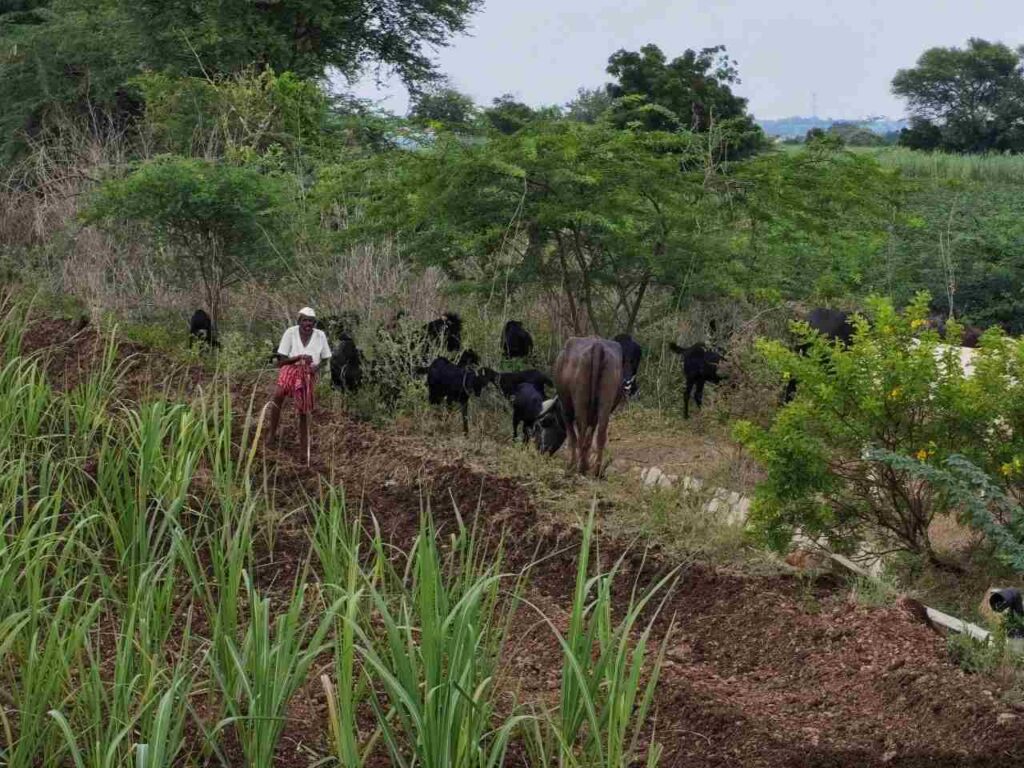
The drive from Bijapur to Bidar is, on paper, simply the longest transit day of the trail. In practice, it crosses the single most concentrated tur dal growing region in the country. Kalaburagi district alone accounts for a large share of Karnataka’s entire pigeon pea harvest, and its tur dal is the only dal anywhere in India to hold a Geographical Indication tag, awarded for a taste and cooking quality that farmers and distributors attribute to the district’s uniquely high calcium and potassium soil content. You will stop at a working farm along this stretch, meet the families who grow this crop through the same drought resistant methods their fathers used, and understand, plate by plate, exactly why a bowl of dal here tastes different from a bowl of dal anywhere else in India.

Few travellers arrive in Bidar expecting wildlife, which is exactly why the blackbuck sightings here land so hard. The grasslands ringing the city, close to the Honnikeri Reserved Forest and Jungle Lodges and Resorts’ own Blackbuck Resort near Vilaspur Lake, hold healthy resident herds of blackbuck, alongside sightings of jackal, mongoose and, for the patient, the occasional jungle cat. Set out at first light, when the antelope are most active and the grass still carries the night’s cold, and watch a male blackbuck’s spiral horns catch the very first sun of the day.
Bidar Fort is not only a monument, it is a raw material. A specific pocket of soil found only in the fort’s unlit interior chambers has, for centuries, been the essential ingredient in Bidriware, the metal craft that gives this city its name. Walk the fort’s ramparts first, then move into a working Bidriware studio to watch the full process with your own eyes, a zinc and copper alloy cast at a ratio of sixteen parts zinc to one part copper, engraved by hand with a metal stylus, inlaid with fine silver wire hammered into every groove.
In the next stage it is rubbed with a paste made from that same fort soil and ammonium chloride, which blackens the base metal instantly while leaving the silver untouched. Bidriware carries its own Geographical Indication tag, and the craftsmen who demonstrate it for you are the same families the GI registration itself names as its custodians.
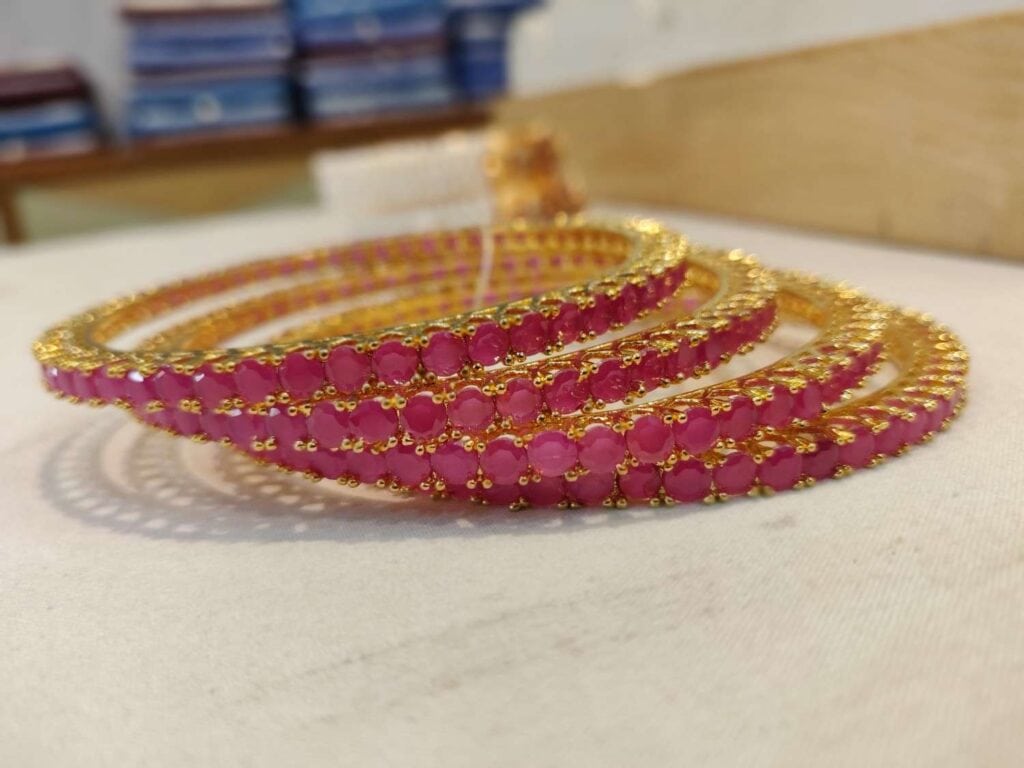
Your final day belongs entirely to Hyderabad’s old city, on foot, starting in Begum Bazaar, one of the subcontinent’s oldest continuously trading markets, before moving toward Charminar and the lane the Qutub Shahis built in the 1590s as their daughter’s bridal trousseau market. Laad Bazaar, its name taken from the lac resin its bangles are made from, still employs more than four thousand craftsmen across a single kilometre of shopfronts, and in March 2024 its lac bangles finally received their own Geographical Indication tag after four centuries of unbroken production. You will sit with a bangle maker and shape lacquer around a base of thin aluminium wire yourself.
Every weaver’s home, every farming family and every craftsman’s workshop on this trail is paid directly by 5 Senses Tours at the time of your visit. The payment is built into what you pay for the tour itself, not left to whatever a guest happens to spend at the end. This is the difference between a craft demonstration staged for a bus of tourists and a real morning inside a real working household, and it is a difference no other operator running this route can honestly claim.
Guledagudda’s khun weavers, Guludagudda’s Ilkal weaving families, the tur dal farmers of Kalaburagi district and the Bidriware and Laad Bazaar craftsmen of Bidar and Hyderabad are each part of trades that Geographical Indication registrations exist specifically to protect, because the skill and the local conditions behind each of them cannot be replicated anywhere else in the world. Travelling this route with 5 Senses Tours puts money directly into the hands keeping those registrations meaningful.
🏆 Outlook Responsible Tourism Award
🏛️ Department of Tourism Recognised
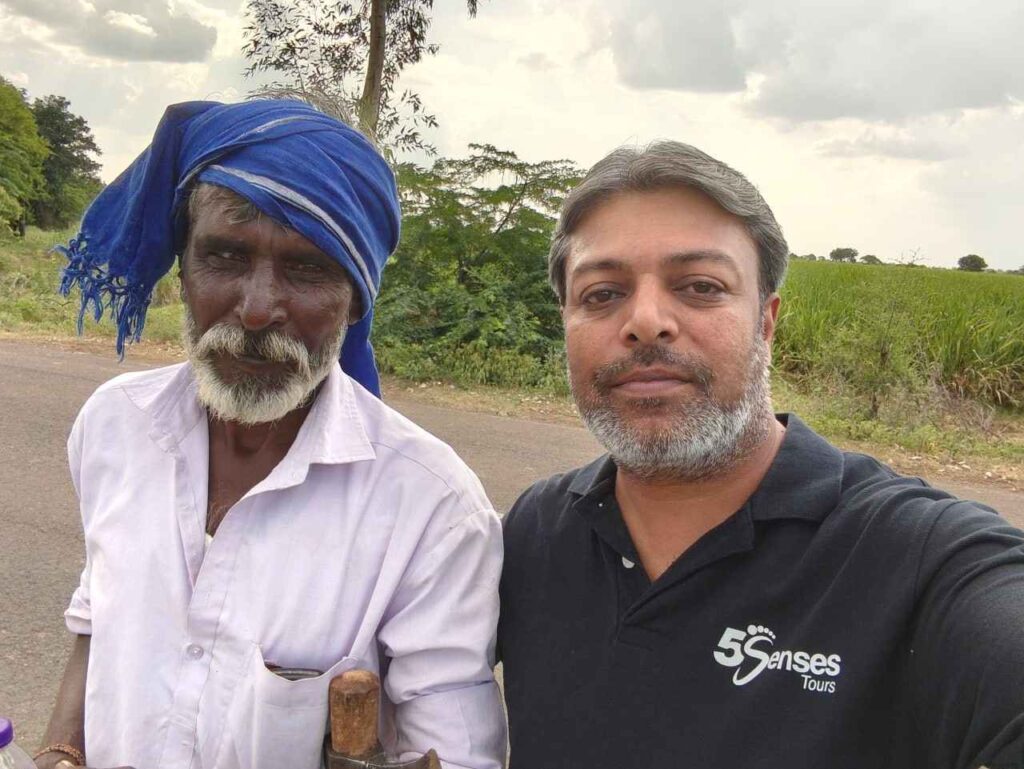
Your guide is a Cultural Evangelist who has spent years walking the specific back lanes of Kalaburagi, Bijapur, Bagalkot and Bidar that most guidebooks skip entirely, and speaks Kannada, Hindi, Urdu and English fluently enough to translate not just a weaver’s words but a weaver’s humour. Expect history delivered as a story you are standing inside, not a script recited at a monument gate, and a pace that adjusts freely to how long your group wants to linger at a loom or a fort wall.
This is a route your guide has walked often enough to read a group within the first hour on the road, and to know which mornings call for an early start and which afternoons can be allowed to slow down. A family travelling with children moves differently through Guledagudda than a retired couple who want to sit with a weaver a little longer, and that difference is planned for quietly rather than announced. The same instinct applies at Bidar Fort, where a guest with a genuine interest in metallurgy might spend twenty extra minutes at the Bidriware workshop while another simply wants to see the soil that makes the craft possible.
Every one of these six days is planned so that the only thing you need to bring is your curiosity.
✅ Private air conditioned vehicle for the entire trail, Hyderabad to Hyderabad ✅ 5 nights accommodation on double occupancy, as listed below ✅ Daily breakfast, plus lunch on all weaving, farm and craft experience days ✅ All entrance fees at Gulbarga Fort, Gol Gumbaz, Ibrahim Rauza and Badami cave temples ✅ The full Guledagudda weaving and village experience, including the weaver’s home lunch ✅ Blackbuck safari and Bidriware workshop visit in Bidar ✅ Full day Old City craft immersion in Hyderabad, including all workshop fees ✅ English speaking expert guide throughout ✅ Airport pickup and final airport drop in Hyderabad
8:30 AM — Mangala Devi Temple, where the city’s name and identity began
10:00 AM — Talipady Weavers Community, the complete production chain of Udupi cotton sarees from dye vat to finished fabric
1:30 PM — Traditional lunch at Kateel Sri Durgaparameshwari Temple on its island in the Nandini River
2:00 PM — Visit to Durgaparameshwari Temple
4:00 PM — Check in to Jasmine Homestay, Shankarapura
6:00 PM — Coastal cuisine cooking class with the homestay family
8:00 PM — Dinner and overnight at Jasmine Homestay
6:00 AM — Jasmine plucking in the fields at dawn, guided by the farming community’s own harvest schedule
8:45 AM — Breakfast
9:30 AM — Learning to tie jasmine using the traditional banana fibre technique
12:00 PM — Jasmine auction market, where the price of a kilogram of flowers is set in minutes by competitive bidding
1:30 PM — Lunch
4:30 PM — Garden walk with farming families, candid conversation about the pressures the trade faces today
6:30 PM — Bonfire
8:00 PM — Dinner and overnight at Jasmine Homestay
5:00 AM — Malpe Harbour fish market, interaction with fishermen about life at sea and the challenges the community faces
9:00 AM — Rest
11:00 AM — Drive to Blue Flag certified Padubidri Beach, one of the few internationally recognised sustainable beaches in India
Check in to Udupi beach view hotel
4:30 PM — Walk at Malpe Beach
7:00 PM — Wooden temple chariot procession at Asthamata, a living ritual of the Tulu Nadu coast
Overnight in Udupi
Morning — Checkout and drive to Agumbe through the Western Ghats
2:00 PM — Agumbe Rainforest visit with the Kalinga Centre for Rainforest Ecology, King Cobra conservation and biodiversity research
Overnight at Muduvalli Heritage Homestay, a traditional 150 year old property near Megaravalli
Morning — Drive toward Sirsi through the Western Ghats
Ripponpet — Hebbar’s Pickles, traditional Malnad pickle-making process, interaction with the family behind the production
Overnight in Sirsi
8:30 AM — Drive to Swarnavalli Mutt
9:00 AM — Breakfast in the Mutt dining hall
9:30 AM — Vedic chanting in the pillared courtyard with eighty resident students, temple visit and goshala
1:00 PM — Lunch at the Mutt
2:30 PM — Sahasralinga, where over a thousand Shiva lingas carved into the Shalmala riverbed emerge from the water
6:00 PM — Walk through Sirsi market streets and visit to Marikamba Temple
Overnight in Sirsi
8:30 AM — Drive to Banavasi
9:30 AM — Madhukeshwara Temple with resident priests, centuries-old stone heritage, carved elephant sculpture and temple chariot under active restoration
12:30 PM — Return to Sirsi, checkout
1:00 PM — Lunch
5:00 PM — Drop to Hubli Airport or Railway Station
Choose from our comprehensive list of private guided tours that bring alive the rich culture of Kartnataka.
Join our immersive culture walks to discover authentic India. Led by a guide, experience culture, heritage & food across India.
Listen to Incredible India Travel, a podcast about the best places to visit and experiences in India.
Join our ride on Royal Enfield Motorcycles s we experience authentic India, led by an escort rider.