
The Elephanta Caves Mystery: A God With 3 Faces Showing, 2 Hidden!

3 faced Shiva of Elephanta caves. A day tour from Mumbai

The Elephanta Caves mystery has four clues, and all of them are hiding in plain sight.

A god with five faces shows you only three. A stone that could have named the builder was taken away centuries ago and has never been seen since. UNESCO’s own advisers told it to wait before listing the caves. And the island that holds it all had no mains electricity until 2018.

Follow the clues. You will see how they connect in about two hours. First you have to cross the harbour.

This is the story of the Elephanta Caves, a UNESCO World Heritage Site on Gharapuri (Elephanta) Island in Mumbai harbour, about 10 kilometres from the Gateway of India, told as four puzzles. The colossal Sadashiva in Cave 1, popularly called the three faced Trimurti, is read by scholars as a five faced Shiva, with three faces carved on the wall and a fourth and fifth implied at the rear and above. The inscription that could have named the builder was removed by the Portuguese, leaving the caves’ date disputed between the mid 5th and 8th centuries. UNESCO’s advisers recommended deferring the 1987 listing, and the island’s villages had no mains electricity until February 2018. The caves can be visited on a private day trip from Mumbai, by ferry from the Gateway of India.

The Ferry: Ten Kilometres and an Hour
Elephanta caves day tour from Mumbai

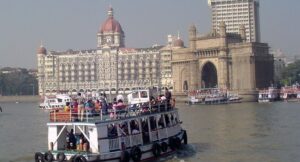
You board at the foot of the Gateway of India, an arch built for a king who never walked through it. The harbour opens out. The city thins into a skyline, and ahead, low and green, lies an island that has been called Gharapuri, the city of caves, for longer than anyone can say.

About a thousand people live on it, in three villages. Remember them. They are part of the mystery.

Elephanta caves tour from Mumbai can be booked at Tour of Elephanta.

The Climb
Toy train in Elephanta

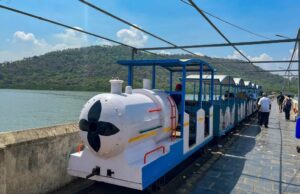
A toy train carries you along the jetty. Then come the steps, about 120 of them, up the hillside. On the western hill stand two cannons left by the Portuguese, who held the island from 1534. Beside the Great Cave, an Archaeological Survey of India resource notes a large water cistern cut into the rock, which it says still supplies the villagers’ drinking water.

Nothing about the island feels staged. It is a village with a temple in its hill.

Inside the Great Cave
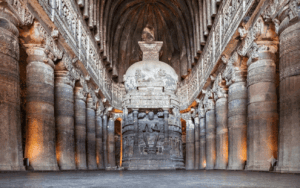
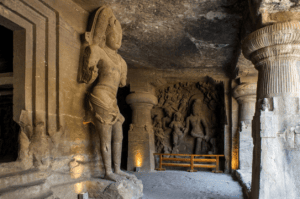
Elephanta Caves tour  You step out of the glare into the dark, and the hill becomes a hall. Rows of pillars rise into a ceiling carved to look like timber beams, although every inch of it is solid basalt. Nothing was built here. The temple was made by taking stone away, until the pillars, the roof and the gods were all that was left standing.

Once it was painted. A Portuguese chronicler recorded colour on the walls, and only traces of fine outline remain. Ahead, a shrine with four doorways, each flanked by towering guardians, holds a lingam. And at the far end of the hall, on the south wall, something waits for you.

Before you go in, ask your guide one question that few visitors think to ask: which of these pillars are old, and which are not? The 1987 evaluation noted that some were made in concrete during restoration, shaped to imitate the original stone.


Clue One: The Face You Cannot See at the Elephanta Caves
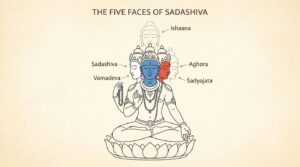
Missing 2 faces of Shiva

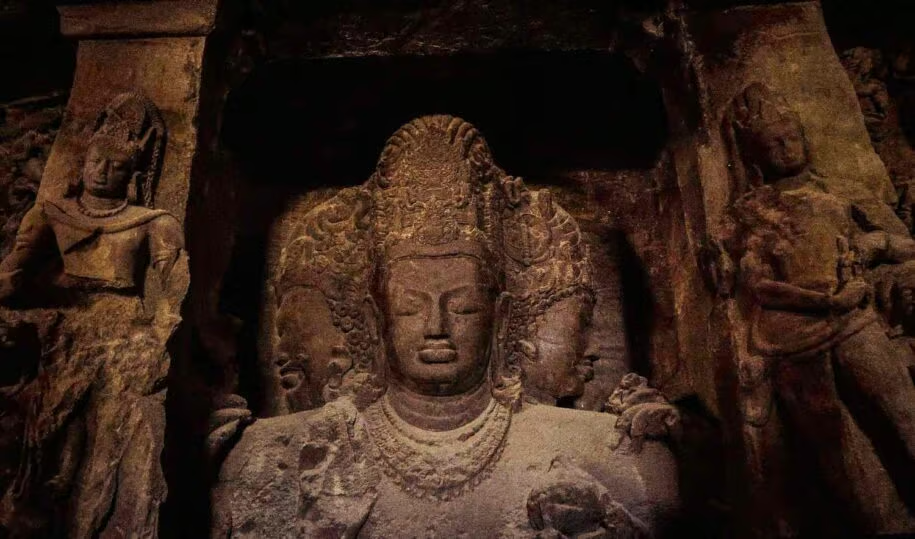
Stand before the great figure. It rises out of the rock as if still emerging from the hill, well over five metres tall.

You see three faces. The centre is calm, composed. On one side is the fierce face, Aghora, the terrifying aspect. On the other, a gentle face, Vamadeva, often read as feminine.

Now look at the signboard. It says Trimurti, the Hindu trinity of Brahma, Vishnu and Shiva. Early scholars thought so too. That identification has since been set aside: all three faces are Shiva. And there are more than three.

Scholars read the figure as Sadashiva, the five faced Shiva. A fourth face is implied at the back of the figure, where the wall is. A fifth faces upward, into the hill itself. The carvers could only show you three from the front. The others are there, in the stone, and you cannot see them.

You are standing in front of a god looking at you with three faces, while two more look away from you for good.

Clue Two: The Stone That Vanished
Missing stone of Elephanta

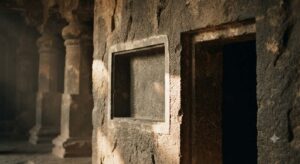
The builders left a name once. A stone slab carried a dedicatory inscription, the kind that usually names a patron, and the Portuguese took it away centuries ago. It has not been seen since.

That is why every date for Elephanta is an argument. UNESCO places the caves in the mid 5th to 6th centuries, the Archaeological Survey of India says about the 6th to 7th, and other scholars go as late as the 8th. Many credit an early Kalachuri king, Krishnaraja, on the evidence of coins. Nobody can prove it.

The Portuguese also found a huge stone elephant near the landing place and named the island after it. UNESCO’s advisers later described how it was cut into pieces, taken to Bombay and somehow put together again, a “melancholy guardian” in a city garden. It stands there still, at the Dr Bhau Daji Lad Museum. The island that was named for it has none.

Clue Three: The Experts Who Said Wait
Elephanta caves tour from Mumbai

In May 1987, the experts advising UNESCO looked at Elephanta and told the World Heritage Committee to wait. They wrote that the boundaries of the proposed site were undefined, that there was no management plan for such a fragile place, that no policy had been set on the concrete pillars, and that the site was threatened by the industrial development of Bombay: an oil port on Butcher Island, petrochemical plants and a nuclear plant at Trombay.

The caves were inscribed that same year anyway.

Look out from the hillside and you will see what they meant. The island lies less than two kilometres from Jawaharlal Nehru Port, one of India’s busiest container ports. A temple more than 1,400 years old sits in the middle of a working harbour. That it survived is part of the mystery.

Clue Four: An Island That Waited Until 2018 for Light

Now go back to the villagers. The island’s three villages, Raj Bunder, Mora Bunder and Shet Bunder, had no mains electricity until February 2018. For years the state supplied a generator that ran about three hours a day. One resident told reporters she used to sit in the dark outside her home and watch Mumbai glow ten kilometres away.

Then engineers spent three months laying a cable of about 7.5 kilometres under the harbour, and the island’s lights came on for the first time since independence.

You have been standing in a sixth century temple while the people who live beside it spent seventy years waiting for a light bulb. That is the last clue, and it changes how the others read. The mystery of Elephanta is not only what the carvers hid. It is also what the world has overlooked.

The Way Back

The last ferries run into the evening. As you head back, the city comes up to meet you. Mumbai’s lights have always been there, ten kilometres off. Now, behind you, the island has its own.

Some villagers are already planning to take guests into their homes. The island that stared at the city is learning to be looked at.

 Frequently Asked Questions

There are four puzzles: the great Shiva shows three faces but is read as having five, the inscription that could have named the builder was taken by the Portuguese, UNESCO’s advisers recommended deferring the 1987 listing, and the island’s villages had no mains electricity until 2018.

Three faces are carved on the wall, but scholars read the figure as the five faced Sadashiva. A fourth face is implied at the rear and a fifth faces upward, neither of which could be carved in relief.

No one knows for certain. The dedicatory inscription was removed by the Portuguese. Many scholars credit the early Kalachuri king Krishnaraja, and UNESCO dates the caves to the mid 5th to 6th centuries CE.

The island’s three villages received mains electricity for the first time in February 2018, through an undersea cable of about 7.5The island’s three villages received mains electricity for the first time in February 2018, through an undersea cable of about 7.5 kilometres. Before that they relied on a generator that ran about three hours a day.

Take the ferry from the Gateway of India, which takes about an hour. The caves are closed on Mondays and ferries do not run in the monsoon. 5 Senses Tours runs a private Elephanta Caves day trip from Mumbai with an expert guide

Whoever carved this temple left no name, and turned half the god’s faces away from the viewer. The villagers who came after kept the water, kept the hill and waited for their own light.

It is the kind of place that is easy to photograph and hard to understand, until someone asks you to look at the part you cannot see.

Elephanta is one of several cave sites within reach of Mumbai. Its eastern hill holds two Buddhist caves and a brick stupa as old as the 2nd century BCE. For booking a private guided tour visit Elephanta Caves Tour.

The older Buddhist world continues at Kanheri, where more than a hundred caves lie in the forest of Sanjay Gandhi National Park, and at Karla and Bhaja, on an ancient trade route near Lonavala. Back on the mainland, the Victorian Gothic and Art Deco buildings around the Oval Maidan are a UNESCO World Heritage ensemble, and you can walk them on our Mumbai architecture walk. The story of Ravana shaking Mount Kailasa, carved here, appears again at Ellora on a far grander scale, and Mumbai is the base for all of it.

Listen to a podcast

Comments are closed.
Pay in your Currency