
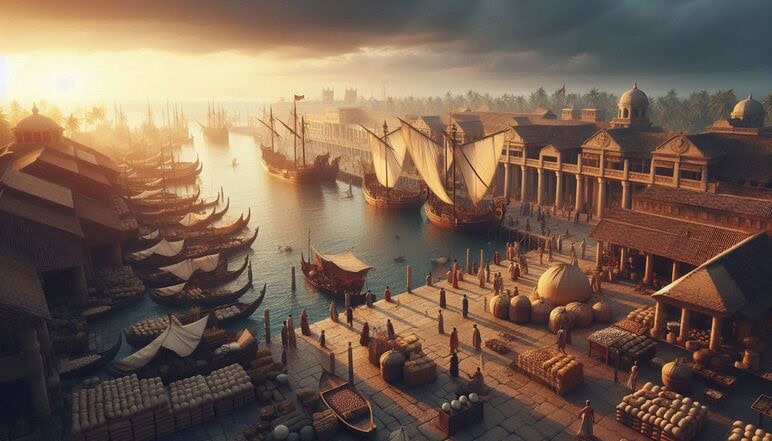
Ancient India’s trade routes were the most sophisticated and most globally connected in the ancient world. And we know this not from Indian sources alone but from a document written by a foreign eyewitness in approximately 60 CE that describes the ports, the goods, the merchants and the monsoon navigation of an India that was trading simultaneously with Rome, Arabia, China, Persia and East Africa fifteen centuries before Vasco da Gama arrived at Calicut and the Western world began calling it a discovery.
The document is called the Periplus of the Erythraean Sea.
In 1498 Vasco da Gama sailed around the Cape of Good Hope, crossed the Indian Ocean and arrived at the port of Calicut on the Kerala coast. Western history calls this the discovery of India.
There is a 2000-year-old document that destroys this claim completely.
The Periplus of the Erythraean Sea is an eyewitness account of ancient travel to Africa and India via the Red Sea written by an unknown Greek-speaking Egyptian author in the 1st century CE. In this detailed account, the conditions of the routes are described, along with the ports along the way, the demeanor of the locals, and the major imports and exports.
It was written approximately 1440 years before Vasco da Gama’s voyage. In practical, specific, commercially detailed language that reads less like a historical document and more like a modern travel guide for ship captains wanting to know which Indian ports to visit, what goods were available and how to use the monsoon winds to get home safely.
And it describes a network of ancient India trade routes and ports so sophisticated, so commercially active and so deeply embedded in the global trading economy of the ancient world that the idea of India needing to be discovered by a Portuguese sailor fifteen centuries later is not merely historically inaccurate.
It is historically absurd.
The Indian port city of Bharuch, which was also a major manufacturing centre, features pre-eminently in the Greek merchant’s handbook. Muziris, roughly near present-day Kochi on the Malabar coast, was another hub of commercial interactions between the Mediterranean, India, Persia, Africa, China, and Southeast Asia.

This blog is the complete story of what the Periplus of the Erythraean Sea tells us about ancient India’s extraordinary trade routes and ports, the civilisations that built them and the global trading networks they sustained for millennia before any European sailor had even conceived of sailing to the East.
And every single port on these ancient India trade routes is a real visitable destination in India today.
Ancient India Trade Routes: Why the Periplus of the Erythraean Sea Destroys the Discovery Myth Forever
 What the Periplus of the Erythraean Sea Tells Us About Ancient India’s Global Trade Routes in 60 CE
 What the Periplus of the Erythraean Sea Tells Us About Ancient India’s Global Trade Routes in 60 CE
The Periplus of the Erythraean Sea is one of those human documents like the journals of Marco Polo and Columbus and Vespucci which express not only individual enterprise but the awakening of a whole race toward new fields of geographical discovery and commercial achievement. It is the first record of organised trading with the nations of the East in vessels built and commanded by subjects of the Western World.
Read that description carefully. The first record of organised trading with the East by Western vessels. Written in 60 CE. Fifteen centuries before Vasco da Gama.
But here is what that description does not emphasise and what the document itself makes absolutely clear. When the Western vessels arrived at the Indian ports described in the Periplus they were not discovering anything. They were arriving at ports that had been commercially active for centuries or in some cases millennia before any Western ship appeared on the horizon.
The Indian merchants described in the Periplus are not grateful recipients of Western commercial enterprise. They are sophisticated traders operating in multiple currencies, maintaining quality standards for their exports, running shipyards that produced vessels larger than anything contemporary European maritime technology could build and managing ancient India trade routes that extended simultaneously to Rome in the west, China in the east, Arabia in the northwest and Southeast Asia in the south.
The ancient India trade routes documented in the Periplus prove definitively that India was the centre of the global economy for over a millennium before any European navigator set foot on its shores.
The Periplus credits a Greek merchant named Hippalus who in approximately 47 BCE discovered the direct sailing route from the Red Sea to the Indian peninsula by using the monsoon winds.
Indian sailors already knew about the monsoon winds. They had been using them to cross the Indian Ocean for centuries before Hippalus made his celebrated discovery. The Periplus itself notes the presence of large Indian vessels off the coasts of East Africa and Arabia, Indian settlements on the island of Socotra and Indian trading networks across the entire arc of the Indian Ocean world.
The monsoon was not discovered by a Greek sailor. It was used by Indian sailors who shared their knowledge with the Greek merchant who then became famous for understanding what Indian navigators had always known.
The Vasco da Gama Myth: Why Ancient India’s Trade Routes Made His Arrival Completely Unremarkable
When Vasco da Gama arrived at Calicut in 1498 he did not find a land that the world did not know about. He found a thriving cosmopolitan port city that was already the centre of an international spice trade involving Arab, Persian, Indian, Chinese, Malay and East African merchants.
The Arab navigators who helped Vasco da Gama find his way across the Indian Ocean from the East African coast to Calicut already knew the ancient India trade routes intimately. They had been sailing them for centuries. They knew exactly where Calicut was, what it traded and what the monsoon winds would do in every month of the year.
What Vasco da Gama discovered was not India. What he discovered was a sea route from Europe to a place that the rest of the world had already been trading with for over a thousand years through ancient India trade routes that the Periplus documented fifteen centuries before his arrival. The discovery was significant for Europe. It was entirely irrelevant to India.
Barygaza Bharuch: The Ancient India Trade Route Hub That Traded With Egypt Before Rome Was a City
Bharuch, located in Gujarat, was a prominent port in the Indian subcontinent during ancient India. Also known as Barygaza, Bhrigukachcha and Broach. Bharuch was a terminus for a number of land-sea trade routes and goods were trans-shipped there to send abroad utilising the monsoon winds.
What the Periplus Tells Us About Barygaza: The Greatest Hub on Ancient India’s Western Trade Routes
The port the Periplus calls Barygaza is the city now known as Bharuch in Gujarat, located at the mouth of the Narmada River. And the description the Periplus gives of Barygaza is one of the most detailed and most extraordinary portraits of any ancient port in any document surviving from the classical world.
The Periplus describes Barygaza as the principal distributing centre of western India. Ships arrived from the Persian Gulf, the Red Sea, the East African coast and the Arabian Peninsula carrying wine, copper, tin, lead, coral, glass, silver and gold. They left carrying pepper, ivory, agate, carnelian, Indian muslin and cotton goods from the inland city of Ujjain, a former royal capital whose goods were brought down to Barygaza for export.
Ujjain was an important trading place. The Periplus describes Ujjain as Ozene, which was a former royal capital, and from where all things needed for the welfare of the country like muslins, cotton, and other products were brought from this place.
The specificity of the Periplus’s description of the Barygaza trade is extraordinary. The document describes the dangerous currents and tidal bores at the mouth of the Narmada, warns merchants about the difficulty of entering the harbour, mentions that local pilots would come out to meet arriving ships and guide them in safely and details the exact types of goods that the local ruler both expected as gifts and was most interested in purchasing.
This is not a document written by someone describing a country they had heard about from a distance. This is a document written by someone who had been to Barygaza, negotiated in its markets and navigated its dangerous harbour entrance.
Bharuch had established trade relations with Arabs, Greeks and Romans, Africans, Chinese and Egyptians. Historians suggest that the history of this port and shipbuilding centre goes back to the days of the Pharaohs.
To the days of the Pharaohs. Bharuch was trading with Egypt before Rome existed as a city. Before Greece had developed its classical culture. Before any of the civilisations that the Western world calls ancient had reached their peak.
Visiting Bharuch Today: Walking the Ancient India Trade Routes at the Mouth of the Narmada
The Bharuch of today is a city of approximately 200,000 people in Gujarat largely unknown to international tourists. Yet beneath its streets and along its riverbanks lie the archaeological remains of a port that was one of the most commercially significant cities in the ancient world.
The ancient fort on the Narmada riverbank, the old city quarter and the view across the Narmada to the opposite bank create a heritage experience of extraordinary depth for the visitor who arrives with the complete story of the ancient India trade routes that once made this city the gateway to the subcontinent.
Our Ahmedabad tours include the broader Gujarat heritage circuit from which Bharuch is accessible as an extraordinary extension adding the ancient India trade routes dimension to the wider heritage of Ahmedabad’s pols, Dholavira and the Indus Valley civilisation sites of Dholavira and Lothal.
Muziris Kerala: The Lost City Where Ancient India’s Most Valuable Trade Route Began and Ended
Muziris remained as a legend for a long period of time until the Kerala Council for Historical Research started a series of excavations in 2006 leading to the discovery of evidence that confirmed the history of Muziris port. It is believed that the golden period of the port and city came to an abrupt end in 1341 after a flood changed the course of the Periyar River.
What the Periplus Says About Muziris: Where Roman Gold Arrived and Ancient India’s Pepper Left
The first major spice trade centre in the world became Muziris located in the Indian state of Kerala on the southwestern coast of India. Probably established by 3000 BCE, it remained one of India’s most important trading ports through the Roman period. In the Akananuru, a collection of ancient Tamil poetry, it was described as the city where the beautiful vessels, the masterpieces of the Yavanas, stir white foam on the Periyar, river of Kerala, arriving with gold and departing with pepper.
Arriving with gold. Departing with pepper.
These five words from an ancient Tamil poem capture the entire economic reality of the ancient India trade routes in a single image. Rome was desperate for Indian pepper. So desperate that Pliny the Elder, writing in Rome at approximately the same time as the Periplus was written, complained bitterly about the enormous outflow of Roman gold to India and argued that it was destabilising the Roman economy.
No other ancient India trade route produced the volume of Roman gold outflow that the Kerala pepper trade generated, a fact that Roman writers documented with a mixture of admiration and economic alarm.
According to the Periplus, numerous Greek seamen managed an intense trade with Muziris. Then come Naura and Tyndis, the first markets of Damirica, and then Muziris and Nelcynda which are now of leading importance.
The Periplus describes Muziris as one of the most important ports in the entire Indian Ocean trading world. Not one of the places worth visiting. One of the most important places in the world. By the standards of 60 CE this is a port city whose commercial significance rivals Alexandria, Antioch and Rome itself.
Visiting Pattanam and Kodungallur: Walking the Ancient India Trade Route Where Roman Ships Once Anchored
The site most strongly associated with ancient Muziris is Pattanam near Kodungallur in Kerala approximately 25 kilometres north of Kochi. The excavations that began in 2006 have produced Roman amphorae, Mediterranean glass beads and a ring with a portrait of a Roman emperor, evidence of a port infrastructure sophisticated enough to handle the largest merchant vessels of the ancient Mediterranean world.
The Muziris Heritage Project has developed a network of heritage sites across the Kodungallur and Thrissur districts that together tell the complete story of the ancient port and its position at the heart of the most lucrative ancient India trade routes in the world.
Our Kochi tours include the complete Muziris heritage circuit with expert cultural guides who bring the full story of the ancient port and its Roman, Arab, Jewish and Chinese trading communities to life in a way that transforms Fort Kochi’s already extraordinary heritage into something of an entirely different historical depth and significance.
Poompuhar Tamil Nadu: The Sunken City at the Heart of Ancient India’s Eastern Trade Routes
Kaveripattinam and the Periplus: Ancient India’s Eastern Trade Routes Through the Eyes of Tamil Poets
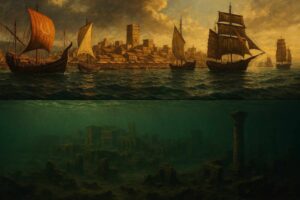
Poompuhar also known as Puhar is believed to be the port town of the Chola Empire. Located in the current Nagapattinam district in Tamil Nadu the ancient port city also named as Kaveripattinam in historic documents was situated at the mouth of the Kaveri River. Details about the port have been found in several historic documents including the Periplus of the Erythraean Sea.
The Silappatikaram, one of the five great Tamil epics written in the first centuries CE at approximately the same time as the Periplus, is set in Kaveripattinam. It describes a city of extraordinary wealth and cosmopolitan character where merchants from Greece, Rome, Arabia, China and Southeast Asia lived alongside Tamil traders, where the markets were filled with every luxury commodity available in the ancient world and where the sound of multiple languages filled the port quarter at all hours.
The city that the Tamil poets described with such pride and specificity was a real city. The Periplus confirms it. The archaeology confirms it. And then the sea took it. Kaveripattinam was gradually submerged by the Bay of Bengal over several centuries. Marine archaeologists working off the Tamil Nadu coast near Poompuhar have discovered submerged structures at depths of up to 70 metres that appear to be the remains of ancient port infrastructure suggesting the ancient India trade route city extended far further into what is now the sea than the current coastline would suggest.
Visiting Poompuhar Today: The Ancient India Trade Route City Now Beneath the Bay of Bengal
The modern village of Poompuhar on the Tamil Nadu coast near Mayiladuthurai is a quiet largely unvisited coastal settlement whose extraordinary ancient history is almost entirely invisible to the casual traveller.
The Poompuhar Museum contains sculptures and artefacts recovered from the site and the surrounding area that give a vivid impression of the city’s ancient character as one of the most cosmopolitan ports on the entire ancient India trade routes network.
Our Chennai tours and Madurai tours include the complete Tamil Nadu coastal heritage circuit that brings the Poompuhar story to life alongside the extraordinary Chola temple tradition and the living craft heritage of the Tamil coast.
Arikamedu Puducherry: The Ancient India Trade Route Where Roman Pottery Still Comes Out of the Ground
What Archaeology Tells Us: How Roman Arretine Pottery Confirms Ancient India’s Global Trade Routes
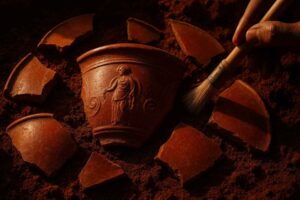
Arikamedu in today’s Puducherry was an important ancient port city. It finds mention in the Periplus of the Erythraean Sea and Tamil poems of the Sangam period. It is believed to be an active trading port of the region with the Roman Empire as early as the second century BCE. Excavations have revealed Roman Arretine ware, pottery, beads, intaglios, lamps, glass and coins here.
Roman Arretine ware. The distinctive red-glazed pottery produced in the city of Arezzo in Tuscany that was the premium tableware of the Roman world. Found in a village outside Puducherry on the Bay of Bengal coast of South India. Fragments of the same pottery that Roman aristocrats ate their meals from in first-century Rome turning up in the soil of Tamil Nadu.
The implication is extraordinary. There was a Roman trading post at Arikamedu. Roman merchants lived here, ate their meals from their Arretine pottery, conducted their commercial business with Tamil traders and eventually left behind the physical evidence of their presence in the soil that archaeologists would find two thousand years later.
The Tamil name for Greeks and Romans was Yavanas. The Sangam poetry of the period describes Yavana traders with their ships, their goods and their lamps burning into the night in the port quarter of Tamil coastal cities. These are not legendary figures. They are the same people whose pottery is still being found in the soil of Puducherry, confirming the extraordinary reach of ancient India’s global trade routes with physical evidence that no amount of historical revisionism can dispute.
Visiting Arikamedu Today: The Ancient India Trade Route Settlement Near Puducherry
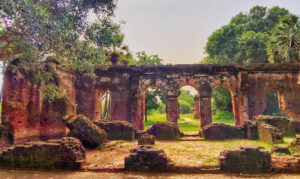
The Arikamedu site is located on the outskirts of Puducherry a few kilometres south of the old town along the Ariyankuppam River. The Puducherry Museum in the old town contains the most important finds from the excavations including Roman Arretine ware, amphorae and beads that physically embody the connection between ancient India’s trade routes and the Roman world.
5 Senses Tours organises heritage tours to Arikamedu as a half-day tour from Pondicherry. For details, visit Arikamedu Tours.
Our Chennai tours include Puducherry as a part of the complete Tamil Nadu and Pondicherry heritage circuit bringing the full ancient India trade routes story to life alongside the French colonial quarter.
Tamralipti West Bengal: The Ancient India Trade Route Port That Sent Buddhism Across Asia
How Ancient India’s Trade Routes From Tamralipti Carried Buddhism Across the Entire Continent
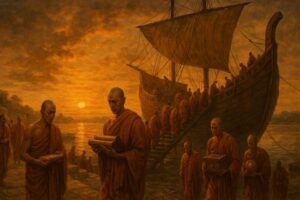
Tamralipti is located in present-day West Bengal. It lies just south of the Rupnarayan River. According to the Mahavamsa, an epic history of Sri Lanka, it was the departure point of Prince Vijaya’s expedition to colonise Sri Lanka approximately 500 BCE. It was the departure point for the Buddhist missionary expedition dispatched by the Mauryan emperor Ashoka to Sri Lanka 250 years later. It was also the port for trade with Southeast Asia. Chinese pilgrim Fa-Hien visited the city in the 5th century CE and Hieun-Tsang visited it in the 7th century.
Tamralipti, the ancient port now known as Tamluk in West Bengal, is one of the most historically significant sites on the entire ancient India trade routes network and one of the least known internationally.
From this port the first Buddhist missionaries sent by Emperor Ashoka departed for Sri Lanka in approximately 250 BCE carrying the teaching that would transform the island and eventually spread across Southeast Asia. From this port the Chinese pilgrim Fa-Hien departed for China after spending years in India studying Buddhist texts, carrying the manuscripts that would shape the development of Chinese Buddhism.
The ancient India trade routes from Tamralipti carried not only physical goods but the intellectual and spiritual heritage of India to the rest of Asia across the centuries. It is not simply a trading port. It is the departure point from which the most transformative cultural transmission in Asian history began.
Visiting Tamluk Today: The Ancient India Trade Route Port That Changed Asian History
The modern city of Tamluk in the Purba Medinipur district of West Bengal sits on the site of ancient Tamralipti. The Tamraluk Heritage Museum contains the most significant finds from local excavations and the ancient Bargabhima Temple preserves the sacred character of the site across millennia of continuous religious practice.
Our Kolkata tours include the broader Bengal heritage circuit that brings the complete Tamralipti story to life alongside the extraordinary cultural depth of Kolkata itself.
Sopara and Kalyan: The Ancient India Trade Route Ports Now Buried Beneath Mumbai’s Suburbs
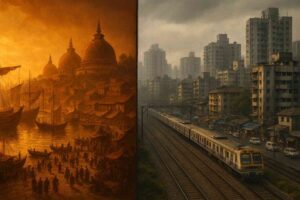
What the Periplus Documents About Ancient India’s Trade Routes Along the Maharashtra Coast
Other seaport towns mentioned in the Periplus are Sopara, Kalliena which is modern Kalyan, Semulla which is Chembur, Mandogra which is Mandad in Amravati district and Melizeigara which is modern Jaigadh.
The Maharashtra coast south of Mumbai contains one of the most extraordinary concentrations of ancient India trade route history in the country and one of the least known to international tourists.
Sopara, now called Nala Sopara in the outer suburbs of Mumbai, was one of the most important ports on the ancient India trade routes. It was a major Buddhist centre, one of the nine cities to which Emperor Ashoka sent his missionary expeditions, and a port with connections to Rome, Arabia and East Africa. The Periplus describes it as an active trading port. Ashoka’s rock edicts were found here. Buddhist stupas were excavated here. And today it is a Mumbai suburb through which commuter trains run every few minutes.
Kalyan, the Kalliena of the Periplus, is now one of Mumbai’s satellite cities. Chembur, the Semulla of the Periplus, is now a densely populated Mumbai suburb. Sitting in the traffic of Chembur today and knowing that the Greek merchant who wrote the Periplus knew this place by name and wrote about it in his commercial handbook fifteen centuries before the first European set foot in India is one of those extraordinary experiences of historical knowledge that transforms the ordinary into the remarkable.
Ancient India Trade Routes Hidden in Plain Sight Beneath the Suburbs of Modern Mumbai
The ancient India trade routes of the Maharashtra coast represent the most dramatically hidden heritage in this entire blog precisely because they are buried under one of the most densely populated urban landscapes on earth. Mumbai’s suburbs sit on top of one of the most historically significant coastlines in the ancient world.
The Sopara Buddhist stupa site, the Ashoka edict inscriptions and the Kanheri Caves whose ancient Buddhist community was directly connected to the port trade of the Maharashtra coast together create a heritage experience of extraordinary depth for the visitor who knows what to look for.
Our Aurangabad tours include the complete Buddhist heritage of Maharashtra including the Ajanta and Ellora caves whose artistic tradition was sustained in part by the wealth generated by the Maharashtra coastal ancient India trade routes documented in the Periplus.
Ancient India Trade Routes You Can Walk Today: The Complete 5 Senses Tours Heritage Guide
How Every Ancient India Trade Route Port in the Periplus Is a Real Visitable Destination Today
The most extraordinary fact about the ancient India trade routes documented in the Periplus of the Erythraean Sea is that every single port it describes is a real visitable location in India today.
Bharuch is still a city in Gujarat accessible from Ahmedabad. Pattanam and Kodungallur are accessible from Kochi. Poompuhar is accessible from Chennai via Nagapattinam. Arikamedu is in the outskirts of Puducherry. Tamluk is accessible from Kolkata. And the ancient Maharashtra ports are buried beneath the suburbs of one of the world’s most visited cities.
Every ancient India trade route port in the Periplus is described in that document with the same practical commercial detail that a modern travel guide uses. The harbour entrance. The local currency. The goods available. The reliability of the local merchants. The best season to arrive. Reading the Periplus is reading a 2000-year-old trip advisor written by someone who had made the journey himself.
And the ground beneath your feet at every one of these sites was described in that Greek merchant’s handbook two thousand years ago. Vasco da Gama did not discover India. India was the most cosmopolitan, the most commercially connected and the most internationally integrated civilisation in the ancient world. The Periplus of the Erythraean Sea proves it with the authority of two thousand years of documented history.
Plan Your Ancient India Trade Routes Heritage Tour With 5 Senses Tours
5 Senses Tours is the only cultural tour operator in India that brings the complete ancient India trade routes story to life for international travellers. Our cultural evangelists connect the physical landscape of modern India to the documentary evidence of the ancient world in a way that transforms every heritage visit from a sightseeing experience into a genuine encounter with the most extraordinary trading civilisation in ancient history.
Every ancient India trade route port described in the Periplus is accessible through 5 Senses Tours expert guided heritage experiences designed for international travellers who want to understand not just what they are looking at but the complete extraordinary story of the most globally connected civilisation in the ancient world.
Our Kochi tours bring the Muziris story to life through the complete Pattanam and Kodungallur heritage circuit alongside the Jewish, Portuguese, Dutch and British layers of Fort Kochi that together make this the most cosmopolitan single kilometre in the history of Asian trade.
Our Ahmedabad tours include the complete Gujarat heritage circuit that connects Bharuch’s ancient port history to the Indus Valley civilisation at Dholavira and Lothal, where the world’s earliest known dock demonstrates that Gujarat’s tradition of maritime commerce is 4500 years old.
Our Chennai tours include the complete Tamil Nadu coastal heritage circuit connecting Poompuhar and Arikamedu to the extraordinary Chola temple tradition and the living craft heritage of the Tamil coast.
Our Kolkata tours include the complete Bengal heritage circuit connecting the ancient port of Tamralipti to the extraordinary cultural depth of one of India’s greatest cities.
Our Madurai tours connect the ancient India trade routes of the Tamil coast to the living temple traditions of South India’s most extraordinary sacred city.
Our Aurangabad tours include the UNESCO World Heritage caves of Ajanta and Ellora whose artistic tradition was sustained by the wealth of the ancient India trade routes.
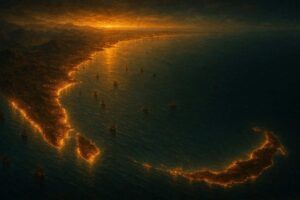
For travellers who want to experience the complete ancient India trade routes trail across multiple destinations, 5 Senses Tours can create a customised private itinerary that follows the Periplus of the Erythraean Sea from Gujarat down the western coast to Kerala, across to Tamil Nadu and up the eastern coast to Bengal. This is perhaps the most intellectually extraordinary heritage journey available in India, tracing in person the route that the ancient Greek merchant described in his handbook two thousand years ago.
Explore our complete portfolio of India heritage tours and begin planning the most extraordinary journey of your life.
Book your ancient India trade routes heritage tour with 5 Senses Tours today
Leave a Reply