
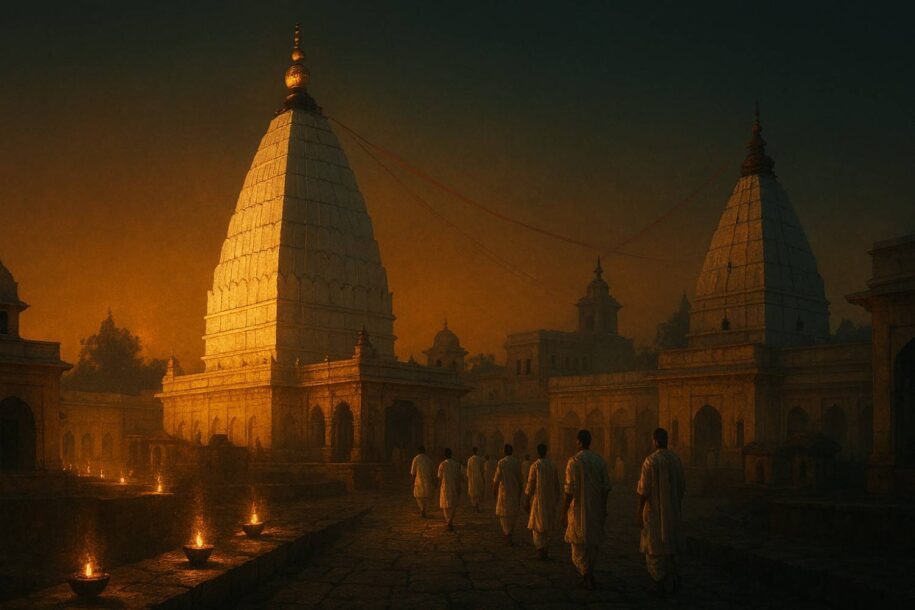
There are twelve Jyotirlingas in India.
There are fifty-one Shakti Peethas.
And there is only one place in the entire world where both exist simultaneously within the same sacred complex.
Baba Dham Deoghar Temple is the only place in the world where Shaktipeeth and Jyotirlinga are united.
That place is Deoghar in Jharkhand. And the story of how it came to hold both of these extraordinary designations is one of the most dramatic, most theologically profound and most emotionally moving narratives in all of Hindu sacred geography.
It begins not with a god. But with a demon.
And it ends with the heart of a goddess falling to earth at the precise spot where that demon’s devotion had already consecrated the ground forever.
For Hindus living outside India, whether in the USA, the UK, Singapore, Canada or Australia, the Baba Baidyanath Jyotirlinga story is not simply mythology. It is the origin narrative of a place whose sacred energy has drawn pilgrims for millennia and continues to draw them today. Understanding the story completely transforms what it means to stand in the Baidyanath Dham complex and receive the darshan of both the divine physician and the heart of the goddess in the same sacred space.
This is the complete Baba Baidyanath Jyotirlinga story. Every chapter. Every character. Every theological dimension. And the reason this extraordinary place is unlike any other sacred site in the world.
The Baba Baidyanath Jyotirlinga Story Part One: Ravana’s Devotion and the Birth of the Divine Physician
The Demon King Who Loved Shiva More Than Any Devotee in History
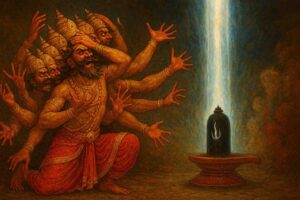
The Baba Baidyanath Jyotirlinga story begins not with a saint or a rishi or an ordinary devotee. It begins with Ravana, the ten-headed king of Lanka. Scholar of the Vedas. Master of classical music. Commander of armies that no human power could withstand.
And the most extraordinary devotee Lord Shiva had ever had.
Ravana’s devotion was not the gentle bhakti of an ordinary worshipper. It was absolute. It was ferocious. And it expressed itself in a form of offering so extreme that it staggers the imagination.
The legend of Baidyanath Jyotirlinga Temple is rooted in the tale of Ravana, the demon king of Lanka, who worshipped Lord Shiva and offered his ten heads one by one. Pleased with his devotion, Shiva appeared and healed him, earning the name Vaidyanath, the divine doctor.
Think about what this means. Ravana did not offer flowers or fruit or chanted prayers from a safe distance. He offered his own heads. Each time one grew back he cut it off again and placed it as a sacred offering to Shiva. Ten times. The physical pain is almost impossible to imagine. The devotion that could sustain such an act across ten repetitions is almost impossible to understand.
And Shiva, moved by a devotion that no other being had ever demonstrated in quite this form, appeared before his devotee. He healed every wound simultaneously. Every severed neck restored. Every head replaced. Every wound closed.
The name Baidyanath comes from two Sanskrit words Vaidya meaning physician and Nath meaning Lord, literally meaning Lord of Physicians. This is where Lord Shiva cured the demon king Ravana, making it an extremely powerful place for healing both physical and spiritual.
This is the first extraordinary truth of the Baba Baidyanath Jyotirlinga story. The temple at Deoghar is not dedicated to Shiva as cosmic destroyer or as the lord of ascetics or as the dancer of creation. It is dedicated to Shiva as the divine healer. As the physician who restores what has been broken. The name Baidyanath, Lord of Physicians, was earned in the moment when the most powerful demon who ever lived cut off his own heads in an act of devotion so extreme that it moved the divine physician to appear and make him whole.
Every person who has ever come to Baba Baidyanath Dham seeking healing, whether physical recovery from illness or spiritual healing from grief or loss or the restoration of what suffering has damaged, is walking in the footsteps of Ravana. And the temple’s extraordinary reputation as a place of healing that has persisted for millennia flows directly from this founding moment of the complete Baba Baidyanath Jyotirlinga story.
The Greatest Boon and the Impossible Condition: How the Jyotirlinga Came to Deoghar
Shiva, moved by Ravana’s extraordinary devotion, offered him a boon. The greatest possible gift available to any devotee in any age.
Ravana asked for the greatest possible thing. He wanted Shiva himself, in the form of a Jyotirlinga, to come and live permanently in Lanka. He wanted the divine presence installed at the heart of his kingdom, making it invincible to every enemy, every power and every cosmic force that might threaten it.
Shiva agreed.
But with one condition.
Lord Shiva found Ravana’s devotion impressive and asked him to carry the lingam to Lanka but with one condition. The journey from Mount Kailash to Lanka should not stop in between. And if that happened, then wherever the lingam fell, there it would reside forever.
The condition seems simple. Carry the lingam from Mount Kailash to Lanka without putting it down even once. Do not stop. Do not rest. Do not place the lingam on the ground for any reason on any pretext at any moment of the entire journey.
Ravana, with the confidence of a man who had just demonstrated his devotion by cutting off his own heads ten times, accepted.
He began his journey south toward Lanka carrying the most sacred object in the universe.
The Cosmic Trick of Ganesha: Why the Baba Baidyanath Jyotirlinga Story Is Also a Story of Divine Wisdom
The gods watching from the heavens understood immediately what Ravana possessing a permanent Jyotirlinga in Lanka would mean.
It would tip the cosmic balance in the direction of the demon kingdom permanently and irreversibly. The divine order of the universe would be disrupted in ways that could not easily be corrected. Something had to be done. And it had to be done with intelligence rather than force because Ravana with the Jyotirlinga in his hands was essentially untouchable.
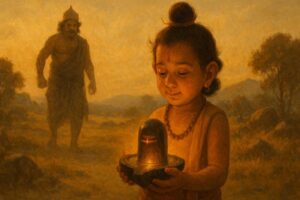
The gods were worried that if Ravana took the Jyotirlinga to Lanka, he would become unstoppable. They approached Lord Ganesha for help. Ganesha cleverly disguised himself as a young boy and approached Ravana when nature called.
The strategy was elegant in its simplicity. If Ravana could be made to put the lingam down even once, it would remain at that spot forever. He would lose it. But how do you make the most powerful and most determined devotee in the universe put down the object he is carrying?
The gods sent the water god Varuna to create a situation where Ravana urgently needed to answer nature’s call. Unable to hold the lingam, Ravana requested the disguised boy to hold it temporarily, warning him not to place it on the ground under any circumstances. The boy, who was Ganesha in disguise, called three times for Ravana. When Ravana did not return in time, Ganesha placed the lingam on the ground.
The ground at Deoghar.
Ravana got very angry when he returned and could not move the lingam. The lingam was hurt when he tried to get it back. Ravana was so enraged that he chose to go to the spot every day to show how ashamed and sorry he was. The spot where the lingam was placed became a holy place where people went to pray.
This is the founding moment of the Baba Baidyanath Jyotirlinga story as we know it today. A demon’s absolute devotion. A divine physician’s compassion. A cosmic trick played by Ganesha with the wisdom to understand that the universe’s balance matters more than any individual’s desire. And a lingam that has stood in the same sacred spot in Deoghar since the Treta Yuga, receiving the prayers of millions of devotees across thousands of years.
The Baba Baidyanath Jyotirlinga Story Part Two: Sati’s Heart and Why Deoghar Is the Only Place in the World Where Shiva and Shakti Are Together
The Second Sacred Story: How the Heart of Sati Fell at Deoghar
The Baba Baidyanath Jyotirlinga story does not end with Ravana and Ganesha. It carries a second chapter of even greater emotional depth and even more extraordinary theological significance.
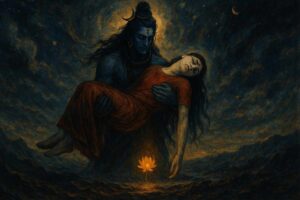
The Shakti Peetha at Baba Baidyanath Dham is associated with the legend of Sati, the consort of Lord Shiva. Upon her self-immolation, Shiva in his grief carried her body across the land. At each place where her body parts fell, a Shakti Peetha emerged. In Deoghar, it is believed that Sati’s heart fell, making it the Hriday Peeth, or the Heart Shrine. The Shakti Peetha here is dedicated to Jaya Durga, a manifestation of Goddess Parvati.
The story of Sati is the most profoundly moving in all of Hindu mythology. She was the daughter of Prajapati Daksha who married Lord Shiva against her father’s wishes. When Daksha organised a great yajna and deliberately excluded Sati and Shiva, Sati, unable to bear the insult to her husband, gave her life by jumping into the sacred fire.
Shiva’s grief was absolute and cosmic. He carried Sati’s body across the universe, inconsolable in his loss, his sorrow so immense that it threatened to disrupt the order of creation itself. Lord Vishnu, understanding what was at stake, used his Sudarshana Chakra to divide Sati’s body into fifty-one parts. Wherever each part fell, a Shakti Peetha was consecrated. Fifty-one sites across the Indian subcontinent where the divine feminine power is permanently enshrined.
At Deoghar, the heart of Sati fell.
Not her hands. Not her feet. Not any other part of her being. Her heart. The organ that in every human and divine tradition is the seat of love, of grief, of devotion and of connection. The heart of the goddess who loved Shiva so completely that she gave her life rather than witness his humiliation.
It is considered a divine confluence to have the Hriday Peeth of Mata Sati with Mahadev in the form of Jyotirling in the holy land of Baidyanath Dham. This is the only Jyotirlinga among the twelve Jyotirlingas where vermilion is donated, Sindur Daan, on the occasion of Maha Shivaratri because Shiva and Shakti are together here.
This is the complete Baba Baidyanath Jyotirlinga story in its full theological depth. In Deoghar, Shiva is present in the form of the divine physician who healed Ravana, the most devoted of all his worshippers. And in the same complex, the heart of his beloved Sati is permanently enshrined. The cosmic physician and the cosmic beloved. The Jyotirlinga and the Hriday Peeth. Shiva and Shakti. Together. In the only place in the world where both are present simultaneously.
The Red Threads Between the Temples: The Living Expression of the Baba Baidyanath Jyotirlinga Story
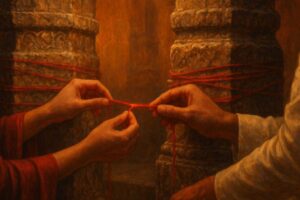
Both the Baidyanath temple and the Jayadurga temple are connected by red threads from their tops, and it is believed that if married couples bind these two tops with silk, they will be blessed with a happy married life.
The red threads that connect the Jyotirlinga temple and the Jayadurga Shakti Peeth temple are one of the most visually distinctive and most theologically meaningful elements of the entire Baidyanath Dham complex. They are the physical expression of the story’s central truth. Shiva and Shakti are not merely present in the same complex as separate divine entities. They are connected. Bound together. United in the same sacred ground as they have been since the Treta Yuga when Ravana’s devotion drew the Jyotirlinga to Deoghar and the heart of Sati consecrated the same earth.
For NRI couples and families visiting Deoghar, the tradition of binding the temple tops with silk is one of the most intimate and most personally meaningful rituals available at any pilgrimage site in India. It is not simply a superstition about marital happiness. It is a participation in the cosmic story of Shiva and Shakti’s union. A physical act of devotion that connects your own marriage and your own family to the most profound love story in the Hindu tradition.
The Unique Sindur Daan Ritual: What Makes Baba Baidyanath Jyotirlinga Different From Every Other Jyotirlinga
One of the most extraordinary and least known facts in the complete Baba Baidyanath Jyotirlinga story is the ritual of Sindur Daan that takes place at Maha Shivaratri.
This is the only Jyotirlinga among the twelve Jyotirlingas where vermilion is donated on the occasion of Maha Shivaratri because Shiva and Shakti are together here.
Sindur, the vermilion that married Hindu women apply to the parting of their hair, is the most visible and most culturally resonant symbol of marriage in Hindu tradition. It is applied at the time of marriage and maintained throughout the life of the marriage as a continuous act of devotion to the husband and an invocation of Goddess Parvati’s blessing.
At Maha Shivaratri, Sindur Daan is performed at Baba Baidyanath Dham. Vermilion is offered to the Jyotirlinga in an act that has no equivalent at any other of the twelve Jyotirlingas in India. It is performed here specifically because Shiva and Shakti are together here. Because the divine masculine and the divine feminine are united in this sacred ground. Because Sati’s heart fell here and consecrated the earth with her love for Shiva permanently and irreversibly.
For families whose mothers and grandmothers applied sindur every morning as their first act of devotion before beginning the day, the Sindur Daan at Baba Baidyanath Dham is not simply a ritual. It is a direct connection to the most intimate and most personal expression of faith in their family tradition, performed in the only place in the world where its full cosmic meaning is present in the sacred ground beneath your feet.
The Sacred Architecture of the Baba Baidyanath Jyotirlinga Temple: What You Will See and Experience
The 72-Foot Lotus Temple: Architecture That Expresses the Baba Baidyanath Jyotirlinga Story in Stone
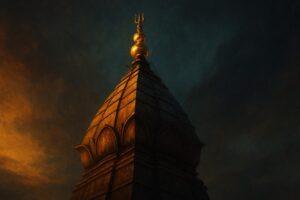
The main shrine is known for its 72-foot tall building in the figure of a lotus flower. The lotus-shaped building faces east, which is a sign of cleanliness and holiness. Crowning the temple are three ascending shaped gold vessels, a generous donation by the Maharaja of Gidhaur. These vessels are joined by a Panchasula, a trident-shaped emblem representing Shiva’s power.
The lotus form of the main temple is not a decorative choice. It is a theological statement in stone. The lotus in Hindu symbolism represents purity that arises from impurity, the sacred that emerges from the ordinary, the divine that is present within the human. A temple shaped as a lotus is a temple that embodies the core theological meaning of the Baba Baidyanath Jyotirlinga story itself. Ravana was a demon. His devotion was real. And from that devotion, the divine physician appeared. Purity arising from an unlikely source. The lotus rising from the mud.
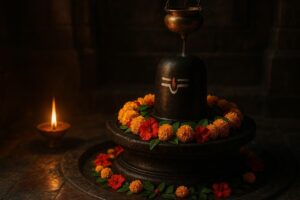
The lingam is of a cylindrical form about 5 inches in diameter and projects about 4 inches from the centre of a large slab of basalt. Devotees also believe that Shiva first turned himself into a Jyotirlinga on the night of Aridra Nakshatra, thus giving special reverence to the Jyotirlinga.
There is Chandrakanta Mani in the sanctorum of the Baidyanathdham temple. Due to this, continuous water is released and falls on the Shivlinga. When people consume the water falling on the Jyotirlinga in the form of Charanamrit, it gives relief from all diseases.
The 22 Temples of the Complex: The Complete Sacred Universe of Baba Baidyanath Dham
Baba Baidyanath Dham is not limited to a single shrine but is a vast and sacred temple complex that houses 21 ancient temples within its premises alongside the main Jyotirlinga temple. A complete pilgrimage to Baidyanath Dham is considered incomplete without visiting these associated shrines, as each temple holds its own religious importance and spiritual energy.
The 22 temples of the Baidyanath Dham complex together create a complete sacred universe in miniature, a landscape in which every dimension of Hindu devotional practice is represented simultaneously. The Jyotirlinga at the centre. The Shakti Peeth of Jayadurga directly opposite. The temples of Parvati, Lakshmi, Saraswati, Ganesha, Hanuman and the entire Hindu divine family arrayed around them.
For NRI pilgrims who grew up with home shrines containing images of multiple deities, the Baidyanath Dham complex offers something uniquely powerful. Every deity your family has ever worshipped is present here. The complete sacred geography of Hindu devotion concentrated into a single temple complex in a small town in Jharkhand.
The Shravani Mela: When the Baba Baidyanath Jyotirlinga Story Becomes a River of Eight Million Devotees
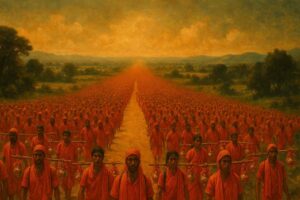
During the monsoon festival of Shrawani Mela, devotees embark on a remarkable pilgrimage. A line of faithful stretching 108 kilometres, all carrying holy water from the river Ganga in Sultanganj to offer at the temple.
During the month of July and August more than 8 million devotees gather and carry holy Ganga water. Unbroken lines of people wearing saffron colored clothes travel over 108 km in a particular month.
The Shravani Mela is the largest religious fair in the world. Eight million people. One hundred and eight kilometres. Bare feet. Saffron cloth. Holy Ganges water carried in kanwar pots. The chant of Bol Bam rising from eight million throats simultaneously and carried across the landscape of Jharkhand like a sound that has no human parallel.
To witness the Shravani Mela is to understand that the Baba Baidyanath Jyotirlinga story is not ancient history. It is living reality that manifests every year in the most dramatic collective act of devotion available anywhere in India or perhaps anywhere in the world.
Why the Baba Baidyanath Jyotirlinga Story Matters Specifically
The Healing Temple and the Longing for Roots
For Hindus living outside India across multiple generations, the relationship with India’s sacred geography is often carried entirely in story and memory. Grandparents who made the pilgrimage to Baidyanath Dham. Mothers who grew up with the Baba Baidyanath Jyotirlinga story as part of their childhood spiritual education. Family traditions of prayer to the divine physician that persist in homes in New Jersey and London and Singapore without the physical connection to the sacred site that gives those prayers their fullest meaning.
The Baba Baidyanath Jyotirlinga story is specifically relevant to families for three reasons that go beyond its general religious significance.
First, the healing dimension. The divine physician who healed Ravana’s wounds is the deity to whom families have prayed for the health of parents, spouses and children across the oceans. A visit to Baidyanath Dham is a direct physical connection to the source of that healing prayer tradition.
Second, the marriage dimension. The Sindur Daan ritual, the red threads connecting Shiva and Shakti, the Hriday Peeth where the heart of the devoted wife fell, all speak directly to the centrality of marriage and family in the Hindu diaspora’s spiritual and cultural identity. Deoghar is the one place in the world where the cosmic marriage of Shiva and Shakti is permanently present in the sacred ground. For couples who want to offer their marriage to the most powerful possible sacred blessing, there is nowhere in the world more appropriate.
Third, the completeness dimension. Deoghar is the only place in the world where a Jyotirlinga and a Shakti Peeth exist together. For NRI pilgrims who can visit India rarely and want to make each visit count in the deepest possible sacred terms, Deoghar offers a completeness that no other single pilgrimage site in India can provide. In one complex, in one sacred geography, the entire story of Shiva and Shakti is present simultaneously.
Experience the Complete Baba Baidyanath Jyotirlinga Story in Person With 5 Senses Tours
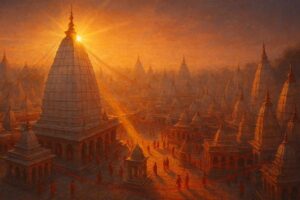
The Baba Baidyanath Jyotirlinga story is one of the most extraordinary narratives in the entire Hindu tradition. But a story heard or read is one thing. A story experienced in the place where it happened, with expert cultural guides who know every dimension of its theological significance, is something of an entirely different order.
Our Baba Baidyanath Jyotirlinga Deoghar tour with 5 Senses Tours is designed specifically to give Indian families and international visitors the complete experience of this extraordinary sacred geography across three immersive days. The pre-dawn darshan at the Jyotirlinga. The Shakti Peeth of Jayadurga. The Shravani Mela if your visit coincides with the sacred month of Shravan. The Basukinath temple. The Tapovan caves. The Tirkuti Pahad. The Rikhiya Yoga Ashram. And the Baba Baidyanath Shringar at 6pm that brings the complete three-day sacred journey to its most intimate and most moving conclusion.
For travellers combining Deoghar with the wider eastern India sacred circuit, our Bodhgaya Buddhist pilgrimage tour covers the Mahabodhi Temple, the Bodhi Tree, Rajgir and the ruins of Nalanda University.
Our Varanasi tours cover the oldest continuously inhabited city on earth, the Ganga Aarti at Dashashwamedh Ghat and the Kashi Vishwanath Temple.
Our Patna tours include Vaishali, the ancient Mauryan capital of Pataliputra and the complete historical landscape of Bihar’s extraordinary ancient past at
Explore our complete portfolio of India pilgrimage and sacred site tours in our Pilgrimage category and begin planning the most extraordinary sacred journey of your life at 5 Senses Tours.
Every experience is guided by cultural evangelists who understand the complete Baba Baidyanath Jyotirlinga story in all its dimensions, theological, historical, emotional and practical, and who deliver it at the exact moment and the exact location where it has its greatest impact.
Explore our complete India pilgrimage tours and begin planning the most extraordinary sacred journey of your life.
Leave a Reply