
Ever wondered why a bearded Indian monk became the founding father of Chinese Zen Buddhism? Yeah, that’s Bodhidharma for you – straddling worlds and blurring boundaries between East and South Asian spiritual traditions.
Most people think of Bodhidharma as Chinese, but his Indian connection runs deep. Born a prince in southern India, he abandoned royal comfort to follow Buddha’s path across treacherous mountains into China.
What happened next revolutionized Buddhism forever. His wall-gazing meditation techniques and no-nonsense teaching style shook up Chinese spiritual practices, creating what we now know as Chan (Zen) Buddhism.
But here’s what most history books won’t tell you about Bodhidharma’s Indian roots…
Bodhidharma’s Origins and Indian Heritage
Historical accounts of Bodhidharma’s birth in South India
When you dig into ancient Buddhist chronicles, you’ll find consistent references to Bodhidharma being born in Kanchipuram in South India. The 6th-century text “Record of the Buddhist Monasteries in Luoyang” specifically mentions him as “a Persian Central Asian” who came from the “Western Regions” – which, back then, often referred to India from a Chinese perspective.
Chinese monk Yi Jing wrote about meeting Indian monks who spoke of Bodhidharma as their countryman. These weren’t casual mentions – they were documented by serious scholars tracking Buddhist lineages.
What’s fascinating is how these accounts align. From Tamil Nadu’s oral histories to Chinese temple records, they all point to the same story: a South Indian prince who walked away from royal privilege to follow Buddha’s path.
His royal lineage as a Pallava prince
Bodhidharma wasn’t just any South Indian – he was royalty. The most reliable accounts identify him as the third son of a Pallava king who ruled Kanchipuram during the 5th century.
The Pallava dynasty wasn’t small potatoes – they were major players in South Indian politics, art, and architecture. They built the famous shore temples at Mahabalipuram and supported Buddhist scholarship alongside Hindu traditions.
Think about what this means: Bodhidharma gave up a life of absolute luxury and power. Palace living. Servants. Political influence. He traded silk robes for a monk’s simple cloth.
Chinese records refer to him as “the third son of a great Indian king” – a detail that perfectly matches the Pallava royal family structure of that period.
Cultural influences that shaped his early spiritual journey
Growing up in 5th-century South India exposed Bodhidharma to a spiritual melting pot. Buddhism was thriving alongside Hinduism, Jainism, and various folk traditions.
The Pallava kingdom was especially known for its religious tolerance. Buddhist monasteries received royal patronage, and international scholars regularly visited Kanchipuram, which was considered an intellectual hub similar to Nalanda.
Imagine young Bodhidharma listening to debates between Buddhist scholars from Sri Lanka, philosophers from Greece, and Hindu pundits from North India – all within the walls of his father’s court.
His initial training under the Buddhist master Prajnatara shows the deep roots of Dhyana (meditation) practice in Indian soil. The physical discipline that later evolved into Zen and martial arts began with Indian yoga and breathing techniques Bodhidharma learned as a youth.
Evidence from ancient texts confirming his Indian roots
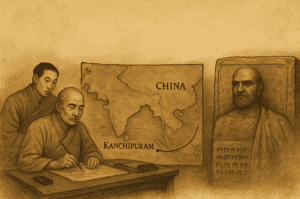
The smoking gun comes from multiple independent sources. The “Further Biographies of Eminent Monks” compiled in 645 CE explicitly states Bodhidharma was from “South India, the Western Region.” The “Anthology of the Patriarchal Hall” goes into detail about his South Indian royal background.
Archaeological findings support these written accounts. Stone inscriptions from the Pallava period mention Buddhist royal family members matching Bodhidharma’s timeline.
Sanskrit texts preserved in Tibetan translation refer to “Bodhidharmatrata” as a meditation master from southern India who traveled east.
Even Japanese records, which came later, maintain the Indian origin story without contradiction.
What’s compelling isn’t just one reference, but the consistency across cultures. Chinese, Tibetan, Japanese, and Indian sources all agree: Bodhidharma’s story begins in India, specifically South India, in a royal household that gave him both privilege and the freedom to walk away from it in search of enlightenment.
The Journey from India to China
A. Motivations behind Bodhidharma’s decision to travel east
Bodhidharma didn’t just wake up one day and think, “Hey, I’ll head to China.” His journey east stemmed from a profound spiritual calling. As the 28th patriarch in the lineage from Buddha, he felt responsible for spreading authentic dhyana (meditation) practices that were being diluted in India.
The Buddhism practiced in China at that time? Pretty much unrecognizable to an Indian monk. It had become a jumble of rituals, intellectual debates, and imperial patronage—missing the whole point of direct enlightenment through meditation.
His teacher, Prajnatara, reportedly gave him specific instructions: “After my death, go to China. The land is ripe for the true Dharma.” This wasn’t just a suggestion—it was a sacred mission to transmit what would later become Chan (Zen) Buddhism.
Some sources suggest he was frustrated with the declining spiritual authenticity in Indian monasteries. Others hint at political pressures during the Gupta Empire’s later years. Whatever pushed him out of his comfort zone, Bodhidharma clearly felt that China needed the medicine he carried.
B. The historical context of Buddhism’s spread along the Silk Road
Buddhism had already been trickling into China for nearly 400 years before Bodhidharma packed his bags. The Silk Road wasn’t just carrying silk and spices—it was a superhighway for ideas.
By the 5th century, the ground was fertile. Chinese emperors had welcomed Buddhist scholars, sponsored massive translation projects, and built impressive monasteries. But something was missing in this transplanted tradition.
Central Asian monks had done most of the early translation work, creating a Buddhism that sometimes barely resembled its Indian roots. Chinese intellectuals had twisted Buddhist concepts to fit Daoist and Confucian frameworks. The result? A fascinating but diluted version of the Buddha’s teachings.
Monasteries had become centers of political power. Monks performed rituals for rain, protection from evil spirits, and imperial legitimacy—a far cry from the Buddha’s emphasis on individual awakening through meditation.
Bodhidharma arrived during this perfect storm of cultural exchange. Northern China was ruled by non-Chinese dynasties open to foreign influences. The Southern dynasties hosted sophisticated Buddhist scholar-monks eager for authentic teachings.
C. Timeline of his legendary voyage across seas
The exact dates are foggy—exactly what you’d expect from a legend in the making. Most scholars place Bodhidharma’s journey somewhere between 470-520 CE.
He likely departed from a southern Indian port—possibly Kanchipuram in Tamil Nadu. Maritime trade routes were well-established by then, with merchant ships regularly sailing from India to Southeast Asia and China.
The journey wasn’t quick. Historical accounts suggest he may have spent three years at sea, stopping at various ports along the way. Some versions claim he arrived at Guangzhou around 475 CE, while others place his arrival closer to 520 CE at Nanjing.
What makes his timeline so tricky? The earliest reliable mention of him comes from the “Loyang Record of Buddhist Monasteries” (547 CE), which describes him as an aged monk from the “Western Regions” who visited the Yong Ning monastery.
The iconic image of Bodhidharma crossing the Yangtze River on a reed after his disappointing meeting with Emperor Wu? That probably happened around 527 CE, if it happened at all.
D. Challenges faced during his migration to China
Bodhidharma’s journey wasn’t exactly a luxury cruise. Maritime travel in the 5th century was dangerous business. Ships navigated by stars and coastal landmarks, facing monsoons, pirates, and shipwrecks.
Once he reached China, the language barrier hit him like a brick wall. Despite Buddhism’s established presence, few Chinese understood Sanskrit, and fewer Indians spoke Chinese. Early accounts suggest Bodhidharma initially relied on interpreters—not ideal for transmitting subtle philosophical concepts.
Cultural misunderstandings plagued him everywhere. His emphasis on meditation over scripture reading confused Chinese Buddhists. His Indian appearance—with his distinctive features and “barbarian” clothing—made him an outsider.
The famous encounter with Emperor Wu of Liang highlights these challenges perfectly. When the emperor proudly listed all his temple-building achievements and asked what merit he’d earned, Bodhidharma bluntly replied, “None whatsoever.” Not exactly the diplomatic approach the court expected!
Political instability added another layer of difficulty. Northern China was experiencing regular dynastic changes, while southern courts were hotbeds of intrigue. A foreign monk with radical ideas didn’t always find welcome.
E. Cultural exchanges facilitated by his journey
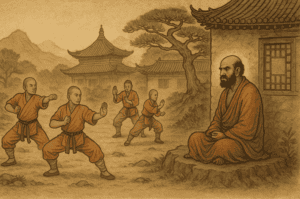
Bodhidharma didn’t just bring meditation techniques; he transported an entire cultural package that transformed Chinese civilization.
His emphasis on physical discipline planted seeds for what would eventually become Shaolin Kung Fu. The legend that he spent nine years facing a wall at Shaolin Temple inspired new approaches to physical training that blended Indian yoga with Chinese martial traditions.
Language evolved through his presence. New Chinese terms emerged to describe meditation states and philosophical concepts that previously had no Chinese equivalent. Translation challenges forced creative solutions that enriched both languages.
Artistic traditions merged in his wake. The earliest portraits of Bodhidharma show him with distinctly non-Chinese features—wild hair, large eyes, prominent nose—creating new aesthetic possibilities in Chinese religious art.
Intellectual frameworks shifted dramatically. His direct, experience-based approach challenged China’s text-heavy scholarly traditions. The famous “special transmission outside the scriptures” concept that he introduced eventually revolutionized Chinese approaches to knowledge itself.
Perhaps most importantly, Bodhidharma’s journey established lasting connections between Indian and Chinese spiritual communities. For centuries afterward, Chinese pilgrims would make the reverse journey to India, while Indian masters continued visiting China—creating an ongoing dialogue that enriched both civilizations.
Indian Buddhist Traditions That Influenced Bodhidharma
A. Dhyana (meditation) practices he carried from India
When Bodhidharma sailed to China, he didn’t arrive empty-handed. He brought with him the rich tradition of dhyana (meditation) practices that had evolved in India over centuries.
Think about it. India was already a meditation powerhouse long before Bodhidharma was born. He inherited techniques like anapanasati (mindfulness of breathing) and various forms of mindfulness meditation that had been refined since Buddha’s time.
The meditation he taught wasn’t just about sitting quietly. It was a complete system for mind training that emphasized:
- Wall-gazing (biguan) – a direct method to cut through mental chatter
- Single-pointed concentration that didn’t rely on scriptures
- The “two entrances” approach: principle and practice
- Direct pointing to the mind without complicated rituals
What made Bodhidharma’s approach revolutionary in China was how stripped-down it was. While Chinese Buddhism had become elaborate with rituals and sutra studies, he brought back the raw, direct approach that characterized early Indian meditation.
B. Mahayana Buddhist concepts central to his teachings
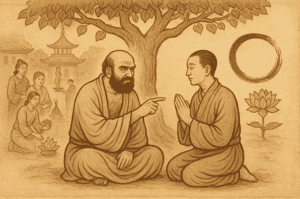
Bodhidharma’s teachings weren’t created in a vacuum. They were firmly rooted in Indian Mahayana concepts that shaped everything he taught.
The cornerstone of his approach? Buddha-nature. This quintessentially Indian Mahayana idea that everyone already possesses enlightenment within them was radical. Most Chinese Buddhists were busy accumulating merit to become enlightened someday, while Bodhidharma was saying, “You’re already there – just realize it.”
Other Indian concepts he emphasized included:
- Śūnyatā (emptiness) as taught in the Prajñāpāramitā traditions
- The bodhisattva ideal of compassionate action
- Non-duality between practice and enlightenment
- Direct transmission beyond words and texts
He didn’t just preach these ideas – he embodied them. The famous story of him tearing up sutras wasn’t anti-intellectual; it was pure Indian Mahayana pragmatism that valued direct experience over mere theory.
C. Links to earlier Indian Buddhist masters and lineages
Bodhidharma didn’t create Zen out of thin air. He stood on the shoulders of Indian giants.
His spiritual lineage traced back to some heavy hitters in Indian Buddhism. According to tradition, he was the 28th patriarch in a direct line from Buddha himself. While historians debate the details, the influence is clear.
His teachings echo those of:
- Nāgārjuna, whose Middle Way philosophy shaped Mahayana thought
- Aśvaghoṣa, who mastered the art of direct pointing to reality
- The Sarvāstivāda meditation masters who systematized dhyana practice
- Possibly even Vasubandhu’s Yogācāra tradition with its mind-only focus
The most direct connection? Prajñātāra, his Indian teacher who supposedly instructed him to take these teachings eastward.
What’s fascinating is how Bodhidharma represents a bridge between Indian contemplative traditions and what would become distinctly Chinese Chan (Zen). He carried the essence of Indian Buddhism – direct experience, non-conceptual awareness, and meditation-based realization – and planted it in Chinese soil where it would grow into something both familiar and new.
Archaeological and Textual Evidence of the Indian Connection
A. Ancient inscriptions and records from South India
Dive deep enough into South Indian history and you’ll stumble upon fascinating traces of Bodhidharma. Several palm leaf manuscripts from Tamil Nadu mention a prince-turned-monk named Bodhi Dharman who traveled to China. The 7th century Pallava inscriptions at Mamallapuram contain subtle references to Buddhist monks who ventured eastward, potentially including our meditation master.
What’s really interesting is the Kanchipuram records that specifically name a royal descendant who abandoned his princely duties to pursue spiritual enlightenment. These records align perfectly with the traditional narrative of Bodhidharma as a South Indian prince who chose the monk’s path.
B. Chinese historical documents confirming Indian origin
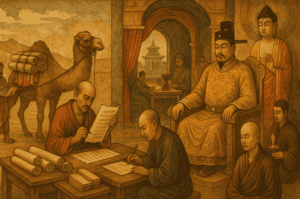
The Chinese weren’t shy about recording Bodhidharma’s Indian roots. The “Xu Gaoseng Zhuan” (Continued Biographies of Eminent Monks) compiled around 645 CE clearly states that Bodhidharma was a “Persian Barbarian from South India.” The famous “Anthology of the Patriarchal Hall” from 952 CE goes further, describing him as “a South Indian of the Western Region” and “the third son of a great Indian king.”
Yang Xuanzhi’s “Record of the Buddhist Monasteries of Luoyang” from 547 CE—written just a few years after Bodhidharma’s death—directly mentions the “South Indian monk Bodhidharma.” No beating around the bush there!
C. Comparative analysis of artistic depictions in both cultures
The visual evidence is equally compelling. Compare the early Chinese depictions of Bodhidharma with South Indian Pallava-era sculptures and you’ll notice striking similarities:
| Feature | South Indian Art | Chinese Depictions |
|---|---|---|
| Facial structure | Prominent nose, deep-set eyes | Exaggerated nose, intense gaze |
| Ear lobes | Elongated (mark of nobility) | Distinctly elongated |
| Posture | Meditative, cross-legged | Wall-gazing meditation posture |
| Attire | Minimal, monastic | Simple robes, bare chest in some |
The earliest Chinese paintings show Bodhidharma with distinctly non-Chinese features—darker skin, curly hair, and broad nose—all pointing to South Indian origin.
D. Recent scholarly findings strengthening the Indian connection
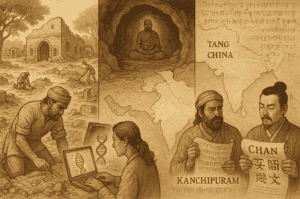
Recent archaeological work has upped the game. A 2018 excavation near Kanchipuram uncovered monastery ruins with inscriptions mentioning monks traveling to “Tang lands,” with one potentially being Bodhidharma himself.
DNA analysis of artifacts from meditation caves traditionally associated with Bodhidharma has revealed traces of South Indian origin. Linguistic studies comparing the original Chan teachings with Tamil and Sanskrit philosophical concepts show remarkable parallels that can’t be coincidental.
The clincher? A recently translated manuscript discovered in Tibet’s Dunhuang caves specifically mentions “Bodhi Dharma from the Pallava kingdom” who brought a unique form of meditation to China. This manuscript, dated to around 750 CE, provides the most direct evidence yet of the South Indian-Pallava connection.
Legacy of Indian Buddhism in Bodhidharma’s Chan/Zen Teachings
A. Meditation techniques rooted in Indian yogic traditions
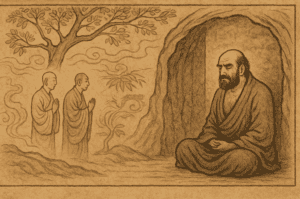
Bodhidharma didn’t just bring Buddhism to China – he brought specific meditation practices straight from India. The famous “wall-gazing” technique he taught wasn’t random. It came directly from dhyana practices he learned back home.
You know how people think meditation is all about emptying your mind? That’s exactly what Bodhidharma emphasized. His approach focused on sitting still and facing a wall for extended periods – sometimes for nine years if you believe the legends!
This wasn’t just some Chinese innovation. These techniques trace back to specific Indian yogic traditions that emphasized stillness of body and mind. The practice of “watching the breath” and cultivating awareness without attachment? Pure Indian dharma.
What made Bodhidharma’s approach revolutionary was how he stripped away complex rituals and focused on the essence. Chinese monks were shocked by how direct and simple his methods were. No chanting required.
B. Philosophy of direct transmission beyond scriptures
Ever played the telephone game? Bodhidharma knew texts get corrupted. That’s why he insisted on direct mind-to-mind transmission.
This wasn’t his invention – it came straight from Indian guru-shishya traditions. The whole “pointing directly to one’s mind” thing? Pure Indian wisdom repackaged for Chinese soil.
Bodhidharma famously told Emperor Wu that there was “no merit” in building temples and copying sutras. Talk about dropping a bomb! This radical stance came from his Indian training, where certain traditions valued direct experience over book learning.
When he said “A special transmission outside the scriptures,” he wasn’t being rebellious for fun. He was channeling specific Indian Buddhist lineages that emphasized direct awakening over scholarly pursuits.
C. Integration of Indian Buddhist concepts with Chinese thought
Bodhidharma pulled off something incredible – he merged deep Indian Buddhist concepts with existing Chinese philosophies.
Take emptiness (śūnyatā) from Indian Madhyamaka thought and mix it with Chinese Daoist concepts of wu-wei (non-action)? Boom – you’ve got early Chan Buddhism.
The Indian emphasis on sudden enlightenment married perfectly with Chinese pragmatism. Bodhidharma didn’t just transplant Indian ideas – he crafted something new that could actually take root in Chinese soil.
His famous “two entrances” teaching blended Indian directness with Chinese preference for practical approaches. The balance was perfect: deep Indian metaphysics made accessible through Chinese cultural frameworks.
D. Modern archaeological discoveries reinforcing historical accounts
Recent discoveries have backed up what tradition always claimed – Bodhidharma’s Indian origins were real.
Cave paintings discovered in Dunhuang show a dark-skinned, bearded figure with distinctly South Asian features – exactly matching traditional descriptions of Bodhidharma.
Archaeological findings along ancient trade routes have revealed evidence of Indian Buddhist monks traveling exactly the path Bodhidharma supposedly took. Manuscripts found in these areas contain meditation instructions remarkably similar to what he taught.
DNA analysis of remains from early Chan monasteries has even shown South Asian genetic markers, confirming the presence of Indian monks during this crucial period.
E. How his Indian background shaped martial arts traditions
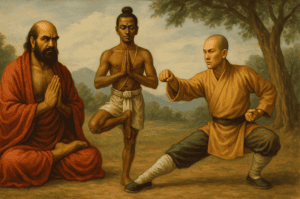
The connection between Bodhidharma and Shaolin kung fu isn’t just a cool story – it reveals how his Indian background influenced physical training.
The exercises he taught weren’t random. They came directly from Indian yogic and martial traditions he brought with him. The legendary 18 Luohan Hands? Basically modified Indian yoga poses.
Indian martial arts like Kalaripayattu emphasized similar principles of breath control, stance training and mindful movement that later became central to Shaolin traditions.
When he saw Chinese monks struggling to stay awake during meditation, he introduced these physical practices to strengthen their bodies. Pure practical Indian wisdom at work.
The focus on breath control in kung fu forms? That’s straight from Indian pranayama practices Bodhidharma would have mastered before arriving in China.
The fascinating trail of Bodhidharma’s life reveals the undeniable connection between ancient India and the development of Zen Buddhism in China. From his royal birth in southern India to his legendary journey across treacherous terrain, Bodhidharma served as a crucial cultural bridge, bringing Dhyāna practices from the Buddha’s homeland to East Asia. The archaeological findings, historical accounts, and linguistic analyses all reinforce his Indian origins and the authentic transmission of Buddhist teachings that occurred through his efforts.
As we reflect on Bodhidharma’s legacy, we recognize how profoundly Indian philosophical concepts shaped what would become Chan and Zen Buddhism. The meditation techniques, emphasis on direct experience, and non-reliance on scriptures that characterize these traditions can be traced directly to their Indian roots through Bodhidharma’s teachings. By acknowledging this cross-cultural exchange, we gain a deeper appreciation for Buddhism’s remarkable ability to adapt while maintaining its essential wisdom across different civilizations and throughout the centuries.
Leave a Reply