
If Goa had a memory palace, Chandor would be one of its oldest rooms.
Long before churches reshaped the skyline and coastal trade drew global attention, power in Goa flowed from inland valleys, fertile fields, and river-fed settlements. Chandor—ancient Chandrapura—was once the political and cultural heart of the region under the Kadamba dynasty. Today, it appears almost modest: a quiet village of temples, mansions, and shaded lanes. Yet beneath this calm lies a deep continuity of life, belief, and governance that stretches back over a thousand years.
Why Chandor Became a Capital
Archaeological and historical research shows that early capitals in peninsular India were rarely coastal. They favored agricultural stability, fresh water, and defensible terrain. Chandor sits close to the Kushavati River system, surrounded by fertile land—ideal for sustaining large populations and administrative centers.
The Kadambas, who ruled parts of Goa between the 10th and 14th centuries, chose Chandor as their capital not for spectacle, but for sustainability. Cultural geography studies support this logic: inland capitals allowed rulers to control resources while remaining connected to trade routes without being vulnerable to seaborne threats.
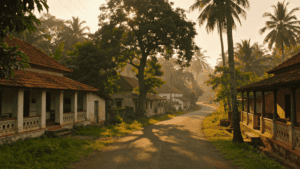
Walking through Chandor today, this logic still makes sense. The village is not dramatic, but it is balanced. Roads curve naturally with the terrain. Sacred spaces are placed where land and water intersect. Nothing feels accidental.
Sacred Landscapes That Predate Empire
Chandor’s temples reveal layers of religious continuity. Sites such as the temples of Brahma, Khandoba, and other village deities sit on land that shows long-term sacred use. Archaeological patterns across India indicate that once a site is designated sacred, it often retains that function for centuries, even as architecture and ritual evolve.
Unlike isolated monuments, Chandor’s temples are woven into daily life. Bells ring not for visitors, but for timekeeping and worship. Offerings are made by residents, not staged for cameras. This living religious landscape offers something increasingly rare: authenticity without performance.
A guided walk helps decode this subtlety. Why is a temple facing a particular direction? Why is one shrine elevated while another remains low? These questions connect cosmology, landscape, and community in ways signage never can.
From Royal Capital to Colonial Village
Chandor did not fall—it transformed.
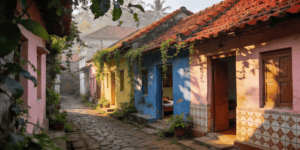
With the arrival of Portuguese power in Goa, political focus shifted toward the coast. Chandor lost its administrative status, but it did not empty out. Instead, it absorbed a new layer of identity. Indo-Portuguese mansions rose alongside older temple sites, creating a village where Hindu and Catholic histories occupy the same physical space.
Architectural historians point out that this layering is one of Goa’s most distinctive features. In Chandor, colonial architecture does not erase the past; it rests on it. The famous Braganza House, for instance, stands near ancient temple land, symbolizing not replacement, but adaptation.
This coexistence challenges the simplified narrative of cultural rupture. Chandor shows that history is often cumulative, not destructive.
Domestic Architecture as Social History
Chandor’s mansions are not merely grand homes; they are social documents. Built by elite Goan families who navigated Portuguese rule while maintaining local identity, these houses reflect a blend of European aesthetics and Indian environmental intelligence.
High ceilings, wide verandas, inner courtyards, and cross-ventilation systems are not decorative choices. Environmental design studies confirm their effectiveness in tropical climates, allowing homes to remain cool without modern technology.
These houses also reflect social values—privacy balanced with openness, formality balanced with domestic intimacy. Visiting them with a knowledgeable guide reveals how architecture encodes class, gender roles, and cultural negotiation.
Reading the Village, Not Just Seeing It
What makes Chandor special is not a single landmark, but the ability to read the village as a whole.
Urban anthropology suggests that older settlements preserve “spatial memory”—the logic of movement, gathering, and separation remains long after original functions fade. Chandor is best understood on foot, moving slowly, noticing transitions between sacred and domestic space.
This is where a private guided experience becomes essential. Chandor does not explain itself loudly. A guide helps connect dots—between temple placement, colonial homes, agricultural land, and social hierarchy—turning a quiet walk into an act of discovery.
Experiencing Chandor with 5 Senses Tours
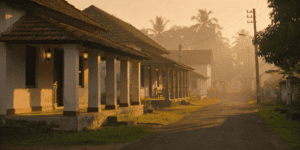
Exploring Chandor with 5 Senses Tours is designed as a private, interpretive journey rather than a sightseeing stop. The experience is paced, conversational, and deeply contextual, allowing guests to engage with history, architecture, and living culture without distraction.
This experience forms part of curated private Goa journeys and can be accessed via Old Capital of Goa.
Why Chandor Matters
Chandor matters because it resists simplification.
It reminds us that Goa was not born with colonialism, nor did it disappear beneath it. The village carries evidence of political power, religious continuity, architectural intelligence, and social adaptation—all existing side by side.
For travelers seeking Goa beyond beaches and churches, Chandor offers something more enduring: a chance to walk through a place where history was not preserved—it was lived, and still is.
Leave a Reply