

Ever wonder how a man who shot over 400 Bengal tigers ended up becoming their fiercest protector? That’s Jim Corbett for you – the British hunter turned conservationist who completely flipped the script on his life’s purpose.
Most folks know Corbett as the legendary tracker who freed villages from man-eating tigers in colonial India. But what’s truly fascinating is his evolution from celebrated hunter to passionate wildlife advocate.
Jim Corbett’s conservation journey began when he swapped his rifle for a camera, realizing these magnificent creatures were disappearing before his eyes. His intimate knowledge of the jungle, gained through years of tracking, made him uniquely qualified to fight for their survival.
But what exactly pushed this expert marksman to become the voice for creatures he once hunted? The answer might surprise you.
For a tour of Corbett National Park from Delhi, please visit Jim Corbett.
Jim Corbett’s Early Life and Hunting Career

Origins in the Indian Wilderness
Born on July 25, 1875, in Nainital, Jim Corbett grew up in the foothills of the Himalayas where wilderness wasn’t just a backdrop—it was his playground. The dense jungles of Kumaon became his classroom. While other kids memorized multiplication tables, young Jim learned to identify animal tracks and bird calls.
His father died when Jim was just a teenager, leaving him to support his mother and siblings. This responsibility pushed him into the forests even more frequently, hunting for food and working as a railway contractor. The mountains and valleys of Uttarakhand weren’t just pretty scenery for him—they were home.
By his early twenties, Corbett knew the forests better than most locals. He could tell you which stream had the sweetest water or which ridge would give shelter during monsoon rains. This wasn’t book knowledge; this was survival.
First Encounters with Man-Eating Tigers
Corbett’s first serious man-eater came calling in 1907. The Champawat Tigress had already killed over 400 people in Nepal and India when local officials begged him to intervene.
Finding this tiger wasn’t like tracking normal tigers. Man-eaters don’t behave like regular tigers. They’re often injured, desperate, and dangerously unpredictable.
For weeks, Corbett followed blood trails, examined pug marks, and interviewed terrified villagers. He didn’t just track the tiger—he got inside its head, predicting where it would strike next.
When he finally cornered the Champawat Tigress, Corbett wasn’t shooting for sport. He was ending a reign of terror that had paralyzed entire communities.
Building a Reputation as a Legendary Hunter
Word spreads fast in the mountains. After the Champawat kill, Corbett became the go-to man for dangerous predators. Government officials would send telegrams begging for his help. Villagers would walk days just to reach him.
Between 1907 and 1938, he tracked and killed more than a dozen man-eaters, including the notorious Leopard of Rudraprayag that had claimed over 125 lives.
What made Corbett different from other hunters was his approach. He never took trophies from man-eaters. He never charged for his services. And he never killed unless absolutely necessary.
Colonial officials offered him medals and money. He accepted the medals but often gave the reward money to the villages terrorized by the man-eaters.
Tracking Techniques That Saved Countless Lives
Corbett didn’t just blast away at anything that moved in the jungle. His tracking methods were surgical.
He pioneered techniques still used today:
- Reading broken twigs and disturbed leaves to determine a tiger’s size and speed
- Using sun position to identify fresh versus old tracks
- Recognizing individual tigers by their unique paw prints
- Understanding how injuries affect a tiger’s hunting patterns
Corbett would often track alone, sometimes for weeks, living off the land with just a rifle and a blanket. He’d study a man-eater’s habits until he could predict its movements.
His most impressive skill? Distinguishing between a normal tiger and a man-eater without seeing it. Just by examining kills, he could tell if a tiger had turned to hunting humans out of necessity or was still a normal predator.
These weren’t just hunting techniques—they were life-saving methods in regions where man-eaters could shut down entire villages, preventing people from collecting water, tending crops, or even going to market.
The Turning Point: From Hunter to Conservationist

The Awakening of Environmental Consciousness
Jim Corbett didn’t wake up one day and decide to save tigers instead of hunting them. His transformation happened gradually, through countless hours spent in the forests observing wildlife in their natural habitat.
During his hunting expeditions in the early 1900s, Corbett began noticing something that troubled him deeply. The animals he tracked weren’t just prey—they were complex beings with social structures and behaviors that mirrored human communities in surprising ways.
“The jungle gives you what you take, but never more,” he once wrote, reflecting his growing understanding that nature operated on principles of balance and sustainability.
By 1920, Corbett had started using his tracking skills more for photography than hunting. He’d spend days following tiger trails just to capture a glimpse with his camera rather than his rifle. This shift marked the beginning of his conservation mindset.
Witnessing the Decline of Indian Wildlife
The India that Corbett loved was changing rapidly. Forests were shrinking. Animal populations were dwindling.
British colonial expansion meant more land cleared for tea plantations and timber. Hunting had transformed from a necessity into a fashionable sport among the elite. Tigers, once revered, were now trophy targets.
Corbett saw the numbers firsthand:
| Year | Estimated Tiger Population in United Provinces |
|---|---|
| 1875 | ~3,000 |
| 1900 | ~1,800 |
| 1925 | ~500 |
“We’re killing what makes India magnificent,” he told fellow hunters, often meeting resistance from those who couldn’t see beyond the next trophy.
Key Incidents That Changed His Perspective
Three moments stand out in Corbett’s transformation:
First was the 1925 shooting of the “Bachelor of Powalgarh,” a magnificent tiger Corbett tracked for days. After killing it, he felt no triumph—only loss and remorse.
Then came his encounter with a tiger family in Kumaon, where he watched a mother teach her cubs to hunt. Corbett lowered his rifle and later wrote, “In that moment, I understood my responsibility extended beyond my village to these forests.”
Finally, witnessing a local prince’s hunting party slaughter 23 tigers in a single week pushed Corbett to action. He began advocating for India’s first national park, eventually established in 1936 (later renamed Jim Corbett National Park).
“Conservation,” he said, “is our moral duty to future generations. Without tigers, India loses part of its soul.”
Conservation Achievements and Legacy

A. Establishing India’s First National Park
Jim Corbett didn’t just hunt tigers – he saved them. After years of tracking man-eaters, he realized these magnificent creatures needed protection, not bullets. In 1934, he helped establish India’s first national park in the Kumaon region of Uttarakhand.
Originally called Hailey National Park (renamed Jim Corbett National Park in 1957), this sanctuary became the cornerstone of India’s conservation movement. Corbett personally mapped boundaries, identified critical habitats, and convinced local communities of the park’s importance.
What made this achievement remarkable? Corbett pushed for conservation decades before environmental protection became mainstream. He understood the delicate balance between humans and wildlife when most saw tigers as threats to be eliminated.
The park now protects 520 square kilometers of diverse habitat, home to Bengal tigers, Asian elephants, and hundreds of bird species. Millions visit annually, supporting local economies while learning about conservation – exactly what Corbett envisioned.
For a tour of Corbett National Park, please visit Jim Corbett.
B. Pioneering Wildlife Photography in India
Before wildlife documentaries filled our screens, Corbett lugged bulky camera equipment through dense jungles. His photographs of tigers in their natural habitat were revolutionary.
Unlike hunters displaying dead trophies, Corbett captured living animals behaving naturally. His photos showed tigers not as monsters but as magnificent creatures worth protecting.
Photography became Corbett’s new hunting – tracking animals for hours, understanding their behavior, but capturing images instead of taking lives. His photos appeared in his books and lectures, giving many Indians their first glimpse of wildlife they shared their country with.
C. Literary Contributions That Raised Awareness
Corbett’s pen proved mightier than his rifle. His books – especially “Man-Eaters of Kumaon” (1944) and “The Man-Eating Leopard of Rudraprayag” (1947) – weren’t just thrilling adventure tales. They were subtle conservation manifestos.
While describing hunts, Corbett wove in detailed observations about animal behavior, forest ecology, and the human impact on wilderness. His writing style – straightforward yet poetic – made readers feel the jungle’s heartbeat.
These books reached global audiences, translated into dozens of languages. They changed how people viewed tigers – from bloodthirsty beasts to complex creatures deserving respect and protection.
Corbett’s writings also documented traditional ecological knowledge and forest management practices that were rapidly disappearing. Today, conservationists still reference his detailed descriptions of Himalayan ecosystems.
D. Advocacy for Tiger Protection
Corbett transformed from India’s most famous tiger hunter to its most passionate tiger defender. When others still saw big cats as vermin with bounties on their heads, he lobbied government officials for protection laws.
He understood something crucial: tigers only became man-eaters when injured, old, or pushed from their territories by human encroachment. At public gatherings and private meetings with officials, Corbett argued that protecting tigers meant protecting forests – and protecting forests benefited everyone.
His advocacy led to some of India’s earliest wildlife protection laws. He convinced officials to end bounty systems that encouraged indiscriminate killing and pushed for habitat preservation instead of fragmentation.
E. Training Forest Officials in Wildlife Management
Corbett didn’t just create protected areas – he helped create protectors. Recognizing that conservation policies were only as effective as the people implementing them, he developed informal training programs for forest guards and officers.
Drawing on decades of fieldcraft, Corbett taught tracking techniques, animal behavior identification, and non-invasive monitoring methods. He emphasized understanding ecological relationships rather than focusing on single species.
His practical approach influenced generations of Indian forest service professionals. Many of his methods – reading pug marks, identifying territories, and monitoring without disturbing animals – became standard practice in wildlife management.
Corbett also insisted that forest officials work with local communities rather than against them – a revolutionary concept at the time but now recognized as essential for conservation success.
Corbett’s Conservation Philosophy
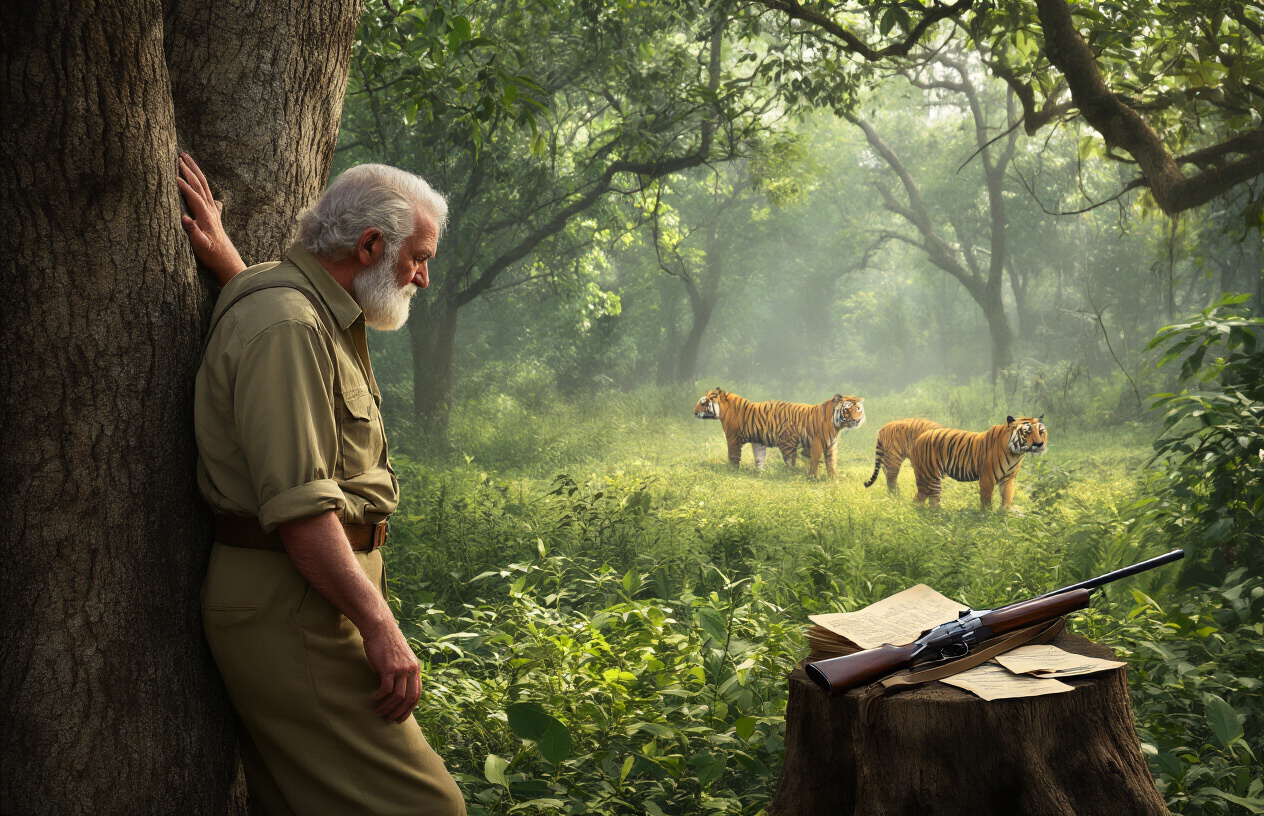
Understanding the Delicate Balance of Nature
Jim Corbett wasn’t your typical hunter. While tracking man-eating tigers through the Indian wilderness, he developed an intimate understanding of nature’s interconnectedness that few people of his era possessed.
“The jungle gives to those who live in it with understanding, far more than it takes from them,” Corbett once wrote. And he meant it.
Unlike many colonial hunters who saw wildlife as mere trophies, Corbett recognized that every creature played a crucial role in maintaining healthy ecosystems. He observed firsthand how the decline of one species could trigger a cascade of consequences throughout the forest.
This wasn’t book knowledge. This was hard-earned wisdom from spending countless nights under the stars, tracking paw prints, and moving silently through the undergrowth of India’s most pristine forests.
Promoting Coexistence Between Humans and Wildlife
Corbett walked a tightrope between two worlds. On one hand, he protected villagers from dangerous predators. On the other, he advocated for the protection of those same magnificent creatures.
His approach was revolutionary for the 1930s: he didn’t see humans and wildlife as enemies, but as neighbors who needed to learn to live together.
“The tiger is a large-hearted gentleman,” he famously said. This wasn’t romantic nonsense but a call for respect and understanding.
Corbett spent countless hours educating local communities about wildlife behavior. He taught them how to minimize conflict through simple measures like improved livestock enclosures and avoiding tiger territories during crucial times.
Indigenous Knowledge in Conservation
Long before it became fashionable in conservation circles, Corbett recognized the value of indigenous ecological knowledge.
He learned tracking, animal behavior, and forest navigation from local hunters and tribal communities. These weren’t just skills to him—they represented generations of accumulated wisdom about living sustainably within nature’s boundaries.
Corbett’s respect for this knowledge shaped his conservation philosophy. He documented traditional practices that promoted ecological balance and incorporated them into his recommendations for wildlife protection.
What made his approach special was his humility. Despite his fame, Corbett never positioned himself as the sole expert. Instead, he amplified indigenous voices and knowledge systems that colonial authorities typically ignored or dismissed.
Impact on Modern Conservation Efforts

A. The Jim Corbett National Park Today
What started as a hunting ground has transformed into a crown jewel of conservation. Jim Corbett National Park now spans over 520 square kilometers of diverse ecosystems. It’s not just a park—it’s a living testament to Corbett’s vision.
The park houses around 110 tiger species, 50 mammal species, 580 bird varieties, and 25 reptile species. These aren’t just numbers; they represent one of the most successful conservation stories in Asia.
Visitor numbers tell their own tale—from a few hundred annually in the early days to over 300,000 tourists now flocking to witness what Corbett fought to preserve. The park’s management model balances tourism with conservation in ways Corbett himself might have approved.
B. Influence on India’s Tiger Conservation Programs
Corbett’s ideas weren’t just ahead of his time—they became the blueprint for India’s approach to saving tigers.
Project Tiger, launched in 1973, borrowed heavily from Corbett’s philosophy of creating protected habitats with minimal human interference. This wasn’t accidental. The architects of the program studied Corbett’s writings and methods extensively.
The results speak volumes. While tiger populations declined drastically across Asia, India maintained relatively stable numbers. The country now houses over 70% of the world’s wild tigers—a direct legacy of approaches pioneered by Corbett.
C. Global Recognition of Corbett’s Methods
Conservationists worldwide have adopted Corbett’s core principles:
- Working with local communities instead of against them
- Understanding predator behavior before attempting management
- Creating buffer zones between wildlife and human settlements
- Using education as a conservation tool
These ideas appear in conservation programs across Africa, Southeast Asia, and the Americas. The IUCN (International Union for Conservation of Nature) regularly cites Corbett’s work in their best practices publications.
D. Lessons for Contemporary Wildlife Management
Corbett’s most enduring lesson? Effective conservation requires both head and heart.
Modern wildlife managers increasingly recognize that Corbett’s approach—combining scientific observation with deep respect for animals—yields better results than purely technical solutions. His emphasis on understanding animal behavior before implementing protection strategies has become standard practice.
The human element matters too. Corbett demonstrated that gaining local support isn’t just nice—it’s necessary. Today’s most successful conservation projects follow his lead by creating economic incentives for communities to protect wildlife.
His work reminds us that conservation isn’t just about saving animals—it’s about preserving what makes us human.

The remarkable journey of Jim Corbett from a skilled hunter to a passionate conservationist represents one of the most profound transformations in wildlife protection history. Beginning as a hunter renowned for eliminating man-eating tigers and leopards, Corbett experienced a fundamental shift in perspective that led him to dedicate his life to safeguarding the very creatures he once pursued. His establishment of India’s first national park, which now bears his name, stands as physical testament to his commitment to conservation, while his writings continue to inspire environmental stewardship worldwide.
Corbett’s legacy reminds us that true conservation comes from understanding and respecting wildlife rather than merely seeking to control it. His philosophy that “the wild things of this earth are not ours to do with as we please” remains powerfully relevant in today’s environmental challenges. As we face increasing threats to biodiversity, Corbett’s transformation invites us all to reconsider our relationship with nature and commit to protecting it for future generations—proving that even those who begin as consumers of natural resources can become their most dedicated guardians.
For a tour of Corbett National Park from Delhi, please visit Jim Corbett.
For immersive culture walks in India, please visit 5 Senses Walks.
Leave a Reply