

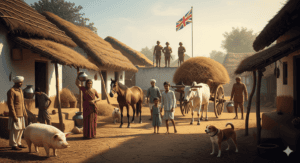
It is one of history’s most delicious ironies that George Orwell, the man who taught the world to distrust empires, was born at the very heart of one. In 1903, on a damp June morning in Motihari, a small town in Bihar, Eric Arthur Blair arrived into the world — not yet George Orwell, not yet the scourge of totalitarianism, but the infant son of a minor British civil servant employed in the Opium Department. The child who would one day write Animal Farm and 1984 — books that warned against the intoxications of power — was, by chance, born into a family whose livelihood depended on a drug that dulled minds and lined the coffers of empire. India has never lacked for ironies, but this one is unusually sharp.
The Father’s Empire of Opium
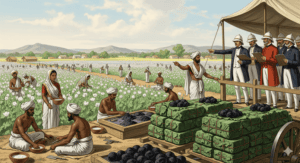
Orwell’s father, Richard Walmesley Blair, was not a man of grand passions or noble ideals. He was, as his son later described with barely disguised contempt, “a low-ranking functionary in the service of Empire.” His work was to oversee the production of opium in Bihar, which the British exported to China in a trade that left behind addiction and social ruin. One might imagine the infant Orwell crying in his cradle while, not far away, poppy fields swayed in the monsoon winds — red petals blooming under the watchful gaze of colonial officers.
The young Eric grew up thousands of miles away in England, but this beginning mattered: his very birth certificate is steeped in empire’s contradictions.
The irony deepens when we recall Orwell’s lifelong obsession with truth. He would dedicate his career to exposing lies — political lies, social lies, the comforting lies people tell themselves. Yet his own life began in a place where the entire economy was built on the great imperial lie: that poppies were simply commerce, not chains.
Gandhi in Champaran
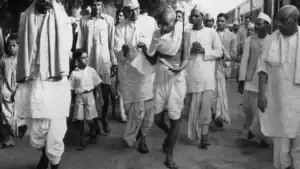
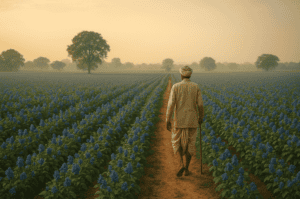
Just beyond Motihari’s dusty streets lies Champaran, where, in 1917, Mahatma Gandhi staged his first great act of civil resistance on Indian soil. The peasants of Champaran were forced by the British to grow indigo for export, a crop that kept their soil exhausted and their pockets empty. Gandhi arrived not with guns or banners, but with a notebook and an ear for the grievances of farmers. His campaign marked the beginning of a movement that would unravel the Empire.
Thus, in the same corner of Bihar, within walking distance of Orwell’s birthplace, two great critiques of Empire were seeded: Gandhi’s, through the quiet revolution of nonviolence, and Orwell’s, through the weapon of plainspoken truth. Neither man ever met, but in Motihari one feels they share a ghostly kinship. Gandhi exposed the brutality of British rule in India; Orwell exposed the brutality that any system of unchecked power, Eastern or Western, inevitably produces.
The Young Orwell’s Rebellion
Orwell never returned to Motihari. His childhood was spent in England, his youth in Burma, where he served as a police officer in the Imperial Police. Yet the ghosts of Bihar seemed to trail him. In his essay Shooting an Elephant, he recounts how he came to hate his role as the visible face of imperial authority. Forced by jeering crowds to kill an elephant he did not wish to shoot, Orwell experienced the paradox of power: the ruler is enslaved by the expectations of the ruled. That insight, forged in the tropics, was the seed of his later clarity about tyranny.
One can almost imagine that the poppy fields of his infancy and the indigo fields of Champaran left a mark somewhere deep in Orwell’s subconscious. He had witnessed empire not in its grand speeches, but in its petty bureaucrats, its routine oppressions, its economic manipulations. His novels and essays bear the stamp of someone who had smelled the sweat of empire up close.
Motihari Today: A Forgotten Shrine
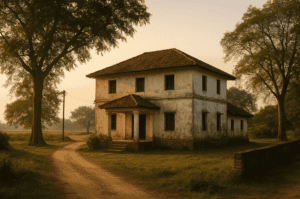
If one were to travel to Motihari today, one can find Orwell’s ancestral house still standing. For decades, it was ignored. Only recently have efforts been made to restore it, to turn it into a modest museum.
There is a strange charm in this neglect. Orwell’s genius was never about grandeur but about stripping things to their bare truth. Perhaps it is fitting that his birthplace is not a polished monument but a structure one must search for, stumble upon, and then pause before in recognition.
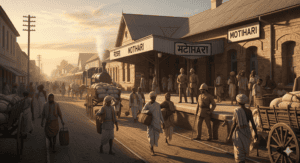
A traveler to Motihari will find more than Orwell. The town hums with bazaars where cycle-rickshaws jostle with vegetable carts, where the smell of fried snacks mingles with incense drifting from roadside shrines. The Gandhian legacy is alive in Champaran’s fields, where one can visit the ashrams and memorials dedicated to that first satyagraha. To walk here is to walk in a landscape that birthed both rebellion by silence and rebellion by pen.
Visiting Motihari with 5 Senses Tours
For the modern traveler, the challenge is not only discovering Orwell’s birthplace but understanding it in the wider story of India. This is where 5 Senses Tours offers a guiding hand. Our journeys into Motihari are not just about pointing to a crumbling building and announcing “Orwell was born here.” They are designed to immerse visitors in the texture of place — to show the old colonial circuits of Champaran, to trace Gandhi’s satyagraha, to step into the still-whispering lanes of Motihari’s bazaars, and finally to stand before Orwell’s house with the quiet shock of recognition.
It is one thing to read 1984 in the comfort of an armchair; it is another to stand in the town where the author first opened his eyes, surrounded by the echoes of empire and resistance. The tour invites travelers to see India through Orwell’s lens: not as a set of monuments alone, but as a living story of power, poverty, dignity, and resilience.
The Orwell–Gandhi Paradox
What makes Motihari truly remarkable is not just that Orwell was born here, nor that Gandhi staged his first satyagraha nearby, but that both events point toward a single truth: empires, however strong, eventually unravel when confronted with the stubborn insistence of the human spirit. Gandhi dismantled empire by refusing to cooperate with its machinery. Orwell dismantled it on the page by revealing its machinery to be nothing more than fear and deceit dressed in the language of inevitability.
For the traveler, Motihari becomes more than a waypoint; it becomes a meditation. One walks through these fields and bazaars with a heightened sense of irony, realizing that a dusty corner of Bihar once produced two of the twentieth century’s most enduring voices against domination.
Why Visit?
To visit Motihari is not to visit a polished tourist attraction. It is to visit a question mark. Why here, of all places, did Orwell begin his life? Why here did Gandhi begin his Indian movement? Why do these two legacies — one rooted in the East, the other in the West — converge in the same soil?
The answer may never be neat, but that is the point. Travel is not always about comfort or spectacle. Sometimes it is about standing in places that unsettle you, that remind you how fragile the structures of power are, and how enduring the hunger for truth remains.
Reflections on an Indian Pilgrimage
As you leave Motihari, you may find yourself thinking less about the past and more about the present. Orwell warned of a future where truth would be manipulated until people doubted their own memories. Gandhi warned of a world where violence would corrupt the soul of even the most just cause. Both warnings ring louder in our own century than perhaps they did in theirs.
To stand at Orwell’s birthplace is not only to honor a writer, but to hear an echo of responsibility. India is a land of many pilgrimages — to temples, rivers, mountains. Motihari is a pilgrimage of another sort: a pilgrimage to conscience.
Epilogue: A Journey Waiting
In the end, George Orwell’s connection to India is not a mere footnote in biography. It is a reminder that the great battles of truth and freedom have roots in unlikely soil. A traveler who follows this trail — from the indigo fields of Champaran to the peeling walls of Orwell’s house — undertakes not just a journey through Bihar, but a journey into the contradictions of empire and the resilience of humanity.
And so the question is left hanging in the air, as Orwell might have left it himself: Will you come and see where the man who taught the world to see through lies first opened his eyes?
Leave a Reply